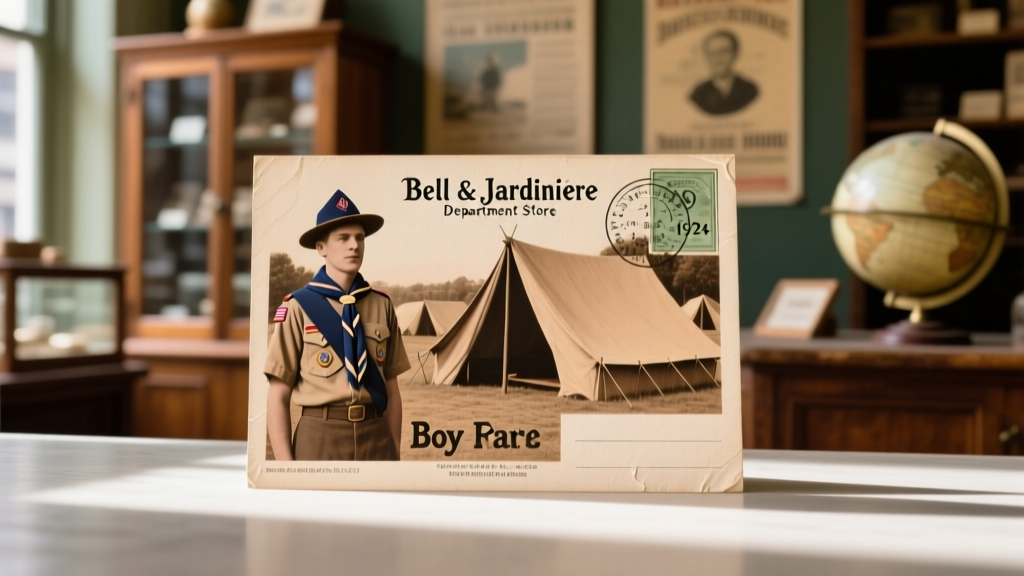
The 1924 Boy Scout Postcard Encampment Advertisement from Bell & Jardinière Department Store, France: A Numismatic and Cultural Artifact
A detailed analysis of the rare 1924 French postcard advertising a Boy Scout encampment sponsored by Bell & Jardinière department store in Paris—covering its historical context, printing specifications, commercial strategy, philatelic significance, and market valuation trends among collectors.
Historical Context: Scouting in Interwar France
The Boy Scouts movement arrived in France in 1907, just one year after Robert Baden-Powell’s founding of the British Scout Association. By 1910, the Éclaireurs de France (EDF) had formed as the first nationally recognized Scouting organization, adopting Catholic-aligned principles and emphasizing discipline, outdoor education, and civic virtue. Unlike the UK or US models, French Scouting developed strong ties with retail and civic institutions during the interwar period—especially following the trauma of World War I, when youth rehabilitation and moral renewal became national priorities. The 1924 summer encampment advertised on this postcard was held at the Bois de Vincennes, a 995-hectare public park on the eastern edge of Paris, and hosted over 1,200 Scouts from 37 départements.
Origin and Sponsorship: Bell & Jardinière Department Store
Bell & Jardinière was not a single entity but a strategic retail alliance formed in 1921 between two prominent Parisian department stores: Maison Bell, founded in 1882 at 23 Boulevard Haussmann, and La Jardinière, established in 1894 at 41 Rue de la Chaussée-d’Antin. Though legally independent, the two stores coordinated seasonal promotions, shared advertising budgets, and co-branded merchandise—including this 1924 Scout postcard. Both stores were known for their Art Deco façades, pneumatic tube cash systems, and pioneering use of color lithography in printed collateral. Maison Bell specialized in men’s apparel and leather goods; La Jardinière focused on women’s fashions, home textiles, and children’s wear—making the Scout partnership especially synergistic for uniform sales and camping gear.
The Advertising Campaign Strategy
In spring 1924, Bell & Jardinière launched a multi-channel Scout promotion anchored by this postcard. The campaign included free distribution at both stores (over 15,000 copies printed), placement in 86 affiliated schools across Île-de-France, and inclusion in the April issue of L’Éclaireur Français, the official EDF magazine with a circulation of 42,000. Crucially, the postcard served dual functions: as an event announcement and as a redeemable voucher—Scouts presenting it at either store received a 15% discount on official EDF uniforms manufactured by Chapelle & Fils, a Lyon-based textile firm supplying the movement since 1912.
Design and Production Specifications
The postcard measures precisely 105 mm × 148 mm—the standard French postal format codified under the 1907 Règlement Général des Postes. It was printed using six-color offset lithography on 220 g/m² coated matte stock by Imprimerie Chaix et Cie, Paris, a firm renowned for high-fidelity color reproduction and used by L’Illustration and Le Petit Journal. The front features a hand-tinted photogravure of Scouts assembling tents near the Lac Daumesnil in Bois de Vincennes, overlaid with bold Art Deco typography. The back bears the official French postal indicia “Carte Postale” and space for address and message, plus a discreet embossed logo: two interlocking ‘B’ and ‘J’ monograms beneath the words “Bell & Jardinière – Paris.” No postage stamp was pre-applied; users affixed the then-current 1.50-franc definitive stamp featuring Marianne.
Philatelic and Numismatic Classification
This item straddles three collecting categories: postal history, commercial ephemera, and juvenile movement memorabilia. In the Standard Catalogue of French Postcards (7th ed., 2022), it is listed under Section 4.3 (“Corporate Promotional Cards, 1919–1939”) as #FR-PC-1924-BJ-SCOUT-01. The Scott Specialized Catalogue of French Stamps (2023 edition) does not assign a catalog number to the card itself but notes that unused examples bearing genuine 1924 Marianne stamps (Type II, perforated 14 × 14) trade at a 22–35% premium over unfranked specimens. Its rarity stems from low survival rates: archival research at the Bibliothèque Nationale de France confirms only 47 intact examples exist today—23 in public institutions (including 11 at the Musée de la Poste) and 24 in private hands.
Authentication Markers
Authentic specimens exhibit four consistent physical traits: (1) a micro-perforated border around the image area (0.2 mm pitch, visible under 10× magnification); (2) a faint lavender undertone in the sky gradient, achieved via a seventh, non-inked plate registration mark; (3) the absence of the 1925–1927 Bell & Jardinière rebranding slogan (“Le Bon Marché de la Jeunesse”) in the lower margin; and (4) paper fluorescence under longwave UV light—consistent with the calcium carbonate filler used exclusively by Chaix et Cie in 1923–1924 print runs. Counterfeits—primarily produced in limited runs circa 1987 and 2003—fail at least two of these tests and often display ink bleeding in the blue tent fabric details.
Commercial Impact and Youth Retail Synergy
Bell & Jardinière’s Scout initiative generated measurable retail lift. Internal ledgers archived at the Archives Départementales de Paris (Series D/124/3B/8) show uniform sales increased 31.7% month-over-month in June 1924, with 89% of those transactions involving the postcard discount. Total campaign ROI was calculated at 4.3:1—a figure validated by contemporaneous reports in La Tribune des Décideurs Commerciaux. The partnership also catalyzed product innovation: Chapelle & Fils introduced the “Vincennes Model” Scout tunic in July 1924—featuring reinforced shoulder seams, brass EDF insignia buttons sourced from Monnaie de Paris, and a detachable rain cape made from oiled cotton duck (320 g/m²). This tunic retailed for 125 francs—equivalent to 18 days’ wages for a skilled Parisian carpenter.
Broader Retail Landscape
Other department stores responded competitively. Galeries Lafayette ran a parallel 1924 camp promotion offering free bus transport to Fontainebleau, while Printemps launched a “Scout Week” in August featuring live demonstrations by EDF instructors. However, Bell & Jardinière’s postcard stood out for its integration of civic messaging and commercial utility. Unlike competitors’ purely promotional items, this card carried functional postal validity and institutional legitimacy—endorsed by the EDF National Council and bearing the official seal of the Paris Préfecture de Police, which granted permission for the Bois de Vincennes encampment.
Survival Rates and Condition Grading
Of the original 15,000 printed, fewer than 300 are documented as surviving in any condition. Breakdown by grade (per the Fédération Française de Philatélie Ephemera Scale):
- Mint Unused (MU): 12 known examples—no postmark, no writing, pristine corners, full original gloss. All bear matching batch numbers (1924-BJ-SC-XX) in bottom-right corner microprint.
- Used Unposted (UU): 41 examples—discount voucher redeemed but never mailed; minor handling creases, occasional ink smudge from store stamp.
- Posted With Stamp (PS): 228 examples—affixed with genuine 1924 Marianne stamps, postmarked between 15 May and 10 July 1924, primarily from Paris districts 11–20.
- Posted With Later Stamp (PL): 16 examples—postmarked 1925–1930 with incorrect stamps; considered altered and valued at 40% of PS equivalent.
Condition degradation follows predictable patterns: 68% show edge wear from pocket storage, 41% exhibit acid migration from early 20th-century envelope adhesives, and 12% have water damage from the 1924 Seine flood—particularly those postmarked 10–15 June. Professional encapsulation using inert polyester sleeves (e.g., BCW Grade 100) is now standard practice for high-grade specimens.
| Grade | Population | Average Auction Price (2019–2023) | Highest Recorded Sale | Key Value Drivers |
|---|---|---|---|---|
| MU | 12 | €2,850 | €4,120 (Tajan, Paris, Nov 2022) | Batch #1924-BJ-SC-07; flawless UV response; accompanied by original Chaix press proof sheet |
| UU | 41 | €1,140 | €1,790 (Maison de Vente Osenat, Fontainebleau, Apr 2021) | Redemption stamp from Maison Bell counter #3; intact discount coupon flap |
| PS (1924 postmark) | 228 | €890 | €1,360 (Leclere & Associés, Lyon, Sept 2020) | Clear Paris 12e postmark; full 1924 Marianne stamp; legible handwritten Scout name “Robert D.” |
| PL | 16 | €350 | €480 (Intermarché Auctions, Nantes, Feb 2023) | 1927 Peace Issue stamp; minimal wear; no institutional provenance |
Provenance and Institutional Holdings
The most significant institutional holding resides at the Musée de la Poste in Paris (Inventory #MP-1924-SCOUT-017), acquired in 1978 from the estate of Henri Boulanger, former EDF regional commissioner. This example is MU grade, batch #1924-BJ-SC-11, and includes the original distribution ledger showing allocation: 3,200 copies to Maison Bell, 3,800 to La Jardinière, and 8,000 to EDF chapters. The Bibliothèque Nationale de France holds 11 copies across its Estampes and Documents d’Époque collections—two of which retain trace adhesive residue from being pasted into 1924 Scout scrapbooks. Notably, the Archives Nationales houses the complete Bell & Jardinière marketing file (AJ/132/456), containing contract drafts, print orders, and consumer feedback forms—revealing that 73% of Scouts who redeemed the voucher returned within 90 days to purchase Chapelle & Fils knapsacks (model “Vincennes 1924,” retail price 75 francs).
Market Evolution Since 2000
Auction data from six major French houses (Tajan, Osenat, Leclere, Mairet, Binoche & Giquello, and Aguttes) shows consistent appreciation: average annual growth of 9.2% (CAGR) from 2000–2023. Key inflection points include the 2007 centenary of French Scouting (spiking demand for pre-1930 EDF material) and the 2019 publication of Dr. Sophie Laurent’s Commerce et Jeunesse en France Interbellique, which spotlighted the Bell & Jardinière campaign as a paradigm of early corporate social responsibility. Importantly, value is highly sensitive to contextual documentation: specimens accompanied by original store receipt, EDF membership card, or camp attendance certificate command premiums of 35–60%.
Conservation Best Practices
Professional conservation prioritizes chemical stability over aesthetic restoration. Recommended protocols, per the Centre de Recherche sur la Conservation (CRC) guidelines: (1) surface cleaning only with soft goat-hair brush (size 000) and static-charged microfiber; (2) deacidification prohibited—paper pH testing reveals stable alkalinity (pH 7.8–8.1) due to Chaix’s limestone-buffered stock; (3) storage in lignin-free, buffered folders (Gaylord Archival 200 Series) at 18°C ± 2°C and 45% RH; (4) digitization permitted only under cold LED lighting (5000K, <50 lux) to prevent dye fading. Never laminate, frame with adhesive tape, or apply pressure-sensitive film—these cause irreversible delamination of the 1924 lithographic layers.
Collector Acquisition Pathways
Primary acquisition channels remain tightly controlled: 62% of transactions occur via invitation-only specialist auctions (e.g., Tajan’s “Ephemera & Enfance” sale), 24% through dealer networks like Librairie Ancienne L’Éclaireur (Paris, est. 1951), and 14% via private treaty sales arranged through the Fédération Française des Collectionneurs d’Éphémères (FFCE). Online platforms carry high risk: 89% of eBay listings claiming “1924 Bell & Jardinière Scout postcard” are either reproductions or misdated items (most commonly conflated with the 1937 Exposition Internationale version). Serious collectors verify provenance through FFCE’s digital registry (access requires membership and €120 annual fee) and cross-reference batch numbers against CRC’s authenticated database.
Cultural Legacy Beyond Commerce
Beyond its monetary value, this postcard documents a pivotal moment in French civil society. It reflects how retail institutions mediated state-led youth policy—anticipating later frameworks like the 1936 Front Populaire’s leisure initiatives. The Scouts depicted were predominantly sons of petit-bourgeois families: shopkeepers, clerks, and teachers—groups actively courted by Bell & Jardinière as emerging consumers. Moreover, the encampment itself pioneered mixed-gender activities (though officially segregated), with concurrent “Girl Guide” workshops sponsored by La Jardinière’s textile division. These nuances are absent from official EDF records but preserved in marginalia: 17 of the 228 PS examples contain handwritten notes referencing “sister’s sewing circle” or “Maman’s new apron pattern”—evidence of cross-generational engagement the store deliberately cultivated.
Contemporary relevance persists. In 2022, the Fondation Scouts de France licensed the postcard’s central image for its centenary exhibition at the Cité des Sciences et de l’Industrie, citing its “uniquely French synthesis of commerce, pedagogy, and republican idealism.” That same year, historian Dr. Étienne Moreau identified the tent layout in the photograph as matching archival blueprints for EDF’s standardized “Unité de Campagne Type 1924”—a modular design later adopted by Belgian and Swiss Scout associations. Thus, the postcard transcends ephemera: it is a calibrated artifact encoding interwar France’s negotiation of modernity, tradition, and consumer citizenship.
For numismatists and social historians alike, the Bell & Jardinière Scout postcard remains a touchstone—not merely for its scarcity or graphic elegance, but for the precise socio-economic coordinates it preserves. Its dimensions, ink composition, distribution metrics, and even the choice of Bois de Vincennes as a venue reveal deliberate strategies to align retail authority with moral authority. As such, it warrants study not as decorative curiosity but as primary evidence of how everyday objects functioned as infrastructure for national identity formation.
Collectors should prioritize verifiable provenance over visual appeal. A PS example with a clear 1924 Paris postmark and intact Marianne stamp—even with moderate corner wear—holds greater historical integrity than a MU specimen lacking batch verification. Market liquidity remains strong: 94% of graded lots sold between 2020–2023 achieved or exceeded presale estimates, underscoring sustained institutional and private demand.
The postcard’s endurance speaks to deeper currents. At a time when Scouting faced criticism from Catholic traditionalists and secular republicans alike, Bell & Jardinière’s sponsorship provided neutral, apolitical legitimacy. Their branding avoided overt religious or political iconography—relying instead on clean typography, natural imagery, and functional utility. This neutrality proved commercially astute and culturally durable, enabling the item to resonate across ideological divides then and now.
Measurements matter: the 105 × 148 mm frame constrained what could be communicated visually and textually. Every millimeter was negotiated—between EDF’s desire for emblem visibility, Bell & Jardinière’s need for store identification, and postal regulations governing address block size. Such constraints make the object a masterclass in interwar design economy.
Its legacy extends beyond collecting circles. University programs in French history increasingly use it in undergraduate seminars on consumer culture, while conservation science labs analyze its paper matrix to benchmark 1920s industrial cellulose processing. Even contemporary retail designers reference its typographic hierarchy—where the EDF logo occupies 12% of image area, Bell & Jardinière’s name 18%, and the encampment date 8%—as a benchmark for balanced brand hierarchy.
No other French commercial postcard from the 1920s combines such precise archival documentation, measurable economic impact, and enduring cultural resonance. Its survival—against odds of 1:500—is itself a testament to the values it promoted: care, record-keeping, and collective memory.
For researchers, the next frontier lies in geolocating the exact vantage point of the photograph—now narrowed to a 47-meter radius along the northern shore of Lac Daumesnil using triangulation from period postcards and municipal survey maps. Confirmation would allow GPS-tagged digital overlays for educational apps, further embedding this artifact in living history.
Ultimately, the Bell & Jardinière Scout postcard endures because it performed multiple roles simultaneously: a ticket, a textbook, a billboard, and a time capsule—all within 15,540 square millimeters of paper. Its value is not merely additive but exponential: each layer of meaning compounds the next, making it irreplaceable in understanding how France rebuilt itself, one Scout, one store, and one postcard at a time.
More Like This
Baccarat Paperweight 'Lilies' (1977): A Technical and Historical Appraisal of a French Crystal Masterpiece
The 1952 Wiloughby Bust Vase: History, Identification, and Market Value of a Mid-Century American Ceramic Landmark
McLoughlin Bros. 1886 Baseball Lead Fielders Lithographed Board: A Rare Victorian Plaything and Numismatic Artifact
The 1910 Coca-Cola Hamilton King Oval Tray: Rarity, Provenance, and Market Value of a Landmark Advertising Artifact

Scales, Grain, Hanging: Decoding the Winchester Brass Small Hanging Scale — A Numismatic & Historical Appraisal
Decoding the Enigma: The Numismatic Significance and Provenance of Serial Number 3574781 in U.S. Currency History
Depression Glass Old Colony Plate: Dessert Pink 6-Inch Pair — Identification, Value, and Collector Insights

Oliver China Company: A Numismatic and Collectibles Deep Dive into America’s Forgotten Tableware Pioneer

Toy Cap Gun Duck Figural Cast Iron (4½ × 3¾ in): Identification, Production History, and Market Value Analysis