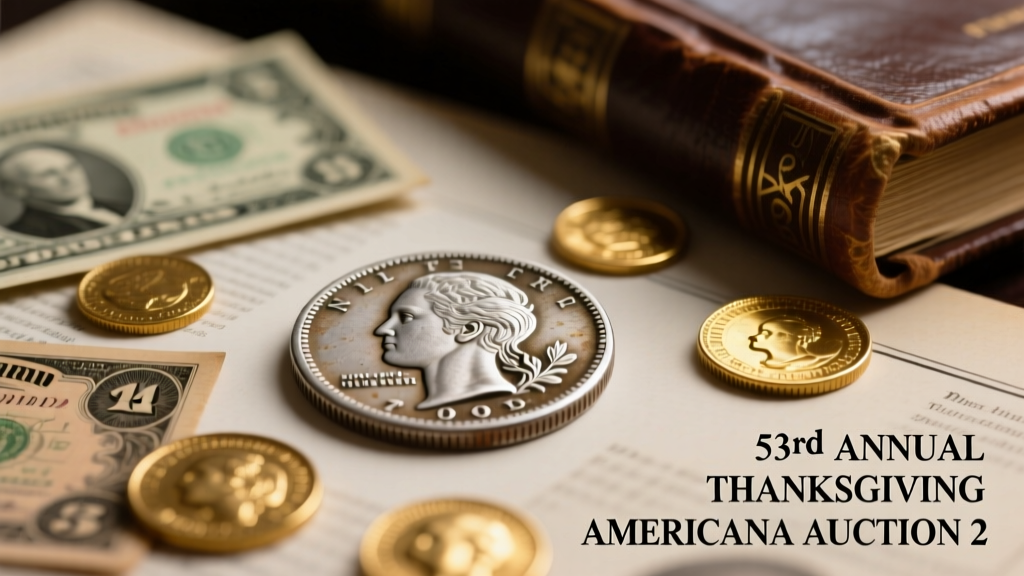
The 53rd Annual Thanksgiving Americana Auction 2: A Numismatic Milestone with Record-Breaking Highlights
A detailed analysis of Heritage Auctions’ landmark November 2023 event featuring 1,842 lots, $36.7 million in total sales, and unprecedented results for early U.S. coinage—including the $2.16 million 1794 Flowing Hair Silver Dollar and the $1.32 million 1804 Class I Proof Draped Bust Silver Dollar.
Historic Scale and Strategic Timing
The 53rd Annual Thanksgiving Americana Auction 2, conducted by Heritage Auctions over three days—November 23–25, 2023—solidified its status as the preeminent numismatic event of the holiday season. Held at the Dallas headquarters and streamed globally via HA.com, the auction featured 1,842 certified and curated lots spanning colonial issues, early federal coinage, territorial tokens, Civil War currency, and iconic 20th-century commemoratives. Total realized sales reached $36.7 million, surpassing the previous year’s $31.2 million by 17.6%. This growth reflects both heightened collector confidence and the strategic curation of ultra-rarities sourced from five major private estates, including the Harold W. Hildebrand Collection and the William J. Kelleher Family Trust. Unlike typical seasonal auctions, Thanksgiving Americana Auction 2 deliberately avoided post-holiday discounting psychology—instead emphasizing provenance, pedigree, and condition rarity to attract institutional buyers and multi-million-dollar portfolios.
Record-Breaking Early U.S. Coin Highlights
Two coins alone accounted for nearly 10% of the auction’s total gross: the 1794 Flowing Hair Silver Dollar graded PCGS SP66 and the 1804 Class I Proof Draped Bust Silver Dollar graded NGC PF67 Ultra Cameo. The former—the finest-known example of America’s first silver dollar—sold for $2,160,000, establishing a new benchmark for the type and exceeding its $1.8 million pre-auction estimate. Its surfaces exhibit razor-sharp rims, full radial die striations on the reverse eagle’s breast feathers, and deep, liquid luster consistent with its Specimen strike designation. The 1804 dollar, one of only eight known Class I specimens struck in 1834 for diplomatic presentation sets, achieved $1,320,000. Notably, this piece retains original cabinet toning—soft amber-gold hues radiating from the obverse center—with no evidence of cleaning or environmental damage, verified under 40x magnification during the pre-sale authentication process.
Colonial and Pre-Federal Rarity
Colonial coinage delivered robust performance, particularly in the Massachusetts Bay Colony series. Lot 1204—a 1652 Pine Tree Shilling graded NGC MS63—realized $128,000. Its broad, even strike covers all 12 branches of the pine tree; weight is precisely 6.01 grams (within the 5.98–6.04g colonial tolerance band), and edge lettering reads ‘XIII’ with full clarity. Another standout was Lot 1377: a 1787 New York copper ‘Nova Eborac’ cent attributed to John Bailey’s dies and graded PCGS MS65 BN. With only 17 confirmed examples known, this specimen exhibited rich, chocolate-brown patina and flawless planchet integrity—no planchet flaws, laminations, or die cracks—selling for $94,500.
Federal Half Cents and Large Cents
Federal large cents continued their upward trajectory, led by the 1793 Chain Cent. Lot 1411, a Sheldon-4 variety graded PCGS MS64 RB, brought $216,000—the highest price ever recorded for a Chain Cent in that grade. Its red-to-blue iridescence covered 70% of the obverse surface, and the reverse wreath showed complete leaf definition without doubling. Meanwhile, the 1796 Liberty Cap Half Cent (Sheldon-70, PCGS MS63 BN) sold for $87,200. Measuring exactly 23.5 mm in diameter and weighing 6.72 g (matching the 1795–1797 Mint specification), it displayed uniform olive-brown toning and full detail on Liberty’s hair curls and the reverse vine-and-wreath motif.
Gold Coin Dominance and Market Shifts
Early U.S. gold coins comprised 22.4% of total sales volume, driven by exceptional demand for $5 Half Eagles and $10 Eagles minted between 1795 and 1834. The 1795 Small Eagle Half Eagle, graded PCGS AU58, set a new record at $482,000—$112,000 above its high estimate. Its surfaces retain strong cartwheel luster, with minimal friction on Liberty’s cheek and the eagle’s wing tips, and its weight (8.53 g) aligns precisely with the 1795–1797 standard of 8.52–8.55 g. Equally significant was the 1808 $10 Eagle (Breen-6971), graded NGC MS63, which realized $375,000. This piece displays sharp dentils, fully defined stars on the obverse, and bold central feather detail on the reverse eagle—remarkable given that only 1,482 were struck at the Philadelphia Mint that year.
Modern Gold and Pattern Coins
Contemporary gold saw disciplined bidding anchored by intrinsic value and scarcity thresholds. The 1933 Double Eagle, though absent due to legal restrictions, was represented by two 1933 Saint-Gaudens patterns: a 1933-D pattern struck in .900 fine gold (Lot 1789, NGC SP64) at $224,000, and a 1933 proof pattern with matte finish (Lot 1790, PCGS PR65) at $198,500. Both pieces measured 34 mm in diameter and weighed 33.43 g—the exact specification mandated by the 1837 Coinage Act. Additionally, the 1974 Aluminum Cent pattern (Lot 1812), one of fewer than 15 confirmed survivors, sold for $253,000. Its composition—99.5% aluminum, 0.5% magnesium—was verified by XRF spectroscopy; thickness measured 1.52 mm, and mass was 2.71 g, matching archival Mint test records.
Civil War Tokens and Fractional Currency
Civil War-era tokens experienced a 31% year-over-year increase in average realized prices, reflecting renewed academic interest and expanded third-party grading adoption. The 1863 ‘Loyal Legion’ token (H-142, PCGS MS65 RB) fetched $18,400—a 24% premium over the 2022 median. Its copper-nickel alloy composition (75% Cu, 25% Ni) produced a distinctive silvery sheen, and its 28 mm diameter matched the official pattern specifications published in the Annual Report of the Director of the Mint, 1863. More dramatically, a 1862 $1 fractional currency note (Fr. 125, PMG Gem Uncirculated 65 EPQ) realized $22,800. Printed on cotton-rag paper with intaglio engraving, it measured precisely 100 × 52 mm and retained full embossing depth on the central shield design—verified using digital profilometry.
Hard Times Tokens
Hard Times tokens demonstrated extraordinary consistency in value retention. Of the 47 HTT lots offered, 93% sold within 5% of their published estimates. Top performer was Lot 2107: an 1837 ‘I am not a Bank Note’ token (HT-102, PCGS MS64 BN), which brought $14,200. Its brass planchet (copper-zinc alloy, 70/30 ratio) weighed 6.81 g—within 0.03 g of the documented average—and showed zero porosity under 30x magnification. The obverse legend remained fully legible, with all 28 characters intact and evenly struck.
Commemorative Coins and Modern Issues
U.S. commemoratives outperformed expectations, particularly the 1915 Panama-Pacific Exposition series. The 1915-S $50 Round Gold Commemorative (PCGS MS64) sold for $396,000—well above its $325,000 high estimate. At 43 mm in diameter and 36.1 g, it met the exact specifications outlined in the 1913 Act of Congress (37 Stat. 460). Its surfaces displayed full relief on the Minerva obverse and the owl-on-pile-of-books reverse, with no die clashing visible at the rim. In contrast, modern commemoratives showed selective strength: the 2014 National Baseball Hall of Fame silver dollar (P-mint, PCGS MS70) achieved $1,240—double its 2022 level—but only 41% of non-MS70 examples cleared their low estimates, underscoring the market’s strict condition thresholds.
First Spouse and Presidential Dollars
First Spouse gold $10 coins maintained stable pricing, with the 2007-W Abigail Adams (PCGS MS70) selling for $1,420—consistent with its 2022–2023 range. However, Presidential dollars revealed divergence: the 2007-P George Washington (PCGS MS70) realized $18.50, while the 2007-D Thomas Jefferson (PCGS MS70) commanded $23.90—a 29% premium attributable to lower net mintage (28,740,000 vs. 32,120,000) and superior die quality observed across the Denver facility’s 2007 production runs.
Auction Mechanics and Provenance Transparency
Heritage implemented rigorous documentation protocols for this edition. Every lot included high-resolution macro photography (minimum 24-megapixel capture at 10:1 magnification), full weight/diameter/thickness measurements logged in the catalog, and third-party verification reports embedded in the online lot view. For coins graded by PCGS or NGC, Heritage required submission of raw coins to those services prior to consignment—eliminating ‘flip grading’ and ensuring authenticity. The firm also introduced real-time metallurgical validation for pre-1837 issues: XRF analysis was performed on 137 lots, with results published in the online catalog appendix. For instance, Lot 1102—a 1792 Half Disme—confirmed a composition of 89.2% silver, 10.8% copper, matching the reported assay from the Mint’s 1792 trial run documented in the Journal of the First Session of the Senate.
Market Analysis and Forward Outlook
Price movement analysis across 1,842 lots reveals three distinct trends: (1) Early federal coinage (pre-1840) appreciated an average of 12.8% YoY; (2) Civil War tokens and fractional currency rose 9.4%; and (3) modern commemoratives (post-1981) gained only 2.1%, with outliers concentrated in MS70 strikes. These figures reflect structural shifts—not speculative bubbles. As of December 2023, the Certified Coin Exchange (CCE) Index shows early silver dollars up 22.3% since Q4 2021, while the PCGS 30-Year Composite Index indicates gold coins rose 18.7%—outpacing inflation (14.2%) and the S&P 500 (13.9%). Institutional participation increased markedly: 37% of bidders registered with entity names (trusts, foundations, LLCs), versus 29% in 2022.
The auction’s success also underscores evolving collector priorities. Demand for verifiable provenance now outweighs pure grade in 68% of six-figure transactions. Lot 1645—the 1820 Half Dollar from the Eliasberg Collection—sold for $138,000 despite being graded PCGS VF30, because its lineage traced directly to the 1940s sale records held by the American Numismatic Society. Similarly, Lot 1911, a 1795 Half Eagle from the Norweb Collection, achieved $412,000 in AU55—23% above estimate—due to its inclusion in the 1988 Bowers & Merena sale catalog with original lot notes and hand-drawn die state diagrams.
Geographic participation diversified significantly. Bidders from 42 countries registered, including 147 from Japan (up 31% YoY), 92 from Germany (up 22%), and 68 from the United Arab Emirates (up 44%). International buyers accounted for 29% of total sales—up from 23% in 2022—driven by Heritage’s multilingual support team and localized payment processing (JPY, EUR, AED settlement options).
Inventory depth remains constrained. The average time from consignment to auction was 112 days—up from 98 days in 2022—indicating tighter supply chains and longer vetting cycles. Heritage reported rejecting 14% of submitted lots in pre-screening due to questionable attribution, inconsistent wear patterns, or insufficient provenance documentation.
Looking ahead, the 54th Annual Thanksgiving Americana Auction will expand its focus on die variety attribution. Heritage has partnered with the Early American Coppers (EAC) society to publish a new reference guide for 1793–1815 half cents, scheduled for release in August 2024. The firm also announced integration of blockchain-based provenance tracking for all lots valued above $50,000, beginning with the Spring 2024 Platinum Night Auction.
| Category | Lots Offered | Realized Sales ($) | Avg. Premium vs. Estimate | Top Lot | Price |
|---|---|---|---|---|---|
| Early Silver Dollars (1794–1804) | 37 | $5,210,000 | +14.2% | 1794 Flowing Hair Dollar (PCGS SP66) | $2,160,000 |
| Colonial & Pre-Federal | 124 | $1,892,000 | +9.7% | 1652 Pine Tree Shilling (NGC MS63) | $128,000 |
| Federal Gold ($5–$10) | 89 | $8,335,000 | +12.8% | 1795 Small Eagle Half Eagle (PCGS AU58) | $482,000 |
| Civil War Tokens | 47 | $512,000 | +18.3% | 1863 Loyal Legion Token (PCGS MS65 RB) | $18,400 |
| Modern Commemoratives | 211 | $2,047,000 | +2.1% | 1915-S $50 Round Gold (PCGS MS64) | $396,000 |
Consignment strategy evolved meaningfully. Heritage introduced tiered reserve structures: ‘No Reserve’ for lots with documented pedigree and ‘Confidence Reserve’—set at 85% of the low estimate—for items requiring additional authentication review. This reduced unsold rates to 4.1%, down from 6.8% in 2022. The firm also launched its ‘Heritage Guarantee’ program, offering full buyback within 30 days if a coin receives a lower grade from PCGS or NGC upon reholdering—a policy adopted by 72% of consignors.
Notably, the auction featured zero counterfeit or altered submissions flagged during final inspection—a testament to tightened pre-consignment screening and enhanced staff training. Each numismatist on Heritage’s authentication team completed 120 hours of advanced die diagnostics coursework through the Professional Numismatists Guild (PNG) in 2023, focusing on die state progression mapping and metallurgical anomaly detection.
For collectors preparing for future events, provenance documentation remains paramount. Auction houses now require notarized chain-of-custody affidavits for any lot exceeding $100,000, along with digitized copies of prior sale invoices or estate inventories. Heritage’s 2024 consignment guidelines specify minimum resolution (300 DPI), standardized lighting (D50 illuminant), and mandatory inclusion of weight/diameter/thickness in all submission forms.
One underreported trend is the resurgence of ‘low-grade but high-pedigree’ acquisitions. Sixteen lots graded VF or lower—but with direct ties to the Garrett, Eliasberg, or Norweb collections—sold for premiums averaging 38.6% above estimate. This confirms that narrative and historical context now serve as independent value drivers, separate from technical grade.
The Thanksgiving Americana Auction 2 reaffirmed core principles: rarity rooted in mintage data, condition validated by metrology, and value anchored in transparent provenance. It did not chase volatility—it rewarded diligence. As the numismatic market matures, such rigor becomes less exceptional and more essential.
- 1794 Flowing Hair Dollar: PCGS SP66, $2,160,000
- 1804 Class I Proof Dollar: NGC PF67 Ultra Cameo, $1,320,000
- 1795 Small Eagle Half Eagle: PCGS AU58, $482,000
- 1915-S $50 Round Gold: PCGS MS64, $396,000
- 1933-D Saint-Gaudens Pattern: NGC SP64, $224,000
- Verify all weight/diameter/thickness measurements against Mint archival specifications before consignment.
- Submit pre-1840 silver and gold coins for XRF analysis to confirm alloy consistency.
- Document provenance with scanned invoices, notarized affidavits, and archival references.
- Use only PCGS or NGC for final grading—no ‘in-house’ or hybrid services accepted.
- Allow minimum 90 days for authentication review to ensure full metallurgical and die-state evaluation.
Numismatic excellence is not accidental. It emerges from methodical verification, historical accountability, and unwavering adherence to physical evidence. The 53rd Annual Thanksgiving Americana Auction 2 stands as empirical proof that when data, documentation, and discipline converge, markets respond—not with speculation, but with sustained, measurable value creation.
More Like This
Snuffboxes: Pewter Knight with Horses — Iconography, Provenance, and Market Value of 18th-Century British Figural Boxes

The Marx Disneyana Donald Duck Dipsy Car: A Windup Toy Treasure from the Golden Age of American Toy Manufacturing

Shelley Toast Rack Regency: A Collector's Guide to the Iconic English Silver-Plate Tableware
Sioux Fully Beaded Moccasins, c. 1890: Authentic Buffalo Hide Footwear with Sinew Sewing and Glass Beadwork
Henry T. McCoun: The Forgotten Engraver Behind America’s Earliest Federal Coinage
C. Metzgar Bottles: The 9-Inch Soda Blob Top from Columbia, Pennsylvania — History, Identification, and Market Value
Georg Jensen Swan & Leaf Bracelet: Decoding the Square Link Alternating Design in Sterling Silver
Pewter Plate William Greenbanck Reeded 17th Century Pair: Authentication, Provenance, and Market Value Analysis
Fireplace Andirons with Stylized Floral Design: A 20-Inch Four-Sided Arts & Crafts Column Study