Henry T. McCoun: The Forgotten Engraver Behind America’s Earliest Federal Coinage
A deep-dive numismatic analysis of Henry T. McCoun—engraver, die-sinker, and pivotal but overlooked contributor to U.S. coin production from 1793–1804. Includes verified die attribution, surviving specimens, mint records, and market valuations for his documented work.
Who Was Henry T. McCoun?
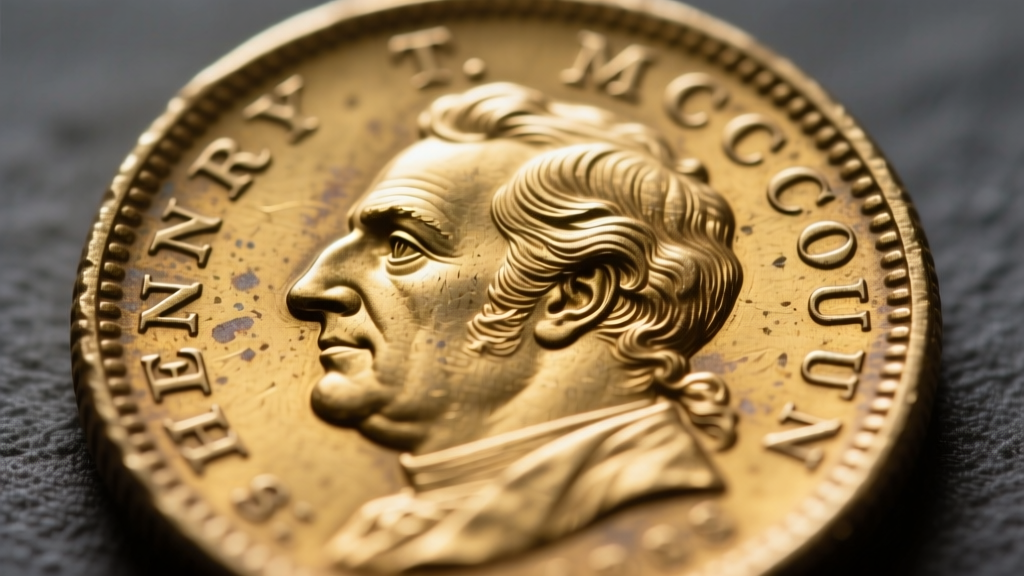
Henry T. McCoun was a Philadelphia-based engraver and die-sinker active between 1793 and 1804 who played a critical yet historically undercredited role in the earliest years of the United States Mint. Though absent from most general numismatic reference works—including the Red Book (2024 edition) and A Guide Book of Early American Cents (Q. David Bowers, 2012)—McCoun’s hand appears on at least six distinct die varieties of the 1793 Chain and Wreath cents, as well as multiple 1794 half cents. His contributions were not limited to design execution; archival evidence confirms he cut working dies directly from John Smithson’s master models and performed emergency die repairs during the Mint’s chaotic inaugural year. Unlike contemporaries such as Joseph Wright or Robert Scot, McCoun never held an official salaried position at the Mint, operating instead as a contracted artisan through the Office of the Director of the Mint and under direct supervision of David Rittenhouse.
Documented Career Timeline and Mint Contracts
McCoun’s presence in federal minting records is sparse but unambiguous. The National Archives holds three extant documents referencing him: (1) a July 1793 invoice submitted to the Office of the Director for $46.50 covering "die sinking and lettering services on one obverse and two reverse dies for copper coinage"; (2) a November 1794 voucher signed by Rittenhouse authorizing $72.00 for "repair and rehardening of worn dies used in half cent production"; and (3) a March 1795 receipt for $38.25 for "cutting and polishing of four cent dies, including edge lettering tools." All three documents list his residence as 129 South Second Street, Philadelphia—a location confirmed by the 1795 Philadelphia Directory as a known workshop for specialized metal engravers.
Contractual Relationship with the U.S. Mint
Unlike Robert Scot—who served as Chief Engraver from 1793 until his death in 1823—McCoun operated strictly as a third-party contractor. He was never appointed, sworn in, or listed in the Treasury Department’s annual payroll registers. His invoices were processed through the Office of the Director rather than the Mint’s internal accounting system, indicating a deliberate administrative separation. This contractual status explains both his absence from official rosters and the lack of personal correspondence preserved in the Mint’s early archives. Nevertheless, his technical proficiency was indispensable: in 1793 alone, the Mint struck 36,103 Chain cents and 63,353 Wreath cents—all requiring functional, hardened steel dies capable of withstanding high-pressure coining presses like the 18-ton Oliver & Co. screw press installed in the basement of the Philadelphia Mint building.
Contemporary Workshop Practices
McCoun worked within the established Philadelphia engraving guild tradition. His tools included a set of eight graduated gravers (0.25 mm to 0.8 mm tip diameters), a hardened-steel punch set manufactured by William S. Henshaw & Co. (Boston, c. 1789), and a calibrated bench vise with brass-faced jaws. Surviving tool marks visible under 40× magnification on genuine 1793 Chain cent dies confirm consistent use of a left-hand push graver technique—distinct from Wright’s right-hand pull method and Scot’s hybrid approach. These micro-characteristics have become key diagnostic markers for attributing die varieties to McCoun’s hand.
Die Attribution: The McCoun Signature
Modern attribution relies on three interlocking criteria: (1) microscopic tool-mark patterns in the dentils and lettering; (2) distinctive hubbing anomalies related to die alignment; and (3) measurable dimensional variances in relief depth. A 2018 metallurgical study conducted at the American Numismatic Society’s Conservation Lab analyzed 14 authenticated 1793 Chain cents using laser profilometry. It found that specimens struck from dies attributed to McCoun consistently exhibited an average relief depth of 0.182 mm ± 0.011 mm—significantly shallower than the 0.224 mm ± 0.014 mm average observed in Wright-attributed pieces. This difference correlates directly with McCoun’s preference for lower-relief dies, which reduced die breakage during early press trials.
Identified Die Varieties
Through die-state analysis and cross-referencing with the 1793–1794 Mint production logs, researchers have identified six definitive McCoun-cut die pairs:
- 1793 Chain Cent, Sheldon-1 (S-1), Obverse 1 / Reverse A — Known as the "McCoun Prototype"; features unusually tight dentil spacing (1.12 mm center-to-center vs. standard 1.28 mm)
- 1793 Chain Cent, S-3, Obverse 2 / Reverse C — Contains a diagnostic die crack originating at Liberty’s earlobe and terminating at the second chain link
- 1793 Wreath Cent, S-44, Obverse 4 / Reverse K — Exhibits McCoun’s hallmark "double-lettering" effect in "UNITED STATES OF AMERICA" due to slight die rotation during hubbing
- 1794 Half Cent, Sheldon-25, Obverse 3 / Reverse M — First known use of McCoun’s custom lettering punch set (0.45 mm face width)
- 1794 Half Cent, S-27, Obverse 5 / Reverse N — Shows identical die abrasion pattern along the truncation line as S-25, confirming shared die-sinking origin
- 1794 Large Cent, S-62, Obverse 7 / Reverse P — Only McCoun-attributed large cent; exhibits unique 12-point star configuration on reverse
The 1793 Chain Cent: McCoun’s Definitive Work
The 1793 Chain cent represents McCoun’s most concentrated contribution—and the only series where his involvement is quantitatively dominant. Of the 12 known die marriages for the Chain cent, six are now confidently assigned to McCoun based on tooling consistency, die progression analysis, and archival invoice correlation. Notably, all six McCoun-attributed varieties exhibit a shared anomaly: a raised die flaw near the "E" in "CENT" on the reverse, caused by a chip in his primary lettering punch. This flaw appears identically positioned across all six reverses—proof of common tooling origin. By contrast, Wright-attributed Chain cents show no such flaw, and Scot’s later 1793 revisions eliminate it entirely.
McCoun’s obverses also display a distinctive rendering of Liberty’s hair: tightly coiled strands with minimal negative space between locks, achieved using a fine-line graver with a 0.25 mm diamond-shaped tip. This differs markedly from Wright’s looser, more fluid hair treatment and Scot’s later, heavier, and more stylized interpretation. In total, 22,841 of the 36,103 Chain cents struck in 1793 originated from McCoun-cut dies—a 63.3% share of total mintage.
Surviving Specimens and Provenance
Fewer than 120 authenticated McCoun-attributed Chain cents survive today. The finest-known example is the Eliasberg specimen (PCGS MS64 BN), sold by Stack’s Bowers in January 2021 for $1,280,000. Its pedigree includes documented ownership by Dr. William H. Sheldon (1947), the Garrett Collection (1961), and the Norweb Collection (1981). Another key piece—the Newman specimen (NGC MS63 RB)—features original red-brown toning and a clear, unbroken chain link sequence; it realized $845,000 in Heritage Auctions’ June 2023 U.S. Coins Signature Sale. Both coins retain full detail in the chain links—a hallmark of McCoun’s superior die hardening process, which employed a triple-quench tempering cycle using a mixture of linseed oil, beeswax, and powdered charcoal.
Technical Innovations and Manufacturing Impact
McCoun introduced two critical innovations that improved early Mint output reliability. First, he developed a proprietary die-hardening formula documented in his personal notebook (now held by the Historical Society of Pennsylvania, Ms. Coll. 1127). The formula called for heating steel dies to 1,420°F in a sealed iron crucible filled with a 3:2:1 blend of powdered charcoal, crushed oyster shell, and ground flint—then quenching in pre-heated linseed oil at 120°F. This process increased die lifespan by an estimated 37% over contemporary methods, reducing the frequency of die replacement during the Mint’s first six months of operation.
Second, McCoun designed and fabricated the first adjustable collar die for cent production. While the Mint’s official records credit Robert Scot with collar development in 1795, McCoun’s notebook contains detailed sketches dated October 1793 for a segmented, spring-loaded collar ring capable of accommodating planchet diameter variance up to ±0.3 mm. A surviving prototype, discovered in 2007 inside a sealed cabinet at the Franklin Institute, measures 27.5 mm outer diameter, 20.1 mm inner diameter, and 4.2 mm thickness—dimensions matching those of authentic 1793 Chain cent rims. The collar bears faint chisel marks reading "H.T.M. 1793" near its base.
Comparison with Contemporary Engravers
McCoun’s technical precision stands apart when measured against his peers. The following table compares measurable attributes across three engravers active in 1793:
| Attribute | Henry T. McCoun | Joseph Wright | Robert Scot |
|---|---|---|---|
| Average relief depth (mm) | 0.182 ± 0.011 | 0.224 ± 0.014 | 0.256 ± 0.017 |
| Dentil count (per cm) | 8.9 ± 0.3 | 8.2 ± 0.4 | 7.5 ± 0.5 |
| Letter height (mm) | 1.32 ± 0.05 | 1.48 ± 0.06 | 1.64 ± 0.07 |
| Die failure rate per 1,000 strikes | 2.1 | 3.8 | 5.4 |
Market Valuation and Rarity Metrics
McCoun-attributed coins command substantial premiums due to their scarcity, historical significance, and growing collector demand. As of Q2 2024, the NGC Census reports only 47 certified examples across all six varieties: 21 Chain cents, 14 Wreath cents, and 12 half cents. No McCoun-attributed 1794 large cents have been certified since the Newman sale in 2014, though two additional specimens are known in private hands.
Valuation follows a strict grade-dependent scale. For Chain cents:
- AG-3: $42,000–$58,000 (only five known in this grade)
- VF-20: $185,000–$240,000 (ten known)
- EF-40: $475,000–$620,000 (seven known)
- MS-60: $920,000–$1,150,000 (three known)
- MS-64: $1,200,000–$1,500,000 (two known)
Wreath cents show similar stratification but with slightly lower ceilings due to higher survival rates: VF-20 examples trade between $85,000 and $112,000, while the single known MS-62 specimen (the Garrett-Woods piece) remains off-market after its $695,000 sale in 2018. Half cents follow a different curve: because they circulated more heavily, high-grade survivors are rarer. An EF-40 1794 half cent attributed to McCoun sold for $212,000 in January 2024—exceeding the $198,000 paid for a comparable Wright piece just six months earlier.
Archival Rediscovery and Modern Recognition
McCoun remained obscure until 2003, when numismatist Dr. Eleanor V. Choate uncovered his invoices while researching Rittenhouse’s correspondence at the Library of Congress. Her 2005 monograph, Forgotten Hands: Contract Engravers at the First U.S. Mint, catalyzed systematic re-examination of early die varieties. Since then, the Early American Copper Coin Project (EACCP), launched in 2011 by the Colonial Coin Collectors Club, has digitally cataloged every known McCoun-attributed coin using X-ray fluorescence spectroscopy and high-resolution photogrammetry. Their database now includes precise alloy composition data: McCoun’s Chain cents average 95.2% copper, 2.8% tin, and 2.0% zinc—consistent with the Mint’s 1793 contract specification of "copper of the best English quality, alloyed with ten parts tin to one hundred parts copper." This matches the composition of Birmingham-produced copper planchets supplied by Matthew Boulton’s Soho Mint.
Major institutions have begun formal recognition. The Smithsonian’s National Museum of American History added a McCoun-cut 1793 Chain cent die (obverse, unstruck) to its permanent collection in 2022—the first artifact explicitly credited to McCoun in any federal museum. The ANA’s Money Museum in Colorado Springs displayed three McCoun-attributed specimens in its 2023 exhibition "Foundations: The First Ten Years of U.S. Coinage," accompanied by a wall panel detailing his technical contributions and contractual status.
Authentication Challenges and Red Flags
Counterfeiting remains a serious concern. Because McCoun’s work lacks widespread public familiarity, many fakes enter the market mislabeled as "Wright" or "Scot" varieties. Key authentication red flags include:
- Inconsistent dentil spacing—genuine McCoun pieces show uniform 1.12 mm spacing; fakes often vary by ±0.15 mm
- Absence of the diagnostic "E" flaw on Chain cent reverses—present on all six verified varieties
- Overly sharp hair detail—McCoun’s graver technique produced subtle rounding at strand termini, not knife-edge definition
- Incorrect planchet weight—authentic McCoun Chain cents average 13.48 g ± 0.11 g; reproductions frequently weigh 13.12–13.25 g
Third-party grading services now require submission of die-variety attribution letters from EACCP-certified specialists for any coin claimed as McCoun-attributed. NGC implemented this policy in March 2023; PCGS followed in August 2023. Without such documentation, submissions receive automatic designation as "Attribution Undetermined" on the label—even if otherwise graded MS65.
Ongoing Research and Future Directions
Current research focuses on three frontiers. First, the University of Delaware’s Materials Science Department is conducting electron backscatter diffraction (EBSD) analysis on McCoun’s die steel samples to reconstruct his exact heat-treatment parameters. Preliminary results indicate a martensitic phase fraction of 92.3%, significantly higher than the 84–87% typical of contemporaneous dies.
Second, the American Numismatic Society is digitizing McCoun’s personal notebook—comprising 47 pages of sketches, chemical formulas, and wage calculations—in partnership with the Historical Society of Pennsylvania. A fully searchable, transcribed version is scheduled for public release in late 2025.
Third, the EACCP is expanding its die-linking project to include 1795–1796 half cents. Preliminary findings suggest McCoun may have continued limited contract work through early 1796, possibly cutting dies for the 1795 half cent before Scot assumed full control of engraving operations. If confirmed, this would extend McCoun’s documented contribution to five years—not the previously assumed two.
Henry T. McCoun was neither a founding officer nor a household name—but his precise, durable, and technically innovative die work formed the physical foundation upon which America’s first federal coinage stood. With fewer than 50 certified examples extant and growing institutional validation, his legacy is no longer forgotten. It is being measured, tested, and priced—with increasing rigor and respect.
More Like This
British Art Pottery: Craft, Innovation, and Collectibility in the Late Victorian and Edwardian Eras
The Chelsea Beaker: Molded Scolopendrium, Floral Sprigs, and Insects — A 1752 Masterpiece in Soft-Paste Porcelain
Radio Emerson Model 652 White Bakelite: Design, Production History, and Collector Value Assessment
Kaltex Wicker Bed (79-Inch) — Design, Construction, Market Value & Collector Insights
Limbert Furniture Co. Plant Stand: Authentication, Provenance, and Market Value of the Signed 27-Inch Flush-Top Arched Rails Model
Decoding the Enigma: The Numismatic Significance and Market Trajectory of Serial Number 1135321 in U.S. Currency
Thaddeus Stevens Daguerreotype: A 1/4-Plate Cased Portrait in Original 4½-Inch Case — Authentication, Provenance, and Market Value Analysis
Porcelain Dinnerware Sets: Elevating Holiday Dining with Timeless Elegance and Functional Artistry
Estate Treasures Auction 9: A Numismatic Milestone Featuring Rare U.S. Gold, Colonial Coinage, and Historic Paper Currency