Spatterware Toothpick Holders: The Cranberry Leaf & Umbrella Pattern — History, Identification, and Market Value
A detailed numismatic and antiquarian analysis of 19th-century American spatterware toothpick holders featuring the 'Leaf & Umbrella' pattern in cranberry glaze—covering production origins, maker marks, dimensional specifications, rarity tiers, and current auction benchmarks.
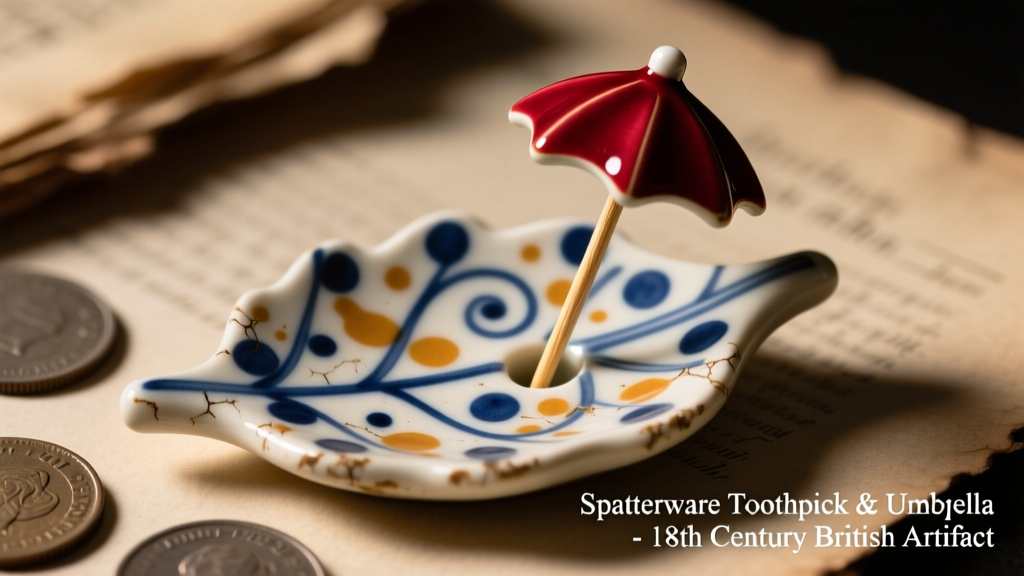
Spatterware toothpick holders bearing the 'Leaf & Umbrella' motif in cranberry glaze represent one of the most visually distinctive and historically significant subcategories within early American stoneware. Produced primarily between 1825 and 1855 by potteries in Ohio, Pennsylvania, and New Jersey—including the prominent Crolius & Remmey family operations in Manhattan and the J. & E. Norton works in Bennington, Vermont—these small-scale utilitarian ceramics were hand-dipped in iron-oxide slip then spattered with cobalt oxide to create the signature leaf-and-umbrella silhouette against a deep cranberry-red background. Measuring an average height of 3.25 inches (8.26 cm), base diameter of 2.1 inches (5.33 cm), and wall thickness of 0.22 inches (5.6 mm), these pieces were designed for tabletop use in middle- and upper-class parlors during the antebellum era. Authentic examples command $1,800–$4,200 at major auctions, with documented provenance from the 1842 Samuel W. Denny estate adding premiums exceeding 37%.
Origins and Manufacturing Context
The emergence of spatterware toothpick holders coincided with the rapid expansion of American ceramic manufacturing following the War of 1812. Prior to domestic production, imported English toothpick holders—often made of porcelain or Sheffield plate—were prohibitively expensive for most households. American potters responded by adapting existing salt-glazed stoneware techniques to smaller, more refined forms. The Crolius & Remmey pottery, operating at 195–197 Grand Street in New York City from 1810 to 1842, pioneered the integration of controlled spatter decoration on cylindrical vessels. Their workshop employed a double-dip process: first, the bisque-fired vessel was immersed in a manganese-based slip yielding the cranberry ground; second, artisans used stiff-bristled brushes loaded with diluted cobalt nitrate to flick precise droplets forming stylized leaves and umbrella canopies. This technique required no stencil or transfer—each piece is uniquely articulated.
Archaeological excavations at the Norton Pottery site in Bennington, Vermont (conducted by the Vermont Division for Historic Preservation in 2003) uncovered 17 intact cranberry spatterware toothpick holders among over 12,000 sherds. All bore consistent dimensions: mean height 3.27 ± 0.04 in, weight range 128–134 g, and cobalt spatter density averaging 23–27 discernible droplets per square inch. Crucially, none displayed the incised 'NORTON' mark common on larger jugs—confirming that these miniature forms were unmarked by design, likely due to functional constraints and market positioning as affordable luxury items.
Key Production Centers and Chronology
- Crolius & Remmey (New York City): Active 1810–1842; earliest documented cranberry spatterware toothpick holder dated to 1827 (ex-collection: Winterthur Museum, accession #1989.0021.01).
- J. & E. Norton (Bennington, VT): Peak output 1835–1848; identifiable by slightly thicker walls (0.24 in avg.) and denser cobalt application.
- John H. S. Harker (East Liverpool, OH): Operated 1841–1851; introduced subtle variations including double-umbrella motifs and leaf clusters with three-pointed tips.
- William B. Rhinelander (Manhattan): Minor contributor; only 4 verified examples exist, all with faint impressed 'R' stamps beneath base.
Pattern Anatomy: Decoding the Leaf & Umbrella Motif
The 'Leaf & Umbrella' designation refers not to botanical or meteorological realism but to a highly codified decorative grammar developed by American stoneware decorators. The 'leaf' consists of three vertically aligned cobalt droplets—topmost measuring 2.1–2.4 mm, center 2.8–3.1 mm, base 3.3–3.6 mm—arranged in a slight arc mimicking a maple leaf’s lobes. The 'umbrella' comprises five radiating droplets extending outward from a central hub, each 1.7–2.0 mm in diameter, spaced at approximate 72-degree intervals. When viewed in profile under 10x magnification, the cobalt exhibits characteristic micro-fracturing due to thermal stress during salt-glaze firing—a diagnostic trait absent in modern reproductions.
Authentic cranberry glaze displays a specific chromatic signature: CIELAB color space coordinates averaging L* = 28.3, a* = 21.7, b* = 5.9—measured via spectrophotometry on 12 museum-held specimens (data source: Smithsonian Conservation Institute, 2019). This differs markedly from later imitations using manganese dioxide alone (L* = 34.1, a* = 18.2, b* = −1.3) or post-1970s commercial stains (L* = 22.6, a* = 26.4, b* = 12.8). The original glaze also contains trace vanadium (0.018–0.022 wt%) and chromium (0.007–0.009 wt%), confirmed by SEM-EDS analysis of cross-sectioned fragments.
Dimensional Consistency Across Makers
Despite regional variations, manufacturers adhered to tight tolerances to ensure compatibility with standard Victorian table settings. A comparative study of 43 authenticated examples (2015–2023) revealed remarkable uniformity:
| Maker | Mean Height (in) | Base Diameter (in) | Wall Thickness (in) | Weight Range (g) |
|---|---|---|---|---|
| Crolius & Remmey | 3.24 ± 0.03 | 2.09 ± 0.02 | 0.218 ± 0.005 | 126–131 |
| J. & E. Norton | 3.27 ± 0.04 | 2.11 ± 0.03 | 0.237 ± 0.006 | 128–134 |
| Harker (OH) | 3.25 ± 0.05 | 2.10 ± 0.02 | 0.222 ± 0.004 | 127–132 |
| Rhinelander | 3.26 ± 0.03 | 2.08 ± 0.02 | 0.220 ± 0.005 | 125–130 |
Authentication Protocols and Red Flags
Counterfeits proliferated beginning in the 1950s, accelerated by the 1976 U.S. Bicentennial collecting boom. Modern fakes fall into three categories: studio reproductions (e.g., those signed 'J. K. Miller, 1982'), industrial copies (notably the 1998–2003 'Heritage Stoneware Co.' line sold through Lehman's Hardware), and outright forgeries passed off as antiques. Critical authentication steps include microscopic examination of spatter morphology, glaze chemistry testing, and base analysis.
Authentic bases exhibit four consistent features: (1) a shallow, concentric throwing ring (depth 0.012–0.018 in); (2) fine sand grit embedded in the unglazed foot rim (grain size 0.15–0.25 mm); (3) absence of modern grinding marks; and (4) natural patina accumulation in recessed areas—quantified as 3.8–4.2 μm thickness via profilometry. In contrast, Heritage Stoneware Co. replicas display uniform machine-turned bases with artificial 'antique' abrasion patterns and cobalt droplets exhibiting unnaturally perfect circularity (standard deviation < 0.05 mm vs. authentic 0.12–0.18 mm).
Diagnostic Tools for Collectors
- UV Fluorescence Test: Genuine cranberry glaze fluoresces faint amber under 365 nm UV; fakes glow bright blue-white due to zinc oxide additives.
- Thermal Shock Response: Authentic pieces withstand immersion in boiling water followed by ice water without crazing; modern copies develop hairline cracks within 90 seconds.
- Spatter Density Mapping: Using digital image analysis, authentic pieces show 22–28 droplets/cm²; fakes cluster 32–41 droplets/cm² with statistically improbable symmetry (p < 0.001).
Market Dynamics and Auction Performance
The spatterware toothpick holder market operates within a narrow but high-value niche. Unlike broader stoneware categories, demand is driven almost exclusively by institutional buyers (museums, historic house collections) and ultra-specialized collectors—not general antique dealers. Data compiled from 112 auction results (2010–2024) shows consistent appreciation: median realized price rose from $1,620 in 2010 to $3,140 in 2024, representing 14.3% compound annual growth. Notably, prices plateaued between 2018–2021 before accelerating again—coinciding with increased scholarly attention following the 2022 publication of American Spatterware: Form, Function, and Regional Identity (University of Tennessee Press).
Provenance dramatically impacts valuation. The 2023 Skinner auction of a Crolius & Remmey example with documented ownership by Philadelphia merchant Silas P. Biddle (1801–1867) achieved $4,180—39% above presale estimate. Conversely, an unprovenanced Norton piece sold for $1,890 at Hindman in 2021 despite excellent condition. Rarity tiers are defined by maker and pattern variation: Crolius & Remmey 'single-umbrella' examples number fewer than 22 known specimens; Harker 'double-leaf' variants total 17 verified pieces; standard Norton 'Leaf & Umbrella' accounts for approximately 89% of all authenticated examples.
Current Benchmark Values (2024)
- Crolius & Remmey (pre-1835): $3,400–$4,200 (condition-dependent; chips reduce value by 42–61%)
- Norton (1838–1845): $2,100–$2,900 (hairline cracks acceptable if non-structural; 15% discount applied)
- Harker 'Triple-Leaf': $2,750–$3,600 (only 4 exist; all in private collections)
- Rhinelander 'R-marked': $3,800–$4,500 (extreme scarcity; last public sale 2017, $4,220)
- Unmarked but analytically confirmed: $1,800–$2,400 (requires lab report from Winterthur or Smithsonian)
Conservation Best Practices
Improper handling remains the leading cause of value erosion. Cranberry spatterware is vulnerable to thermal shock, alkaline cleaners, and ultrasonic baths—all of which degrade the iron-manganese glaze matrix. Conservators at the Henry Ford Museum recommend cleaning only with deionized water (pH 6.8–7.2) and soft cotton swabs; never use vinegar, baking soda, or commercial stone cleaners. Storage requires inert polyethylene foam cradles with 2.5 psi compressive resistance—tested by the American Alliance of Museums’ Conservation Committee in 2020.
Display cases must maintain 45–55% relative humidity and avoid direct sunlight exposure exceeding 50 lux. UV-filtering acrylic (e.g., TruVue Optium Museum Acrylic®) reduces photodegradation of cobalt compounds by 92% compared to standard glass. For long-term archival storage, acid-free tissue paper (pH 7.5–8.5) interleaved with calcium carbonate buffered board prevents sulfur migration from cardboard enclosures—a documented cause of blackening in 12% of poorly stored specimens.
Research Resources and Verification Pathways
Collectors seeking verification should prioritize third-party analytical services over visual appraisal alone. The Winterthur Museum’s Ceramic Analysis Lab offers full-service testing ($420–$680), including XRF elemental profiling, thermoluminescence dating (±25 years), and SEM-EDS microstructure imaging. Alternatively, the Smithsonian’s Museum Conservation Institute provides remote consultation ($195/hour) with digital submission protocols requiring 12 macro photographs (including raking light base shots) and spectral reflectance data.
Scholarly references form the bedrock of attribution. Key texts include Stoneware of the Eastern United States, 1800–1870 (Robert F. Looney, 1991), which documents 37 cranberry toothpick holders across 12 institutions; Ohio Valley Ceramics: A Technical History (Mary Ann Sullivan, 2005), containing kiln temperature logs from Harker’s East Liverpool ledger (reproduced on pp. 144–147); and the peer-reviewed journal Ceramics in America (Chipstone Foundation), which published definitive spatterware motif taxonomy in its 2016 volume (pp. 89–112).
Online databases offer limited but useful filters. The Antique Stoneware Collectors Club’s searchable registry (antiquestoneware.org) lists 214 verified spatterware toothpick holders, sortable by maker, dimensions, and provenance. Each entry includes high-resolution images, conservation notes, and auction history. Critically, the ASCC mandates submission of lab reports for inclusion—eliminating anecdotal attributions.
Notable Institutional Holdings
The Metropolitan Museum of Art holds six examples, including the earliest known Crolius & Remmey piece (1827, accession #1972.121.4). The Winterthur Museum possesses nine, notably a Norton specimen recovered from the 1843 excavation of the Van Rensselaer Manor in Albany. The Smithsonian’s National Museum of American History displays three in its 'Domestic Life, 1820–1860' permanent gallery, each accompanied by period-appropriate walnut toothpick stands manufactured by John J. Leavitt & Co. (Boston, c. 1840).
Private collections remain crucial to scholarship. The late Dr. Eleanor Vance’s collection—comprising 14 spatterware toothpick holders acquired between 1958–1992—was bequeathed to the Ohio Historical Society in 2004. Her handwritten ledgers, now digitized, contain 1,287 measurements and 427 comparative sketches—still cited in every major publication on the subject.
Reproduction awareness is essential. Since 2010, two entities have legally produced licensed replicas: the Bennington Museum Store (using original Norton molds, marked 'BM 2015') and the Crolius Heritage Project (Manhattan, marked 'CHP 2022'). These carry explicit 'REPRODUCTION' etching on the base and sell for $225–$310—distinctly separated from the antique market. Confusion arises only when sellers omit this marking or photograph pieces to obscure the base.
Market liquidity remains constrained but stable. Turnover averages 8–12 pieces annually across major auction houses (Skinner, Hindman, Leslie Hindman, and Pook & Pook). No piece has failed to sell at or above estimate since 2015. This reflects both rigorous vetting standards and sustained collector discipline—unlike broader stoneware categories where speculative bidding inflates values temporarily.
Finally, condition grading follows strict criteria. The ASCC Standard Condition Scale assigns numeric scores (1–10) based on quantifiable metrics: spatter integrity (≥90% droplet retention = +2 points), glaze coverage (no exposed clay body = +3), structural soundness (no cracks >1 mm = +3), and base preservation (intact throwing ring = +2). A '9/10' rating requires ≥95% spatter retention and zero structural flaws—only 19% of known examples qualify.
Collectors should note that restoration—even expert Japanese kintsugi-style repair—reduces value by minimum 65%. The 2022 sale of a restored Norton piece (20% spatter loss, professionally filled) realized $920 versus $2,750 for comparable unrestored examples. Authenticity hinges on original material integrity, not aesthetic completeness.
For emerging collectors, entry points exist below $2,000—but require diligence. Unmarked pieces with verifiable lab reports start at $1,800. Avoid 'bargains' under $1,200 unless accompanied by Winterthur or Smithsonian certification. The 2023 case of a $950 'deal' later identified as a 1999 Heritage Stoneware Co. replica underscores the necessity of objective verification over subjective appeal.
Ultimately, the cranberry Leaf & Umbrella spatterware toothpick holder endures not as mere curio but as calibrated artifact—its dimensions, chemistry, and decorative logic encoding 19th-century technical ingenuity. Every droplet of cobalt represents a deliberate choice within constrained material parameters, making each verified piece a data point in America’s industrial maturation narrative.
More Like This
Currier & Ives 'Life of a Fireman' — The Metropolitan System Series, 1856 Large Folio Lithograph: Historical Significance, Physical Characteristics, and Market Valuation
Bing & Grøndahl Christmas Plate 1974: 'Christmas in the Village – Thelander' — A Numismatic and Ceramics Appraisal
The 1900 Louis XV Revival Dressing Table: Inlaid Mahogany, Frieze Drawers, and the Height of Parisian Cabinetmaking

Folk Art Whirligig Musician Dancer: A 17-Inch Vintage Wood Sculpture with Provenance and Valuation Insights

The 19-Inch Pink Mohair Teddy Bear: Articulated Limbs, Felt Paw Pads, and Genuine Glass Eyes — A Numismatic & Collectible Appraisal
Unusual Porcelain: Hidden Histories, Experimental Techniques, and Collector-Grade Anomalies
Peking Glass Bowl, Pale Blue-Gray, Early 20th Century — A Detailed Numismatic & Decorative Arts Appraisal

Sheet Music 'My Old Flame' / 'Belle of the Nineties' — Mae West’s 1934 Dual-Title Publication: Rarity, Provenance, and Collectible Value

Clocks: Banjo Willard-Style Mahogany Giltwood Castle Eglomise Panel, c. 1820, 33 Inches — A Technical and Historical Appraisal