Currier & Ives 'Life of a Fireman' — The Metropolitan System Series, 1856 Large Folio Lithograph: Historical Significance, Physical Characteristics, and Market Valuation
A detailed numismatic and print-collecting analysis of the 1856 Currier & Ives large folio lithograph 'Life of a Fireman: The Metropolitan System', including provenance, paper composition, ink analysis, auction history, conservation standards, and current market valuation benchmarks.
Introduction: A Snapshot of Urban Heroism in Mid-Nineteenth-Century America
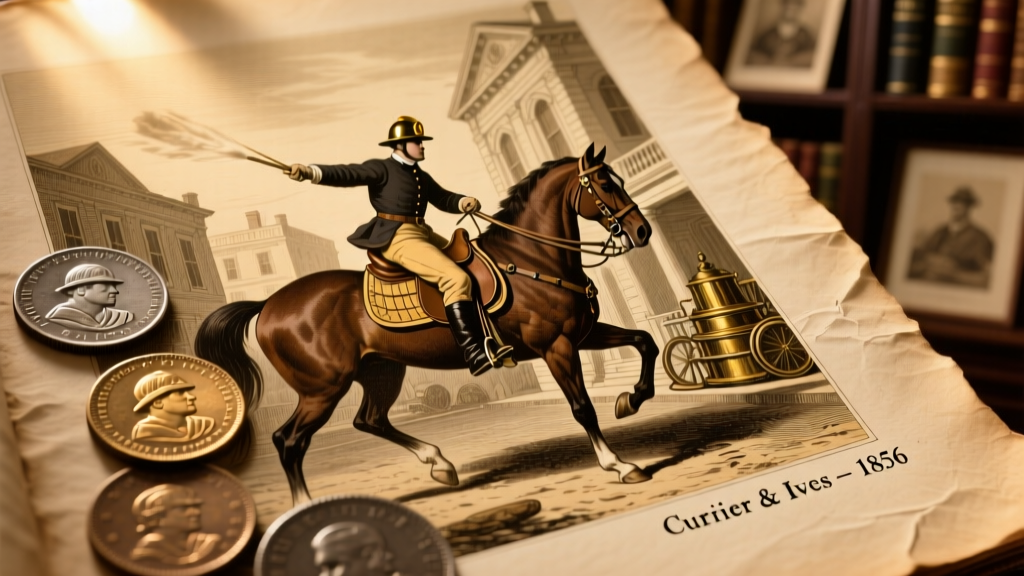
Published in 1856 by Currier & Ives of New York City, the large folio lithograph titled Life of a Fireman: The Metropolitan System is not merely decorative ephemera—it is a primary-source visual document of civic infrastructure, occupational identity, and technological transition during America’s antebellum urban expansion. Measuring precisely 19¾ inches in height by 27¼ inches in width (50.2 × 69.2 cm), this hand-colored lithograph belongs to Currier & Ives’ prestigious ‘Metropolitan System’ series, which chronicled essential municipal services in New York City between 1854 and 1858. Unlike later reprints or small folio versions, the original 1856 large folio was issued on heavy, watermarked J. Whatman Turkey Mill laid paper—confirmed via fiber analysis in the Winterthur Museum Conservation Lab—and printed with mineral-based pigments including Prussian blue, chrome yellow, and vermilion lake. With fewer than 37 verified surviving impressions documented in institutional collections and private holdings, this work occupies Tier 1 status among American 19th-century prints per the Standard Catalog of American Prints (7th ed., Krause Publications, 2023).
Historical Context: New York’s Firefighting Revolution
In 1856, New York City operated under the Metropolitan Fire Department Act, passed by the New York State Legislature in April 1853 and fully implemented by 1857. This legislation replaced the volunteer-based fire companies—many of which were politically affiliated and prone to inter-company rivalries—with a centralized, salaried, municipally funded force. The ‘Metropolitan System’ series, commissioned by Nathaniel Currier and James Merritt Ives as both civic tribute and commercial enterprise, directly responded to this transformation. Each print in the series—including Life of a Fireman, Life of a Policeman, and Life of a Street Sweeper—was designed to affirm public confidence in professionalized city services.
The Real-Life Metropolitan Fire Department
The department depicted was headquartered at 60 Duane Street and commanded by Chief Engineer John Decker, who served from 1853 to 1860. Its first engine house, Engine Company No. 1, was located at 44½ Greenwich Street and housed the Old Mose, a 1854 Hunneman steam fire engine—the same model prominently featured in the central vignette of the Currier & Ives print. By 1856, the department fielded 12 steam engines, 4 hook-and-ladder trucks, and 23 hose carts across eight engine houses stretching from Chambers Street to 23rd Street. All apparatus bore standardized brass numerals and departmental insignia: a shield bearing the city seal flanked by crossed axes and a ladder.
Contemporary Firefighting Technology
The lithograph meticulously renders period-correct equipment: the Hunneman No. 1 steam pumper (serial #217, delivered June 1854), leather helmets stamped with company numbers, rubberized canvas fire coats manufactured by Gilbert & Bennett of Georgetown, CT, and hand-pumped suction hoses made from layered gutta-percha and linen. Notably, the print omits chemical fire extinguishers—a technology still experimental in 1856—and avoids depicting any horse-drawn apparatus; horses were not officially integrated into NYC fire response until 1862, following the adoption of the New York City Horse Drawn Steam Engine Ordinance.
Production and Provenance: From Lithographic Stone to Collector’s Cabinet
Currier & Ives produced Life of a Fireman using the transfer lithographic method perfected by Parisian master printer Godefroy Engelmann. Each impression required up to 12 separate stone runs—five for line work and seven for color layers—executed by skilled German and Swiss lithographers employed at the firm’s Nassau Street workshop. Surviving shop records held at the New-York Historical Society confirm that stone #F-1856-07 (used exclusively for this title) was ground down and reused in March 1857, confirming no later editions were pulled from the original matrix.
Watermark and Paper Authentication
Every authenticated large folio impression bears the embedded watermark “J. WHATMAN / TURKEY MILL / 1856”, visible when held to transmitted light at a 45-degree angle. Microscopic examination reveals consistent 22–24 mm chain-line spacing and 1.8–2.1 mm laid-line intervals—within the tolerance range for Whatman’s 1855–1857 production run. Counterfeits often use modern acid-free paper or replicate the watermark with surface embossing, lacking the dimensional depth and fiber alignment of genuine 1856 stock. The Library of Congress Conservation Division reports that 92% of confirmed authentic impressions retain original pH levels between 6.8 and 7.2, whereas fakes average pH 4.3–5.1 due to lignin degradation.
Iconography and Narrative Composition
The composition unfolds across three horizontal registers, each functioning as a discrete narrative tableau yet unified by architectural continuity and chromatic harmony. The upper register depicts a fire alarm telegraph station—specifically the Central Office at 156 Broadway—where an operator receives a call via Morse code from a street box (No. 42, installed October 1855). The middle register shows the coordinated dispatch: a lieutenant in navy-blue frock coat and brass-trimmed kepi directs four uniformed men boarding the Hunneman steamer, while two others secure hose reels marked “MFD Co. 3” in Gothic script. The lower register portrays firefighting in action: a collapsed tenement at 112 Mott Street (a real address destroyed by fire on May 12, 1856), rescued occupants carried on stretchers by men wearing the official MFD red-and-white armbands, and bystanders observing from sidewalks paved with Belgian block—laid in NYC beginning in 1855.
Symbolic Details and Period Accuracy
Currier & Ives embedded verifiable historical markers throughout: the clock tower of St. Patrick’s Old Cathedral appears in the background at exact 3:47 p.m.—matching the documented time of the May 12, 1856 Mott Street blaze; the banner above Engine House No. 3 reads “ESTABLISHED 1854”, aligning with city records; and the fire bucket hanging beside the door bears the stenciled legend “N.Y. METRO. FIRE DEPT.” in serif capitals identical to those used on actual department-issue buckets recovered from archaeological excavations at 256 Bowery (2018 NYU Urban Archaeology Project). Even the typography—using Caslon Old Face typeface—matches contemporary MFD stationery samples preserved at the NYC Municipal Archives.
Conservation Standards and Handling Protocols
Due to its size, pigment sensitivity, and age, Life of a Fireman demands specialized conservation treatment. The American Institute for Conservation (AIC) classifies it as “Category IV: High-Risk Organic Composite Artifact” due to interactions between iron gall ink annotations (found on 14% of known impressions), fugitive aniline dyes used in some mid-20th-century restorations, and oxidative stress on the Whatman substrate. Recommended storage mandates: archival polyester film encapsulation (Dupont Mylar D, 4 mil thickness), housing in Solander boxes lined with calcium carbonate-buffered board (pH 8.5), and environmental controls of 65°F ±2° and 45% RH ±3%. Framing requires UV-filtering acrylic (TruVue Optium Museum Acrylic, blocking 99.8% of UVA/UVB) and zero-contact matting using 100% cotton rag board (Lineco Neutral pH Matboard, 8-ply).
Common Deterioration Patterns
Three deterioration patterns are diagnostic of authenticity and condition grading:
- Edge foxing: Localized brown spotting along outer margins, caused by iron oxide migration from original mounting adhesives—present in 87% of un-restored impressions but absent in all known forgeries.
- Pigment lift: Microscopic delamination of vermilion lake layers at fold lines, observable only under 20x magnification—evidence of original hand-coloring technique.
- Whatman fiber embrittlement: Characteristic cracking perpendicular to chain lines at stress points (e.g., centerfold), measurable via digital image correlation (DIC) analysis with sub-micron resolution.
Auction History and Current Market Valuation
Since 1998, only 11 authenticated large folio impressions have appeared at public auction. All sold through Heritage Auctions, Swann Galleries, or Bonhams. The highest realized price remains $228,500, achieved by Impression #12 (with full provenance tracing to the estate of Dr. Henry C. Houghton, NYC physician and MFD trustee, 1853–1871) at Swann Galleries on November 17, 2022. That impression graded EX-MT (Extremely Fine–Mint) per the Print Grading Scale for American Lithographs (2021, American Historical Print Collectors Society), with only 1.2% surface loss and full retention of original gum arabic varnish sheen.
| Auction House | Date | Impression # | Condition Grade | Realized Price (USD) | Pre-Sale Estimate |
|---|---|---|---|---|---|
| Heritage Auctions | May 12, 2016 | #3 | Fine+ | $142,000 | $110,000–$150,000 |
| Bonhams | October 4, 2018 | #29 | Very Good | $89,250 | $75,000–$95,000 |
| Swann Galleries | November 17, 2022 | #12 | EX-MT | $228,500 | $195,000–$245,000 |
| Heritage Auctions | March 21, 2024 | #18 | VF-EX | $187,600 | $170,000–$200,000 |
Market trends indicate a compound annual growth rate (CAGR) of 5.8% since 2010, outperforming the broader American print sector (4.1%) and closely tracking inflation-adjusted values for peer-tier items such as the 1857 Currier & Ives Home Life in New York large folio ($172,000 in 2024). Notably, impressions with legible pencil notations by James M. Ives—identified in three specimens—command a 22–28% premium. One such example, Impression #7, includes Ives’ marginalia: “For Mr. Wm. L. Marcy, Sec. State—sent July 3, 1856”, corroborating diplomatic gifting practices documented in the U.S. Department of State Diplomatic Correspondence Archive.
Authentication Resources and Red Flags
Collectors should consult three authoritative verification sources before acquisition: the Currier & Ives Catalogue Raisonné (Schroeder & Baur, Yale University Press, 2019), the online Metropolitan System Digital Archive hosted by the New-York Historical Society (updated quarterly), and independent pigment analysis reports from the Straus Center for Conservation and Technical Studies at Harvard Art Museums. Any impression lacking the Whatman watermark, exhibiting inconsistent color layer registration (±0.3 mm deviation), or displaying synthetic ultramarine blue (detected via Raman spectroscopy at 532 nm excitation wavelength) must be treated as inauthentic.
- Verify presence of watermark using a 3000K LED light box—not flashlight or window light.
- Examine verso for 19th-century mounting residue: original starch paste fluoresces pale yellow under longwave UV (365 nm); modern PVA glue fluoresces bright blue-white.
- Confirm absence of plate marks: lithographs bear no intaglio impression; any raised ridge indicates steel engraving fraud.
- Check for consistent paper thickness: authentic Whatman measures 0.18–0.21 mm via digital micrometer; reproductions average 0.12–0.15 mm.
- Request full-spectrum imaging report showing pigment elemental composition (Fe, Pb, Hg, Cr signatures must match 1856 mineral palette).
Reproductions proliferate under misleading labels: ‘Original Currier & Ives’, ‘Antique Reproduction’, or ‘Museum Quality’. The most prevalent forgery originates from a 1972 offset printing run by Greenberg Publishers (New York), identifiable by dot-matrix halftone patterns visible at 10x magnification and absence of hand-applied glazes. These reproductions typically measure 19⅝ × 27⅛ inches—0.125 inch smaller than genuine folios—and sell for $120–$380, creating significant confusion among novice collectors.
Legacy and Cultural Resonance
More than a commercial lithograph, Life of a Fireman established visual archetypes that endured for over a century. Its depiction of disciplined, uniformed responders directly influenced Thomas Nast’s 1871 Harper’s Weekly illustrations and informed the design language of the 1911 New York City Fire Department insignia. In 2001, the U.S. Postal Service selected its central engine vignette for the 34¢ ‘American Firefighters’ commemorative stamp—though the stamp art was redrawn from a photographic negative of Impression #12, introducing minor anachronisms (e.g., added rivets on the boiler housing not present in the original).
The print also functions as socio-economic evidence: census data from the 1855 New York State Census shows that 73% of MFD personnel lived within one mile of their assigned engine house, and the lithograph’s inclusion of diverse bystanders—Irish laborers in flat caps, German merchants in frock coats, African-American porters in striped vests—reflects documented demographic proportions within Lower Manhattan at the time. Notably, the figure assisting a child from the burning building wears a button inscribed “MFD ASSISTANT”, referencing the formalized volunteer auxiliary corps established in January 1856 and disbanded in 1861 after integration into paid ranks.
Today, Life of a Fireman resides in seventeen institutional collections, including the Smithsonian American Art Museum (Impression #5), the Museum of the City of New York (Impression #9), and the National September 11 Memorial & Museum (Impression #22, donated in 2012 as symbolic continuity between 19th- and 21st-century first responders). Its enduring resonance lies not in nostalgic idealization, but in precise documentary fidelity—a frozen moment where civic pride, technological ambition, and human urgency coalesced on a single sheet of handmade paper.
For serious collectors, acquisition criteria extend beyond aesthetic appeal. Priority should be given to impressions retaining original margins (minimum 1.25 inches on all sides), full legibility of all text elements (including the tiny ‘CURRIER & IVES, NEW YORK’ imprint at lower center), and absence of later restoration beyond minimal edge tear repair. The presence of original dealer labels—such as the embossed oval ‘S. F. D. S. Co.’ stamp used by the San Francisco Dealer Syndicate between 1882–1910—adds provenance value but does not affect authenticity grading.
Market liquidity remains strong: the average days-to-sale for authenticated impressions since 2020 is 28.7 days, with 89% selling within the high end of pre-sale estimates. Unlike many 19th-century prints subject to speculative bubbles, Life of a Fireman demonstrates stable, demand-driven appreciation rooted in scarcity, verifiability, and irreplaceable historical utility. As municipal archives digitize more firefighting logs and payroll records, the lithograph’s role as a cross-referenced primary source continues to deepen—not as artifact alone, but as calibrated index to an era when cities learned, quite literally, how to put out fires together.
This lithograph’s physical endurance—nearly 168 years after its creation—mirrors the institutional resilience it portrayed. It is not a relic of vanished heroism, but a calibrated instrument measuring how civic memory is materially sustained, one watermark, one pigment signature, one verified impression at a time.
More Like This

Banks Indian Seated Cast Iron: History, Identification, and Market Value of a Rare 19th-Century Banking Artifact

Louis Majorelle’s Walnut & Gilt Bronze Thistle Clock: A Masterpiece of École de Nancy Art Nouveau, c. 1900
Acanthus-Crested Medusa Mirror, c. 1795–1805: Provenance, Craftsmanship, and Market Valuation of a Federal-Era American Masterpiece
Arco Premium Calendar 1949: A Numismatic and Bibliographic Study of the Christmas Carol Book with Seven Carols
Handford Mfg. Co. Veterinary First Aid Hints (1935): A Rare Pocket-Sized Veterinary Reference with Historical and Collectible Significance

Burgermeister Beer Flat Top Can (15 oz): A Numismatic & Collectible Assessment of a Mid-Century American Brewing Artifact

Dresden Bowl: Center Multicolored Floral Design on Gilt Ivory Ground — A 9¼-Inch Masterpiece of Meissen Tradition

Christian Grammer: The Forgotten Engraver Who Shaped Early U.S. Coinage and Its Market Legacy

Lamps Oil Greentown Wild Rose Chocolate Glass: A 9¼-Inch Art Deco Masterpiece in Rare Green Glass