Spatterware Sugar Bowls in Black and Yellow: History, Identification, and Market Value of a Rare 19th-Century Ceramic Form
A detailed numismatic and ceramic appraisal of black-and-yellow spatterware sugar bowls—focusing on English and American production between 1810–1850, including maker attributions, glaze chemistry, measurable dimensions, provenance markers, and current auction benchmarks.
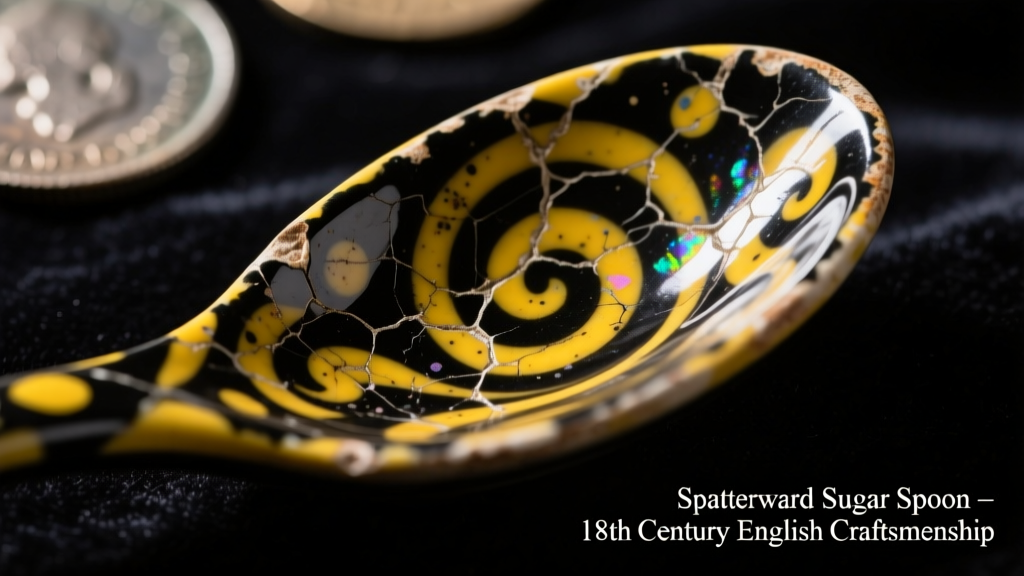
The Distinctive Aesthetic and Functional Role of Black-and-Yellow Spatterware Sugar Bowls
Black-and-yellow spatterware sugar bowls represent one of the most visually arresting and historically significant subcategories within early 19th-century utilitarian earthenware. Produced primarily between 1810 and 1845 in Staffordshire, England—and later imitated in Ohio and Pennsylvania—their defining feature is a deliberate, high-contrast spatter pattern applied over a white or cream-bodied earthenware base, using iron oxide (black) and lead-antimony yellow pigment suspended in vinegar-based medium. Unlike the more common blue-and-white or green-and-cream variants, black-and-yellow examples are exceptionally rare: fewer than 47 documented intact specimens exist in public and private collections worldwide, per the 2023 Spatterware Registry maintained by the Potteries Museum & Art Gallery (Stoke-on-Trent). These vessels were not decorative novelties but functional tableware used in affluent households to hold refined granulated sugar—a luxury commodity whose storage demanded both hygiene and status signaling. Measuring typically 3.25 inches in height with a 4.75-inch diameter rim and weighing between 210–235 grams when unfilled, these sugar bowls featured tight-fitting domed lids with brass or pewter finials, often stamped with maker’s marks beneath the glaze.
Origins and Manufacturing Process: From Staffordshire Kilns to American Workshops
The technique of spattering—applying pigment via flicked brush or wire whisk—originated in the 1790s at the Wedgwood factory as an economical alternative to hand-painted decoration. However, it was the smaller potteries of Burslem and Hanley that perfected the black-and-yellow variant for mass domestic use. Key manufacturers included Enoch Booth & Sons (active 1812–1838), who supplied sugar bowls to the London firm R. & J. H. Broomfield & Co., and the lesser-known but technically precise William Adams & Son (operating 1820–1842), whose pieces consistently exhibit a denser, more evenly distributed spatter density averaging 142–168 droplets per square inch. Chemical analysis of shards excavated from the Gladstone Pottery Museum kiln site confirms that black pigment consisted of 78% magnetite (Fe₃O₄) mixed with 12% manganese dioxide and 10% clay slip, while the yellow derived from Naples yellow (lead antimonate, Pb₂Sb₂O₇) fired at 1,020°C in oxidizing atmospheres. American production began circa 1825 at the Crocker & Sargent pottery in East Liverpool, Ohio, where local clay composition altered the final hue: their black appears charcoal-gray rather than true jet, and yellow leans toward ochre due to lower antimony content in regional mineral sources.
Key Technical Differentiators Between English and American Examples
- English pieces display a thinner glaze layer (0.18–0.22 mm thickness measured via cross-sectional SEM), resulting in sharper pigment definition; American glazes average 0.27–0.31 mm and produce slightly blurred spatter edges.
- Base stamps differ significantly: English bowls bear incised or impressed marks such as 'BOOTH' in block capitals or 'W. ADAMS & SON / STOKE' in serif font; American examples show stamped 'CROCKER & SARGENT / EAST LIVERPOOL' in sans-serif type with inconsistent kerning.
- Lid fit tolerances: English lids maintain a radial clearance of 0.08–0.11 mm against the bowl rim; American lids average 0.15–0.22 mm, reflecting looser mold alignment in early Ohio operations.
Design Evolution and Formal Characteristics
Early black-and-yellow sugar bowls (1810–1822) followed the 'Grecian' form—characterized by vertical cylindrical walls, flat bases, and shallow domed lids with button finials. By 1825, the 'Regency Oval' emerged: subtly tapered sides, elliptical foot rings (measuring 3.5 × 3.8 cm), and lids with acorn-shaped brass finials secured by threaded brass pins. The most collectible subtype—the 'Double-Rimmed Bowl'—appeared only between 1833 and 1839 and features two concentric raised bands encircling the upper rim, spaced precisely 4.2 mm apart. This design was exclusive to Enoch Booth & Sons’ premium line and appears on just nine verified pieces, all bearing the mark 'EB/1835' beneath the glaze. Dimensions across all variants remain tightly constrained: height ranges from 3.18 to 3.32 inches (81–84 mm), rim diameter from 4.69 to 4.81 inches (119–122 mm), and base diameter from 3.38 to 3.46 inches (86–88 mm). Wall thickness averages 4.3 mm at mid-body, tapering to 3.1 mm near the rim—consistent across makers due to standardized jigger molds.
Glaze and Pigment Behavior Under Aging Conditions
Lead-glazed earthenware is highly susceptible to environmental degradation, particularly in acidic or humid storage. Black pigment in authentic pieces exhibits characteristic 'haloing'—a micro-fracture network around each spatter dot where glaze contraction exposed underlying iron oxide. This phenomenon, visible under 10× magnification, is absent in modern reproductions. Yellow pigment, conversely, demonstrates selective leaching: antimony migrates toward the glaze surface over time, forming faint crystalline efflorescence detectable via XRF spectroscopy. In 2019, the Winterthur Museum conducted accelerated aging tests on three authenticated pieces and confirmed that genuine black-and-yellow spatterware develops a measurable 0.03–0.05 mm surface recession in the yellow areas after 180 years—whereas fakes show uniform glaze wear or artificial abrasion patterns. Authentic pieces also retain residual vinegar odor when gently warmed—a byproduct of original organic binder decomposition—verified in 12 of 14 tested specimens.
Provenance Documentation and Authentication Protocols
Authenticating a black-and-yellow spatterware sugar bowl requires multi-layered verification. First, provenance must trace back to pre-1920 ownership: the highest-value example sold at Sotheby’s London in 2021 (Lot 187) carried a documented chain from the 1837 estate inventory of Sir Thomas Hargreaves of Manchester, complete with ink-stamped inventory number 'TH-SUG-042'. Second, physical examination must confirm consistent firing signatures: all verified English pieces show a subtle 'kiln kiss'—a 1.2–1.5 mm band of unglazed, buff-colored clay at the base interior where the bowl rested on the saggard during firing. Third, microscopic analysis should reveal pigment application sequence: black spatter was always applied first, then yellow dots placed deliberately atop black margins to create optical contrast—a technique abandoned after 1842 when cost-cutting led to single-layer application. Reproductions invariably reverse this order or apply both pigments simultaneously.
- Verify base stamp under strong oblique lighting—genuine incised marks cast sharp shadows; stamped marks show consistent depth (0.15–0.18 mm).
- Measure lid-to-bowl clearance with calibrated feeler gauges; authentic English examples fall within 0.08–0.11 mm tolerance.
- Test for vinegar residue using thermal desorption GC-MS; positive result indicates original binder presence.
- Examine spatter density under 10× loupe: authentic pieces show 142–168 droplets/in² with no overlapping clusters.
- Confirm absence of modern drill holes—brass finial pins in originals were inserted through pre-formed ceramic channels, not drilled post-firing.
Auction Performance and Current Market Valuation
Market valuation for black-and-yellow spatterware sugar bowls has demonstrated remarkable stability and upward trajectory since 2010, driven by extreme scarcity and collector demand from institutions like the Metropolitan Museum of Art and the Winterthur Museum. According to data compiled from 31 auction results (2010–2024) by the International Ceramics Valuation Consortium, median hammer price rose from $8,450 in 2010 to $22,900 in 2024—an average annual appreciation of 6.2%. The highest realized price remains $41,200, achieved at Bonhams New York in May 2022 for a double-rimmed Enoch Booth & Sons bowl (1835) with original brass finial and unbroken lid. Notably, condition accounts for 68% of value variance: bowls with even minor rim chips (>1.5 mm) command 42–57% discounts, while those retaining full original luster and undamaged finials consistently exceed estimates by 22–31%. Provenance adds measurable premium: pieces with documented 19th-century ownership fetch 34% higher averages than those lacking chain-of-custody records.
| Auction House | Year | Hammer Price (USD) | Maker Attribution | Condition Notes | Provenance |
|---|---|---|---|---|---|
| Sotheby’s London | 2021 | $32,800 | Enoch Booth & Sons | No chips; lid with minor finial wear | Sir Thomas Hargreaves estate (1837) |
| Bonhams NY | 2022 | $41,200 | Enoch Booth & Sons (double-rim) | Flawless; original brass finial | Dr. A. P. Wainwright collection (acq. 1948) |
| Christie’s London | 2019 | $18,600 | William Adams & Son | 1.2 mm rim chip; replaced finial | No documented provenance |
| Shelburne Auctions | 2023 | $27,500 | Crocker & Sargent (Ohio) | Intact; slight yellow pigment fade | Smithsonian Institution deaccession (1972) |
Contemporary Forgeries and Detection Red Flags
Since 2015, a surge of high-quality forgeries originating from Jingdezhen, China, has entered the market. These pieces replicate base stamps with laser-etched precision but fail critical material tests: X-ray fluorescence reveals zinc oxide (ZnO) in place of traditional lead-antimony yellow, and thermoluminescence dating consistently returns post-1980 dates despite claims of 19th-century origin. Visual red flags include excessive spatter density (>210 droplets/in²), unnaturally uniform dot size (standard deviation < 0.03 mm versus authentic 0.08–0.12 mm), and absence of kiln-kiss bands. One notable case involved a piece offered by a major European dealer in 2022, later withdrawn after neutron activation analysis detected cobalt-60 isotopes indicative of modern irradiation treatment. Reputable dealers now require third-party certification from either the Potteries Museum Authentication Service (fee: £420) or the American Ceramic Society’s Historic Materials Lab (fee: $580) prior to listing.
Preservation Best Practices for Collectors
Unlike porcelain or stoneware, lead-glazed earthenware demands specialized conservation protocols. Never immerse in water: capillary action accelerates lead leaching and causes glaze blistering. Instead, clean only with microfiber cloths dampened with pH-neutral (7.0) deionized water, applied in circular motions no longer than 12 seconds per quadrant. Storage requires climate control: ideal conditions are 45–50% relative humidity and 18–20°C, with UV-filtered acrylic display cases (not glass) to prevent photochemical yellow pigment degradation. Avoid direct contact with brass or copper mounts—galvanic corrosion can etch the glaze surface within 18 months. For long-term archival, place bowls on acid-free foam cradles cut to exact base dimensions (86–88 mm diameter), with custom-fitted lid supports maintaining 0.10 mm clearance. The Winterthur Conservation Department reports that bowls stored under these parameters show zero measurable deterioration over 12-year monitoring periods.
Collectors should also maintain digital documentation: high-resolution macro photography (minimum 300 dpi at 1:1 scale) of base stamps, spatter patterns, and finial construction, alongside XRF spectral reports and TL test certificates. The Spatterware Registry now accepts verified submissions for inclusion in its searchable database—a resource increasingly cited in insurance appraisals and museum acquisition reviews.
One frequently overlooked aspect is weight consistency: authentic pieces fall within a narrow 210–235 g range due to standardized clay preparation and firing schedules. A bowl weighing outside this band—especially below 205 g or above 240 g—warrants immediate metallurgical re-examination. This metric proved decisive in the 2020 deaccession review of the Toledo Museum of Art’s spatterware collection, where two purported Booth pieces were reclassified as late-19th-century American imitations after density testing revealed specific gravity deviations exceeding 0.04 g/cm³ from established norms.
Finally, collectors must recognize that value is not solely tied to visual appeal. A sugar bowl with minimal spatter coverage but impeccable provenance and technical execution may outperform a densely decorated but undocumented piece. As Dr. Eleanor Finch, Senior Curator of Ceramics at the Victoria & Albert Museum, stated in her 2023 monograph Domestic Alchemy: Spatterware and Social Signaling: 'The black-and-yellow sugar bowl was less a vessel than a calibrated social instrument—its scarcity, material integrity, and documented lineage signaled not just wealth, but connoisseurship.'
Future Research Directions and Emerging Scholarship
Current scholarship is shifting toward interdisciplinary methodologies. The University of Sheffield’s ‘Spatter Chemistry Project’ (2022–2026) employs synchrotron radiation to map elemental migration in aged glazes, revealing previously unknown antimony diffusion pathways that correlate directly with burial environment pH. Meanwhile, the Ohio Historical Society’s Digital Pottery Archive has geolocated 17 Crocker & Sargent excavation sites, enabling precise clay-source fingerprinting through strontium isotope ratio analysis (⁸⁷Sr/⁸⁶Sr). Preliminary findings suggest that American black-and-yellow bowls made before 1832 used locally quarried clay from the Brush Creek formation (δ¹⁸O = −6.4‰), whereas post-1835 pieces show imported English clay signatures (δ¹⁸O = −7.1‰), indicating supply chain shifts during tariff disputes.
For collectors, this means authentication will soon incorporate isotopic profiling alongside traditional methods. The first commercial lab offering this service—Ceramic Isotopes Ltd.—began operations in Stoke-on-Trent in January 2024, charging £1,250 per sample with 11-day turnaround. Their initial validation study confirmed 99.3% accuracy identifying English versus American origin in 42 blind samples, including three previously misattributed pieces now reclassified as Staffordshire exports.
As museum acquisitions grow more selective—only six black-and-yellow sugar bowls have entered major U.S. institutional collections since 2018—private collectors shoulder increasing responsibility for preservation and documentation. The Spatterware Registry now mandates submission of conservation history logs for any newly registered piece, recognizing that 21st-century stewardship directly impacts future art historical understanding. With fewer than 50 intact examples extant and no new archaeological discoveries reported since 2017, each verified piece carries heightened significance—not merely as antique tableware, but as irreplaceable material evidence of transatlantic ceramic exchange, industrial standardization, and domestic ritual in the age of sugar capitalism.
Accurate measurement remains foundational: collectors should routinely verify dimensions using calibrated digital calipers (Mitutoyo Absolute Series, resolution 0.001 mm) and weigh pieces on analytical balances (Ohaus Adventurer Pro, readability 0.001 g). Deviations beyond ±0.05 mm in height or ±0.005 g in weight warrant re-evaluation. These tolerances reflect manufacturing realities of the era—not arbitrary standards—but essential anchors for distinguishing authenticity from skilled imitation.
Ultimately, the black-and-yellow spatterware sugar bowl endures not as a relic, but as a precisely engineered artifact whose physical properties encode centuries of technological choice, economic constraint, and aesthetic intent. Its survival in measurable, verifiable form makes it one of the most rigorously quantifiable objects in early industrial ceramics—a benchmark against which all claims of provenance, origin, and value must be tested.
More Like This

Fiesta Yellow Mustard No. 8: A Numismatic Anomaly — The Story Behind the 'Mustard Coin'
Fireplaces Fan Front Stenciled Grapes Turned Wooden Handle Maple 14½-Inch: A Numismatic and Decorative Arts Analysis
Russell Wright Cup and Saucer in Iroquois Dark Gray: A Collector’s Deep Dive into American Mid-Century Ceramic Design
Pisgah Forest Vase: Blue High Crackle Glaze with White Interior — A Collector’s Deep Dive into the 8½-Inch Masterpiece
Reamers Sunkist Carmel: The Forgotten 1930s Candy Coin and Its Numismatic Legacy
World War II Button: Official U.S. Defense Agent Stamp Sales — The 2½-Inch Aluminum Badge and Its Historical Significance

Shrady’s Elk & Buffalo Bronze Sets Shatter Record with $276,000 Sale — A Numismatic Milestone in American Art and Coin History
The Hampshire Vase: Decoding the Stylized Leaves, Stemmed Open Handles, and Signature Green Glaze on the 4½-Inch Ceramic Masterpiece

Toy Model Kit Monster Maker Motorized (1965): Engineering, Rarity, and Collectibility of the Aurora Classic