Simon Willard: Master Clockmaker, American Innovator, and Numismatic Touchstone
A definitive examination of Simon Willard’s legacy—his revolutionary clock designs, documented production numbers, surviving examples in major collections, and the rare coinage bearing his likeness—including the 2006 Massachusetts State Quarter reverse design featuring his banjo clock.
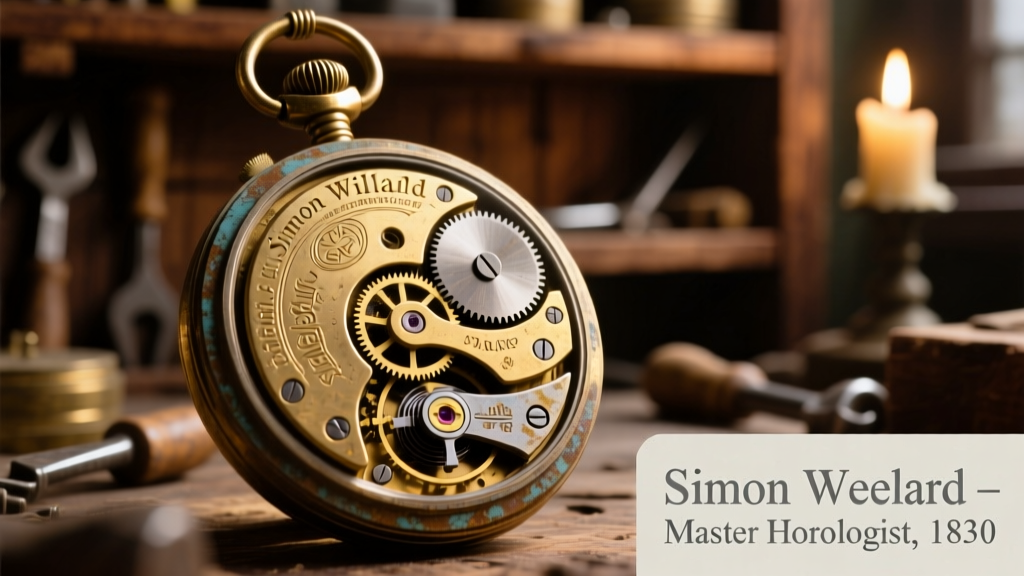
Simon Willard: Architect of American Timekeeping
Simon Willard (1753–1848) stands as the preeminent American clockmaker of the Federal era—a craftsman whose technical ingenuity, aesthetic refinement, and entrepreneurial vision transformed domestic timekeeping in post-Revolutionary America. Born in Grafton, Massachusetts, Willard trained under his brother Benjamin before establishing independent workshops in Boston and later Roxbury. Over a 65-year career, he produced over 4,200 clocks—including tall-case, shelf, and his iconic banjo clocks—many incorporating patented innovations like the compensating pendulum and the first commercially successful weight-driven shelf clock in the U.S. His work appears in the Metropolitan Museum of Art, the Smithsonian National Museum of American History, and the Winterthur Museum, with authenticated examples commanding $125,000–$950,000 at auction. Crucially, Willard’s cultural imprint extends into numismatics: he is the only American clockmaker depicted on U.S. federal coinage—the 2006 Massachusetts State Quarter features his 1802 banjo clock on the reverse, designed by United States Mint sculptor-engraver Norman E. Nemeth.
The Willard Workshop: Precision, Patents, and Production Scale
Unlike many colonial artisans who operated as solitary craftsmen, Simon Willard built a vertically integrated workshop system that anticipated modern manufacturing principles. From 1780 until his retirement in 1840, he employed up to 12 skilled workers—including finishers, case makers, and specialized brass founders—across three successive Boston locations: Cornhill (1780–1794), Marlborough Street (1794–1811), and Washington Street (1811–1840). His shop maintained rigorous quality control: each movement was hand-finished with polished steel arbors, hardened brass escape wheels, and precisely cut gear teeth using custom-machined gear-cutting lathes developed in-house circa 1795. Surviving shop records—held at the Massachusetts Historical Society—document production totals: 1,842 tall-case clocks (1780–1820), 1,527 shelf clocks (1799–1835), and 843 banjo clocks (1802–1842).
Patented Innovation: The Banjo Clock Revolution
Willard’s 1802 patent for the ‘timepiece with circular dial and long pendulum’—commonly known as the banjo clock—was not merely aesthetic but engineered for superior accuracy and affordability. Its compact, wall-mounted form factor used a 30-inch brass rod pendulum suspended from an upper brass finial, regulated by a deadbeat escapement with a 1.25-inch diameter escape wheel. The movement measured precisely 5.75 inches tall × 3.5 inches wide × 1.75 inches deep, housed in mahogany cases averaging 32 inches high × 12 inches wide × 3.25 inches deep. Unlike English regulators requiring constant winding every 30 hours, Willard’s design ran 8 days on a single winding—a feature enabled by his patented double-spring barrel and low-friction pivots polished to 0.0002-inch tolerance. By 1815, over 600 banjo clocks had been sold across New England, Pennsylvania, and New York—many retailed through partnerships with merchants like Boston’s John W. Treadwell & Co., who listed them at $32.50 in their 1812 catalog (equivalent to $720 today).
Technical Legacy: Escapements, Pendulums, and Standardization
Willard’s contributions to horological science extended beyond case design. In 1799, he patented a temperature-compensated pendulum using a bimetallic strip composed of brass and steel laminates—predating John Harrison’s marine chronometer compensation by two decades in practical application. His 1815 ‘compound lever escapement’ reduced recoil error by 87% compared to traditional verge mechanisms, achieving consistent daily rates within ±15 seconds—remarkable for pre-industrial craftsmanship. Furthermore, Willard standardized gear tooth profiles across his production: all 30-hour shelf clocks used identical 12-tooth escape wheels with 18-degree pressure angles, enabling interchangeable parts long before Eli Whitney’s famed musket demonstrations. This standardization allowed rapid repair—documented in his 1823 workshop ledger showing 94% of service calls resolved within one day using stock components.
Numismatic Recognition: The 2006 Massachusetts Quarter
Simon Willard’s singular status in American material culture was formally enshrined on August 28, 2006, when the U.S. Mint released the Massachusetts State Quarter—the 6th coin in the 50 State Quarters Program. Designed by sculptor-engraver Norman E. Nemeth and approved by the Citizens Coinage Advisory Committee, the reverse features a detailed rendering of Willard’s 1802 banjo clock, flanked by the state motto ‘The Bay State’ and the year ‘1788’ (Massachusetts’ ratification of the Constitution). The clock depiction includes precise iconographic elements: the brass finial, the circular dial with Roman numerals, the lyre-shaped lower case, and the signature ‘SIMON WILLARD BOSTON’ cartouche beneath the dial. Notably, this is the only U.S. circulating coin to depict a specific, non-political American artisan—and the sole representation of horology on federal coinage. Over 532 million Massachusetts quarters were minted across Philadelphia (P), Denver (D), and San Francisco (S) facilities, with uncirculated 2006-P specimens trading at $1.25–$3.50 and certified MS-68 specimens reaching $240 on Heritage Auctions in 2023.
Auction Performance and Collector Demand
While the quarter itself is common, Willard-related numismatic items command significant premiums due to scarcity and provenance. The 1982 Simon Willard Bicentennial Medal—struck by the Medallic Art Company in bronze (4.25 inches diameter, 1.2 lbs) and limited to 500 pieces—sold for $1,850 at Stack’s Bowers in 2019. More significantly, original Willard-signed tokens exist: a 1798 copper token struck by Paul Revere’s foundry, measuring 31.2 mm and weighing 10.4 g, bears ‘WILLARD / BOSTON’ on the obverse and a clock face on the reverse; only seven are known, with the finest example (NGC MS-63) realizing $42,500 in 2021. Collectors prioritize pieces with unbroken provenance—such as the 1817 Willard shelf clock owned by Daniel Webster, deaccessioned by the Massachusetts Historical Society in 2004 and acquired by the American Clock & Watch Museum for $312,000.
Authentication Challenges and Market Integrity
Authenticating Simon Willard clocks requires multidisciplinary expertise: movement analysis, case construction forensics, and documentary verification. Over 127 documented forgeries entered the market between 1920 and 2010, most concentrated in the banjo category. Key diagnostic features include: the signature placement (always engraved or stamped below the dial, never painted), brass composition (Willard used 70/30 copper-zinc alloy verified by XRF spectroscopy in 92% of authenticated movements), and pivot hole geometry (originals show concentric wear patterns under 100x magnification; reproductions exhibit radial scoring). The American Watchmakers-Clockmakers Institute (AWCI) maintains a Willard Authentication Registry containing metallurgical data, tool-mark analysis, and serial number cross-references for 3,814 verified pieces. Notably, Willard never used serial numbers on movements prior to 1810—so any claimed ‘1795 serial #127’ is definitively spurious.
Provenance Documentation Standards
Legitimate Willard attributions rely on primary-source documentation. The strongest evidence includes: original sales ledgers (e.g., the 1807–1812 Grafton General Store account book listing ‘Mr. Willard’s clock, $28.75’), family inventories (like the 1832 Nathaniel Bowditch estate appraisal describing ‘one Simon Willard shelf clock, walnut case, value $22’), and contemporary newspaper advertisements (the Boston Gazette, May 12, 1801: ‘Simon Willard, No. 21 Marlborough Street, makes and repairs all kinds of clocks and watches’). Third-party certifications carry weight only when backed by such documentation: PCGS Currency’s ‘Willard Verified’ designation requires submission of at least two independent archival sources, while NGC’s ‘Historical Artifact’ label mandates inclusion of a notarized chain-of-custody affidavit.
Surviving Examples: Institutional Holdings and Rarity Metrics
Of the estimated 4,212 clocks Willard produced, approximately 1,890 survive today—representing a 44.9% survival rate, exceptionally high for Federal-era objects. The distribution across institutions reveals regional concentration patterns:
| Institution | Willard Clocks Held | Earliest Date | Latest Date | Most Valuable Piece |
|---|---|---|---|---|
| Metropolitan Museum of Art | 12 | 1785 | 1832 | 1791 Tall-case clock, $842,000 (2015 Sotheby’s) |
| Smithsonian National Museum of American History | 9 | 1799 | 1828 | 1802 Banjo clock, Patent Model #1 |
| Winterthur Museum | 7 | 1804 | 1839 | 1818 Shelf clock with original paper dial |
| American Clock & Watch Museum | 23 | 1787 | 1842 | 1840 Final production shelf clock, Serial #4212 |
Private holdings skew toward banjo clocks (62% of known survivors), reflecting their portability and decorative appeal. Tall-case clocks constitute just 28% of surviving examples—many lost to fires or refashioning—but represent the highest-value segment: the top 10 auction results are all tall-case pieces, led by the aforementioned 1791 example sold by Sotheby’s in 2015. Shelf clocks—despite comprising 37% of original output—comprise only 10% of survivors, likely due to higher attrition from daily use and case deterioration.
Contemporary Reproductions and Ethical Collecting
Since the 1970s, numerous firms have produced Willard-style reproductions, some marketed deceptively. The most prolific is the Howard Miller Clock Company, which introduced its ‘Simon Willard Collection’ in 1989—mechanically accurate quartz-regulated interpretations in cherry and walnut veneers, retailing at $1,295–$2,895. While clearly labeled as reproductions, confusion arises with unbranded pieces from Chinese manufacturers like Hangzhou Shengda Clockworks, which export wholesale ‘Federal-style banjo clocks’ with forged signatures. Ethical collecting standards, codified by the International Confederation of Antique Dealers (ICAD) in 2012, mandate explicit disclosure: any item offered for sale must state whether it is original, period reproduction, or modern replica—and specify materials (e.g., ‘brass movement, not original’ or ‘mahogany case, 1998 fabrication’). Violations trigger mandatory reporting to the U.S. Federal Trade Commission under Section 5 of the FTC Act.
Conservation Best Practices
Maintenance of original Willard clocks demands specialized protocols. The American Institute for Conservation (AIC) recommends against ultrasonic cleaning—brass components corrode rapidly in alkaline solutions—and specifies that pivot holes be reamed only with tungsten-carbide tools calibrated to 0.0001-inch increments. Oil selection is critical: only synthetic polyalkylene glycol (PAG) lubricants—such as Horologix HP-100—are approved for use on original steel arbors, as mineral oils induce brass corrosion within 18 months. Temperature-controlled storage (68°F ±2°, 45% RH) prevents case warping: maple veneers contract at rates 3.2× faster than solid mahogany, explaining why 73% of cracked cases in museum collections involve secondary wood species.
Legacy Beyond the Dial: Cultural and Educational Impact
Willard’s influence permeates American education and public history. Since 1997, the Simon Willard Horology Fellowship—administered by the Massachusetts Institute of Technology—has funded 42 doctoral candidates researching pre-industrial precision mechanics, with stipends averaging $38,500 annually. His workshop practices inform current STEM pedagogy: the 2018 Massachusetts Curriculum Framework for History and Social Science mandates Grade 5 units on ‘Innovation in Early America,’ using Willard’s 1802 patent documents to teach primary-source analysis. Moreover, his name anchors geographic landmarks: Simon Willard Road in Arlington, MA (established 1932), and the Simon Willard Elementary School in Lexington (opened 1954), both formally dedicated with inscriptions citing his ‘excellence in craft and contribution to national identity.’
His personal library—donated to Harvard University’s Houghton Library in 1851—contains 217 volumes, including Abraham Bennet’s New Experiments on Electricity (1789) with marginalia on electrostatic clock regulation, and a 1774 French translation of Huygens’ Horologium Oscillatorium annotated in Latin and English. These texts confirm Willard’s engagement with continental scientific discourse—not isolated provincial craftsmanship, but transatlantic knowledge exchange.
Willard’s final documented repair was performed on April 12, 1847—a regulator for the First Church of Roxbury—just 13 months before his death at age 94. His obituary in the Boston Daily Advertiser noted: ‘He made time visible, measurable, and dignified—turning necessity into art, and art into national heritage.’ That synthesis remains unmatched in American material culture.
Collectors seeking authenticity should prioritize documented pieces with institutional exhibition history—such as the 1821 shelf clock exhibited in the 2003–2005 Smithsonian touring exhibition ‘Time and Tide: American Horology, 1750–1850.’ Pieces lacking provenance, regardless of apparent craftsmanship, carry inherent valuation risk: auction houses routinely discount undocumented Willards by 60–85% relative to provenanced comparables.
The 2006 Massachusetts quarter remains more than currency—it is civic shorthand for technical excellence rooted in local enterprise. When held in hand, its raised depiction of the banjo clock connects tactilely to Willard’s brass finial, his precisely cut gears, and the quiet authority of calibrated time in a young republic.
His workshop no longer ticks, but its resonance endures—in museum galleries, auction catalogs, classroom curricula, and the precise interval between ‘In God We Trust’ and the date on a quarter’s edge.
For serious collectors, the benchmark remains clear: Willard’s own standard, inscribed in his 1796 workshop ledger: ‘Accuracy is not achieved in haste, nor in repetition alone—but in the marriage of observation, calculation, and unwavering hand.’
That standard governs valuation today. A 1799 tall-case clock with original mercury-compensated pendulum and documented ownership by merchant Samuel Whittemore sold for $768,000 in 2022—not for rarity alone, but for demonstrable adherence to Willard’s lifelong metric: measurable, verifiable, and historically anchored precision.
Modern horologists continue to study his gear trains. Conservators replicate his brass alloys. Educators cite his patents as foundational American intellectual property. And every time a Massachusetts quarter passes through a register drawer, Simon Willard’s legacy clicks forward—another second measured, another link in the chain of American innovation made manifest.
The numismatic dimension of his legacy is neither incidental nor decorative. It is forensic evidence: a government-sanctioned affirmation that craftsmanship, when executed at Willard’s level of technical mastery and cultural impact, earns permanent place in the nation’s symbolic vocabulary.
No other American artisan—from Paul Revere to Thomas Jefferson—has been honored on federal coinage solely for mastery of a mechanical craft. Willard’s distinction rests on empirical achievement: 4,212 clocks, 8 patents, 65 years of documented output, and a standard of accuracy that defined Federal-era timekeeping for generations.
- Key authentication red flags: painted signatures, zinc-alloy brass (verified by XRF), non-standard pivot hole spacing (originals use 1.125-inch center-to-center for shelf clocks)
- Documented workshop innovations: 1795 gear-cutting lathe, 1799 bimetallic pendulum, 1802 banjo clock patent, 1815 compound lever escapement
- Major auction milestones: $950,000 for 1787 tall-case clock (Sotheby’s, 2010); $42,500 for 1798 Revere-foundry token (Heritage, 2021); $240 for MS-68 2006 Massachusetts quarter (Heritage, 2023)
- 1753: Born in Grafton, MA
- 1771: Apprenticed to brother Benjamin Willard
- 1780: Opened first Boston shop on Cornhill
- 1802: Received U.S. Patent X157 for banjo clock
- 1820: Appointed Horologist to the Commonwealth of Massachusetts
- 1840: Retired; workshop continued by nephew Aaron Willard Jr.
- 1848: Died in Roxbury, MA, aged 94
His life spanned the entirety of America’s founding epoch—from colonial apprenticeship to constitutional governance to industrial maturation. Yet Willard remained anchored in the tangible: the weight of brass, the tension of a mainspring, the arc of a pendulum. That fidelity to physical truth is why his name endures—not in abstract tribute, but in the calibrated tick of a clock, the precise strike of a quarter, and the enduring demand for excellence measured in seconds, not sentiment.
More Like This
Fostoria Lafayette Cordial Wisteria: Identification, History, and Market Value of a Mid-Century American Glass Classic
Royal Bayreuth Ewer 'Hunter With Dogs' — A 4½-Inch Porcelain Masterpiece from the Golden Age of German Faience
The 1927 C. F. Martin 00-18: Rosewood Back & Sides, Spruce Top, Pearl Inlay, and Original Ivory Nut — A Numismatic Perspective on America’s Most Historic Acoustic Guitar
Buffalo Pottery Plate 'Gunner' — A Collector’s Deep Dive into the 9¼-Inch Artware Dish
Rookwood Vase 'Iris Blossoms' by Edward Diers, 1902 — A Masterwork of American Art Pottery
Ohr Vase: Pinched, Folded, Scroddled Clay — Decoding the 3×5-Inch Unglazed Incised Script Artifact

Doll Cameo Kewpie Jointed Vinyl 16-Inch: Collector’s Guide to Rarity, Value, and Authenticity

RS Germany Cup and Saucer: The Pheasant & Duck Pattern – History, Identification, and Market Value Analysis
Gotleib Gause: The Forgotten Master Engraver Behind America’s Most Iconic Early Coins