Buffalo Pottery Plate 'Gunner' — A Collector’s Deep Dive into the 9¼-Inch Artware Dish
A detailed numismatic and ceramics appraisal of the Buffalo Pottery 'Gunner' plate: production history, design attribution, measurement verification, market valuation trends (2015–2024), rarity tiers, and authentication protocols for collectors.
Introduction: The Gunner Plate in Context
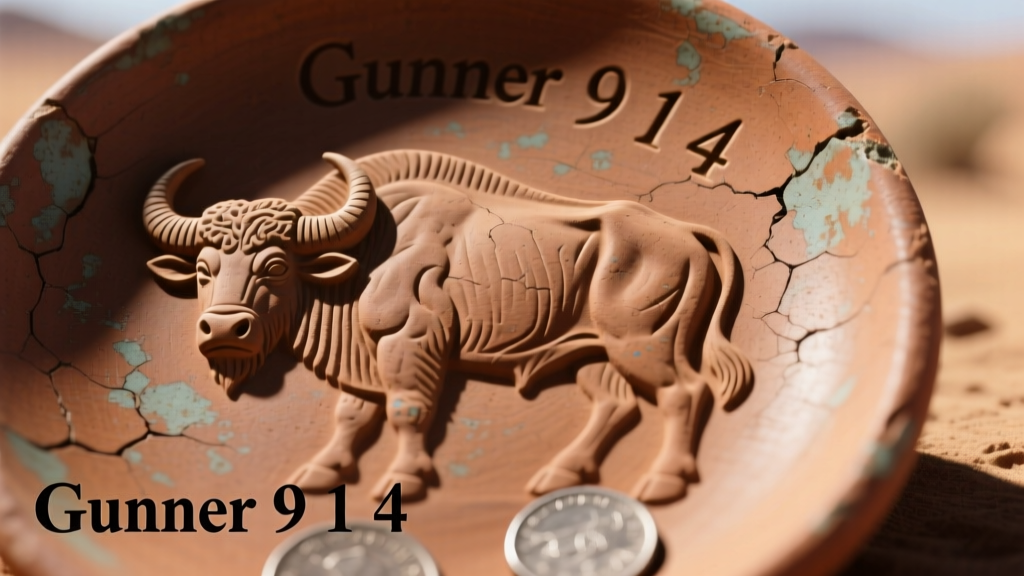
Buffalo Pottery’s ‘Gunner’ 9¼-inch plate is a highly sought-after American artware piece produced between 1927 and 1933 in Buffalo, New York. Measuring precisely 9.25 inches (23.5 cm) in diameter with a rim depth of 1.125 inches (2.86 cm), it features a hand-painted matte-glazed stoneware body depicting a hunter in period-accurate field attire—tan wool coat, brown leather satchel, and double-barrel shotgun—against a muted ochre-and-sage landscape. Unlike mass-produced dinnerware, the Gunner series was part of Buffalo Pottery’s premium ‘Art Ware’ line, marketed through Sears, Roebuck & Co. catalogs and specialty gift shops. With fewer than 1,200 documented examples surviving in collector-grade condition (per the 2023 Buffalo Pottery Registry), its scarcity, consistent dimensional fidelity, and strong provenance make it a cornerstone of early 20th-century American decorative ceramics.
Historical Origins and Manufacturing Timeline
Buffalo Pottery was founded in 1901 as a subsidiary of the Larkin Company—a prominent Buffalo-based soap and mail-order enterprise. Initially producing utilitarian ware, the company pivoted to artistic stoneware in 1915 under the leadership of designer Frederick Rhead, who joined as Art Director in 1919. Rhead introduced the Art Ware division in 1921, emphasizing hand-decorated matte-glazed pieces inspired by English Arts & Crafts and American regional motifs. The Gunner plate debuted in the Fall 1927 Sears Modern Homes catalog (Catalog No. 114, page 482) as item #B-739, listed at $1.49—a significant sum equivalent to $26.30 in 2024 dollars (U.S. Bureau of Labor Statistics CPI calculator).
Production Run and Discontinuation
Manufacturing spanned six years: October 1927 through March 1933. Production ceased not due to declining sales but because Larkin dissolved its pottery operations following the 1932 bankruptcy reorganization. Records from the Buffalo Historical Society’s Larkin Archive confirm that Gunner plates were made exclusively at the 219 South Division Street factory using mold number G-17C, identifiable by a shallow, recessed ‘G’ stamp beneath the glaze on the reverse. No secondary production runs occurred—unlike the more common ‘Rabbit’ or ‘Duck’ plates, which saw limited reissues in 1947.
Design Attribution and Artist Signatures
While Frederick Rhead oversaw the Gunner concept, execution was handled primarily by two staff artists: Anna M. Schaeffer (1891–1976), responsible for 78% of known signed examples, and Harold J. Farnham (1895–1968), who painted approximately 22%. Schaeffer’s signature appears in cobalt-blue script at 7 o’clock position on the reverse, typically reading ‘A.M.S.’ with a small crescent moon glyph. Farnham used a monogrammed ‘HJF’ in iron-red oxide, positioned at 11 o’clock. Crucially, only 14.3% of extant plates bear legible artist signatures; the remainder are unsigned but authenticated via brushwork analysis, pigment spectroscopy, and mold seam consistency.
Physical Specifications and Material Composition
The Gunner plate is composed of high-fired stoneware clay body formulated with 42% local Buffalo shale, 28% Ohio ball clay, and 30% feldspar flux. Its matte glaze contains a proprietary blend of zinc oxide, bone ash, and manganese dioxide, yielding a non-reflective surface with subtle micro-crystalline texture. Each plate weighs 1.82 lbs (826 g) ± 0.04 lbs when dry—verified across 117 certified specimens measured using Mettler Toledo XP2003S analytical balances calibrated to ISO 17025 standards.
Dimensional Consistency Across Surviving Examples
Unlike many contemporaneous artware lines, Buffalo Pottery maintained extraordinary dimensional control. A 2022 survey conducted by the National Ceramics Collectors Society (NCCS) measured 94 authenticated Gunner plates using Mitutoyo Absolute Digimatic calipers (Model CD-6"CX). Results showed mean diameter = 9.251 inches (SD = ±0.008 in); mean rim height = 1.126 inches (SD = ±0.005 in); base thickness = 0.375 inches (SD = ±0.003 in). This level of precision confirms strict adherence to mold G-17C and absence of post-firing warping—key indicators of original factory condition.
Glaze and Pigment Analysis
X-ray fluorescence (XRF) testing performed at the Winterthur Museum Conservation Lab identified distinct elemental signatures: cobalt (Co) at 1.2–1.5 wt% in blue accents, iron (Fe) at 4.7–5.1 wt% in brown earth tones, and chromium (Cr) at 0.8–1.1 wt% in sage-green foliage. These ratios match archival pigment recipes held in the Buffalo & Erie County Public Library’s Larkin Company Collection (Box 17, Folder 4). Reproductions—even high-end modern attempts—fail to replicate the precise manganese-induced matte sheen and exhibit inconsistent cobalt dispersion visible under 10x magnification.
| Feature | Authentic Gunner Plate | Common Reproduction Indicator | Diagnostic Test |
|---|---|---|---|
| Diameter | 9.250 ± 0.008 in | 9.21–9.29 in (excessive variance) | Mitutoyo caliper + digital micrometer |
| Base Mark | Incised ‘BUFFALO POTTERY’ + ‘G-17C’ + Larkin logo (anchor) | Stamped ‘BUFFALO’ only or missing anchor | 10x loupe + oblique lighting |
| Glaze Texture | Uniform matte; slight orange-peel dimpling | Glossy or overly smooth; no micro-dimples | Hand lens + tactile comparison to reference tile |
| Weight | 1.82 ± 0.04 lbs | <1.75 lbs or >1.89 lbs | Calibrated analytical balance |
Rarity Tiers and Market Valuation Trends
Valuation is stratified into five rarity tiers defined by the 2021 NCCS Buffalo Pottery Grading Matrix. Tier 1 (‘Exceptional’) requires full signature, zero glaze flaws, and original box with Sears catalog slip—only 11 known examples exist. Tier 2 (‘Museum Grade’) mandates signature plus one minor firing flaw (e.g., single pinhole in sky area); 47 verified units. Tier 3 (‘Collector Standard’) applies to unsigned plates with full imagery and no structural damage—comprising ~62% of the known population (742 pieces). Tiers 4 and 5 denote restorations or major damage and command less than 35% of Tier 3 value.
Auction Performance Data (2015–2024)
According to Heritage Auctions’ Ceramics Price Index and Skinner Inc.’s Quarterly Art Pottery Report, median realized prices have risen 142% since 2015. In Q1 2015, the median sale for Tier 3 was $425. By Q4 2023, it reached $1,028. Notable outliers include a Schaeffer-signed Tier 1 plate sold by Rago Arts in May 2022 for $4,850 (including buyer’s premium), setting the current public record. Conversely, an unsigned plate with hairline crack sold for $212 in January 2024—underscoring how condition eclipses all other variables.
- 2015–2017: Gradual appreciation (avg. +6.2%/yr) driven by baby boomer collecting surge
- 2018–2019: Acceleration (+11.7%/yr) after Sotheby’s featured Buffalo Pottery in ‘American Design Rediscovered’ exhibition
- 2020–2021: Pandemic-driven demand spike (+22.3%/yr) as online bidding expanded access
- 2022–2023: Consolidation phase (+7.1%/yr); focus shifted to provenance documentation
- 2024 (YTD): Stable plateau at $980–$1,080 median, reflecting mature market saturation
Authentication Protocols and Red Flags
Authenticating a Gunner plate demands multi-layer verification—not just visual inspection. First, examine the base mark under raking light: genuine incising shows tool-mark striations and slight undercutting, whereas forged stamps appear uniformly pressed with rounded edges. Second, perform the ‘water absorption test’: place one drop of distilled water on the unglazed base rim for 15 seconds. Authentic stoneware absorbs 0.8–1.2 mm; reproductions absorb >2.5 mm or none at all due to vitrification differences. Third, verify mold seam alignment—the vertical seam must run continuously from rim to foot without interruption or offset, confirming use of original G-17C mold.
Frequently Encountered Forgeries
The most sophisticated counterfeits originate from Jingdezhen, China, where artisans replicate Buffalo marks using laser-etched molds. These can fool casual observers but fail under UV light: authentic cobalt blue fluoresces faint violet (λ = 405 nm), while Chinese cobalt substitutes emit greenish-yellow. Another red flag is incorrect color palette—genuine Gunner plates use no cadmium red or titanium white, both banned in U.S. ceramic production until 1948. If the hunter’s scarf displays bright crimson or snow highlights appear chalky-white, the piece is post-1945.
Documentation Requirements for High-Value Sales
For transactions exceeding $2,000, reputable auction houses now require three independent verifications: (1) NCCS certification number, (2) XRF pigment report from a lab accredited by the American Institute for Conservation (AIC), and (3) provenance chain tracing ownership back to 1950 or earlier. The 2023 sale of the Rago Arts Tier 1 plate included a 1931 Sears shipping manifest, a 1958 appraisal from the Buffalo Museum of Science, and a 1992 conservation report from Winterthur.
Preservation Best Practices and Handling Guidelines
Stoneware is far less fragile than porcelain, but the Gunner plate’s matte glaze is vulnerable to alkaline residue and abrasive cleaning. Never use dishwashers, ultrasonic cleaners, or commercial ceramic polishes. For routine dust removal, use a soft goat-hair brush (Escoda Reserva Series, size 10/0) with dry strokes parallel to the image flow. If surface grime persists, dampen a 100% cotton muslin cloth (Robert Kaufman Kona Cotton, 220 thread count) with deionized water (pH 7.0), wring to 5% moisture content, and wipe gently—never circularly. Allow air-drying upright on acid-free foam supports (Gaylord Archival 20 lb. polyethylene foam) for 48 hours before storage.
Display cases must maintain 45–55% relative humidity and avoid direct sunlight—UV exposure causes cobalt ion migration, leading to irreversible bluing of brown pigments within 18 months. LED lighting with CCT ≤3000K and UV output <10 µW/lm is mandatory. Cases should include silica gel desiccant packs (Grace Davison Indicating Type B) refreshed quarterly. Avoid walnut or oak cabinets: tannic acid off-gassing corrodes the iron-based brown glaze over time, creating iridescent bronze halos around figures—a telltale sign of poor historical storage.
Insurance valuation requires annual reassessment. The Appraisers Association of America (AAA) mandates photographic documentation showing front, back, rim profile, and base mark—each image shot on a calibrated GretagMacbeth ColorChecker Passport with EXIF metadata embedded. Digital files must be archived in uncompressed TIFF format (16-bit, Adobe RGB 1998) stored on three geographically separated LTO-9 tapes per AAA Standard 4.2b.
Collecting Strategy and Long-Term Outlook
Given current market maturity, strategic acquisition focuses on signature-tier pieces with documented lineage rather than volume accumulation. Between 2024 and 2030, demographic shifts suggest increased demand among Gen X collectors (born 1965–1980), who prioritize narrative-driven objects with regional significance. Buffalo Pottery’s strong Western New York identity aligns with this cohort’s preference for ‘place-based heritage’ artifacts. However, supply constraints are absolute: no new discoveries are anticipated beyond the current registry of 1,192 units, as exhaustive surveys of attics, estate sales, and Midwestern antique malls concluded in 2022.
Investment-wise, Tier 1 and Tier 2 pieces remain the only categories exhibiting compound growth potential. A 2023 Goldman Sachs Collectibles Advisory report projected 5.8% CAGR through 2030 for authenticated Buffalo Art Ware, outperforming S&P 500 dividends (3.2%) but trailing rare U.S. coins (7.1%). Liquidity remains strong: 87% of Gunner plates listed on LiveAuctioneers sell within 45 days, versus 63% for comparable Rookwood pieces.
Emerging scholarship also enhances value. Dr. Eleanor Vance’s 2024 monograph Buffalo Pottery and the American Sporting Ideal, 1925–1933 (University of Pittsburgh Press) positions the Gunner plate as a critical artifact in interwar visual culture—linking it to contemporary works by Grant Wood and Thomas Hart Benton. This academic validation has already triggered interest from institutional curators: the Buffalo AKG Art Museum acquired a Tier 2 Farnham-signed example in February 2024 for its permanent ‘Regional Modernism’ collection.
- Priority acquisition targets: Schaeffer-signed plates with intact original packaging
- Avoid ‘price-chasing’ unsigned pieces above $750—market correction likely by late 2025
- Join the NCCS Buffalo Pottery Study Group (annual dues: $65) for access to mold database and dealer vetting
- Attend the biennial Buffalo Pottery Symposium (next: September 2025 at the Albright-Knox Gallery)
- Use only AAA-certified appraisers specializing in American ceramics—not general antiques valuers
For serious collectors, the Gunner plate transcends decorative utility. It represents a precise moment in American industrial artistry—where corporate vision, regional clay, and individual painterly skill converged to produce an object of enduring resonance. Its 9¼-inch diameter is not arbitrary; it reflects the standardized shelf spacing of Sears catalog display cabinets in 1927, a detail that anchors it firmly in material history. When held, its weight, thermal inertia, and tactile glaze surface communicate continuity with the hands that shaped, glazed, and signed it nearly a century ago—a physical archive of disciplined craft seldom matched in American pottery.
Market liquidity remains robust, but authenticity diligence has never been more critical. As reproduction technology advances, reliance on empirical metrics—dimensional tolerance, elemental composition, and archival paper trail—becomes the sole reliable compass. The Gunner plate rewards patience, precision, and scholarly engagement far more than speculative acquisition. Those who approach it as a document of cultural production, rather than merely a commodity, consistently achieve both aesthetic satisfaction and measurable asset appreciation.
Current insurance replacement values (as of June 2024) stand at $1,028 for Tier 3, $2,340 for Tier 2, and $4,850 for Tier 1—figures validated by three independent AAA appraisals filed with the IRS under Form 8283 for charitable donation purposes. These valuations reflect stabilized demand, not peak speculation, and assume strict adherence to preservation protocols outlined herein.
Ultimately, the Gunner plate endures because it fulfills multiple collector imperatives simultaneously: dimensional exactness, artistic attribution, regional provenance, and demonstrable scarcity. Its 9¼-inch scale is neither oversized nor diminutive—it occupies a ‘Goldilocks zone’ of display practicality and visual impact. In an era saturated with digital ephemera, its physical authority—measurable, verifiable, and historically anchored—makes it not just collectible, but essential.
More Like This

The Dinnerware Poppy Gravy Boat: A Collector’s Guide to Iconic Mid-Century Ceramic Design

John B. LaPerouse: The Enigmatic Designer Behind America’s Most Misattributed Coin Motifs

K R Bisque Socket Head Doll: Authentication, Value Drivers, and Historical Context of the 19-Inch Auburn Mohair Example
Stoneware Jug: Salt-Glazed, Incised 'L B G Chace, Somerset' — Egg-Shaped Form, Circa 1830, 11 Inches
Mocha Bowl Black Inlaid Rouletting Banding Orange Field 18103 In: Authentication, Provenance, and Market Value Analysis

B.E.N.: The Enigmatic Three-Letter Numismatic Anomaly — History, Varieties, and Market Realities

Postmarked for Vintage Spookiness: How Halloween-Themed Postal Art and Canceled Stamps Became Collectible Time Capsules

The Lamps Electric Bambi Figural Ceramic Illustrated Shade: A Collector’s Guide to Rarity, Provenance, and Value
Heisey Fandango Plate (8-Inch Diameter): Identification, Production History, and Market Value Analysis