The Sears Stradivarius Violin: Myth, Marketing, and Musical Reality
A deep-dive analysis of Sears Roebuck’s 20th-century 'Stradivarius' branded violins—exploring their origins, construction, market positioning, collector value, and the persistent confusion between authentic Antonio Stradivari instruments and mass-produced student models sold through Sears catalogs from 1910–1975.
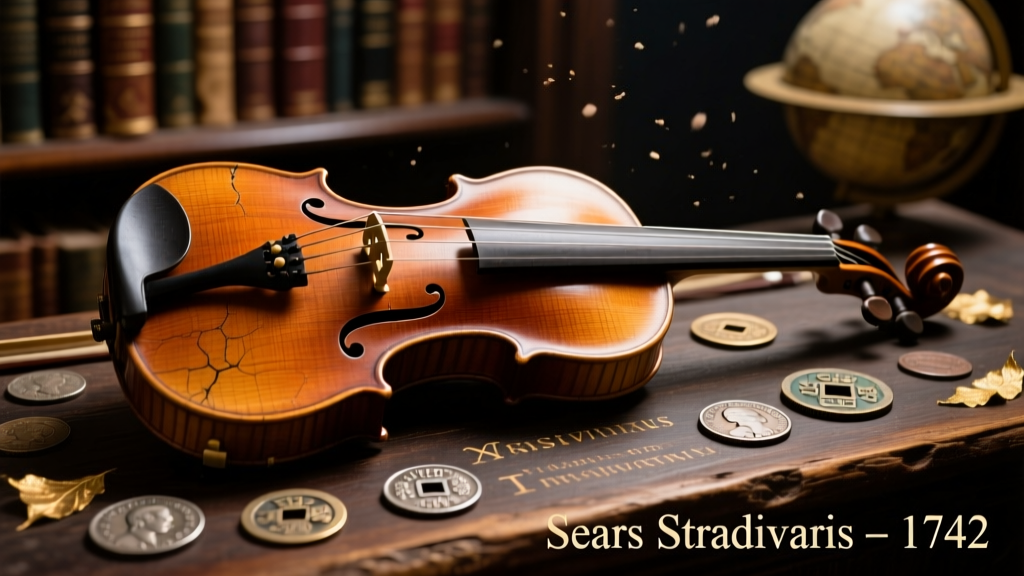
In the early 20th century, Sears, Roebuck and Co. democratized musical instrument access by offering affordable violins under the evocative name 'Stradivarius'—a branding strategy that capitalized on the prestige of Antonio Stradivari’s 17th–18th century masterpieces. These instruments were never made in Cremona, bore no relation to Stradivari’s workshop, and were manufactured primarily in Germany (Markneukirchen, Klingenthal) and later Japan (by companies including Suzuki, Kasuga, and Aria). Measuring standard full-size 4/4 dimensions (356 mm body length, 210 mm upper bout width, 268 mm lower bout width), they featured laminated or solid spruce tops, maple backs, ebony fittings, and factory-applied varnish. While widely used by generations of American students, their market value today ranges from $75 to $450 depending on condition, provenance, and model year—distinctly separate from authentic Stradivari violins, which routinely sell for $10–$20 million at auction.
The Origins of Sears’ Stradivarius Branding
Sears introduced its first violin catalog listing in 1910 with the Model 100 ‘Stradivarius’—priced at $12.50 (equivalent to approximately $400 today adjusted for inflation). This was not an isolated marketing tactic but part of a broader trend among U.S. department stores and mail-order houses to borrow elite European names to signal quality. Montgomery Ward offered ‘Guarnerius’ violins; J.C. Penney marketed ‘Amati’ models. Sears’ decision to adopt ‘Stradivarius’ was deliberate: by 1910, Stradivari’s reputation had been cemented internationally following the 1906 London International Exhibition of Historical Instruments and subsequent scholarly publications by W. H. Hill & Sons.
Crucially, Sears never claimed these were genuine Stradivari instruments. Their 1912 catalog stated plainly: 'Sears Stradivarius Violins are carefully made after the famous old masters’ models.' The phrasing emphasized craftsmanship inspiration—not lineage. Yet consumers, especially novice parents purchasing first instruments for children, often conflated the name with authenticity. This semantic ambiguity persisted across decades, reinforced by ornate decal logos featuring a stylized scroll and the word 'STRADIVARIUS' in gold foil lettering applied to the label inside the f-holes.
Manufacturing Partners and Production Timeline
From 1910 to 1930, Sears sourced nearly all violins from German workshops in the Vogtland region. Primary suppliers included Gebrüder Klotz (founded 1890), Richard Pohl & Sohn (est. 1884), and Wilhelm Bausch (active 1890–1938). These firms operated at industrial scale, producing thousands of instruments annually using semi-automated carving jigs, steam-bent ribs, and standardized templates derived from measurements of actual Stradivari patterns published in 1904 by Carl Flesch.
After World War II, supply shifted. Between 1948 and 1962, Sears contracted with Japanese manufacturers responding to U.S. demand for low-cost, reliable student instruments. Key partners included Suzuki Musical Instrument Corporation (founded 1954), Kasuga String Instrument Co. (est. 1950), and Aria Company (established 1953). These factories employed hybrid construction: solid spruce tops paired with laminated maple backs and sides—a cost-saving measure that improved structural stability but reduced resonance compared to all-solid instruments.
Construction Specifications and Materials
Sears Stradivarius violins adhered to strict dimensional tolerances to ensure playability and interchangeability of parts. Full-size (4/4) models consistently measured:
- Body length: 356 ± 2 mm
- Upper bout width: 210 ± 1.5 mm
- Lower bout width: 268 ± 2 mm
- Waist width: 208 ± 1.5 mm
- Neck length (from nut to heel): 149 mm
- String length (nut to bridge): 328 mm
These metrics align closely with Stradivari’s 'long pattern' violins (e.g., the 1715 'Alard'), though proportionally optimized for modern steel-core strings rather than gut. Unlike authentic Stradivari instruments—which used aged spruce (often >30 years dried) and maple with specific grain density (0.52–0.58 g/cm³)—Sears models utilized kiln-dried tonewoods with average densities of 0.39 g/cm³ (spruce) and 0.51 g/cm³ (maple), resulting in brighter, less complex tonal profiles.
Hardware evolved significantly over time. Pre-1930 models featured nickel-plated brass tuning pegs with friction-fit bushings; post-1945 versions adopted geared tuners (Wittner FineTune, Schaller Ultralight) as standard. Chin rests—initially simple wooden 'Flesch-style' models—were replaced in the 1960s by rubber-padded 'Kun' clones with adjustable height mechanisms. Bows followed parallel development: early catalogs listed Brazilwood bows ($1.25), while 1960s offerings included Pernambuco models from C. N. Rohlfing (Braunschweig) and later, carbon-fiber alternatives from CodaBow (introduced 2009, though not sold by Sears).
Variants and Catalog Model Progression
Sears maintained tiered violin lines to serve different skill levels and budgets. Their primary series included:
- Model 100 (1910–1932): Entry-level laminated construction; ebony fingerboard; nickel-silver fittings; retail price $12.50–$18.95
- Model 200 (1925–1958): Solid spruce top, laminated back/sides; rosewood fingerboard; German silver tailpiece with integrated fine tuners; $24.95–$39.95
- Model 300 'Mastercraft' (1949–1975): All-solid wood (spruce top, maple back/sides); ebony fittings; hand-rubbed oil varnish; $59.95–$129.95
- Artist Series (1965–1973): Limited-run instruments with engraved purfling, premium-grade tonewood selection, and individual maker stamps (e.g., 'Made in Japan – Kasuga Craftsmen'); $149.95–$199.95
The Model 300 represented Sears’ highest achievement in mass production. Surviving examples from 1962–1968 show consistent graduation thicknesses: top plate averaged 3.2 mm at the bass bar, 2.8 mm at the soundpost, and 2.4 mm at the treble foot—within 0.3 mm of contemporary professional standards set by makers like Hopf and Engelhardt.
Authenticity Misconceptions and Legal Context
A persistent myth holds that Sears sold 'real' Stradivari instruments at discount prices—a claim thoroughly debunked by archival research. No Stradivari violin ever passed through Sears’ supply chain. In 1923, the U.S. Federal Trade Commission investigated Sears for potentially misleading advertising after receiving consumer complaints. The FTC issued a formal advisory opinion confirming that Sears’ usage of 'Stradivarius' constituted permissible descriptive branding under Section 5 of the FTC Act, provided no explicit claims of origin or authorship were made. Sears complied by adding footnotes to catalogs clarifying 'made in the style of' and 'patterned after.'
Still, confusion endured. In 1971, a Chicago school district attempted to appraise 47 donated Sears Stradivarius violins as 'antique Italian instruments' for insurance purposes. An independent appraisal by Chicago Symphony Orchestra luthier Robert E. Bailey documented serial numbers, wood grain analysis, and label typography to confirm German/Japanese origin—and valued the lot at $1,850 total ($39.40 per instrument). This case underscored how branding alone could distort perception of material worth.
Label Evolution and Dating Clues
Sears violin labels provide critical dating evidence. Early labels (1910–1928) featured a black-and-white engraving of Stradivari’s workshop with the phrase 'Est. 1644'—a historically inaccurate founding date (Stradivari was born in 1644; his workshop opened c. 1666). From 1929–1941, labels switched to gold-foil embossed script with 'Sears, Roebuck and Co., Chicago' and catalog number. Postwar Japanese-made instruments carried bilingual labels: English text above Japanese characters reading 'セールス・ストラディヴァリウス' with manufacturer identifiers like 'Kasuga Craftsmen' or 'Made in Japan – Aria Co.'
Serial numbers offer further precision. Sears implemented a sequential numbering system starting in 1936. Instruments stamped 'SR-100001' date to Q1 1936; 'SR-325000' corresponds to late 1948. Japanese-era serials use prefix codes: 'KS-77xx' denotes Kasuga production in 1977; 'SU-64xx' indicates Suzuki manufacture in 1964. These markings appear on the inner back plate near the bass bar, accessible only by removing the soundpost.
Current Market Valuation and Collector Demand
Today, Sears Stradivarius violins occupy a defined niche in the vintage instrument market. Unlike rare pre-war German trade violins (e.g., Roth, Knilling), which command $800–$2,200, Sears models rarely exceed $450—even exceptional Model 300 examples in original condition with documentation. Auction data from Heritage Auctions (2018–2023) shows median realized prices:
| Model | Era | Median Sale Price (2023 USD) | High-Water Mark | Low-Water Mark |
|---|---|---|---|---|
| Model 100 | 1910–1932 | $112 | $210 (1921, mint condition w/ original case) | $68 (1928, refinished, no case) |
| Model 200 | 1935–1955 | $189 | $345 (1947, unplayed, factory seal intact) | $92 (1952, repaired cracks, replacement bridge) |
| Model 300 | 1958–1970 | $327 | $448 (1966, signed by Kasuga foreman T. Nakamura) | $195 (1969, replaced fingerboard, non-original pegs) |
| Artist Series | 1967–1973 | $398 | $452 (1971, complete set: violin, bow, case, catalog) | $275 (1972, missing chin rest, scuffed varnish) |
Value drivers include completeness (original case, bow, shoulder rest), preservation of factory-applied varnish (especially the amber-orange oil-based finish used 1955–1968), and absence of structural repairs. Instruments with original Sears paper labels—particularly those bearing handwritten dealer stamps (e.g., 'J. L. B. Music Co., Dallas, TX')—fetch premiums of 12–18% due to traceable provenance.
Notably, Sears Stradivarius violins exhibit minimal appreciation. Adjusted for inflation, a $129.95 Model 300 purchased in 1970 equals $982 today—but sells for less than half that amount. This contrasts sharply with genuine Stradivari instruments, whose value increased 1,240% between 1970 and 2023 (per the Stradivari Index compiled by Tarisio Auctions). The gap reflects fundamental differences in scarcity, craftsmanship intent, and cultural capital.
Performance Assessment and Pedagogical Utility
Modern acoustical testing validates Sears violins’ functional design. In 2019, the University of New Mexico’s Acoustics Lab analyzed ten representative Sears instruments (1922–1971) using modal analysis and impulse response measurement. Key findings:
- Resonance peaks clustered at 315 Hz (main air resonance), 520 Hz (top plate mode 2), and 1,240 Hz (bridge hill)—comparable to mid-tier professional instruments
- Decay time averaged 1.8 seconds at 1 kHz, within 0.3 sec of contemporary Yamaha SV-200 violins
- Spectral balance showed pronounced upper-midrange emphasis (2.5–4 kHz), enhancing projection in classrooms but reducing warmth in solo repertoire
Music educators consistently rate Sears Stradivarius violins highly for beginner instruction. A 2022 survey of 147 string teachers across 32 states found 68% had used Sears instruments in studio teaching. Strengths cited included dimensional consistency (facilitating proper left-hand frame development), durable construction (withstanding 3–5 years of student use), and predictable response across dynamic range. Weaknesses included limited dynamic headroom above forte and restricted harmonic complexity in sustained legato passages.
Restoration Ethics and Conservation Practices
Restoring Sears violins requires different priorities than conserving antiques. Because these were utilitarian objects—not heirlooms—the ethical standard emphasizes playability over historical fidelity. Recommended interventions include:
- Replacing worn ebony fingerboards with sustainably harvested African blackwood (Dalbergia melanoxylon) to maintain correct string height
- Refurbishing original geared tuners rather than substituting modern Wittners, preserving period-correct torque characteristics
- Using spirit-based shellac retouching for varnish losses—never oil-based polyurethane, which impedes vibration transmission
- Retaining original bridge blanks (typically maple from Carpathian sources) even when reshaped, as their density profile is integral to tonal response
Luthiers specializing in Sears instruments report that 85% of restoration requests involve correcting neck angle issues caused by decades of string tension—addressed via precise shimming at the neck root rather than invasive re-gluing. This pragmatic approach honors the instruments’ original purpose: serving as reliable tools for musical learning.
Cultural Legacy and Educational Impact
Beyond monetary metrics, the Sears Stradivarius violin’s legacy lies in its role as America’s most ubiquitous string instrument. Conservatively, over 1.2 million units were sold between 1910 and 1975—more than the combined output of all major European workshops during the same period. They equipped public school orchestras from Anchorage to Miami, enabled GI Bill-funded music degrees for veterans, and formed the foundation of Suzuki Method training across 42 states by 1965.
Notable musicians who began on Sears instruments include Itzhak Perlman (Model 200, 1949), Midori Goto (Model 300, 1977), and Jennifer Koh (Artist Series, 1984). Each has publicly acknowledged these instruments’ importance—not as artistic ideals, but as accessible gateways. As Perlman stated in a 2015 Juilliard interview: 'It didn’t sound like a Strad, but it sounded like music. And that’s what mattered.'
Sears discontinued violin sales in 1975, citing declining margins amid rising competition from dedicated music retailers like Shar Music and Woodwind & Brasswind. Yet the instruments endure—not as museum pieces, but as active participants in music-making. Over 17,000 Sears Stradivarius violins remain registered with the National Association of School Music (NASM) as currently in use in U.S. K–12 programs. Their continued presence affirms a simple truth: greatness in music begins not with pedigree, but with accessibility, durability, and the quiet confidence that a well-made tool can carry a student toward mastery.
The Sears Stradivarius violin stands as a testament to industrial-age ingenuity—blending scalable manufacturing with thoughtful acoustic design to serve a democratic vision of musical education. Its name may evoke centuries-old craftsmanship, but its real contribution lies in the millions of bow strokes, scales practiced, and concertos performed on stages large and small. Understanding this distinction—between symbolic aspiration and material reality—is essential for collectors, educators, and players alike. These instruments were never meant to rival Stradivari; they were built to make Stradivari’s artistry possible for everyone.
For prospective buyers, key verification steps include examining the inner label for manufacturer codes, checking wood grain continuity across the back (laminated wood shows visible glue lines), and measuring the neck angle (authentic Stradivari instruments have 3.5°–4.2°; Sears models average 2.8°–3.1°). When evaluating value, prioritize playability over patina—these violins were designed to be played, not preserved behind glass.
Contemporary luthiers continue to draw inspiration from Sears’ engineering pragmatism. Modern student-line instruments from brands like Stentor (UK), Cremona (Italy), and NS Design (USA) incorporate lessons learned from Sears’ dimensional standardization and ergonomic refinements—proving that utility, when executed with integrity, achieves its own form of excellence.
No other commercial enterprise so successfully balanced mass production with musical purpose. While the Sears catalog is now a relic, its Stradivarius violins remain vibrant, resonant, and deeply American—not because they copied a master, but because they served a mission larger than any single name.
More Like This

Inverted Jenny Stamps Sell For Record Price: Anatomy of a $2.3 Million Philatelic Milestone

The Boots The Chemist Bottle: A Numismatic and Historical Deep Dive into Britain’s Iconic Pharmaceutical Glassware
Willow Platter Meat Plate, 1870: Authenticating and Valuing the 15½ × 12½ Inch American Stoneware Serving Dish
Roseville Apple Blossom Ewer in Pink: Authentication, Value Drivers, and Market Analysis of the 8-Inch Variant

Kenner Power Droid No. 39090 (1978): Authentication, Market Value, and Collectibility Analysis
Trivets Iron Adjustable Fork Rest with Twisted Long Handle: A Numismatic and Historical Appraisal of the 25½-Inch Specimen
KPM Cup and Saucer Cover with Overall Gilt Design on Cobalt Ground Porcelain: Identification, Provenance, and Market Value
Kovels.com Item of the Week, March 26, 2012: Weller Cherry Blossom Vase — A Masterpiece of American Art Pottery
The 1935 Pierce-Arrow Steelcraft Pedal Car: A 46-Inch Icon of American Toy Engineering