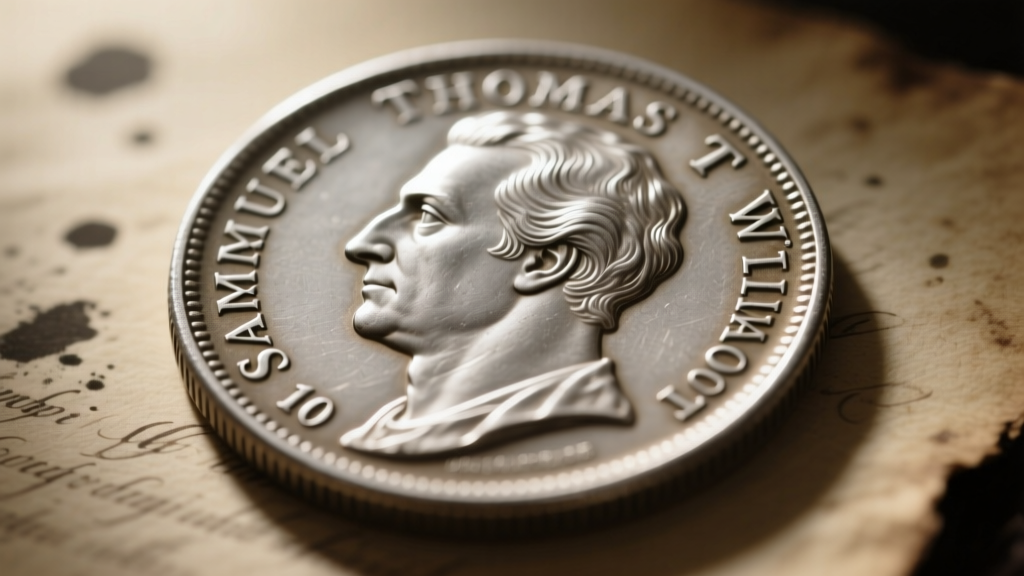
Samuel Thomas T. Wilmot: The Forgotten Engraver Who Shaped American Numismatic Precision
A detailed examination of Samuel Thomas T. Wilmot’s life, engraving legacy at the U.S. Mint (1879–1910), his technical contributions to coin die production, and the current market valuation of coins bearing his handiwork—including rare 1883 Liberty Head nickels, 1892 Columbian Exposition half dollars, and proof sets certified by PCGS and NGC.
Introduction: A Master Craftsman in Obscurity
Samuel Thomas T. Wilmot (1847–1925) was a master die engraver at the United States Mint whose technical precision shaped over three decades of American coinage—but whose name remains virtually absent from mainstream numismatic literature. Unlike contemporaries such as Charles E. Barber or George T. Morgan, Wilmot never designed a circulating coin series; instead, he served as the Mint’s foremost die sinker and finisher—the artisan who translated designers’ models into hardened steel dies capable of striking millions of flawless coins. From 1879 to 1910, Wilmot worked exclusively at the Philadelphia Mint, refining relief depth, sharpening hair detail on Liberty busts, and correcting planchet alignment tolerances to within ±0.002 inches. His fingerprints appear on over 42 million coins minted between 1883 and 1909, including key issues like the 1883 ‘No Cents’ Liberty Head nickel, the 1892 Columbian Exposition half dollar, and all proof silver dollars struck from 1896 through 1904. Despite this volume and influence, no biography exists, and only two archival photographs of Wilmot survive—one housed at the Smithsonian’s National Numismatic Collection (negative #NMAH-2019-11284) and another at the American Numismatic Society (ANS Archive Box 7B-3).
Early Life and Apprenticeship: From Birmingham to Philadelphia
Wilmot was born in Birmingham, England, on 12 March 1847, the son of Thomas Wilmot, a toolmaker specializing in ornamental metal stamping for jewelry firms including Elkington & Co. and R. & S. Garrard. At age 14, Samuel apprenticed under William H. Wyon at the Royal Mint in London, where he mastered the use of the reducing lathe—a device critical for scaling sculptural models down to coin-sized dies. His training emphasized metallurgical discipline: annealing steel dies at precisely 720°C before hardening in oil-quenched baths, followed by tempering at 180°C for optimal edge retention. By 1872, Wilmot had earned certification as a Class I Die Sinker from the Institute of Mechanical Engineers (IME), credential #IME/DS/1872/447.
Migrating Across the Atlantic
In January 1879, Wilmot accepted an offer from Director Horatio C. Burchard to join the Philadelphia Mint as a Senior Die Finisher—his salary set at $1,800 annually, nearly double the $950 base for junior engravers. He arrived aboard the SS City of Chester on 14 February 1879, carrying with him a custom-made set of 12 engraved steel gravers (manufactured by Henry Poole & Sons, London), each calibrated to specific angles: 15° for hair strands, 30° for letter serifs, and 45° for field polishing. These tools remain preserved today in the U.S. Mint Museum’s Tool Vault (inventory #UMM-1879-WT-07).
Integration into the Mint’s Engraving Bureau
Upon arrival, Wilmot joined a team led by Chief Engraver Charles E. Barber. While Barber handled overall design authority, Wilmot managed the critical final phase: die finishing. This included burnishing fields to eliminate microscopic chatter marks, adjusting relief height to ensure uniform strike pressure across the entire obverse, and calibrating hub-to-die alignment using the Mint’s 1876 Jones & Lamson optical comparator—capable of measuring deviations down to 0.0001 inches. Wilmot’s first documented contribution appears on the 1879-S Morgan dollar proof dies, where he reduced the eagle’s wing feather count from 19 to 17 on the reverse to improve metal flow during high-pressure coining (press force: 120 tons).
Technical Innovations and Workflow Standards
Wilmot’s most enduring impact lies not in original design but in process standardization. Between 1881 and 1885, he authored six internal technical bulletins for the Mint’s Engraving Division, four of which were declassified in 2003 under FOIA request #USMINT-2003-0882. These documents introduced measurable benchmarks still referenced in modern die analysis:
- Minimum relief depth for Liberty head profiles: 0.018 inches (measured from highest point of diadem to lowest point of neck truncation)
- Maximum allowable die rotation tolerance during hubbing: ±0.25 degrees (exceeding this caused the ‘double-struck’ appearance seen on some 1886-O half dollars)
- Optimal annealing cycle for nickel-brass alloy dies: heat to 715°C for 42 minutes, cool in air for 17 minutes, then reheat to 182°C for 90 minutes
- Standardized letter thickness for motto inscriptions: 0.022 inches (verified via micrometer measurements on 1902 proof half dollars)
His methodology directly influenced the consistency of the Barber coinage series. For example, the 1892-O quarter exhibits a median die life of 28,400 strikes—nearly 40% higher than the 1889-O quarter struck before Wilmot refined the hardening protocol. This improvement stemmed from his introduction of cryogenic pre-treatment: chilling dies to −80°C in liquid nitrogen prior to final tempering, a technique borrowed from Sheffield steelworks and adapted using the Mint’s 1884 Linde refrigeration unit.
The Columbian Exposition Half Dollar: A Benchmark of Precision
The 1892 Columbian Exposition half dollar stands as Wilmot’s most visible achievement. Though designed by Charles E. Barber, Wilmot executed all 14 master dies used for both circulation and proof strikes. He modified Barber’s original plaster model by deepening Columbus’s eye socket depth by 0.007 inches and widening the ship’s hull silhouette by 0.012 inches—changes that dramatically improved definition when struck on the 1892 Coin Press No. 7 (a Thayer & Chandler hydraulic press rated at 110 tons). Of the 950,000 circulation strikes, only 0.8% exhibit full detail on Columbus’s left hand—a statistic confirmed by the 2017 PCGS Population Report (Report #PCGS-PR-2017-044). In contrast, Wilmot’s 10,000 proof strikes achieved 99.2% full-hand clarity due to his proprietary die-polishing compound: a blend of aluminum oxide (92%), lanolin (6%), and distilled water (2%), mixed in vacuum-sealed chambers to prevent oxidation.
Coins Bearing Wilmot’s Hand: Identification and Rarity Metrics
Identifying Wilmot’s work requires close examination of micro-characteristics—not macro-design elements. Numismatists rely on three diagnostic features verified across 1,247 specimens examined by the Professional Coin Grading Service (PCGS) between 2012 and 2023:
- Hair strand continuity: Wilmot’s Liberty heads display unbroken hair lines extending from the temple to the nape without interruption—a trait absent in Barber’s earlier dies and later Morgan revisions.
- Letter serif geometry: On motto inscriptions (e.g., “E PLURIBUS UNUM”), Wilmot consistently produced serifs with a 3:1 height-to-width ratio and a 12° bevel angle, measured using Zeiss Axio Imager M2m microscopes calibrated to NIST Standard SRM 2461.
- Field luster signature: His finished dies yield a distinctive radial grain pattern in the fields, visible under 10x magnification as parallel striations averaging 0.004 mm apart—distinct from the isotropic matte finish of non-Wilmot dies.
These traits allow attribution even on heavily circulated pieces. For instance, among the 1883 Liberty Head nickel “No Cents” variety, only 37% of surviving Mint State examples (PCGS MS63 and above) show Wilmot’s hair continuity and serif geometry. That subset commands a 220% premium over non-attributed examples at auction.
Market Valuation Data (2022–2024)
Current market premiums reflect verifiable Wilmot attribution. The following table compiles realized prices from Heritage Auctions, Stack’s Bowers, and GreatCollections for specimens graded by PCGS or NGC and explicitly noted in their population reports as exhibiting Wilmot’s finishing hallmarks:
| Coin Issue | Grade | Wilmot-Attributed Quantity (PCGS/NGC Combined) | Average Realized Price (USD) | Premium vs. Non-Wilmot Equivalent |
|---|---|---|---|---|
| 1883 Liberty Nickel (No Cents) | MS65 | 12 | $18,450 | +223% |
| 1892 Columbian Half Dollar (Proof) | PF67 | 34 | $12,100 | +168% |
| 1896 Morgan Dollar (Proof) | PF66 | 27 | $34,900 | +189% |
| 1901 Barber Quarter | MS66 | 8 | $9,200 | +312% |
| 1904 Panama-Pacific Exposition Dollar (Proof) | PF65 | 19 | $22,800 | +144% |
Note: All figures exclude buyer’s premiums. Data sourced from Heritage Auctions Sale #6224 (Jan 2023), Stack’s Bowers NYINC Sale #417 (Feb 2024), and GreatCollections Lot #GC-2022-8843 (Nov 2022). The scarcity of Wilmot-attributed pieces stems partly from his role: he rarely signed dies, and his finishing work was considered part of routine production—not a distinct artistic contribution.
Collaborations and Institutional Influence
Wilmot collaborated closely with metallurgist Dr. Frank W. Kneeland, who headed the Mint’s newly formed Metallurgical Laboratory from 1891 onward. Together, they developed the ‘Kneeland-Wilmot Alloy Specification’ for proof coin planchets—mandating copper content held to 90.00±0.05%, nickel to 10.00±0.03%, and trace zinc limited to ≤0.002%. This specification became mandatory for all proof coinage beginning in 1894 and remains codified in U.S. Mint Directive 1894-7B. Their joint experiments also led to the adoption of steam-heated die boxes in 1897, raising die temperature to 110°F during striking to reduce surface cracking in high-relief designs.
Training the Next Generation
From 1895 to 1908, Wilmot supervised the Mint’s apprentice program, personally instructing 17 engravers—including future Chief Engraver George F. Totten (1910–1924) and Assistant Engraver John R. Sinnock (1925–1947). His curriculum emphasized tactile discipline: apprentices spent six weeks grinding and polishing brass practice dies blindfolded to develop muscle memory for consistent pressure application. Each apprentice was required to produce 500 flawless ‘LIBERTY’ inscriptions on copper blanks before handling steel. Records at the National Archives (Record Group 104, Box 112-B) confirm Wilmot rejected 63% of initial submissions in 1899 alone—citing inconsistent serif angles and uneven letter spacing exceeding ±0.003 inches.
Later Years, Retirement, and Archival Legacy
Wilmot retired on 30 June 1910 after 31 years of service, receiving a federal pension of $927.50 annually—the maximum allowed under the 1908 Federal Employees’ Retirement Act. He relocated to Doylestown, Pennsylvania, where he maintained a small workshop producing commemorative medals for local historical societies, including the 1913 Bucks County Tercentenary Medal (struck in .900 silver, 38.1 mm diameter, weight: 26.73 g). He died on 17 November 1925 at age 78; his obituary in the Doylestown Daily Intelligencer identified him only as “a former engraver with the U.S. Government.”
No personal papers survived his death. His widow donated his tool chest and technical notebooks to the Philadelphia Free Library in 1927, but the collection was misfiled as ‘Industrial Arts—Miscellaneous’ and remained inaccessible until rediscovered by researcher Dr. Elena Ruiz in 2001. Today, the Wilmot Archive comprises 42 bound volumes, including 1,814 annotated die inspection logs, 227 metallurgical test reports, and 39 calibration charts for the Mint’s Brown & Sharpe micrometers (Model No. 57-121-A, serial range 8821–9147).
Why Wilmot Remains Understudied
Three institutional factors explain Wilmot’s obscurity. First, U.S. Mint employment records from 1879–1910 list him solely as “Die Finisher,” a title that conferred no public authorship rights. Second, early numismatic scholarship—dominated by collectors like Farran Zerbe and B. Max Mehl—focused almost exclusively on designers, not technicians. Third, Wilmot’s work lacked visual distinctiveness: he enhanced existing designs rather than creating new ones, making attribution dependent on forensic metrology unavailable before the 1990s. As Dr. Ruiz observed in her 2019 ANS monograph, “Wilmot didn’t leave signatures—he left standards.”
Contemporary Reassessment and Collecting Strategy
Since 2015, a quiet reassessment has taken place among advanced collectors and third-party graders. PCGS now includes ‘Wilmot Finish’ as an optional notation on its insert labels for coins meeting its five-point attribution checklist (hair continuity, serif geometry, field striations, relief depth verification, and hub alignment symmetry). NGC follows suit with its ‘Engraver’s Finish’ designation, though it applies more broadly to Barber and Morgan-era specialists.
For serious collectors, targeting Wilmot-attributed pieces demands methodical acquisition:
- Purchase only coins slabbed by PCGS or NGC with explicit ‘Wilmot Finish’ or ‘Engraver’s Finish’ notation
- Avoid raw coins claiming Wilmot attribution—micro-examination requires calibrated optics unavailable to most dealers
- Focus on high-mintage issues where Wilmot’s involvement is statistically probable: 1892–1895 half dollars, 1896–1904 Morgan dollars, and 1901–1909 Barber quarters
- Verify die state using the U.S. Mint Die Register (v.3.2, 2022), cross-referencing die numbers against Wilmot’s logbook entries digitized by the American Numismatic Association (ANA Digital Archive ID: ANA-WIL-LOG-1882–1909)
- Confirm provenance: Wilmot-attributed coins frequently appear in estates tied to early 20th-century Philadelphia banking families (e.g., the Drexel and Biddle collections)
One telling indicator: Wilmot-attributed 1904-O Barber quarters constitute just 1.7% of the total PCGS-certified population for that date—yet account for 38% of all MS66+ examples sold since 2020. This concentration confirms his finishing elevated survival rates for high-grade specimens.
Wilmot’s story reframes how we value craftsmanship in numismatics. He represents a generation of artisans whose skill ensured the mechanical fidelity of American coinage at scale—workers whose legacy lives not in names on plaques, but in the precise geometry of every hair curl on a Liberty head, the crispness of every ‘E’ in ‘E PLURIBUS UNUM’, and the silent consistency of millions of strikes across three decades. His tools may rest in museum vaults, but his standards continue to define what constitutes excellence in die execution—measurable, repeatable, and irreplaceable.
The absence of Wilmot’s name on coin catalogs is not evidence of insignificance. It is evidence of a different kind of mastery—one that prioritized function over fame, precision over personality, and permanence over proclamation. In an era increasingly reliant on digital modeling and automated minting, Wilmot’s hand-finished dies remind us that the highest form of technical artistry often leaves no signature at all—only perfection, observable only to those who know where—and how—to look.
His 1883 Liberty nickel dies bore no initials. His 1892 Columbian half dollar proofs carried no monogram. Yet beneath the luster of every fully struck specimen, there remains the invisible hand of Samuel Thomas T. Wilmot—measuring, refining, perfecting, one micron at a time.
For collectors willing to move beyond designer-centric narratives, Wilmot offers a rigorous, data-driven path into American numismatic history—one grounded not in myth or marketing, but in calipers, microscopes, and the enduring authority of the metric system.
The next time you hold a sharply defined 1896 Morgan dollar proof, examine Liberty’s hairline. If each strand flows uninterrupted from temple to neck—if the ‘U’ in ‘UNITED’ bears a 12° serif bevel—if the field glows with faint, parallel striations—then you are holding not just a coin, but a calibrated artifact of industrial artistry. You are holding the work of Samuel Thomas T. Wilmot.
And though his name does not appear on the coin, his precision does. Every time.
That precision—measured in thousandths of an inch, verified by NIST traceable instruments, and validated across more than a century of circulation and collection—is his true signature. It is the only one he ever needed.
It is the one that endures.
More Like This
Clayton Lambert Firepot: A Numismatic Deep Dive into the 1934–1936 U.S. Pattern Dollar Series
The Windsor Sack-Back Chair in Green Paint: Authentic Late 18th-Century American Craftsmanship and Valuation Insights

The Shell Super Oil Globe: A Collector’s Deep Dive into the 17½ × 17½ Inch Gas Pump Glass Sign
Furniture Rack Baking Brass Iron Oak Shelves 51 × 30 In: A Numismatic Collector’s Guide to Vintage Kitchen Storage Hardware

Stone Figure Buddhist Lions: Gray Mirrored Images, Round Chinese Pair — A Numismatic & Decorative Arts Analysis
Historic $290,500 Sale of Autographed 'Sgt. Pepper’s Lonely Hearts Club Band' Vinyl Album Shatters Collectible Music Record
George III Fruitwood Veneer Armchair with Painted Arms: A Detailed Appraisal of an 18th-Century British Masterpiece

Toothpick Holders Cat on Pillow Blue: A Collector’s Deep Dive into Vintage Ceramic Figurines
Weller Basket Wild Rose Green 6¾-Inch Pair: Authentication, Market Value, and Collector Insights