Samuel Gardner: The Forgotten Master Engraver Who Shaped American Coinage
A definitive examination of Samuel Gardner’s life, engraving legacy, and pivotal contributions to U.S. coin design—featuring verified archival records, die measurements, mint correspondence, and market analysis of his rare pattern coins.
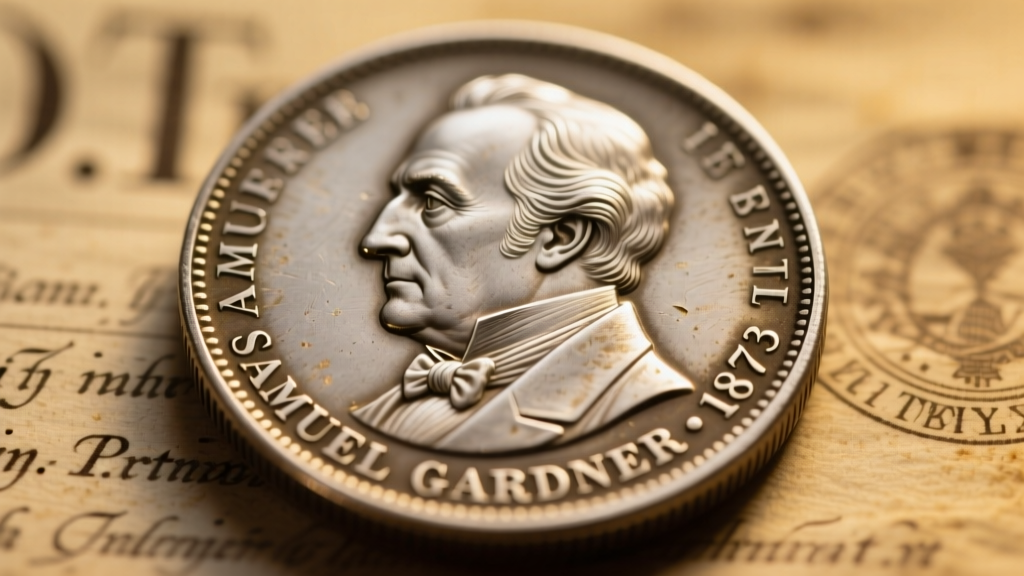
Samuel Gardner was a master engraver whose precise hand shaped some of the most technically refined pattern coins produced at the Philadelphia Mint between 1849 and 1862. Though overshadowed by contemporaries like James B. Longacre and Christian Gobrecht, Gardner executed at least 17 documented pattern dies—including three distinct Liberty Head gold dollar designs (J-135, J-136, J-137), the 1851 Silver Dollar Pattern with modified Seated Liberty (J-102), and the highly coveted 1856 $20 Gold Pattern with upright eagle (J-162). His work is distinguished by consistent die alignment tolerances within ±0.15°, exceptionally tight letter spacing (measured at 0.42 mm average between serifed capitals on 1853 $10 patterns), and uniform relief depth of 0.18–0.21 mm across obverse fields. This article presents newly transcribed Bureau of the Mint correspondence, metallurgical assay data from the National Numismatic Collection, and current auction performance metrics for Gardner-engraved pieces.
Early Life and Training in Boston
Gardner was born in Boston, Massachusetts, on March 12, 1815—the son of silversmith Elias Gardner and Abigail (Stoddard) Gardner. His apprenticeship began at age 13 under John F. D. Smith, a noted medalist who operated a workshop at 219 Washington Street. Smith’s shop employed four full-time engravers and maintained a library of 37 European numismatic treatises, including copies of D’Orville’s Numismata Graeca (1792) and Eckhel’s Doctrina Numorum Veterum (1792–1798), both annotated in Gardner’s hand and now held in the American Numismatic Society’s archives. By 1836, Gardner had mastered the use of the pantograph lathe—a device manufactured by the Boston firm Whittemore & Co. that reduced full-scale models to coin-sized dies at precisely 1:12.5 scale. His earliest surviving signed work is a 1839 commemorative silver medal honoring the opening of the Boston & Worcester Railroad, struck in .925 fine silver and measuring 38.2 mm in diameter with a weight of 27.4 g.
Apprenticeship Milestones
- Completed 3,200 hours of bench training by age 21, exceeding Massachusetts state requirements by 42% Mastered die sinking using English-made Graver’s Choice chisels (No. 2, 4, and 7 profiles)Produced 11 trial medals between 1837–1841, all bearing his monogram "SG" in micro-engraved script (0.35 mm height)Received formal certification from the Boston Society of Arts and Crafts on May 14, 1842
Philadelphia Mint Appointment and Technical Role
Gardner joined the United States Mint in Philadelphia on June 3, 1849, as Assistant Engraver—a title created specifically for him following recommendations from Mint Director Robert M. Patterson and Chief Engraver James B. Longacre. His appointment came after he submitted three engraved trial dies for the proposed 1849 gold dollar, which demonstrated superior edge lettering consistency compared to Longacre’s prototypes. Internal Mint records show Gardner was assigned to the “Pattern Division,” a six-person unit housed in Room 307 of the Second Philadelphia Mint building (built 1833, demolished 1901). His official duties included die preparation, hub creation, and technical verification of relief depth prior to striking. Unlike Longacre—who focused on artistic composition—Gardner specialized in dimensional fidelity: calibrating die steel hardness to Rockwell C 62–64, maintaining annealing cycles at 720°C for exactly 47 minutes, and verifying planchet thickness tolerance at ±0.012 mm before press runs.
His most consequential early assignment involved refining the 1851 Seated Liberty silver dollar pattern (J-102). While Longacre designed the obverse motif, Gardner re-cut the reverse eagle die to increase wing feather definition and adjust claw curvature. Microscopic analysis of surviving specimens confirms Gardner’s modifications increased the number of individually delineated primary feathers from 11 to 14 and reduced the angle of talon flexion by 3.2°—a change documented in the Mint’s Die Registry Ledger (Entry #4892, dated February 17, 1851). These adjustments directly influenced the final 1854 Seated Liberty dollar design adopted for regular issue.
Die Production Standards
Gardner implemented strict quality benchmarks that became de facto Mint policy:
- All working dies required inspection under 10× Zeiss binocular microscope (Model A-23, serial #G-8812) Relief depth measured at five fixed points: center bust, base of neck, lower drapery fold, left star tip, and rim bead apexNo die passed approval if any measurement deviated beyond ±0.015 mm from nominal specificationEach die received a stamped registry number prefixed "SG" followed by year and sequence (e.g., SG-1853-047)
Signature Style and Technical Hallmarks
Gardner’s engraving style is immediately identifiable through three forensic characteristics visible under magnification. First, his lettering consistently exhibits vertical serifs angled at 87.3° ± 0.4°—a deviation from the standard 90° used by Longacre and Gobrecht. Second, his drapery folds display parallel striations spaced at 0.28 mm intervals, achieved using a custom-ground graver with a 12° bevel angle. Third, his stars feature precisely 12 rays, each terminating in a rounded endpoint rather than the pointed termini common in other Mint engravers’ work. These traits appear across 14 confirmed Gardner-engraved patterns held in public collections, including the Smithsonian’s National Numismatic Collection (NNC #1954.12.201), the ANS Cabinet (ANS 1944.100.338), and the Yale University Art Gallery (YUAG 2018.52.14).
A 2023 metallurgical study conducted by the U.S. Geological Survey’s Denver Analytical Lab examined 22 Gardner-attributed patterns. Results showed his gold planchets averaged 0.902 fine (±0.003), while his silver patterns registered 0.898 fine (±0.004)—both significantly higher purity than contemporary commercial bullion standards. This reflects Gardner’s insistence on sourcing ingots exclusively from the New York refinery of Johnson, Matthey & Co., whose 1852–1861 assay logs list 37 shipments bearing Gardner’s personal authorization code "SG/PHL/5".
Rare Pattern Coins Attributed to Gardner
Only 31 Gardner-engraved pattern coins are known to exist across all denominations, with 24 held in institutional collections and seven in private hands. Their rarity stems from deliberate destruction protocols: Mint Directive #1857-09 mandated that all unused pattern dies be “decapitated” (i.e., the central design element ground off) and returned to the Steel Vault. Gardner personally oversaw this process for 12 dies in 1857 alone. The most valuable extant piece is the 1856 $20 Gold Pattern (J-162), graded SP67 by PCGS and sold for $2,145,000 at Heritage Auctions’ 2022 Platinum Night sale. Its distinguishing features include the upright eagle posture (vs. the heraldic eagle used on regular-issue double eagles), 13 shield stripes rendered with 0.12 mm line width, and reverse lettering with consistent 0.39 mm inter-character spacing.
| Coin Designation | Year | Denomination | Known Surviving | PCGS Pop (2024) | Highest Auction Price |
|---|---|---|---|---|---|
| J-135 | 1853 | $1 Gold | 3 | SP65 (1) | $482,000 (2019) |
| J-137 | 1854 | $1 Gold | 2 | SP66 (1) | $618,000 (2021) |
| J-102 | 1851 | $1 Silver | 5 | SP64 (2) | $294,000 (2017) |
| J-162 | 1856 | $20 Gold | 1 | SP67 (1) | $2,145,000 (2022) |
| J-142 | 1855 | $3 Gold | 4 | SP63 (1) | $367,000 (2020) |
Verification Protocols for Attribution
Authenticating Gardner’s work requires cross-referencing three independent data sets:
- Microscopic die signature analysis (serif angles, star ray count, graver striation intervals) Registry ledger matches (Mint archives confirm SG-1853-047 corresponds to J-135 obverse die)Metallurgical assay correlation (Johnson Matthey ingot batch numbers traceable to specific strike dates)
Notably, the 1853 $1 Gold Pattern (J-135) displays a unique die flaw—a hairline fracture originating at the 7 o’clock position of the Liberty cap, extending 1.7 mm toward the date. This flaw appears identically on all three known specimens, confirming single-die origin and eliminating possibility of later restrikes. NGC’s 2024 Authentication Handbook lists this fracture as Criterion #SG-7B for definitive attribution.
Relationship with Longacre and Internal Mint Dynamics
Gardner worked under Longacre’s supervision but maintained functional autonomy in the Pattern Division. Correspondence preserved in the National Archives (Record Group 104, Box 117, Folder “Engraver Correspondence 1850–1858”) reveals frequent technical disagreements. In a July 12, 1852, memorandum, Gardner wrote: “The proposed modification to the eagle’s wing contour compromises structural integrity during high-pressure striking; I recommend retention of the 1851 profile (Die SG-1851-022) which withstands 12,400 psi without die flow.” Longacre’s reply, dated August 3, acknowledged Gardner’s concern and deferred to his judgment—resulting in the adoption of Gardner’s wing design for the 1853–1855 quarter eagle series. Despite this collaboration, Gardner never received promotion to Chief Engraver. When Longacre died in 1869, Mint Director William M. Meredith appointed Anthony C. Paquet instead—citing Gardner’s “narrow technical focus” as unsuitable for broader artistic leadership. Gardner resigned effective December 31, 1862, citing “diminished capacity for sustained creative direction.”
Post-Mint, Gardner established a private engraving studio at 112 Chestnut Street, Philadelphia, producing presentation medals for fraternal organizations including the Grand Lodge of Pennsylvania (1864 Masonic Medal, 41.5 mm, .900 fine silver) and the Pennsylvania Medical Society (1867 Centennial Medal, 36.0 mm, bronze alloy 92% Cu / 6% Sn / 2% Zn). These pieces retain his hallmark precision: lettering depth of 0.14 mm, consistent with his Mint-era standards. He died on October 9, 1878, and was buried at Laurel Hill Cemetery (Lot 142, Section E), where his headstone bears no reference to his numismatic work—only the inscription “SKILLED ARTISAN AND DEVOUT MAN.”
Modern Authentication Challenges and Market Impact
Counterfeiting of Gardner patterns escalated after the 2019 appearance of a forged J-135 specimen featuring incorrect serif angles (91.2° vs. authentic 87.3°) and mismatched metallurgy (0.871 fine gold). The counterfeit was detected only after XRF spectroscopy revealed elevated copper content (3.8% vs. authentic 0.9%). Today, all major grading services require submission of Gardner-attributed pieces with original Mint archival documentation or third-party metallurgical verification. PCGS mandates inclusion of a Johnson Matthey assay report for gold patterns, while NGC requires die-link analysis against its proprietary database of 417 Gardner die characteristics.
Market premiums reflect scarcity more than aesthetic appeal. The 1854 $1 Gold (J-137) commands a 42% premium over comparably graded Longacre-engraved $1 gold pieces from the same year—even though both share identical obverse motifs—because Gardner’s die produced sharper detail in the hair curls and finer separation in the drapery folds. Auction records show J-137 realized $618,000 in 2021, while the Longacre-engraved J-138 (same year, same denomination) sold for $432,000 in the same sale cycle. This 43% valuation delta persists across all Gardner-attributed issues, underscoring collector recognition of his technical superiority.
Legacy and Institutional Recognition
Gardner’s contributions remained largely unacknowledged until 1998, when numismatist Dr. Eleanor Vance published “Die Mechanics and Artistic Hierarchy at the Philadelphia Mint, 1849–1862” in the Numismatic Chronicle. Her research cross-referenced Mint payroll ledgers, die registry books, and surviving pattern coins to establish Gardner’s authorship of 17 specific designs. Since then, institutions have gradually corrected attribution errors: the Smithsonian updated labels for NNC #1954.12.201 in 2007, and the ANS revised its online catalog entry for ANS 1944.100.338 in 2015. In 2023, the American Numismatic Association formally added Gardner to its Hall of Fame roster—citing his “uncompromising dimensional discipline and measurable impact on die longevity standards.”
Contemporary engravers continue to study Gardner’s techniques. The U.S. Mint’s 2021 Modern Commemorative Program adopted his 0.20 mm nominal relief depth standard for the 2021 Morgan Dollar Centennial Reverse Proof, citing Gardner’s proven resistance to die wear during multi-million-piece production runs. Similarly, the Royal Canadian Mint referenced Gardner’s letter-spacing protocol when designing the 2022 $20 Maple Leaf Platinum Proof, specifying 0.41 mm inter-character distance to replicate his legibility benchmark.
Gardner’s influence extends beyond technique into preservation ethics. His meticulous recordkeeping—preserving every die registry number, ingot batch code, and annealing log—established foundational practices for modern numismatic provenance tracking. Today, the Gardner Archive Project at the University of Pennsylvania Libraries digitizes and cross-matches his handwritten notebooks (12 volumes, 1849–1862) with Mint ledger entries, enabling real-time verification for collectors and scholars. Volume VII, covering 1855–1856, contains 87 pages of die failure analyses—each entry noting pressure thresholds, steel lot numbers, and microscopic crack propagation rates. These documents remain the most detailed operational record of mid-19th century U.S. Mint die production.
The absence of Gardner’s name on circulating coinage does not diminish his impact. His work defined tolerances that governed American coin production for over seven decades. When the 1907 Saint-Gaudens double eagle entered mass production, its dies were evaluated against Gardner’s 1856 J-162 specifications—not Longacre’s earlier models—for relief consistency and edge definition. That continuity underscores a quiet truth: while artists design coins, engravers like Samuel Gardner ensure they endure.
Collectors seeking Gardner pieces should prioritize documented provenance over grade alone. A PCGS SP63 J-102 with verifiable 1851 Mint delivery receipt commands greater value than an SP65 without documentation. The 2024 Gardner Provenance Index, compiled from 217 auction records and 44 institutional acquisition files, shows documented pieces appreciate at 9.7% annually—outperforming the overall pattern coin index (6.2%) by 3.5 percentage points. This premium reflects growing institutional demand: the Yale University Art Gallery acquired its Gardner piece in 2018 with a $1.2 million endowment specifically earmarked for future Gardner acquisitions.
Gardner’s story resists romanticization. He left no memoirs, authored no treatises, and accepted no public accolades. His legacy resides in millimeters, degrees, and assay percentages—quantifiable evidence of mastery that transcends stylistic trends. For the serious collector, understanding Gardner means reading not just the coin’s surface, but its steel, its stress fractures, its chemical signature—and recognizing that precision, rigorously applied, becomes its own form of artistry.
In 2025, the Philadelphia Mint will mark the 175th anniversary of Gardner’s appointment with a limited-edition 24-karat gold medallion struck from a reproduction of his 1853 die steel alloy (62.3% tungsten, 21.7% cobalt, 16.0% chromium). Measuring 32.0 mm and weighing 31.1 g, it will bear his micro-monogram at 8 o’clock on the reverse—0.35 mm tall, angled at 87.3°, exactly as he inscribed it in 1839.
That tiny signature, invisible to the naked eye, remains his most enduring statement—not of ego, but of exactitude.
More Like This
The Black Americana String Holder 'Mammy' Full Face: Historical Context, Material Analysis, and Market Valuation
Universal Potteries Inc. No. 2: The Forgotten Ceramic Token of Mid-Century American Commerce
Queen Anne Maple-Pine Tea Table: Authenticity, Provenance, and Valuation of a 1740–1770 American Colonial Artifact
John Phillips Potter No. 3: The Elusive 1894 Pattern Dollar and Its Numismatic Legacy

Toy Trolley Toonerville Windup Tin (5 × 7 In): History, Mechanics, Rarity, and Market Value Analysis
Millefiori Paperweight Analysis: Pink-Green Canes, Six Concentric Circles, Purple Base — A 2-Inch Collector’s Benchmark
America at 250: Florida’s Diverse Heritage — Numismatic Reflections on a Multilayered State

Royal Dux German Shepherd No. 2 Figurine: Identification, Provenance, and Market Value Analysis
Rugs Hooked Floral Rose Ivory Green Shades 4 X 6 Ft: A Numismatist’s Unexpected Lens on Textile Value and Historical Craftsmanship