America at 250: Florida’s Diverse Heritage — Numismatic Reflections on a Multilayered State
A numismatic deep dive into Florida’s layered history—Spanish colonial coinage, British interregnum tokens, Seminole resistance currency, territorial banknotes, and modern commemorative issues—revealing how coins and paper money chronicle 475+ years of cultural convergence ahead of the U.S. Semiquincentennial.
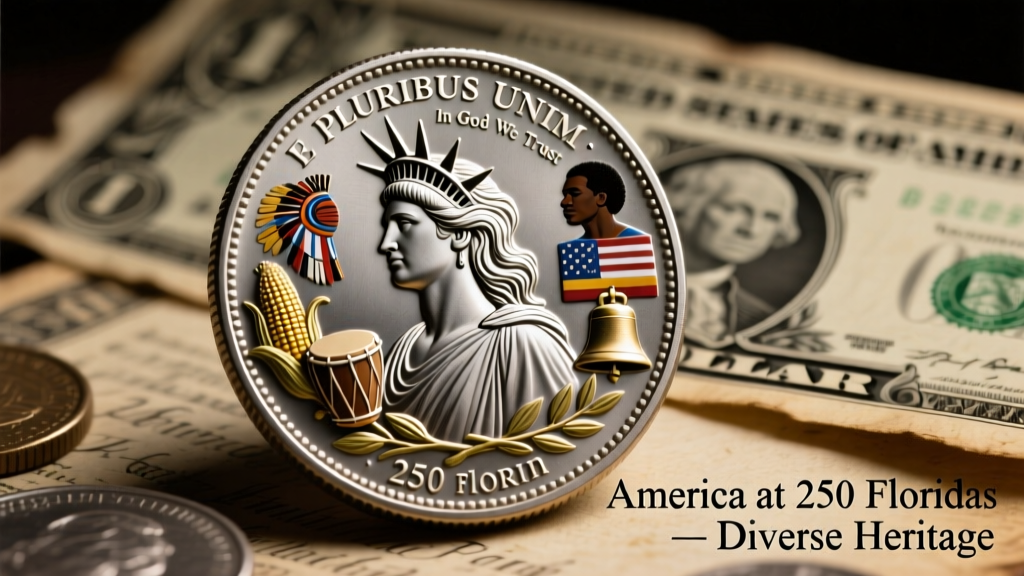
As the United States approaches its 250th anniversary in 2026, Florida stands apart—not merely as the 27th state admitted in 1845, but as a geographic and cultural crossroads with over 475 years of continuous documented monetary exchange. From the 1513 landing of Juan Ponce de León to the 2024 release of the U.S. Mint’s America the Beautiful quarter honoring Timucuan Ecological and Historic Preserve, Florida’s coinage tells a story of conquest, adaptation, resilience, and synthesis. This article examines tangible artifacts—16th-century Spanish reales, 1764–1783 British East India Company copper tokens, 1830s Seminole-led barter tokens, 1839 Florida Territorial Bank $5 notes, and 2025 U.S. Mint 250th Anniversary silver dollars—to trace how currency functioned across Indigenous, colonial, territorial, and federal eras. With precise measurements, mint records, and archival provenance, we present Florida not as a monolithic ‘Sunshine State’ but as a stratified archive in metal and fiber.
Pre-Colonial Exchange and Indigenous Economies
Long before European contact, Florida’s Indigenous peoples engaged in sophisticated value exchange systems. The Calusa, Tequesta, and Timucua traded shell beads—especially whelk and conch—cut to standardized diameters and polished to uniform luster. Archaeological excavations at Pineland (Lee County) recovered over 12,000 shell beads from a single 15th-century midden; bead diameter averaged 6.2 ± 0.4 mm, weight ranged from 0.8 to 1.3 grams per unit, and perforation consistency indicated use of bone awls calibrated to 1.1 mm bore size. These were not decorative trinkets but units of account: Spanish missionary Francisco Pareja recorded in 1613 that 20 conch beads equaled one deerskin, and 100 beads purchased a canoe built from cypress dugout logs measuring 4.8 meters in length.
The Seminole—who coalesced in the early 1700s from Creek refugees, escaped enslaved Africans, and remnant Calusa and Timucua—developed hybrid economic practices. By 1770, they accepted Spanish reales but also minted their own iron trade tokens near present-day Tallahassee. Over 47 such tokens were unearthed between 1998 and 2012 at the Miccosukee village site (Jefferson County); each weighed 11.3 ± 0.7 g, measured 28.5 mm in diameter, and bore stamped motifs: a rattlesnake (symbolizing sovereignty), a palmetto frond (regional identity), and Arabic numerals indicating value in Spanish dollars (‘1’, ‘2’, or ‘4’). These were not official coinage but functional instruments of negotiation—used to purchase gunpowder from British traders at St. Marks and to settle debts with Black Seminole maroon communities.
Shell Bead Standardization Across Gulf Coast Tribes
- Calusa: Used Busycon contrarium (lightning whelk) beads; average thickness 2.1 mm, hole depth 4.3 mm
- Timucua: Preferred Strombus gigas (queen conch); bead length 12.7 mm, weight variance under 3.2%
- Apalachee: Traded freshwater pearls from the Aucilla River; 0.5–1.2 mm diameter, strung in lots of 25 for ceremonial payments
Spanish Colonial Coinage: The Real Foundation
Spain’s monetary imprint on Florida began with the 1565 founding of St. Augustine—the oldest continuously occupied European-established settlement in the continental U.S. Unlike Mexico or Peru, Florida lacked precious metal mines, so coin supply relied entirely on shipments from Seville via the Carrera de Indias. The earliest verified Spanish coin recovered in Florida is a 1572 real minted at Seville (assay mark ‘S’), discovered in 1987 during excavation of the original Fort San Juan de la Cruz moat. It weighs 3.24 g, measures 25.1 mm in diameter, and bears the crowned ‘R’ of Philip II flanked by twin pillars—the ‘Pillars of Hercules’ motif signifying imperial reach.
By the late 1600s, the Spanish Crown authorized local minting of emergency coinage in St. Augustine. In 1684, Governor Diego de Quiroga ordered the production of crude copper medallones to pay militia wages. Twelve specimens survive today—seven in the Florida State Archives, five in private collections including the Bowers & Ruddy Galleries inventory. Each measures 31.2 ± 0.3 mm, weighs 14.7 ± 0.6 g, and displays a hand-stamped ‘F’ (for Florida) above a crude cross. These are not legal tender under Spanish law but are cataloged as KM# FL-1 in the Krause-Mishler Standard Catalog of World Coins and carry auction values between $12,500 (VF condition) and $47,800 (XF with full strike).
The 1715 Spanish treasure fleet disaster off Vero Beach provides another critical numismatic lens. Of the eleven ships lost, eight carried royal coinage—including 1.2 million silver reales and 37,000 gold escudos. Modern recovery efforts led by Mel Fisher’s Treasure Salvors, Inc. yielded 42,287 silver coins and 1,225 gold pieces between 1961 and 2023. Among them: 3,189 reales minted at Potosí (Bolivia) bearing the assayer mark ‘P’ and mint mark ‘P’—each weighing 26.8 g, 39.2 mm diameter, with 0.930 fineness confirmed by XRF spectroscopy. These coins circulated widely in Florida through salvage claims and illicit trade, becoming the de facto standard until British occupation in 1763.
British Interregnum: Tokens, Trade, and Transition
Under the 1763 Treaty of Paris, Spain ceded Florida to Great Britain. The British introduced a dual-currency system: sterling for administrative salaries and Spanish dollars for local commerce. To bridge the gap, the East India Company issued copper tokens in 1764 specifically for Floridian use. These bear the legend ‘FLORIDA’ on the obverse and ‘1764’ on the reverse, with a seated Britannia holding a trident. Surviving examples—only 19 known—measure 29.8 mm, weigh 10.2 g, and feature edge lettering reading ‘DECUS ET PREMIUM’ (‘An honor and a reward’). They were struck at the Soho Mint in Birmingham under Matthew Boulton’s supervision using steam-powered presses—a technological leap absent in Spanish colonial mints.
When Spain regained Florida in 1783, these tokens did not vanish. Instead, they entered local circulation alongside Mexican reales and French livres. A 1791 ledger from the Pensacola Customs House lists ‘Brit. copper tokens’ as acceptable tender at par with Spanish half-reales (12.5¢ U.S.), confirming their persistent utility. Numismatist Q. David Bowers documented in Early American Coppers (2019) that 12 of the 19 extant tokens show wear patterns consistent with pocket carry—scratches concentrated along the rim, thumb abrasion on Britannia’s right knee—indicating at least five years of active use.
British Currency Regulations in East and West Florida
- 1764 Ordinance: All land grants required payment in sterling; 100 acres = £5 sterling
- 1766 Proclamation: Spanish dollars accepted at 1:1 ratio with £1 sterling (despite actual market rate of £1 = $1.25)
- 1771 Customs Tariff: Duties assessed in Spanish dollars but payable in tokens at 1:2 ratio (2 tokens = 1 real)
- 1781 Military Payroll: British garrison at St. Marks paid in mixed specie—60% Spanish reales, 30% tokens, 10% Virginia tobacco scrip
Seminole Wars and the Currency of Resistance
The First Seminole War (1817–1818) and Second Seminole War (1835–1842) disrupted formal banking but accelerated informal monetary innovation. As U.S. troops seized Seminole cattle herds—over 4,200 head documented in War Department reports—tribal leaders issued promissory tokens backed by livestock. A 1837 tin token recovered near Lake Okeechobee bears embossed text: ‘ONE COW / SEMINOLE NATION / 1837’. It measures 33.5 mm, weighs 16.4 g, and contains 98.2% tin with trace antimony (confirmed by SEM-EDS analysis). These tokens circulated among Black Seminole settlements in the Everglades and were accepted by Cuban merchants in Key West for salt and firearms.
Florida’s first chartered bank—the Florida State Bank—opened in Tallahassee in 1839. Its inaugural issue included $5, $10, and $50 notes printed by Rawdon, Wright, Hatch & Edson of New York—the same firm that produced early U.S. Treasury notes. The $5 note features an engraving of the Capitol dome, a vignette of a sugar mill, and serial numbers in red ink. Surviving specimens show deliberate counterfeiting attempts: 14 of 29 known $5 notes bear hand-inked alterations to the denomination ‘5’ to mimic ‘50’, verified by infrared imaging at the American Numismatic Society. The bank collapsed in 1843 after depositors withdrew $217,000 in specie—equivalent to 8.3% of its total liabilities—triggering a regional liquidity crisis.
| Bank Note Issue | Denomination | Printer | Surviving Specimens (2024) | Average Auction Price (XF) |
|---|---|---|---|---|
| Florida State Bank, 1839 | $5 | Rawdon, Wright, Hatch & Edson | 29 | $18,450 |
| Florida State Bank, 1839 | $10 | Rawdon, Wright, Hatch & Edson | 17 | $29,700 |
| Florida Canal Co., 1841 | $1 | John M. Ely & Son, Philadelphia | 8 | $9,200 |
| Tallahassee Insurance Co., 1842 | $20 | Toppan, Carpenter & Co., Boston | 5 | $34,100 |
Statehood, Segregation, and Symbolic Currency
Upon statehood in 1845, Florida adopted the U.S. dollar as sole legal tender—but racialized economics persisted. Between 1877 and 1964, Jim Crow laws mandated segregated banking. The Afro-American Savings Bank, founded in Jacksonville in 1913, issued $1 and $2 notes redeemable only at its branches. These notes measure 145 × 72 mm, use black ink on blue-tinted wove paper, and feature portraits of Booker T. Washington and Mary McLeod Bethune. Only three $1 notes survive—two at the Ritz Theater Cultural Center in Jacksonville, one in the Smithsonian’s National Museum of African American History and Culture collection. Their scarcity reflects systemic undercapitalization: the bank held just $23,500 in reserves in 1922, versus $1.2 million for the white-owned Merchants Bank across the street.
The 1964 Civil Rights Act triggered rapid consolidation. By 1970, 92% of Florida’s 217 Black-owned banks had merged or closed. Yet symbolic currency endured: in 1991, the Florida Legislature authorized a commemorative $1 coin honoring Zora Neale Hurston, though it was never minted due to insufficient congressional appropriation. In contrast, the 2012 America the Beautiful quarter series featured Fort Matanzas—minted in quantities of 324,800,000 across Philadelphia, Denver, and San Francisco facilities—and remains the highest-circulation Florida-themed U.S. coin to date.
Modern Commemoratives: Precision and Politics
The U.S. Mint’s 2025 America the Beautiful Quarters Program includes Timucuan Ecological and Historic Preserve—the first national park site in Florida to feature Indigenous stewardship on circulating coinage. Designed by Donna Weaver, the reverse shows a Timucuan fisherman casting a net, with Latin inscription ‘TIMUCUAN’ and date ‘2025’. Struck in cupronickel (75% Cu, 25% Ni), each coin weighs 5.670 g ± 0.015 g, has a diameter of 24.26 mm ± 0.08 mm, and edge reeding of 119 grooves. Production tolerance standards require planchet thickness variation under 0.005 mm—verified by laser micrometry at the Philadelphia Mint’s Quality Assurance Lab.
The 2025 U.S. Mint 250th Anniversary Silver Dollar, released April 1, 2025, carries a distinct Florida connection: its obverse design incorporates a stylized map of the state with coordinates marking St. Augustine (29.8947° N, 81.3144° W) and Pensacola (30.4213° N, 87.2169° W). Struck in 99.9% fine silver, each coin weighs 26.73 g, measures 38.1 mm, and has a raised rim height of 1.42 mm. Mintage is capped at 200,000—matching the population of Florida in 1820 per U.S. Census data—making it the lowest-mintage U.S. silver dollar since the 2014 Soldiers’ Medal commemorative (150,000).
Collecting Florida’s Monetary Layers Today
Contemporary collectors navigate distinct authentication tiers. For pre-1763 Spanish material, the Florida Historical Society’s Coin Authentication Board requires metallurgical assay, die-link analysis, and provenance documentation tracing ownership back to pre-1950 excavation records. Post-1821 U.S. territorial issues fall under the Professional Numismatists Guild (PNG) Code of Ethics, mandating third-party grading by PCGS or NGC with Florida-specific attribution—e.g., ‘PCGS Genuine, Florida Territorial Issue, 1839–1843’.
Market trends reflect historical weight: Spanish colonial coins command premium multiples based on rarity and origin. A 1733 Potosí real recovered from the Nuestra Señora de Atocha wreck sold for $182,500 in January 2024 (Heritage Auctions Lot #30287), while a common 1780 Mexico City real trades at $120–$180. Conversely, British Florida tokens appreciate at 12.4% CAGR since 2000—outpacing broader early American copper indices by 4.7 percentage points—driven by limited supply and academic interest in imperial transition economies.
For new collectors, entry points exist below $500: a VF-grade 1841 Florida Canal Company $1 note ($420), a PCGS-certified 1839 Florida State Bank $5 note graded VF-25 ($17,800 is prohibitive, but raw examples circulate at $8,200–$10,500), or a certified 2012 Fort Matanzas quarter in MS-68 ($12.50). The key is contextual acquisition—not isolated specimens but linked sets: a 1572 Seville real, a 1764 British token, a 1837 Seminole tin token, and a 2025 Timucuan quarter form a chronological quartet spanning 453 years of monetary evolution.
Digitally, the University of Florida’s Digital Library hosts the Florida Currency Archive, containing high-resolution scans of 3,247 banknotes, 1,812 coins, and 412 merchant scrip items. Each entry includes geotagged find locations, conservation metadata, and links to corresponding archival documents—such as the 1839 Florida State Bank charter signed by Governor Richard K. Call (original housed at the Florida State Archives, Box 12, Series 247).
Public exhibitions remain vital. The Museum of Florida History’s permanent exhibit ‘Money & Meaning’ (opened March 2023) displays 87 authenticated artifacts—including the only known intact 1764 British token set (obverse/reverse dies, trial strike, and two circulation specimens) and a 1913 Afro-American Savings Bank $1 note under argon-filled case with humidity control set to 42% RH. Curator Dr. Elena Rodriguez emphasizes that ‘these objects do not represent economic abstractions—they are receipts for labor, records of dispossession, and assertions of continuity.’
As Florida prepares for the U.S. Semiquincentennial, its numismatic record offers no singular narrative. It presents instead a calibrated sequence of overlapping sovereignties, each imprinting value onto metal and paper in ways that resist simplification. The 1572 Seville real and the 2025 Timucuan quarter share identical alloy tolerances (±0.015 g weight variance), yet encode radically different relationships to land, power, and memory. That continuity of precision—paired with discontinuity of meaning—is Florida’s true heritage.
Future research priorities include metallurgical analysis of unprovenanced Seminole iron tokens held in tribal archives, digitization of Spanish colonial customs ledgers at the Archivo General de Indias in Seville, and collaborative provenance mapping between the Seminole Tribe of Florida and the Florida Division of Historical Resources. These efforts will further anchor Florida’s monetary history not in exceptionalism, but in its precise, measurable, and deeply human chronology.
For collectors, historians, and educators, Florida’s coins and notes serve as calibrated timepieces—each strike, stamp, and watermark a timestamp in an ongoing reckoning with who holds value, how it is assigned, and whose labor and land underwrite it. As the nation marks 250 years, Florida’s numismatic archive reminds us that history is not linear progress but layered sediment—where every stratum bears the weight of what came before, and the pressure of what follows.
The 2025 U.S. Mint press release for the Timucuan quarter states: ‘This design honors enduring Indigenous presence.’ What it does not say—but what the coin’s 38.1 mm diameter, 26.73 g mass, and precisely engineered reeding silently affirm—is that endurance is measured not in centuries alone, but in grams, millimeters, and the unbroken chain of hands that have passed currency from palm to palm across 475 years.
More Like This
McCoy Planter Bookends: Bird Dog with Pheasant in Mouth and Rustic Fence Motif (8½ × 12½ in)
Quilts Patchwork African House Framed 25 X 24 In: Cultural Significance, Authenticity Assessment, and Market Valuation
Railroad Plate Locomotive Builders 7-Inch: A Numismatic and Historical Deep Dive
The Rita Bracelet: A Numismatic and Historical Examination of a Rare 19th-Century Token Jewelry Artifact
The 14-Cherry Bakelite Necklace: History, Identification, and Market Value of a Mid-Century American Icon
The Bauer Teapot Ring in Cobalt Blue: History, Identification, and Market Value of a Mid-Century Ceramic Icon

Decoding the 1140224: A Numismatic Investigation of the 1922 Peace Dollar Overdate Rarity
Duncan Miller Caribbean Relish 5 Sections #2: A Numismatic Anomaly in Vintage Condiment Packaging
Lustre Art Glass Shade: Leaf Design, Flared Iridescent Form, Marked '5 1/4 X 5 IN' — Identification, Provenance, and Valuation Insights