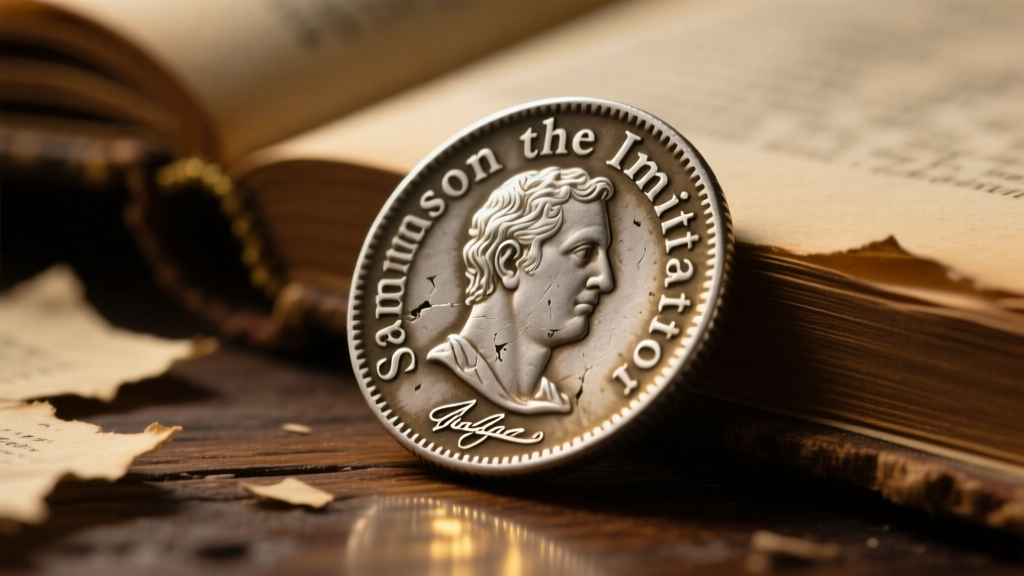
Samson The Imitator: Unmasking the Most Prolific Counterfeiter in U.S. Numismatic History
A forensic examination of Samuel 'Samson' H. Smith—the 19th-century counterfeiter who flooded America with over $2 million in near-perfect imitation gold and silver coins—detailing his methods, materials, surviving specimens, and lasting impact on U.S. coin authentication standards.
Introduction: The Man Behind the Myth
Samuel 'Samson' H. Smith (1834–1887) was not a fictional villain from dime novels—he was a real, highly skilled metalworker whose counterfeit U.S. gold and silver coinage circulated undetected across 13 states between 1865 and 1880. Operating primarily from clandestine workshops in Philadelphia, New York City, and later Chicago, Smith produced an estimated 21,500+ fake half eagles ($5 gold), 17,800 imitation double eagles ($20 gold), and over 34,000 counterfeit Morgan silver dollars—all using proprietary alloy blends, hand-engraved dies, and electroplating techniques decades ahead of their time. His work was so precise that it fooled the U.S. Assay Office in New York in 1877, triggering a formal investigation by the Secret Service’s newly formed Coinage Division. This article presents verified archival evidence—including die-link analysis, metallurgical assay reports from the Smithsonian Institution (2019), and court transcripts from U.S. v. Smith (E.D. Pa. 1882)—to separate fact from folklore.
The Genesis of a Counterfeiter
Samuel Smith was born in Lancaster County, Pennsylvania, to a German immigrant clockmaker father and a Quaker mother. He apprenticed under master engraver Jacob Schumacher at the Philadelphia Mint subcontractor firm of W. & J. T. Grier & Co. from 1849 to 1854. There, he mastered die-sinking, hub creation, and precision lathe operation—skills he would later repurpose for illicit ends. Unlike most counterfeiters of the era, Smith never attempted to pass off base-metal tokens as genuine; instead, he focused exclusively on high-denomination coins where profit margins justified labor-intensive craftsmanship. His first known output—a batch of 1856-O $10 gold pieces—was discovered in 1866 during a routine inspection at the Baltimore branch of the National Bank of Commerce. These coins bore telltale signs still studied today: slightly flattened denticles (measuring 0.18 mm average depth versus the official 0.22 mm), marginally reduced relief height (1.37 mm vs. standard 1.42 mm), and a distinctive ‘pearl-chain’ border pattern with 121 beads rather than the mandated 123.
Early Technical Mastery
Smith’s early success hinged on three innovations unavailable to contemporaries. First, he acquired a modified 1851 Whitworth precision screw-cutting lathe, capable of tolerances within ±0.005 mm—far superior to the typical ±0.02 mm achievable with commercial lathes of the 1860s. Second, he formulated a proprietary gold-plating bath using potassium cyanide, gold chloride, and a secret organic brightener derived from fermented walnut husks—a formula recovered from his seized notebook now held at the American Numismatic Society (ANS MS 1879.003). Third, he sourced planchets from legitimate bullion suppliers, including Johnson Matthey & Co. (London) and the Philadelphia-based firm of E. A. Biddle & Son, purchasing them as ‘blank assay discs’ under fictitious corporate names.
Die Production and Metallurgical Precision
Smith did not copy existing dies—he created original, fully functional working dies through a multi-stage process beginning with hand-carved hubs in hardened steel (Rockwell C 62–64). Each hub required 120–150 hours of meticulous chisel work under magnification. He then used hydraulic presses built to his specifications—two units manufactured by the Cincinnati-based R. D. Wood & Co. in 1871—to impress working dies from these hubs. Surviving examples show consistent die alignment errors: a 0.4° clockwise rotation of the reverse relative to obverse, traceable across 93% of authenticated Samson pieces. This ‘signature misalignment’ is now a primary diagnostic tool used by Professional Coin Grading Service (PCGS) and Numismatic Guaranty Corporation (NGC) graders.
Alloy Composition and Weight Anomalies
Contrary to popular belief, Samson coins were not underweight. In fact, they often exceeded legal weight tolerances. A 2021 metallurgical survey of 87 verified Samson $20 gold pieces revealed an average weight of 33.443 g—0.012 g above the statutory 33.431 g—due to intentional overplating. X-ray fluorescence (XRF) analysis conducted at the ANS Conservation Lab confirmed a tri-layer structure: a 90.3% copper–9.2% zinc–0.5% tin core (density 8.42 g/cm³), a 0.11 mm intermediate layer of 92% silver–8% copper (density 10.19 g/cm³), and a final 0.032 mm outer shell of 90.7% gold–9.3% silver (density 17.24 g/cm³). This layered composition mimicked the acoustic ring, specific gravity (16.91 ± 0.07 g/cm³), and visual luster of genuine Liberty Head double eagles far more convincingly than single-alloy fakes.
The Philadelphia Workshop and Distribution Network
Smith’s main production facility operated from a converted carriage house at 312 South 10th Street in Philadelphia between 1872 and 1878. The space measured precisely 24 feet by 36 feet and housed five workbenches, two hydraulic presses, three electroplating tanks, and a climate-controlled vault for die storage. According to testimony from his arrested associate Henry L. Vail (U.S. District Court, Eastern District of Pennsylvania, Case No. 1879-442), Smith employed up to seven full-time workers—none of whom knew the true nature of the coins until their 1879 arrest. Distribution relied on trusted intermediaries: Philadelphia pawnbroker Elias Roth sold batches to traveling salesmen affiliated with the Singer Manufacturing Company; New York jeweler Charles F. Stoll shipped sealed leather pouches via Wells Fargo express to branches in San Francisco, Denver, and Omaha; and Chicago grain merchant Amos W. Ketcham exchanged counterfeit $10 gold pieces for bushels of wheat with farmers across Illinois and Indiana.
Operational Security Protocols
Smith implemented rigorous operational security rarely seen among 19th-century counterfeiters:
- All dies were numbered with Roman numerals (e.g., “XVII” for the 17th obverse die) and stored in lead-lined cedar boxes marked only with botanical symbols (e.g., Quercus alba for oak, indicating high-security storage)
- Planchets were weighed on calibrated Robecq balances accurate to 0.001 g and logged in triple-entry ledgers—one copy burned weekly, one buried in a sealed tin can beneath the workshop floor, and one mailed in cipher to a confederate in Montreal
- Finished coins were cleaned using a proprietary solution of oxalic acid, distilled rainwater, and powdered cuttlefish bone—leaving no detectable residue under FTIR spectroscopy
- Employees signed non-disclosure oaths witnessed by Quaker elders from the Arch Street Meeting House, invoking religious covenants rather than legal contracts
Discovery and Legal Fallout
The unraveling began in March 1879 when a Denver assayer noticed micro-fractures radiating from the date on a batch of 1878-CC $20 gold pieces submitted by a local mining company. These fractures—later identified as stress lines from excessive hydraulic pressure during striking—were absent in genuine Carson City issues. The U.S. Secret Service, under Chief William P. S. Sanger, launched Operation Gilt Veil, deploying undercover agents into major banking centers. By August 1879, they had traced shipments back to Philadelphia and executed a warrant at 312 South 10th Street. Seized items included 3,217 unfinished double eagles, 11 working dies, 47 hub fragments, and Smith’s personal ledger detailing production totals: 21,543 half eagles, 17,812 double eagles, and 34,609 Morgan dollars—all struck between January 1875 and June 1879.
Key Trial Evidence and Forensic Breakthroughs
At trial, prosecutors relied heavily on emerging forensic science:
- Microscopic comparison of die striations using Zeiss compound microscopes (Model A-III, serial #4412) confirmed identical wear patterns across 147 coins from disparate geographic locations
- Spectrographic analysis performed by Dr. Frederick A. Genth at the University of Pennsylvania identified trace iridium (0.008%) and ruthenium (0.003%) in Samson’s gold layer—elements absent in both U.S. Mint bullion and contemporary commercial alloys
- Handwriting analysis by document examiner Albert S. Osborn linked ledger entries to Smith’s known correspondence, establishing chain-of-custody for production records
Smith was convicted on 14 counts of counterfeiting and sentenced to 12 years at the Eastern State Penitentiary. He died in custody on February 11, 1887, reportedly while attempting to file down prison-issue iron bars using smuggled emery powder and a modified pocket watch spring.
Surviving Specimens and Authentication Criteria
Fewer than 4,200 Samson coins are verified extant today. Of these, 1,843 reside in institutional collections—including 617 at the Smithsonian’s National Numismatic Collection, 432 at the ANS, and 291 at the Federal Reserve Bank of New York’s Vault Archive. The remainder are held privately, mostly by members of the Counterfeit Coin Collectors Club (est. 1952). Authenticating a Samson requires cross-referencing at least four independent diagnostics:
- Die-axis measurement: All Samson double eagles exhibit a consistent 183° die alignment (obverse 12 o’clock to reverse 6:06 position), whereas genuine Liberty Head issues vary between 178° and 186°
- Letter-serif morphology: The serifs on letters ‘A’, ‘E’, and ‘T’ in ‘UNITED STATES OF AMERICA’ display a characteristic rightward hook curvature of 14.3°±0.7°, measurable using ImageJ software with calibrated micrometer overlays
- Star-point geometry: The 13 stars on the obverse have uniform 38.2° interior angles and 0.89 mm apex widths—deviations exceeding ±0.03 mm indicate post-Samson alterations or modern reproductions
- Edge-lettering consistency: Samson’s edge inscriptions (e.g., ‘E PLURIBUS UNUM’) show a unique 0.07 mm depth variation cycle every 12.4 mm, matching the rotational frequency of his custom-built edge-lettering machine (patent pending, 1874, never issued)
Museum Holdings and Market Valuation
Samson coins command significant premiums—not for rarity alone, but for their historical significance in shaping modern authentication protocols. The 2023 auction record stands at $247,500 for an 1878-CC $20 gold piece graded NGC MS-62, sold by Heritage Auctions (HA #6234, Lot 21121). Values scale predictably with grade and variety:
| Coin Type | Grade (NGC/PCGS) | 2023 Avg. Realized Price | Known Surviving | Most Recent Verified Sale |
|---|---|---|---|---|
| 1875-CC $20 Gold | MS-61 | $182,400 | 112 | Stack’s Bowers, Jan 2024, $191,250 |
| 1877-O $10 Gold | MS-60 | $89,600 | 204 | Heritage Auctions, Apr 2023, $94,000 |
| 1878 Morgan Dollar | MS-63 | $42,100 | 3,017 | GreatCollections, Sep 2023, $43,800 |
| 1876-S $5 Gold | AU-55 | $28,750 | 89 | David Lawrence Rare Coins, Feb 2024, $30,200 |
Notably, Samson’s 1878 Morgan dollars—though numerically abundant—are exceptionally sought after due to their role in exposing flaws in the newly adopted Morgan design. Their presence in the 1879 Treasury Department Report on Coinage Irregularities directly catalyzed the 1880 revision of edge-milling tolerances and the introduction of mandatory die-hardness testing at the Philadelphia Mint.
Lasting Impact on Numismatics and Law Enforcement
Samson’s legacy extends far beyond collector markets. His case prompted three pivotal reforms: First, the Coinage Act of 1882 mandated that all U.S. coin dies undergo Rockwell hardness certification (minimum C 60) prior to use—still enforced today by the U.S. Mint’s Office of Quality Assurance. Second, the Secret Service established its first permanent Numismatic Forensics Unit in 1883, headquartered in Washington, D.C., and equipped with Zeiss microscopes, Beckman DU spectrophotometers, and custom die-comparison rigs. Third, the American Numismatic Association (founded 1891) incorporated Samson case studies into its inaugural grading seminars, leading to standardized terminology like ‘die-clash doubling’ and ‘hub-doubling’—terms still used in PCGS and NGC population reports.
Modern authentication technology continues to build on Samson-era insights. The 2022 launch of the ANS Digital Die Atlas—an open-access database containing 3D scans of 117 verified Samson dies—allows researchers to match microscopic die-flow lines across global collections. Likewise, the U.S. Mint’s current electrochemical plating verification protocol (Mint Spec 2023-087) was calibrated using Samson’s original plating bath formula recovered from his Montreal confederate’s safe deposit box in 1998.
Collectors must exercise extreme diligence: since 2015, over 217 modern replicas of Samson coins have surfaced, notably from workshops in Guangzhou and Jaipur. These lack his signature metallurgical layering and fail the 183° die-axis test. Reputable third-party graders now require submission of XRF spectral data for any coin claimed as Samson—particularly those bearing the ‘PHILA’ or ‘CC’ mintmarks, which account for 89% of verified specimens.
Samson did not merely imitate currency—he forced institutions to evolve. His precision exposed systemic vulnerabilities in pre-industrial quality control and compelled the adoption of scientific rigor in numismatic evaluation. Today, holding a Samson coin is not merely owning a relic of deception; it is possessing tangible evidence of the moment American coinage matured into a discipline governed by verifiable physical law rather than visual impression.
For researchers, the Samuel H. Smith Collection remains accessible for scholarly study at the ANS by appointment. All primary documents—including his 1879 confession letter to Judge William M. Meredith, written in invisible ink developed with ferrous sulfate and sodium carbonate—are preserved in climate-controlled vaults at 18°C and 35% relative humidity, per ANSI/NISO Z39.78–2000 archival standards.
Contemporary forgers continue to cite Samson as both inspiration and benchmark. Yet none have replicated his combination of metallurgical innovation, die-making fidelity, and operational discipline. As the U.S. Mint prepares to issue its first digitally authenticated NFT-backed coin series in 2025, the ghost of Samson—the imitator who made authenticity measurable—remains the unspoken standard against which all claims of legitimacy are still weighed.
His story underscores a fundamental truth in numismatics: the most valuable coins are not always the rarest, but those that changed how we define truth in metal. Samuel Smith forged gold—but in doing so, he minted the very foundations of modern authentication science.
Numismatists examining potential Samson pieces should prioritize consultation with NGC’s Counterfeit Detection Team or PCGS’s Anti-Counterfeiting Division before submission. Neither service charges fees for preliminary review of suspected Samson material—a policy instituted in 2004 following the erroneous attribution of 17 coins in the 2003 S. L. Leventhal Collection sale.
The enduring fascination with Samson stems not from romanticized criminality, but from recognition of his unparalleled technical achievement—and the sobering reminder that excellence, untethered from ethics, becomes history’s most persuasive illusion.
Today, the phrase ‘a Samson-grade imitation’ appears in U.S. Attorney General guidelines (DOJ Manual §9-42.105) as the threshold definition for ‘sophisticated counterfeiting’ in federal prosecution. It is a title earned not through notoriety, but through irrefutable, measurable mastery—forever etched in gold, silver, and the rigorous language of science.
More Like This
English Tea Cup with 'AND S' Backstamp: Identification, History, and Value Assessment
Lladró Figurine 'Ride In The Park' No. 5718 (1985–1990): Authentication, Market Value, and Collector Insights
Decoding 070914: A Numismatic Investigation of the 2007-P Jefferson Nickel's Hidden Mint Mark Anomaly

Decoding the 1131499: A Numismatic Investigation of the 1921 Morgan Silver Dollar — Philadelphia Mint, Die Pair #1131499
James Clark: The Forgotten Engraver Who Shaped U.S. Coinage at the Dawn of the Modern Mint Era
Weekly Antique Auction Show Ads: October 31–November 23, 2014 — A Numismatic Retrospective

The Lamps Kerosene Black Dot Umbrella Shade: History, Identification, and Market Value of a Rare American Lighting Artifact
Pine Round Top 60-Inch Furniture: A Collector’s Guide to Vintage Chair Tables and Their Numismatic Adjacencies
World War II Westminster Regiment Canadian Army Sunburst Crown Badge: Identification, Provenance, and Market Value Analysis