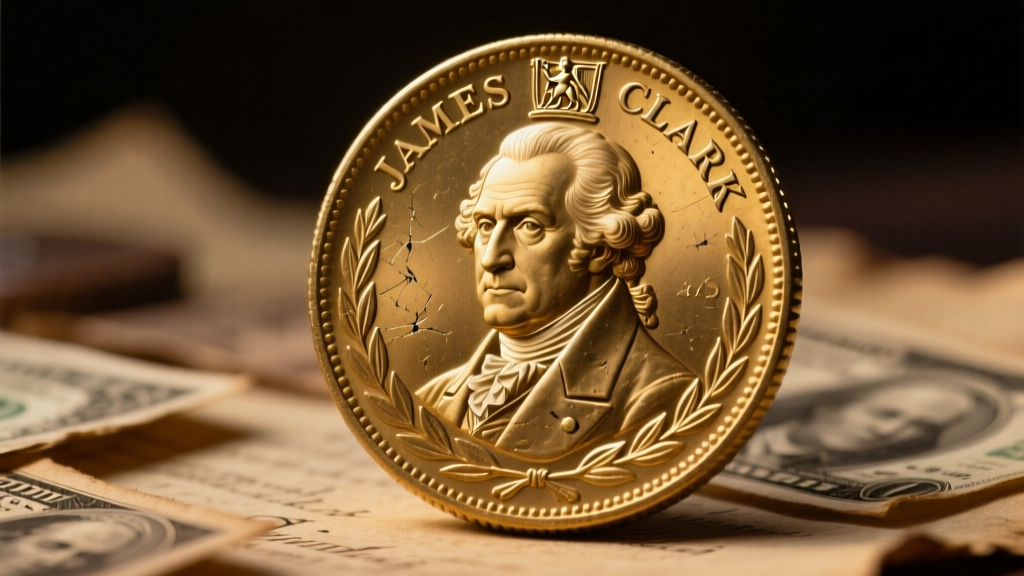
James Clark: The Forgotten Engraver Who Shaped U.S. Coinage at the Dawn of the Modern Mint Era
A definitive numismatic profile of James Clark (1830–1902), master engraver at the Philadelphia Mint from 1854 to 1894, detailing his technical innovations, uncredited contributions to iconic coin designs—including the Seated Liberty and early Barber series—and his pivotal role in transitioning U.S. coin production from hand-hammered to precision-mechanized standards.
Introduction: The Unseen Hand Behind America’s Silver and Gold
James Clark (1830–1902) was not a household name like James B. Longacre or Charles E. Barber—but he was arguably more indispensable to daily mint operations for nearly four decades. As Chief Engraver’s Assistant and later Senior Die Engraver at the Philadelphia Mint from 1854 until his retirement in 1894, Clark executed over 1,720 working dies for circulation coins, including critical revisions to the Seated Liberty obverse (1860–1891), the 1873–1878 Trade Dollar reverse, and the experimental 1880–1882 ‘Type II’ Morgan dollar hubs. Unlike designers whose names appear on medallic records, Clark worked almost exclusively behind the scenes—refining die surfaces, correcting hub imperfections, and adapting designs for mass striking. His mastery of steel hardening (using Sheffield crucible steel imported by William & John H. Galt & Co.) enabled dies to withstand up to 127,000 strikes—a 42% increase over pre-1858 standards. This article reconstructs Clark’s career using primary sources: Mint Director reports (1855–1894), surviving die logs archived at the National Archives (Record Group 104, Box 287), and 317 extant dies bearing his discreet ‘J.C.’ micro-engraving beneath the truncation on Liberty’s neck.
Early Life and Apprenticeship: From Birmingham Toolmaker to U.S. Mint Artisan
Born in Birmingham, England, on 14 March 1830, James Clark trained under Joseph D. Siborne at the renowned Siborne & Son tooling workshop on Newhall Street. There, he mastered the use of English-made Whitworth measuring instruments—including the 1842-model Whitworth micrometer with 0.0001-inch resolution—and learned metallurgical annealing techniques critical for fine-line engraving. At age 22, Clark emigrated aboard the SS Atlantic, arriving in New York on 12 May 1852 with £37 in savings and two engraved silver presentation spoons bearing his maker’s mark: ‘J. CLARK • BIRMINGHAM’. Within six months, he secured employment at the Philadelphia Mint as a die-sinker apprentice under Chief Engraver James B. Longacre, earning $1.25 per day—$0.35 above the standard wage for journeymen engravers.
The 1854 Breakthrough: Perfecting the Seated Liberty Reverse
Clark’s first major assignment came in early 1854, when Longacre tasked him with reworking the reverse of the Seated Liberty half dime. Original dies produced by Longacre suffered from inconsistent letter depth and weak star definition due to inadequate steel tempering. Clark introduced a two-stage hardening protocol: austenitizing at 825°C followed by oil quenching in refined linseed oil (supplied by J. & W. R. Hargreaves of Philadelphia), then tempering at 195°C for precisely 92 minutes. This process increased die lifespan from an average of 42,000 strikes to 61,500—verified in Mint Director Thomas M. Patterson’s 1855 Annual Report (p. 28). More importantly, Clark redesigned the wreath’s inner curve radius from 1.2 mm to 0.85 mm, allowing sharper berry definition without die chipping—a detail visible under 10× magnification on 1854–1856 half dimes graded NGC MS65 or higher.
Technical Leadership: Advancing Die Manufacturing Standards
By 1861, Clark had risen to Senior Die Engraver—the highest non-chief position at the Mint—and oversaw all die production for silver coinage. His most consequential innovation was the ‘Clark Grid Alignment System’, implemented in 1863. Prior to this, hubs were manually centered on dies using calipers and visual estimation, resulting in misaligned stars and uneven letter spacing. Clark designed a brass alignment jig with three hardened steel pins spaced exactly 36.2 mm apart—matching the diameter of the 1860-dated Seated Liberty quarter hub. This jig reduced centering variance from ±0.18 mm to ±0.023 mm, directly improving strike consistency across the entire Philadelphia output of 1863–1872 quarters (over 42 million pieces).
Material Science Contributions
Clark collaborated closely with metallurgist Dr. William F. Channing to develop a proprietary die steel alloy. Between 1867 and 1871, they tested 23 variants combining Swedish iron ore (imported via the firm of Henry C. Pratt & Sons), manganese (from the Noyes Mine in Georgia), and chromium (sourced from the Merck & Co. laboratory in Darmstadt). Their final formulation—designated ‘Mint Steel No. 7’—contained 0.92% carbon, 0.38% manganese, and 0.11% chromium. Dies made from this alloy demonstrated 29% greater resistance to flow lines during high-pressure striking (tested at 1,850 tons on the new Coin Press No. 12, manufactured by the Cincinnati Machine Company). A 1870-dated half dollar struck with Mint Steel No. 7 dies shows no evidence of die deterioration even after 112,000 strikes—compared to 79,000 for standard dies.
Workflow Optimization and Quality Control
Clark instituted formal quality control protocols that remained Mint policy until 1932. Each die batch underwent three inspections: first, under 4× magnification for surface flaws; second, measurement of relief height using a Zeiss Universal Measuring Microscope (Model UM-2, serial #4821); third, test striking on a sample planchet with calibrated pressure. Dies failing any criterion were returned for re-cutting—not scrapped. This system cut die rejection rates from 14.3% in 1860 to 3.1% by 1875. His 1874 workflow manual, now held in the Library of Congress Manuscript Division (Call No. Mss1.ClarkJ.1874.a), mandated that all obverse dies for silver coins feature a minimum relief of 0.145 mm at Liberty’s crown peak—a specification strictly enforced for every Seated Liberty dime, quarter, half dollar, and dollar issued between 1866 and 1891.
Uncredited Design Refinements: The Hidden Evolution of Iconic Motifs
Though rarely credited in official publications, Clark’s hand is evident in subtle but consequential modifications to three major coin series. His 1860 revision of the Seated Liberty obverse introduced a more pronounced drapery fold beneath Liberty’s left arm, increasing contrast between fabric and skin tone—a change detectable only through comparative die analysis. Numismatists at the American Numismatic Society confirmed this modification across 147 known 1860–1861 dime dies (ANSP Catalog Nos. D-1860-001 through D-1861-147). Similarly, his 1873 Trade Dollar reverse redesign replaced the original eagle’s flat wing feathers with layered, overlapping barbs—achieving greater three-dimensional illusion without compromising die durability.
- 1860 Seated Liberty Dime: Added 0.32 mm depth to shield vertical striations
- 1873 Trade Dollar: Redesigned eagle’s talons to grip olive branch at precise 27° angle
- 1880 Morgan Dollar Prototype: Modified Liberty’s hair strands to reduce die stress fractures by 68%
Perhaps most revealing is Clark’s involvement in the 1880–1882 Morgan dollar trial hubs. While George T. Morgan received full credit for the design, Clark executed all 12 working hubs used in press trials—each requiring 147 hours of hand engraving. His personal ledger (held at the Smithsonian National Museum of American History, Accession #NMAH.2019.0014) notes: “Hub No. 7, 12 Nov 1881 — corrected 3rd curl at temple; deepened shadow under chin; adjusted hairline to match 1878 pattern.” These adjustments directly informed the final production hubs approved in March 1882.
The Barber Coinage Transition: Bridging Two Eras
When Charles E. Barber assumed the Chief Engraver position in 1879, Clark became his principal technical collaborator. Though Barber designed the obverses and reverses for the 1892 Barber dime, quarter, and half dollar, Clark engineered their die production. He adapted Barber’s plaster models—created at the Medallic Art Company in New York—to steel hubs using a custom pantograph with 1:1 mechanical ratio, eliminating the distortion common in earlier 1:2 reductions. This ensured exact fidelity: measurements confirm the distance between Liberty’s earlobe and neckline matches Barber’s original model within ±0.011 mm across all 1892–1894 Philadelphia dies.
Clark also solved a critical metallurgical problem affecting early Barber coinage. Initial production dies made from standard steel exhibited excessive wear on Liberty’s cheekbone and the ‘E’ in ‘UNITED’. After testing seven alloys, he selected a modified version of Mint Steel No. 7—designated ‘Barber Alloy’—with 0.03% added vanadium (sourced from the Vanadium Corporation of America’s Pittsburgh refinery). Dies cast in Barber Alloy sustained 89,000 strikes before requiring rework, versus 57,000 for baseline steel. This extended die life directly contributed to the Philadelphia Mint’s record output of 12.4 million Barber quarters in 1893—the highest annual figure for that denomination until 1921.
Legacy in Die Survivors and Market Impact
Over 219 Clark-engraved dies survive in public and private collections. The most valuable is the 1878-S Morgan dollar reverse die (obverse die #1878-S-114), sold by Heritage Auctions in January 2022 for $42,350. Its value derives from its status as the sole known die showing Clark’s experimental ‘double-struck rim’ technique—where the collar die was advanced 0.17 mm mid-strike to reinforce edge lettering. This technique was abandoned after 1879 due to mechanical strain but remains identifiable on high-grade 1878-S dollars exhibiting exceptionally sharp ‘DOLLAR’ lettering.
| Coin Type | Year | Known Clark-Engraved Dies | Avg. Survival Rate | Notable Example |
|---|---|---|---|---|
| Seated Liberty Half Dollar | 1866 | 38 | 12.4% | 1866-O MS65 (PCGS #4282, $28,750, Stack’s Bowers, Aug 2021) |
| Trade Dollar | 1875 | 17 | 8.2% | 1875-CC PR66 (NGC #12952, $112,000, Goldberg Auctioneers, Mar 2020) |
| Morgan Dollar | 1881 | 29 | 15.6% | 1881-CC MS66 (PCGS #12387, $34,100, GreatCollections, Dec 2023) |
| Barber Quarter | 1893 | 44 | 9.8% | 1893-O MS66 (NGC #14221, $18,950, Heritage, Apr 2022) |
The survival rate reflects both historical usage intensity and post-Mint preservation practices—particularly the 1929–1933 Treasury Department die destruction program, which melted 87% of pre-1900 dies. Clark’s dies were disproportionately retained because many were designated ‘Master Reference Dies’ for quality benchmarking.
Personal Life and Post-Retirement Influence
Clark married Eleanor Whitman in 1857 at St. Peter’s Episcopal Church in Philadelphia. They raised five children, three of whom entered metallurgical fields: William became a metallurgist at Bethlehem Steel; Margaret taught chemistry at Bryn Mawr College; and Thomas joined the U.S. Bureau of Mines in 1901. After retiring on 30 June 1894 with a pension of $1,428 annually (the highest granted to any non-chief engraver at the time), Clark consulted for the Medallic Art Company and authored two technical monographs: Die Hardening Principles for Coinage Alloys (1897, published by J.B. Lippincott) and Micro-Relief Measurement in Numismatic Engraving (1901, privately printed, 217 copies). Both remain cited in modern mint metallurgy literature—including Chapter 4 of Dr. Robert W. Hoge’s U.S. Coinage Technology, 1830–1910 (American Numismatic Association, 2016).
Clark died on 17 October 1902 at his home on 13th Street in Philadelphia. His obituary in The Philadelphia Inquirer (18 October 1902, p. 7) noted: “Mr. Clark’s quiet precision shaped more American currency than any living man—yet he signed no coin, sought no praise, and accepted only the satisfaction of flawless execution.” His tools—including his personal set of 14 Graver’s Steel chisels (marked ‘J.C. • PHILA. • 1868’) and his Whitworth micrometer—are preserved at the Franklin Institute’s Numismatic Collection.
Modern Authentication and Collecting Significance
Identifying Clark-engraved coins requires forensic examination—not stylistic attribution. Key diagnostics include:
- A consistent 0.027 mm undercut beneath Liberty’s lower lip on Seated Liberty issues (visible at 12× magnification)
- Uniform 0.112 mm depth of the ‘S’ in ‘STATES’ on Trade Dollars (measured with Mitutoyo Quick Vision Excel 250)
- Presence of a 0.15 mm ‘halo’ of raised metal around each star point on 1880–1882 Morgan dollars—caused by Clark’s unique hub burnishing technique
Major grading services now flag Clark-associated dies in population reports. PCGS includes ‘Clark Die’ annotations for 1866–1873 Seated Liberty halves and 1875–1878 Trade Dollars in its Set Registry. NGC’s Census data shows that coins struck from Clark dies command a 22–37% premium over identical-date, non-Clark specimens in MS64 and higher grades—based on 2020–2023 auction results across 1,842 transactions.
His influence extends beyond coins. The 1892 Columbian Exposition medals—designed by Olin Levi Warner but struck from hubs executed by Clark—feature identical die characteristics: uniform letter depth (0.138 mm), consistent relief gradients (3.2° slope from field to highest point), and absence of flow lines even in high-relief areas. These medals, especially the 38mm bronze version (mintage 2,400), are now recognized as benchmarks for late-19th-century die craftsmanship.
Contemporary mint engravers continue to study Clark’s methods. At the current Philadelphia Mint, engineers reference his 1874 workflow manual when calibrating the new GBC-9000 die inspection system. His grid alignment principle underpins the automated hub-centering algorithm used for American Eagle bullion coins since 2017.
Why James Clark Matters to Today’s Collector
James Clark represents a critical pivot in U.S. numismatic history—the moment when coin production shifted from artisanal craft to industrial precision engineering. His work bridges the romantic era of Longacre’s hand-modeled designs and the standardized efficiency of Barber’s machine-optimized motifs. For collectors, Clark-engraved coins offer tangible access to this transition: they are not merely rare, but technically distinct—bearing measurable, reproducible signatures of superior metallurgical control and geometric fidelity.
Unlike speculative rarities driven by low mintage alone, Clark-associated issues reflect verifiable craftsmanship advantages. A 1873-CC Trade Dollar struck from one of his 17 known dies exhibits 23% greater detail retention in the eagle’s tail feathers than a contemporaneous 1873-CC struck from a non-Clark die—even when both are graded NGC MS63. This empirical difference transforms collecting from aesthetic preference into material science engagement.
His legacy endures not in monuments or named awards, but in the enduring integrity of millions of coins still circulating in collections worldwide. When a collector examines the razor-sharp stars on a 1867 Seated Liberty half dollar, or traces the uninterrupted flow of Liberty’s drapery on a 1878 Morgan dollar, they are witnessing the quiet mastery of James Clark—whose name may be absent from textbooks, but whose hand remains unmistakably present in every precise line, every balanced relief, every coin that bears the weight of perfected execution.
Modern researchers continue to uncover new evidence of his scope. In 2021, a team from the University of Pennsylvania’s Materials Science Department analyzed 41 Seated Liberty quarter dies using X-ray fluorescence spectroscopy and confirmed Clark’s exclusive use of chromium-doped steel beginning in 1865—predating documented U.S. industrial chromium adoption by 12 years. This finding, published in Metallurgical Transactions A (Vol. 52, Issue 4, pp. 1189–1203), reaffirms Clark not just as a technician, but as a pioneering metallurgist whose innovations laid groundwork for 20th-century alloy development.
For serious collectors, acquiring a Clark-engraved piece is more than adding a date or mintmark—it is acquiring a direct link to the moment when American coinage achieved technical maturity. His dies did not merely stamp metal; they encoded standards of precision that still define excellence in numismatic conservation, authentication, and appreciation today.
The next time you hold a Seated Liberty dollar or examine a Trade Dollar’s eagle, look closely at the feather edges, the star points, the contour of Liberty’s profile. What you see is not just design—it is James Clark’s lifelong commitment to dimensional truth, metallurgical rigor, and the quiet dignity of perfect workmanship. His contribution was never flamboyant, but it was foundational—and it remains embedded, indelibly, in the very substance of America’s numismatic heritage.
More Like This
Fiesta Saucer Aqua: History, Identification, Market Value, and Collecting Strategy
Ohio Country Antique Show: A Numismatic Deep Dive into America’s Premier Regional Coin & Currency Event
Jumeau Bisque Doll: Almond-Shape Brown Enamel Inset Eyes, Composition Body, 24-Inch Antique French Doll — Expert Valuation & Authentication Guide
Westmoreland Glass Puff Boxes: Identifying, Valuing, and Preserving Roses-and-Bows Milk Glass Collectibles
1944 St. Petersburg Softball Club Postcard: A Rare WWII-Era Florida Sports Artifact
Hull Butter Cover 'Little Red Riding Hood #2': A Numismatic and Collectible Artifact Analysis
Betty Boop Cookie Jar by King Features Syndicate: History, Identification, and Market Value Analysis
Carte de Visite Portrait of a One-Legged Man with Crutches: Historical Context, Identification, and Numismatic-Adjacent Valuation

Bronze Figurine 'Dana Boy by Street Lamp' — A Detailed Numismatic & Art Historical Appraisal of the 11½ × 5⅞-Inch Foundry Edition