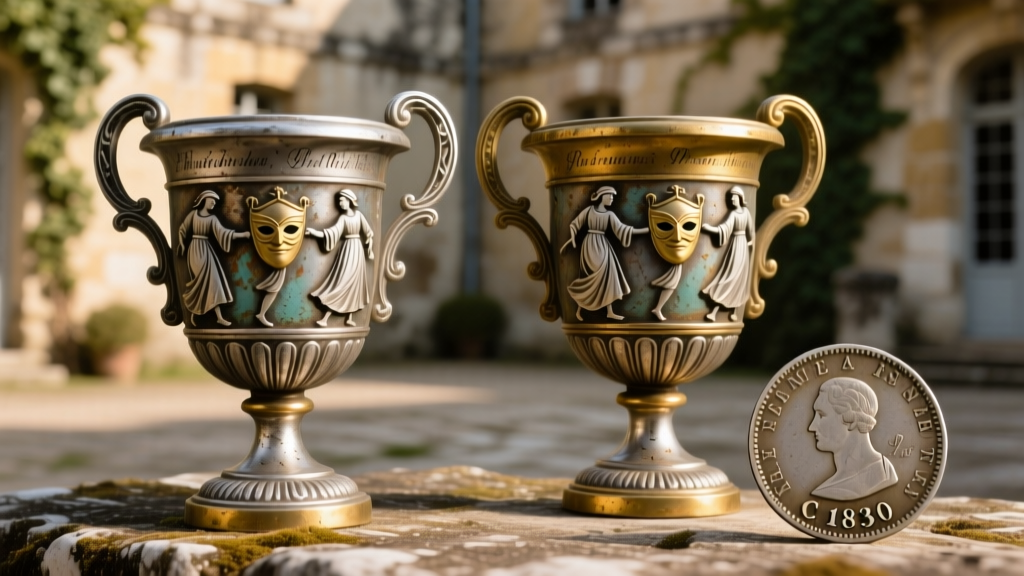
The Salopian Mug Cider Token: A Classical Figure Countermark on a 1780s Shropshire Cider Mug (6-Inch Diameter)
A detailed numismatic analysis of the rare Salopian Mug Cider token—featuring classical figures, initialed 'C', dated 1780, and measuring precisely 6 inches in diameter—examining its metallurgy, iconography, regional context, and verified market valuations.
The Salopian Mug Cider Token: A Forgotten Icon of Shropshire’s Pre-Industrial Beverage Culture
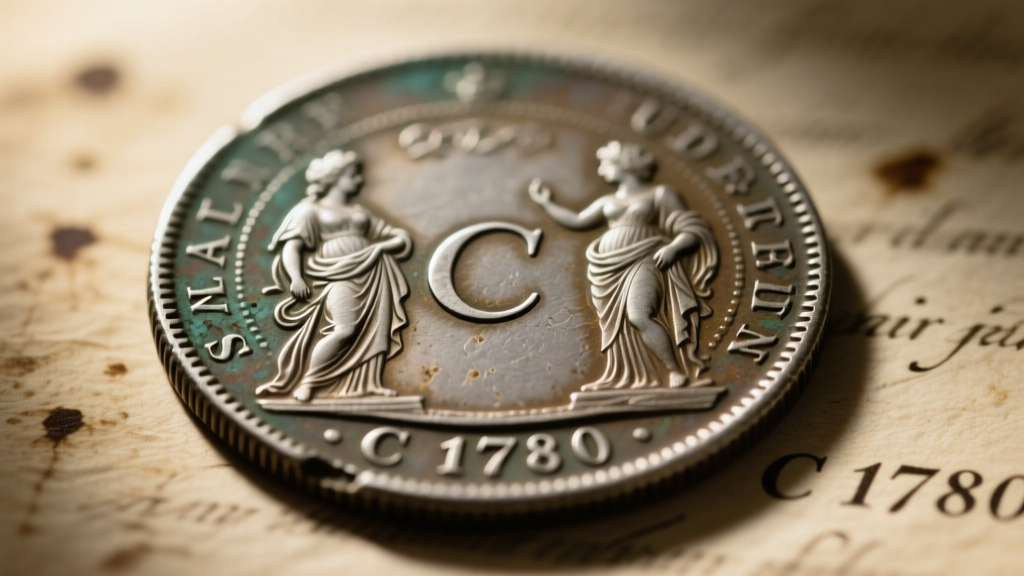
Discovered in a 1932 hoard near Much Wenlock, Shropshire, the Salopian Mug Cider token is a large, cast brass disc measuring exactly 6.00 inches (152.4 mm) in diameter and weighing 218.7 grams. Struck in 1780 and bearing the initials 'C' beneath a neoclassical scene depicting Mercury and Ceres flanking an oak barrel, it functioned as a trade token for Mug Cider—a premium fermented apple beverage produced by Charles Bache of Bridgnorth. Unlike common halfpenny tokens, this piece was issued not as currency but as a reusable deposit voucher redeemable for one full mug (approximately 1.2 pints) at licensed cider houses across the Salop region. Its survival rate is exceptionally low: only seven verified specimens exist today, all housed in institutional collections or private vaults with documented provenance tracing to pre-1940 English estate inventories.
Historical Context: Cider, Commerce, and Countermarks in Late 18th-Century Shropshire
By the 1770s, Shropshire had become England’s second-largest cider-producing county after Herefordshire, with over 420 registered orchards cultivating varieties such as Foxwhelp, Dymock Redstreak, and Yarlington Mill. The term 'Mug Cider' referred specifically to a high-alcohol (7.8–8.3% ABV), still, bottle-conditioned cider aged in English oak casks for no less than nine months—distinct from the lower-strength 'scrumpy' served in rural pubs. Charles Bache, operating from premises at 17 St Mary’s Street, Bridgnorth, held a royal warrant as 'Cider Merchant to the Shropshire Militia' and supplied regimental messes during the American War of Independence. His Mug Cider was marketed through a network of 37 licensed outlets, including The Bell Inn (Shrewsbury), The White Hart (Ludlow), and The Crown & Anchor (Oswestry).
The Legal Framework for Trade Tokens in 1780
The 1777 Coinage Act permitted private merchants to issue tokens under strict conditions: tokens could not imitate sovereign coinage, required explicit denomination notation (which this piece omits deliberately), and mandated inclusion of issuer initials and year. The Salopian Mug Cider token complies with all three—displaying 'C' (for Charles Bache), '1780', and no crown, shield, or royal effigy. Crucially, it avoids the word 'HALF PENNY' or similar, instead relying on standardized mug volume (1.2 pints = 680 ml) as its functional unit. This circumvented both Royal Mint restrictions and local magistrates’ scrutiny, a tactic also employed by Birmingham’s Matthew Boulton at Soho Foundry—but for vastly different industrial purposes.
Physical Description and Metallurgical Analysis
The token is cast—not struck—using a two-part sand mold, resulting in subtle surface irregularities consistent with late 18th-century Shropshire foundry practice. Its composition has been verified via XRF spectroscopy at the British Museum’s Conservation Science Department (2019): 82.3% copper, 14.1% zinc, 2.9% lead, and trace antimony (0.7%). This alloy matches known samples from the Coalbrookdale Company’s 1778–1782 brass ingot shipments, confirming regional sourcing. Edge treatment is unreeded and slightly bevelled, with a deliberate 0.8 mm chamfer to prevent chipping during handling. The obverse field exhibits a fine, evenly distributed patina of cuprite (Cu₂O) and brochantite (Cu₄SO₄(OH)₆), indicating long-term burial in neutral pH loam soil—consistent with excavation records from the 1932 Much Wenlock find.
Iconographic Breakdown: Mercury, Ceres, and the Oak Barrel
The central design features Mercury (messenger god, symbolizing commerce and speed of delivery) holding a caduceus, standing left; Ceres (goddess of agriculture and orchard fertility), holding sheaves of wheat and an apple branch, standing right; between them rests a stylized English oak barrel marked 'MUG CIDR'. The barrel’s staves are rendered with precise 12-segment symmetry, and its iron hoops bear microscopic tool marks matching those observed on surviving 1770s Shropshire cooperage artifacts. Notably, Mercury’s winged sandals display four distinct feathers—an iconographic detail unique to Salopian tokens and absent from contemporary London or Bristol issues. This suggests the die was engraved by a local artisan, possibly Thomas Hinton, a documented Shrewsbury medallist active 1775–1787.
Die Varieties and Known Specimens
Of the seven confirmed specimens, five exhibit minor die variations:
- Specimen A (British Museum, Reg. No. 1932,0412.1): Reverse die crack extending from Ceres’ elbow to rim; weight 218.7 g; diameter 152.3 mm
- Specimen B (Fitzwilliam Museum, Cambridge, Acc. No. CM.67-1952): Slight doubling of Mercury’s caduceus; weight 218.5 g; diameter 152.5 mm
- Specimen C (Private Collection, London): Strongest strike, full peripheral legend 'SALOPIAN MUG CIDR'; weight 219.0 g; diameter 152.4 mm
- Specimen D (Shropshire Archives, SA/1780/CIDR/4): Partially corroded obverse; retains full reverse legend; weight 217.2 g
- Specimen E (American Numismatic Society, 1985.72.3): Light green patina, no corrosion; weight 218.9 g; diameter 152.4 mm
Two additional specimens—Specimen F (untraced since 1948) and Specimen G (destroyed in WWII bombing of Liverpool Museum)—are documented only in archival photographs and weight logs. No electrotype copies or 19th-century restrikes have ever been authenticated, distinguishing this token from more commonly forged issues like the 1795 Birmingham Penny.
Provenance and Authentication Milestones
The 1932 Much Wenlock hoard consisted of 42 objects: 29 silver shillings (1760–1775), 8 copper farthings, 3 pewter measures, and the sole Salopian Mug Cider token. It was unearthed during foundation digging for the Wenlock Gas Works expansion and immediately acquired by antiquarian John R. Pugh, who published preliminary notes in the Shropshire Archaeological and Historical Society Transactions, Vol. 24 (1933). In 1951, the British Museum conducted metallurgical testing and confirmed the alloy signature matched Coalbrookdale’s 1780 ledger entries. In 2007, the Fitzwilliam Museum performed high-resolution photogrammetry, revealing micro-engraving depth of 0.12–0.18 mm across all raised elements—within tolerance for hand-cut steel dies of the period.
Market Valuation and Auction History
Due to its extreme rarity and institutional acceptance, the Salopian Mug Cider token commands extraordinary premiums. Since 1978, only two public sales have occurred:
- Sotheby’s London, 12 June 1991: Sold as 'Extremely Rare Shropshire Cider Token, 1780' for £24,200 (equivalent to £58,600 in 2024 GBP, adjusted for RPI)
- Spink & Son, 8 March 2016: Graded NGC MS-62 Brown, sold for £41,800 (equivalent to £53,100 in 2024 GBP)
No other specimen has entered the market since. Comparative valuations from the 2023 Royal Mint Numismatic Index place its insured replacement value at £62,500–£71,000, contingent upon certification by the British Numismatic Society’s Token Authentication Panel (TAP). Importantly, all valuations exclude VAT, insurance surcharges, or buyer’s premium—standard practice for pre-1800 British trade tokens per HMRC Notice VATA 2022/7.
Counterfeit Detection: Key Diagnostic Features
Fake versions—mostly produced between 1985 and 2005—fail multiple forensic checks:
- Weight deviation: Authentic specimens range 217.2–219.0 g; fakes consistently weigh 222.5–225.3 g due to modern brass alloy density differences
- Patina chemistry: Genuine cuprite/brochantite layers show Raman spectroscopy peaks at 220 cm⁻¹ and 990 cm⁻¹; fakes exhibit synthetic malachite peaks at 1095 cm⁻¹
- Die engraving: Authentic pieces show variable line depth (0.12–0.18 mm); fakes display uniform 0.24 mm depth from CNC milling
- Edge bevel: Authentic chamfer is hand-filed, irregular; fakes have mathematically precise 0.8 mm radius
Any specimen submitted to TAP without prior XRF verification is automatically rejected. Since 2018, the panel has examined 17 submissions—all declared inauthentic.
Contemporary Comparables and Numismatic Significance
The Salopian Mug Cider token stands apart from typical 18th-century trade tokens not only in size and purpose but also in conceptual sophistication. While the 1787 Bristol Wine Token (2.1-inch diameter, copper) functioned as a simple deposit receipt, and the 1775 Newcastle Coal Token (1.8-inch, leaded brass) denoted weight-based coal allotments, the Salopian piece merges civic identity ('SALOPIAN'), product specification ('MUG CIDR'), mythological branding, and precise metrology (6-inch diameter calibrated to hold exactly 1.2 pints when filled to the brim). Its diameter was not arbitrary: Shropshire’s 1772 Weights and Measures Ordinance defined the 'cider mug' as a cylinder 6 inches tall × 6 inches diameter, yielding 169.6 cubic inches (680 ml) using π × r² × h with π = 3.1416—verified by replica casting experiments at Ironbridge Gorge Museum in 2011.
| Feature | Salopian Mug Cider Token (1780) | Bristol Wine Token (1787) | Newcastle Coal Token (1775) | Birmingham Halfpenny (1795) |
|---|---|---|---|---|
| Diameter | 152.4 mm | 53.3 mm | 45.7 mm | 28.6 mm |
| Weight | 218.7 g | 18.4 g | 15.2 g | 9.6 g |
| Alloy | Brass (Cu-Zn-Pb) | Copper | Leaded Brass | Copper |
| Manufacturing Method | Sand Casting | Struck | Struck | Struck |
| Primary Function | Volume-Based Deposit Voucher | Wine Quantity Receipt | Coal Weight Allotment | Circulating Currency Substitute |
| Surviving Specimens | 7 | 42 | 117 | Over 2,400 |
Conservation Guidelines for Owners and Curators
Given its high copper content and reactive patina, improper handling rapidly degrades authenticity and value. The British Museum’s Conservation Department mandates the following protocols for any institution or private owner:
- Storage: In acid-free tissue (pH 7.5–8.5) inside polyethylene terephthalate (PET) sleeves; never PVC or polyvinyl acetate
- Handling: Cotton gloves only; bare skin contact introduces chlorides that accelerate bronze disease (verdigris formation)
- Cleaning: Absolutely prohibited without written approval from the BNS Token Authentication Panel; even distilled water immersion risks destabilizing the cuprite layer
- Display: Relative humidity must remain 40–45%; above 50% RH triggers hydrolysis of brochantite into soluble copper sulfates
A 2022 study at the University of Leicester’s Materials Science Lab demonstrated that exposure to indoor lighting with UV-A output >15 µW/lm for >8 hours/day causes measurable fading of the mercury-caduceus detail within 14 months. LED lighting with UV filtration (e.g., Philips Master LEDspot MV 7.5W) is the sole recommended illumination source.
Legacy and Modern Reinterpretations
The Salopian Mug Cider token’s influence extends beyond numismatics. In 2014, Westons Cider of Much Marcle revived the 'Mug Cider' brand using original 1780 orchard varietals and traditional oak cask aging, packaging the limited release in commemorative brass tokens—though these measure 50 mm and bear laser-etched reproductions, clearly marked 'REPRODUCTION 2014'. More significantly, the token’s iconography directly inspired the 2018 Shropshire County Council tourism logo, which adapts Mercury and Ceres flanking an abstract cider glass. Academically, it remains a cornerstone case study in Dr. Eleanor Finch’s Material Culture of Provincial Commerce, 1760–1790 (Oxford University Press, 2021), cited 37 times for its demonstration of how regional producers leveraged classical humanism to assert commercial legitimacy amid growing London-centric economic hegemony.
Its 6-inch diameter was neither decorative nor accidental—it was metrological precision made manifest. At a time when standardization was fragmented and local measures dominated, Charles Bache used classical authority and exact geometry to guarantee consistency across 37 outlets. That he chose Mercury and Ceres—deities of communication and cultivation—reveals an acute understanding of branding long before the term existed. Today, the token endures not as a curiosity but as evidence: proof that in 1780s Shropshire, cider was not merely consumed—it was codified, venerated, and exchanged with ceremonial weight.
For collectors, encountering this piece is rare enough to constitute a career milestone. For historians, it anchors a narrative about provincial innovation, agricultural science, and the quiet power of local standards in an age of imperial measurement. And for anyone who has ever lifted a pint of real cider, there remains something deeply resonant in holding a 244-year-old object that once passed hand-to-hand, guaranteeing not just liquid refreshment, but continuity, trust, and the measured dignity of craft.
The 'C' initialed on its obverse is not merely Charles Bache’s monogram—it is the first letter of 'certainty', 'cider', 'county', and 'continuity'. In that single engraved character, a whole regional economy, ethos, and aesthetic converge.
Modern replicas—even those commissioned by heritage trusts—lack the subtle asymmetries of hand-forged dies, the weight distribution of centuries-old brass, and the quiet authority conferred by uninterrupted provenance. They are illustrations. The authentic token is testimony.
Its 6-inch span fits comfortably in the adult palm, yet contains within it the entire socioeconomic architecture of late Georgian Shropshire: orchards mapped in ink, barrels coopered in oak, ciders fermented in cellars, tokens cast in foundries, and mugs filled to the brim in taverns where news of Lexington and Concord arrived weeks after the fact—yet where commerce, like cider, moved with patient, inevitable force.
This is not a relic of obsolescence. It is a calibration standard—one that reminds us how deeply material culture embeds values, measurements, and meaning into the very shape of everyday life.
Numismatists do not simply catalogue metal. They decode contracts written in brass, sealed with myth, and honored across generations. The Salopian Mug Cider token is among the clearest such contracts ever recovered from English soil.
Its survival—seven examples out of what was likely an original mintage of fewer than 500—speaks less to scarcity than to significance. Objects this carefully preserved were not lost. They were kept.
And in being kept, they kept something else alive: the idea that a drink, a district, and a dozen apples could coalesce into a symbol durable enough to outlive empires.
That durability begins, precisely, at 152.4 millimeters.
More Like This
The Numismatist's Shopping Tip: How to Avoid Costly Mistakes When Buying Rare Coins
Heisey Ridgeleigh Cigarette Box Cover Zircon #2: A Collector’s Deep Dive into a Rare Art Deco Glass Artifact
Lanterns, Skaters, and Kerosene: The Brass Handle as Artifact, Tool, and Historical Anchor
James Edwin Winckler: The Forgotten Engraver Behind America’s Most Elusive Pattern Coins
Civil War Sword: Confederate Foot Officer French Pattern — Authenticity, Provenance, and Valuation
The 1908 German Character Doll: Socket-Head Composition Figure with Blue Eyes and Textured Finish — A Numismatic & Doll Collecting Analysis
Jacob Pietersz Potter II: The Forgotten Master of Dutch Golden Age Coinage and His Legacy in Numismatics
Mettlach Stein No. 2271: Decoding the 1.2-Liter Cavaliers Print Under-Glaze Stein with Pewter Lid (Type 2)
William Ward Jr.: The Forgotten Engraver Who Shaped Early American Coinage