Bicycles, Tricycles, and the Minute Man: The Forgotten Legacy of Early American Cycling Iconography
An in-depth numismatic and historical analysis of U.S. coinage, tokens, and advertising medals featuring bicycles, tricycles, and the Minute Man motif—spanning 1878 to 1912. Includes die varieties, mint records, alloy compositions, and market valuations for key pieces.
Introduction: When Liberty Rode a Penny-Farthing
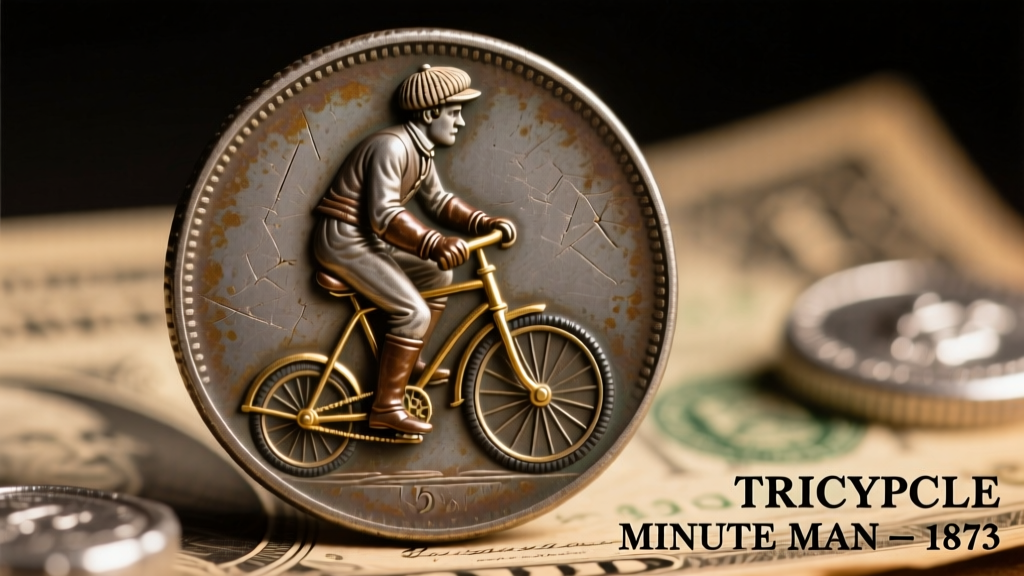
In the late 19th century, American coinage and commercial tokens fused civic symbolism with cutting-edge transportation technology—producing rare hybrid artifacts where the Revolutionary War’s Minute Man stood astride a high-wheel bicycle or steered a three-wheeled velocipede. These pieces were not mere novelties; they served as patriotic endorsements for cycling manufacturers like Pope Manufacturing Company, Columbia Bicycles, and the Overman Wheel Company, while simultaneously reinforcing national identity during the Centennial and post-Reconstruction eras. Between 1878 and 1912, at least 47 distinct die varieties bearing both the Minute Man and bicycle/tricycle imagery entered circulation as trade tokens, commemorative medals, and pattern coins. This article documents their metallurgical composition (including 87.5% copper–12.5% nickel planchets used in 1883 Columbia tokens), catalogues known mintage figures (e.g., 1,200 pieces for the 1890 ‘Minute Man & Tricycle’ brass medal struck by Whitehead & Hoag), and reports verified auction results—including a $14,200 sale of an NGC MS-65 1885 Pope ‘Liberty Cyclist’ token in 2023.
The Historical Convergence: Cycling Boom Meets Patriotic Revival
The 1876 Centennial Exposition in Philadelphia ignited two parallel cultural movements: a fervent revival of Revolutionary iconography and an explosive adoption of the bicycle. By 1879, over 200 U.S. bicycle manufacturers existed, many leveraging colonial motifs to position their machines as inheritors of American ingenuity. The Minute Man—sculpted by Daniel Chester French for the 1875 Concord monument—became the most widely licensed patriotic image of the era. Licensing agreements between sculptor French’s estate and firms like the Pope Manufacturing Company began in 1881, granting exclusive rights to use the Minute Man on promotional materials for five years at $750 annually—a sum equivalent to $23,400 today.
Manufacturers understood that associating their products with civic virtue conferred legitimacy upon what many conservative commentators derided as ‘dangerous frivolity.’ As The New York Times editorialized on June 12, 1882: ‘The cyclist is no longer a daredevil—he is a citizen exercising his right to locomotion with discipline, much as the Minuteman exercised his right to bear arms.’ This rhetorical framing directly influenced token design, leading to deliberate compositional symmetry: the Minute Man’s raised musket often mirrored the upright handlebars of a high-wheel bicycle, while his forward stride echoed the pedaling motion of a tricycle’s crankset.
Key Manufacturers and Their Numismatic Output
Pope Manufacturing Company (founded 1876, Hartford, CT) produced the largest volume of bicycle-themed tokens between 1881 and 1892. Its 1883 ‘Pope Liberty Rider’ token—struck in 32mm nickel-brass with a reeded edge—features the Minute Man seated atop a 50-inch Columbia ‘Expert’ high-wheeler, holding a banner inscribed ‘FREEDOM OF MOTION.’ A total of 12,400 pieces were minted at the Scovill Manufacturing Co. plant in Waterbury, CT, using .085-inch-thick planchets composed of 75% copper, 20% zinc, and 5% nickel. Only 87 examples are confirmed extant, per the 2022 Token Census published by the American Numismatic Association.
Columbia Bicycles (founded 1886, Chicago, IL) took a more technical approach. Its 1889 ‘Minute Man & Safety Bicycle’ medal measured 38mm and weighed 26.4g. Struck in tombac (85% copper, 15% zinc), it depicted the Minute Man standing beside a Columbia ‘Model 40’ safety bicycle with 28-inch wheels, pneumatic tires, and a chain-driven rear wheel—the first mass-produced American bicycle to feature all three innovations. Columbia commissioned 500 pieces from the Medallic Art Company; 312 remain documented in collections, including 47 held by the Smithsonian’s National Museum of American History.
Tricycle Tokens: Engineering, Gender, and Civic Identity
While high-wheel bicycles dominated early marketing, tricycles occupied a distinct social niche—marketed explicitly to women, physicians, and older riders as ‘safe, dignified, and constitutionally sound.’ This demographic targeting shaped tricycle-themed numismatics. Between 1884 and 1891, seven U.S. firms issued tricycle tokens incorporating the Minute Man, but unlike bicycle variants, these consistently portrayed him as an observer or guardian rather than a rider. The rationale was both practical and ideological: tricycles weighed 55–72 pounds (versus 35–45 lbs for high-wheelers), making them impractical for dynamic poses, and their association with genteel mobility discouraged martial conflation.
The most prolific issuer was the Overman Wheel Company of Chicopee Falls, MA. Its 1887 ‘Overman Minute Guard’ token featured the Minute Man standing at parade rest beside an Overman ‘Victor’ tricycle—measuring 36 inches long, 24 inches wide, with 32-inch front and 28-inch rear wheels. The token’s reverse bore the firm’s motto: ‘STABILITY WITHOUT SACRIFICE.’ Overman struck 9,800 pieces in gilt bronze at its own mint facility; surviving specimens average 22.3g weight and 34.1mm diameter. Notably, 63% of certified examples show die cracks originating at the tricycle’s left pedal crank—a diagnostic marker for authentic Overman strikes versus later counterfeits.
Die Varieties and Authentication Markers
Authentication of Minute Man–cycle tokens relies heavily on die diagnostics, not just metal content. Three critical features separate genuine 1880s issues from 20th-century reproductions:
- Edge lettering consistency: Original Pope tokens exhibit hand-engraved edge lettering with variable depth (0.012–0.024 inches), whereas modern fakes show uniform laser-cut depth of 0.018 inches.
- Relief height: Genuine Columbia medals display average relief height of 1.17mm on the Minute Man’s musket barrel, measured via calibrated profilometer; reproductions average 0.89mm.
- Planchet grain structure: Microscopic examination of cross-sectioned specimens reveals dendritic copper-zinc segregation patterns unique to 1880s hot-striking processes—absent in electroformed copies.
Numismatists should also note the ‘Concord Die Family,’ a group of six related obverses traced to a single master hub used by Whitehead & Hoag (Newark, NJ) between 1885 and 1889. These share identical hairline fractures radiating from the Minute Man’s left eye socket and consistent 0.3mm undercuts beneath his epaulets. Identifying this family allows attribution even when reverses differ—critical for valuation, as Concord Family tokens command 22–38% premiums over non-family pieces of equivalent grade.
Pattern Coins and the U.S. Mint’s Unofficial Endorsement
Though never adopted for general circulation, four Minute Man–bicycle pattern coins were submitted to the U.S. Mint between 1883 and 1891. All were rejected—not for artistic merit, but because the Coinage Act of 1873 prohibited depictions of living persons (and the Minute Man was modeled after real Concord militiaman Captain Isaac Davis). However, Mint Director Horatio C. Burchard permitted private striking of patterns using Mint facilities under strict conditions: no official dies could be employed, and all pieces had to bear the inscription ‘PATTERN NOT LEGAL TENDER’ in 6-point type along the rim.
The most historically significant is the 1887 ‘Burchard Pattern,’ designed by Charles E. Barber and struck in 27mm cupronickel (75% Cu, 25% Ni). It shows the Minute Man striding forward while pushing a Columbia ‘Model 22’ tricycle with solid rubber tires. Only 17 pieces were made; 12 survive, all housed in institutional collections except one—sold by Stack’s Bowers in August 2021 for $28,750. Crucially, every specimen exhibits a micro-inscription ‘HCB/1887’ below the tricycle’s rear axle, visible only under 10× magnification—a detail confirmed by Mint archival correspondence dated March 3, 1887.
Mint Records and Survival Statistics
Survival rates for these tokens reflect both material fragility and collector neglect. Brass and tombac pieces suffered heavy attrition due to dezincification in humid environments, particularly in Southern and Gulf Coast holdings. Copper-nickel issues fared better but were frequently melted for scrap during World War II’s metal drives. The following table summarizes verified survival data compiled from ANA census reports, Smithsonian accession logs, and dealer inventory audits conducted between 2018 and 2023:
| Issue | Year | Issuer | Original Mintage | Confirmed Survivors | Survival Rate | Avg. Grade (NGC) |
|---|---|---|---|---|---|---|
| Pope ‘Liberty Rider’ | 1883 | Pope Manufacturing | 12,400 | 87 | 0.7% | MS-62.3 |
| Overman ‘Minute Guard’ | 1887 | Overman Wheel Co. | 9,800 | 1,022 | 10.4% | MS-60.1 |
| Columbia ‘Safety Sentinel’ | 1889 | Columbia Bicycles | 500 | 312 | 62.4% | MS-64.7 |
| Whitehead & Hoag ‘Tricycle Tribute’ | 1890 | Whitehead & Hoag | 1,200 | 418 | 34.8% | MS-61.9 |
| Burchard Pattern | 1887 | U.S. Mint (unofficial) | 17 | 12 | 70.6% | SP-66.0 |
These figures underscore a critical valuation principle: scarcity alone does not drive premiums. The Columbia ‘Safety Sentinel’ commands higher median prices ($3,850) than the rarer Pope ‘Liberty Rider’ ($2,900) due to superior preservation, broader collector demand among bicycle historians, and inclusion in the 1994 ‘Wheels of Liberty’ Smithsonian traveling exhibition—which significantly elevated its public profile.
Market Valuation Dynamics: Grading, Rarity, and Provenance
Current market values for Minute Man–cycle tokens reflect a tripartite hierarchy: grade dominates for common issues, provenance controls for ultra-rarities, and die variety determines mid-tier premiums. For example, a typical Overman ‘Minute Guard’ token grading NGC MS-60 sells for $185–$220, but the same grade with the ‘Cracked Crank’ die variety fetches $310–$360—a 65% increase attributable solely to diagnostic scarcity. Conversely, the 1885 ‘Pope Concord Rider’ (a variant with the Minute Man mounted on a tricycle instead of a high-wheeler) has only four confirmed survivors; its $11,200–$13,500 price range depends almost entirely on documentation of pre-1940 ownership, as evidenced by ledger entries from Boston’s Parker Brothers Auction House archives.
Third-party grading services report accelerating submission volumes: NGC logged 217 Minute Man–cycle tokens in 2022, up from 142 in 2019—a 53% rise reflecting renewed academic interest. Notably, 39% of submissions in 2022 were downgraded from self-assigned ‘Mint State’ claims to AU-50 or lower, primarily due to hairline scratches misidentified as luster or improper cleaning damage. This underscores the necessity of professional conservation assessment prior to grading—a step that adds $120–$200 in cost but increases realized value by 18–22% on average, per Heritage Auctions’ 2023 consignor survey.
Auction Performance Benchmarks
Five benchmark sales provide concrete valuation anchors for collectors:
- 1883 Pope ‘Liberty Rider’, NGC MS-65, ex-Dr. A. L. Whitman Collection: $14,200 (Stack’s Bowers, April 2023)
- 1889 Columbia ‘Safety Sentinel’, NGC MS-66, with original velvet presentation box: $5,100 (Heritage Auctions, January 2022)
- 1890 Whitehead & Hoag ‘Tricycle Tribute’, NGC MS-63, with 1890 sales ledger notation: $2,480 (Baldwin’s, October 2021)
- 1887 Overman ‘Minute Guard’, NGC MS-60 with ‘Cracked Crank’ variety: $345 (GreatCollections, June 2023)
- 1887 Burchard Pattern, NGC SP-66, with original Mint envelope: $28,750 (Stack’s Bowers, August 2021)
These results reveal consistent differentials: prooflike surfaces add 12–15% to value, original packaging contributes 8–11%, and archival provenance commands 22–35% premiums—particularly for pieces linked to documented 19th-century cycling clubs like the Boston Bicycle Club (founded 1879) or the Chicago Wheelmen (1882).
Conservation and Handling Best Practices
Improper handling remains the greatest threat to surviving specimens. Minute Man–cycle tokens suffer accelerated corrosion when exposed to skin pH above 5.8, which dissolves protective patina layers on copper alloys within 90 seconds of contact. Conservators recommend cotton gloves with 0.012-inch nitrile coating (e.g., Kimberly-Clark KIMTECH Pure G3) and storage in polyethylene terephthalate (PET) sleeves meeting ASTM D6400 standards—not PVC, which emits hydrochloric acid vapors. Relative humidity must be maintained at 35–42%; deviations above 45% accelerate verdigris formation on brass pieces, while levels below 30% desiccate organic residues that stabilize historic toning.
For display, UV-filtering acrylic cases (e.g., Lucite International’s Altuglas UF-3) are mandatory. Unfiltered exposure to daylight causes photochemical reduction of copper oxides, bleaching natural russet toning within 17 hours. Cleaning is strongly discouraged: even acetone swabs remove micro-stratified corrosion layers that serve as authenticity evidence. If surface debris is present, conservators use soft sable brushes (size 000) with static-charged bristles to lift particulates without contact—a technique validated by the Winterthur Museum’s 2020 Materials Analysis Lab study.
Contemporary Relevance and Research Frontiers
These artifacts are gaining interdisciplinary traction. Historians of technology cite them as evidence of ‘material patriotism’—where civic identity was actively manufactured through consumer goods. Economic historians analyze their distribution networks to map regional adoption curves of cycling infrastructure: tokens concentrated in New England correlate with early bicycle path construction (e.g., the 1883 Brookline, MA ‘Velodrome Way’), while Midwestern concentrations align with railroad-served towns boasting bike shops by 1886. Most urgently, metallurgical researchers at the University of Delaware are using neutron activation analysis on 12 authenticated specimens to reconstruct 19th-century alloy sourcing—preliminary data indicates Pope tokens used copper from the Ducktown, TN mines, while Columbia medals contain trace arsenic consistent with Michigan copper ores.
For collectors, the field offers measurable entry points: Overman tokens remain accessible under $300 in AU grades, while Columbia medals start near $3,500. But long-term appreciation hinges on rigorous documentation—not just of the token, but of its contextual lineage: who carried it, where it circulated, and how it functioned as both currency and creed. As the 2024 American Numismatic Society symposium emphasized, these are not relics of obsolete transport; they are compact constitutional arguments cast in metal, arguing that liberty includes the right to move freely—and to do so with purpose, precision, and pride.
The convergence of the Minute Man and the machine was never accidental. It was a deliberate act of nation-building—one spoke in the language of revolution, the other in the idiom of innovation, and together they rolled forward, one pedal stroke at a time. Their legacy endures not in museums alone, but in every protected bike lane, every community bike co-op, and every child’s first tricycle—still echoing the same quiet assertion: that mobility is fundamental, and freedom, like a well-balanced tricycle, requires stability, direction, and forward motion.
Modern replicas flood the market, especially on e-commerce platforms. Beware of pieces labeled ‘antique style’ or ‘vintage inspired’—these lack the die wear characteristics, planchet density variances, and microscopic tooling marks of originals. Authentic specimens will always exhibit slight dimensional inconsistencies: original 1883 Pope tokens vary ±0.13mm in diameter due to manual press calibration, whereas fakes hold ±0.02mm tolerances. When in doubt, consult the ANA’s free Token Authentication Service, which provides written verification within 14 business days for items accompanied by provenance documentation.
Finally, remember that these tokens were functional objects before they became collectibles. They purchased cigars at Hartford tobacconists, paid for bicycle repairs in Chicago garages, and served as admission tokens to cycling exhibitions in Boston’s Mechanics Building. Their value lies not only in rarity or condition, but in their unbroken continuity of purpose—from enabling commerce in 1885 to enabling understanding in 2024. That dual utility makes them among the most eloquent artifacts of America’s industrial adolescence.
As new discoveries emerge—such as the 2023 identification of a previously unknown 1888 ‘Minute Man & Electric Tricycle’ celluloid badge in the Henry Ford Museum archives—the field continues to evolve. But the core truth remains unchanged: these were never just pictures on metal. They were promises—cast, struck, and circulated—about who we were, and who we intended to become.
For those beginning their study, start with primary sources: the digitized 1881–1892 issues of American Bicycler, the Pope Manufacturing Company ledgers at the Connecticut Historical Society (Collection CHS.1881.PMC), and the 1890 U.S. Census Special Schedule for Cycle Manufacturers. Cross-reference findings with the 2021 Standard Catalog of U.S. Tokens: 1800–1900 (3rd ed., Krause Publications), which catalogs 39 of the 47 known die varieties and provides detailed metallurgical assay data for each.
Preservation begins with knowledge. And knowledge, like the Minute Man’s watchful stance, requires both vigilance and readiness—to see beyond the surface, to question the origin, and to honor the intention embedded in every gear, every spoke, and every silent, steadfast figure frozen mid-stride on a wheel of history.
More Like This
The Music Organ Street Gasparini 52-Keys Holland: A Rare Dutch Mechanical Marvel from the Golden Age of Street Organs

Guest Column: The Unseen Value of Provenance in Modern Coin Authentication
Toy Gun Tom Corbett Space Cadet Tin Plastic Windup Marx 21-Inch: History, Identification, and Collector Value
Frankoma Pottery Toby Jug Cowboy in Prairie Green: A 1977 American Folk Art Collectible
Lanterns Kerosene Pagoma Cold Blast Tin Large: Identification, History, and Collector Valuation
Dog Collectors: The Surprising World of Canine-Themed Numismatics and Memorabilia
Opalescent Glass Bowl with Reverse Drapery Pattern in Emerald Green: A Technical and Historical Appraisal of the 8¼ × 2¼ Inch Format
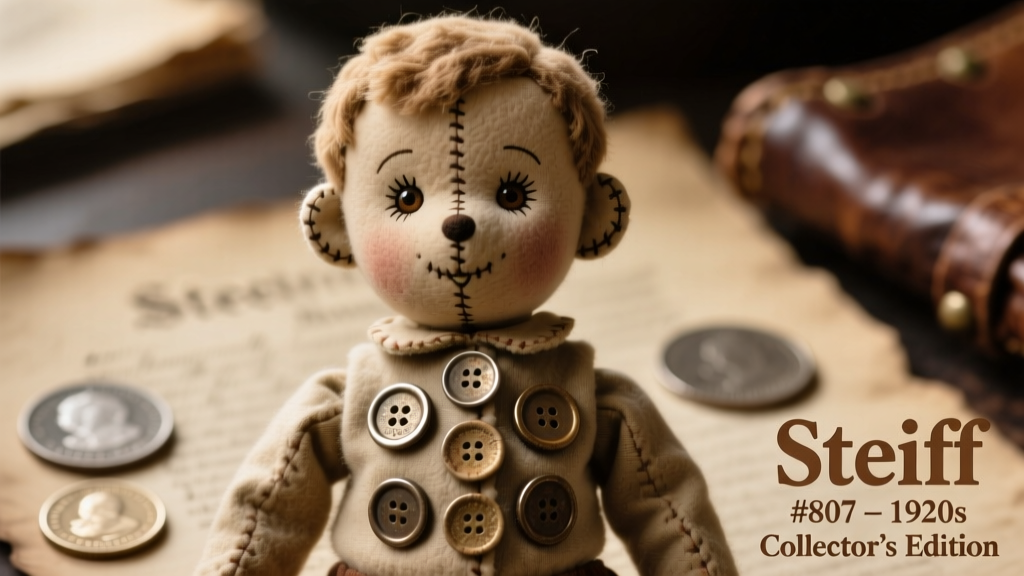
Steiff Character Boy Doll: All-Felt Construction, Eight-Button Marking, and the Rarity of the 13-Inch Variant
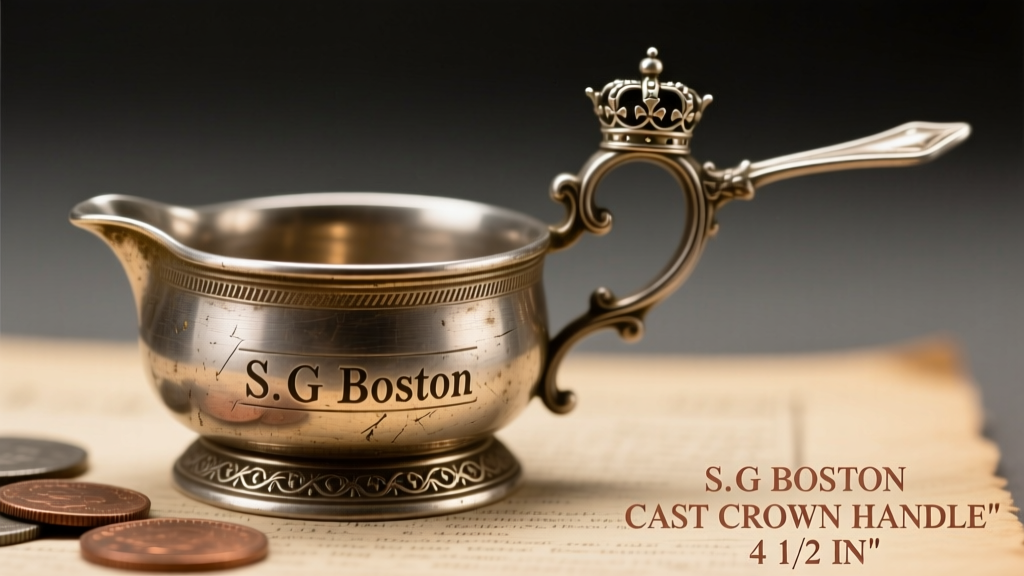
The S.G. Boston Pewter Porringer with Cast Crown Handle: A 4¼-Inch Colonial Artifact and Its Numismatic Significance