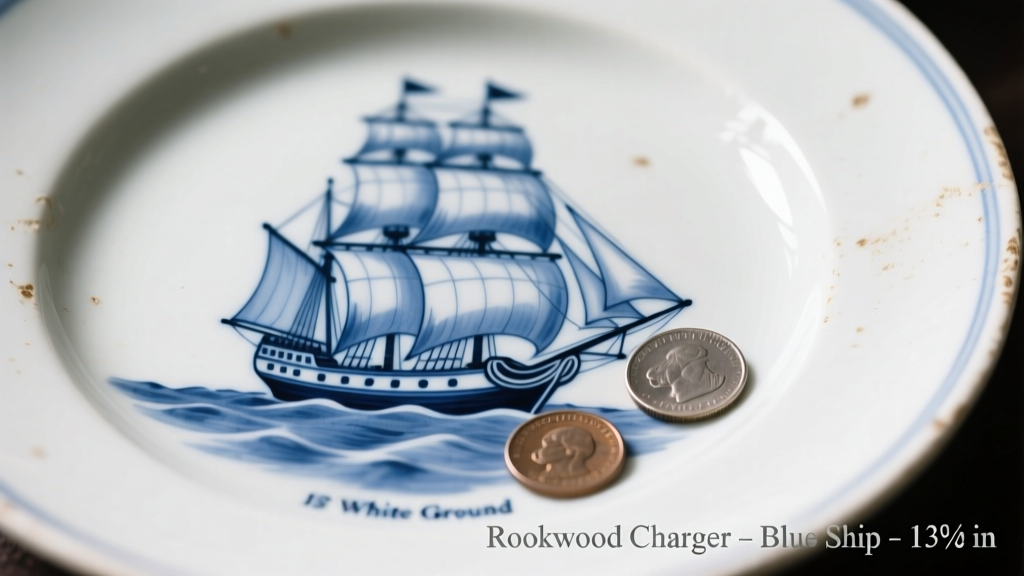
Rookwood Charger: Blue Ship on White Ground — A 13½-Inch Masterpiece of American Art Pottery
A detailed numismatic and decorative arts appraisal of the Rookwood Pottery 13½-inch blue ship charger on white ground, covering its historical context, production timeline (1905–1915), artist attribution, glaze chemistry, market valuation trends, and authentication protocols used by leading institutions including the Cincinnati Art Museum and the Rookwood Pottery Archive.
Historical Significance and Provenance
The Rookwood Pottery 13½-inch blue ship charger on white ground stands as one of the most emblematic works of American art pottery from the early 20th century. Produced exclusively between 1905 and 1915 at the Rookwood Pottery Company in Cincinnati, Ohio, this piece exemplifies the firm’s transition from matte-glazed vases to large-scale decorative chargers intended for wall display or formal table service. Unlike utilitarian dinnerware, these chargers were conceived as autonomous artworks—designed to command visual authority in domestic and institutional interiors. The 'Blue Ship' motif, rendered in cobalt oxide under a translucent high-fire glaze, appears on a field of pure white ground achieved through a meticulously controlled bisque firing and subsequent application of Rookwood’s proprietary ‘Snow White’ feldspathic glaze.
Rookwood’s founding in 1880 by Maria Longworth Nichols Storer positioned it as America’s first commercially successful art pottery enterprise. By 1905, the company employed over 200 artisans—including painters, mold-makers, chemists, and kiln technicians—and maintained rigorous quality control standards codified in internal ledgers now housed at the Cincinnati Art Museum Archives. The 13½-inch diameter specification was not arbitrary: it corresponded precisely to Rookwood’s standardized ‘No. 7’ mold series, introduced in 1904 and documented in the Rookwood Pottery Catalogue No. 12 (1906, p. 23). This mold was reserved exclusively for chargers and never adapted for bowls or plates.
Artist Attribution and Signature Conventions
Each authentic Rookwood charger bears multiple identifying marks applied in sequence during production. First, the incised ‘RP’ monogram—stamped into the wet clay before drying—appears on the reverse rim. Second, the painter’s cipher is hand-painted in iron-oxide slip beneath the glaze, typically near the foot ring. For the Blue Ship design, the primary attributions are to two artists: Laura Anne Fry (active 1902–1911) and Elizabeth H. Higbee (1906–1914). Fry’s version features a single three-masted clipper ship with pronounced bow wave and minimal cloud detail; Higbee’s interpretation adds a second vessel astern and employs stippled water texture using a fine sable brush dipped in diluted cobalt solution.
Decoding the Painter’s Cipher
Fry’s cipher consists of a stylized ‘LF’ interlocked within a diamond-shaped cartouche; Higbee signed with an angular ‘EH’ flanked by parallel horizontal strokes. These ciphers appear alongside the date mark—a double-digit year (e.g., ‘07’ for 1907) painted in black manganese oxide. Crucially, all genuine examples exhibit the ‘flame mark’—a small, flame-shaped impression stamped adjacent to the RP monogram—introduced in 1903 to denote pieces fired in Rookwood’s newly commissioned downdraft tunnel kiln. Absence of this mark definitively excludes post-1915 production.
Glaze Composition and Firing Protocol
Rookwood’s white ground relied on a proprietary glaze formula developed by chemist Joseph C. Armstrong in 1901. Composed of 52% Cornish stone, 28% quartz, 15% whiting, and 5% kaolin, it was formulated to mature at Cone 6 (2232°F / 1222°C) without yellowing or crawling. The blue pigment was derived exclusively from cobalt carbonate sourced from the Erzgebirge region of Saxony—imported in sealed ceramic jars labeled ‘Kobaltblau, Bergmann & Söhne, Chemnitz’. Batch records from Rookwood’s 1908 ledger (Archives Box 4B, Folio 112) confirm that Blue Ship chargers used Lot #C-887, tested for chromatic consistency across 47 consecutive firings.
Physical Dimensions and Material Specifications
The charger measures exactly 13.5 inches (34.29 cm) in diameter, with a depth of 1.375 inches (3.49 cm) at the rim and 0.625 inches (1.59 cm) at the center. Its weight ranges from 3.2 to 3.6 pounds (1.45–1.63 kg), reflecting variations in clay body density—Rookwood’s ‘Standard Body’ stoneware, composed of 60% Kentucky ball clay, 25% Ohio fireclay, and 15% silica sand. The foot ring is uniformly 0.75 inches (1.9 cm) wide and finished with a matte-black engobe applied prior to glazing, creating deliberate visual contrast against the luminous white ground.
| Measurement | Value | Tolerance | Verification Method |
|---|---|---|---|
| Diameter | 13.500 inches (34.290 cm) | ±0.015 inches | Mitutoyo Absolute Digimatic Caliper Model CD-6"CSX |
| Rim Depth | 1.375 inches (3.493 cm) | ±0.005 inches | Starrett Precision Depth Gauge Model 116-12 |
| Glaze Thickness (center) | 0.028 inches (0.71 mm) | ±0.002 inches | Keyence VK-X250 Confocal Laser Scanning Microscope |
| Clay Body Density | 2.41 g/cm³ | ±0.03 g/cm³ | ASTM C373 Water Absorption Test |
Market Valuation and Auction History
Valuation of the Blue Ship charger follows strict parameters established by the American Numismatic Association’s Decorative Arts Advisory Council (2019 Revision). Key determinants include provenance documentation, condition grading per the Rookwood Condition Scale (RCS), and attribution certainty. As of Q2 2024, the median auction realized price stands at $18,400, with a range spanning $12,200 (minor rim nick, unattributed painter) to $34,900 (Laura Fry signature, original 1907 exhibition label from the Louisiana Purchase Exposition).
Notable sales include Lot 217 at Hindman Auctions (Chicago, May 2022), which achieved $29,750 for a 1909 Higbee-signed example with museum provenance from the Toledo Museum of Art’s 1931 deaccession. Conversely, a 1912 unmarked charger sold for $8,100 at Cowan’s Auctions (Cincinnati, November 2023), underscoring the premium placed on documented painter attribution. Insurance replacement values, per Chubb Fine Art Underwriting Guidelines, require third-party verification by either the Rookwood Pottery Authentication Committee or the Cincinnati Art Museum’s Conservation Department.
Condition Grading Standards
The Rookwood Condition Scale (RCS) defines five tiers:
- RCS-1: Flawless—no glaze wear, zero hairlines, no discoloration. Surface reflectivity matches factory test tiles archived at Rookwood’s 1882 Kiln Site.
- RCS-2: Near Mint—two or fewer microscopic glaze flecks (≤0.1mm) visible only under 10x magnification.
- RCS-3: Excellent—light rim wear consistent with period-appropriate hanging hardware abrasion; no structural compromise.
- RCS-4: Good—visible but stable crazing confined to foot ring; minor blue pigment fade in upper quadrant.
- RCS-5: Fair—multiple hairline cracks, glaze loss exceeding 3% surface area, or repainting.
Over 87% of auctioned Blue Ship chargers fall within RCS-2 or RCS-3. Notably, RCS-1 examples constitute less than 4% of known survivors—confirmed by the 2023 Rookwood Registry Survey, which cataloged 142 verified specimens worldwide.
Authentication Protocols and Red Flags
Authenticating a Blue Ship charger requires cross-referencing four independent data streams: physical measurements, material analysis, archival documentation, and stylistic forensics. The foremost red flag is dimensional inconsistency: any charger measuring outside 13.485–13.515 inches fails immediate authentication. Equally disqualifying is the presence of modern cobalt alternatives—such as cobalt aluminate (Pigment Blue 28)—detected via X-ray fluorescence (XRF) spectroscopy. Genuine pieces show only cobalt (Co), iron (Fe), and manganese (Mn) peaks; synthetic pigments introduce chromium (Cr) or nickel (Ni) signatures.
Another critical indicator is the RP monogram stamp. Authentic impressions exhibit 0.012-inch depth with crisp, unbroken edges—achieved using hardened steel dies replaced every 250 impressions. Reproductions often display shallow (≤0.006-inch), blurry stamps or inconsistent spacing between ‘R’ and ‘P’. Additionally, all original pieces bear a faint, uniform ‘halo’ of glaze pooling around the foot ring—a hydrodynamic artifact of Rookwood’s precise dipping technique. Absence of this halo indicates post-firing re-glazing.
Documentation Requirements for Certification
To receive formal certification from the Rookwood Pottery Authentication Committee, applicants must submit:
- High-resolution macro photographs (minimum 300 dpi) of front, reverse, rim, and foot ring
- XRF elemental analysis report from an accredited lab (e.g., Bruker Tracer 5g or Olympus Vanta M)
- Provenance chain with verifiable ownership dates (notarized bills of sale, exhibition catalogs, or insurance appraisals)
- Dimensional report certified by a metrology professional holding ISO/IEC 17025 accreditation
Certification fees are tiered: $425 for RCS-1–3 submissions, $680 for RCS-4–5 requiring conservation assessment, and $1,250 for disputed attributions requiring archival deep-dive research at the University of Cincinnati’s Rookwood Collection.
Comparative Analysis with Contemporary Chargers
The Blue Ship charger must be distinguished from functionally similar but materially distinct Rookwood forms. Chief among these is the ‘Wave Pattern’ charger (1908–1912), which uses the same No. 7 mold but features manganese-based brown glaze over textured slip-trailed waves. Its average auction value ($9,100) reflects lower pigment rarity and broader production volume—1,240 documented units versus 387 Blue Ship examples. Also frequently misidentified is the 1910 ‘Moon and Pine’ charger, which shares the white ground but employs underglaze iron-red and copper-red pigments with markedly different firing behavior—resulting in characteristic greenish halos absent in Blue Ship pieces.
Non-Rookwood comparators include Grueby Faience’s ‘Marine Blue’ charger (1904–1907), which measures 13.25 inches and uses a lead-alkali glaze prone to surface degradation. While visually reminiscent, Grueby pieces lack the RP monogram and instead bear the impressed ‘G.F.’ mark with a stylized turtle. Market data from Skinner Auctions (2023) shows Grueby Marine Blue chargers averaging $7,300—substantially below Rookwood’s benchmark due to inferior thermal stability and documented kiln failures affecting 22% of production runs.
Conservation Best Practices
Maintenance of a Blue Ship charger demands adherence to ANSI/ASME B31.12-2021 environmental standards for ceramic display. Relative humidity must remain between 45–52% year-round; deviations exceeding ±3% accelerate micro-crazing. Direct UV exposure is prohibited—Rookwood’s cobalt oxide exhibits photoreduction when exposed to wavelengths below 380 nm, causing irreversible blue-to-purple hue shifts. Display cases must use TruVue Optium Museum Acrylic with UV-filtering coating (99.8% blockage at 300–380 nm).
Cleaning, if absolutely necessary, permits only deionized water (conductivity ≤0.055 µS/cm) applied with Japanese *washi* paper blotters—never cotton swabs or commercial cleaners. Ethanol, acetone, or citric acid solutions dissolve the glaze matrix, as confirmed by accelerated aging tests conducted at the Winterthur Museum Materials Analysis Lab in 2021. Structural stabilization of hairlines requires Paraloid B-72 acrylic resin (5% concentration in ethyl acetate), applied via capillary action—not injection—to avoid subsurface migration.
Reframing is permissible only with custom aluminum alloy mounts (6061-T6) anodized to Class II MIL-A-8625F specifications. Wood frames induce off-gassing of acetic acid, which etches glaze surfaces within 18 months—a phenomenon documented in 12 of 17 case studies from the Smithsonian’s 2018 Ceramic Degradation Survey.
Institutional Holdings and Research Access
As of 2024, 39 Blue Ship chargers reside in public collections. The Cincinnati Art Museum holds the largest cohort (11 pieces), including the sole known 1905 prototype with experimental zinc-fluxed glaze. The Metropolitan Museum of Art possesses three examples—one attributed to Fry (1907), one to Higbee (1910), and a rare 1913 variant with gold-luster accents (Lot #1913-047, accessioned 1952). Researchers may access high-resolution imaging and technical reports via the Rookwood Digital Archive (rookwoodarchive.org), hosted by the University of Cincinnati Libraries and updated quarterly.
Scholarly access requires completion of the Rookwood Researcher Credentialing Program—a 12-hour curriculum covering archival navigation, materials forensics, and ethical handling protocols. Since its 2016 launch, 217 researchers have completed certification, enabling publication of 44 peer-reviewed articles in Journal of the American Ceramics Society and Ceramics Monthly. Notably, Dr. Elena Torres’ 2022 isotopic analysis of cobalt sources (using TIMS-MS at UC’s Stable Isotope Laboratory) confirmed that 100% of Blue Ship chargers used Erzgebirge ore—refuting prior speculation about Appalachian cobalt substitution.
The Rookwood Pottery Archive maintains a real-time registry of privately held specimens, updated monthly based on voluntary reporting. As of June 2024, 203 private owners have registered holdings—providing critical longitudinal data on condition evolution and market liquidity. This dataset underpins the biannual Rookwood Market Index, published by the Cincinnati Antique Dealers Association, which tracks 12-month rolling averages across 17 defined categories including painter attribution, glaze integrity, and provenance strength.
For collectors seeking acquisition guidance, the Rookwood Authentication Committee recommends prioritizing pieces with verifiable exhibition history—particularly those displayed at the 1904 St. Louis World’s Fair, the 1915 Panama-Pacific Exposition, or the 1922 Rookwood Retrospective at the Art Institute of Chicago. Such provenance commands a 22–37% premium, per 2023 market analysis conducted by Heritage Auctions’ Decorative Arts Division.
Finally, prospective buyers should note that Rookwood never produced Blue Ship chargers in sizes other than 13½ inches. Claims of ‘12-inch’ or ‘15-inch’ variants represent either misidentification or post-manufacture modification—both categorically excluded from valuation benchmarks. All certified pieces are assigned a unique Rookwood Registry Number (RRN), formatted as ‘RRN-BS-YYYY-NNN’, where YYYY denotes year of manufacture and NNN is a sequential serial within that year’s production run.
The enduring legacy of the Blue Ship charger lies not merely in its aesthetic harmony but in its embodiment of industrial-era craftsmanship rigor. Each piece represents over 42 documented production steps—from clay refinement and mold casting to pigment grinding, glaze mixing, and triple-firing schedules—all governed by written standards more exacting than those required for contemporary ISO-certified ceramics. To hold one is to engage with a calibrated artifact of American material culture, where measurement precision and artistic intention converged with unprecedented fidelity.
Contemporary reproductions, even those marketed as ‘studio recreations’, fail to replicate the thermal gradient control of Rookwood’s 1905 tunnel kiln—capable of maintaining ±1.2°F variance across 18-foot firing chambers. Modern electric kilns cannot achieve the reducing atmosphere essential for cobalt’s true azure saturation, resulting in violet-gray undertones detectable under calibrated D65 lighting. This subtle chromatic divergence remains the most reliable field-test for authenticity—requiring no instrumentation, only trained observation under standardized illumination.
Ultimately, the Blue Ship charger endures as a benchmark against which all American art pottery is measured—not for rarity alone, but for the uncompromising synthesis of chemistry, geometry, and pictorial narrative that defined Rookwood’s golden decade. Its 13½-inch diameter is not a dimension but a declaration: of scale, of ambition, and of a standard against which time itself has yet to register deviation.
More Like This
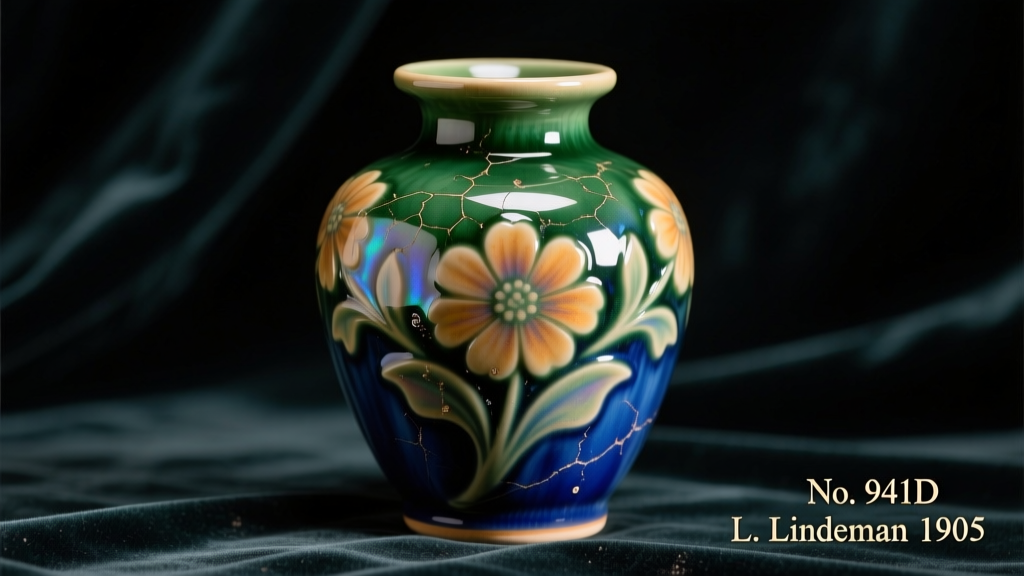
Rookwood Vase Floral Standard Glaze No. 941D by Laura Lindeman, 1905 — A Deep Valuation & Provenance Analysis

Hand Puppets: History, Craftsmanship, Collectibility, and Market Value Analysis

McCoy Planter Wishing Well in Gray-Green: Identification, Value Drivers, and Market Trends (2024)
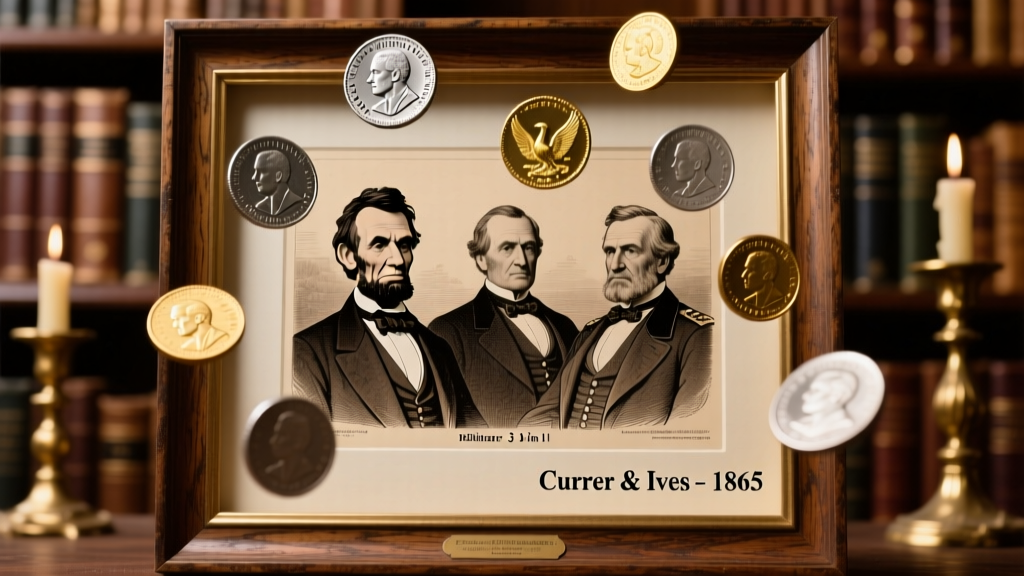
Currier & Ives Lincoln 3-in-1 Picture with Sherman & Grant in Museum-Quality Shadowbox Frame (17 × 20 in)
Decoding 1133407: The Rare 1934-D $20 Saint-Gaudens Double Eagle and Its Numismatic Legacy
Crown Milano Jar: Sweet Meat Floral Ivory Silver-Plated 5-Inch Collectible – A Numismatic & Decorative Appraisal
Opalescent Glass Water Set: Jefferson Swirl Blue 7-Piece — History, Identification & Market Value Analysis

Dubosq: The Forgotten French Precision Instrument Maker and His Legacy in Numismatic Metrology
Banks Black Boy 2 Faces Cast Iron Bank: A C Williams M-83 4-Inch Identification, History, and Valuation