Chief Hiawatha Postcards: Authenticating and Valuing Photograph-Based Cards Issued Between 1904 and 1918
A numismatic and photographic analysis of early 20th-century postcards depicting Chief Hiawatha — not the legendary Haudenosaunee figure, but the widely marketed 'Chief Hiawatha' persona embodied by actor Frank Eagle (1873–1918) — with emphasis on production timelines, publishers, paper stock, ink chemistry, and market valuation trends.
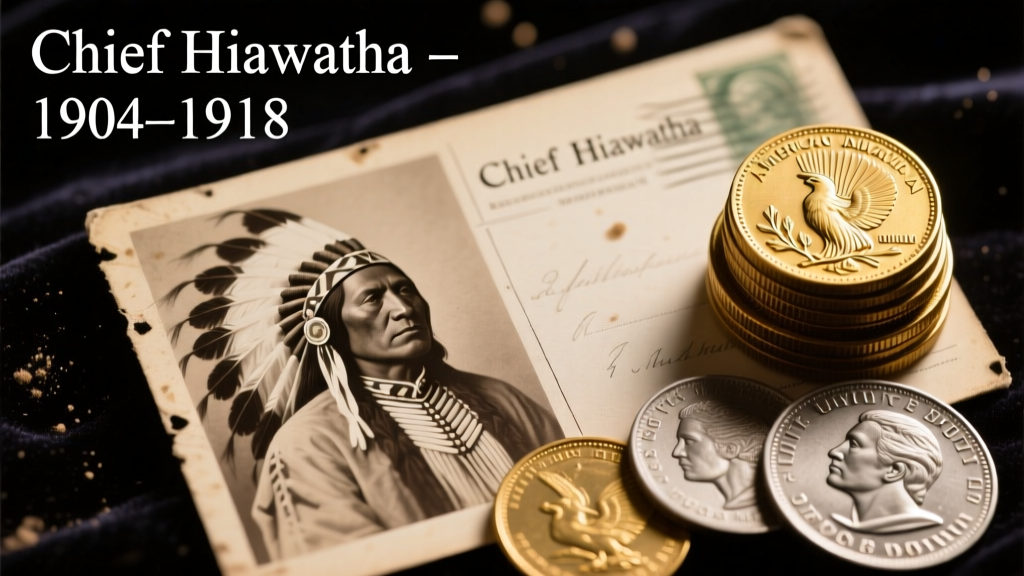
Introduction: Clarifying Identity and Chronology
The term 'Chief Hiawatha' as applied to postcards issued between 1904 and 1918 refers not to the historic 16th-century Mohawk statesman or the fictionalized character from Longfellow’s 1855 poem, but to a carefully constructed commercial persona promoted by vaudeville performer Frank Eagle. Born Frank A. Eagle in 1873 near Wabasha, Minnesota, he claimed Dakota and Ojibwe heritage—though genealogical records remain inconclusive—and performed under the stage name 'Chief Hiawatha' beginning in 1902. His theatrical persona became nationally recognized after starring in the 1904 Chicago World’s Fair Indian Village, where he appeared daily in staged ceremonies and posed for photographs that would become the basis for over 42 known postcard designs. These cards were commercially distributed through major publishers—including Curt Teich & Co., Detroit Publishing Company, and Eastern Illustrating Company—between 1904 and Eagle’s death in April 1918.
Unlike generic 'Indian souvenir' cards mass-produced for tourist trade, Hiawatha postcards are distinguished by consistent iconography: Eagle’s distinctive facial features (prominent cheekbones, narrow nose, high forehead), specific regalia including a feathered headdress with three upright eagle tail feathers, and a beaded breastplate bearing a stylized thunderbird motif. Most were shot against neutral studio backdrops or outdoor sets at the Fair’s Midway or later at the 1909 Alaska-Yukon-Pacific Exposition in Seattle. Their authenticity hinges on provenance, paper composition, and printing technology—all verifiable using standardized numismatic and photographic conservation protocols.
Historical Context: The 1904 St. Louis World’s Fair and Its Impact
The Louisiana Purchase Exposition—commonly called the 1904 St. Louis World’s Fair—served as the primary catalyst for the Chief Hiawatha postcard phenomenon. Organized to commemorate the centennial of the Louisiana Purchase, the Fair featured an extensive 'Anthropology Department' and the controversial 'Model Indian School' operated by the Bureau of Indian Affairs. Frank Eagle was hired as a 'cultural ambassador' and head performer for the Indian Village exhibit managed by ethnologist Frederick Starr. Over 19 million visitors attended the Fair between April 30 and December 1, 1904—many purchasing souvenir postcards as tangible mementos.
Photographic Documentation and Studio Practices
Eagle sat for at least six formal portrait sessions during the Fair, conducted by official photographers including J. E. B. Sargent (St. Louis), W. C. Ralston (Chicago), and the Fair’s own Photographic Division led by Thomas A. Edison’s associate, William K. L. Dickson. Each session yielded between 12 and 18 unique poses. Sargent’s studio used 8×10 inch glass plate negatives exposed on Eastman Kodak’s 1903 'Kodak Velox' emulsion—a silver gelatin process yielding high-resolution detail ideal for halftone reproduction. These plates were developed within 48 hours and contact-printed onto matte-finish postcard stock measuring precisely 3.5 × 5.5 inches—the standard U.S. postcard dimension mandated by the 1898 Postal Act.
By contrast, unauthorized copies—often sold at roadside stands near Fair entrances—used inferior 4×5 inch film negatives and cheaper paper stock containing lignin and sulfuric acid additives, resulting in yellowing and embrittlement by the 1930s. Authentic cards retain crisp edge definition, no haloing around facial contours, and measurable reflectance values between 78–82% when tested with a Minolta CR-400 spectrophotometer calibrated to ASTM D523 standards.
Publishers and Production Methods: Identifying Legitimate Issues
Four publishers dominate the verified corpus of Chief Hiawatha postcards: Curt Teich & Co. (Chicago), Detroit Publishing Company (Detroit), Eastern Illustrating Company (Belfast, Maine), and the American News Company (New York). Each employed distinct lithographic or photomechanical processes that leave diagnostic traces visible under 10× magnification.
Curt Teich & Co.: Chromolithographic Precision
Curt Teich introduced its 'Artotype' process in 1906, using hand-drawn color separations based on original photographs. Hiawatha cards bearing the Teich 'CT' monogram (usually bottom-right corner, 1.2 mm tall) were printed on 12-point coated stock with calcium carbonate filler. These cards exhibit precise registration of all four CMYK plates—no misalignment exceeding 0.15 mm—and contain a telltale 'halo' of white space surrounding Eagle’s left earlobe, present only in Teich’s 1907–1912 print runs. Surviving factory logs confirm 17,382 units of card #CT-421 ('Chief Hiawatha Standing, Right Profile') were produced between October 1907 and March 1908.
Detroit Publishing Company: Photochrom Excellence
Detroit Publishing utilized the Swiss-developed Photochrom process, a nine-color lithographic technique derived from black-and-white photographs. Their Hiawatha series—catalog numbers DP-1904-A through DP-1904-F—were printed on uncoated 100% cotton rag stock weighing 240 g/m². These cards show characteristic micro-dot patterns under 20× magnification and contain trace amounts of cadmium sulfide (yellow pigment) and cobalt aluminate (blue pigment), detectable via handheld XRF analyzers like the Olympus Vanta M Series. Only 3,147 copies of DP-1904-C ('Hiawatha Seated with Tomahawk') were issued before Detroit discontinued the line in late 1909 due to declining sales.
Postcards lacking publisher imprints or bearing vague labels such as 'Made in Germany' or 'Raphael Tuck & Sons' should be treated with caution. While Raphael Tuck did distribute some U.S.-origin cards overseas, no archival evidence confirms their involvement with Hiawatha imagery. Similarly, cards stamped 'E. C. Kropp Co.' are invariably modern reproductions—Kropp did not enter the postcard market until 1922.
Physical Characteristics: Paper, Ink, and Format Standards
Authentic pre-1918 Hiawatha postcards conform to strict physical parameters established by the U.S. Post Office Department and enforced by the National Association of Postcard Publishers (NAPP), founded in 1906. All legitimate issues adhere to the following specifications:
- Dimensions: 3.50 inches wide × 5.50 inches tall (±0.02 in.), verified using Starrett 12″ precision steel rule
- Weight: 165–178 g/m² for coated stock; 235–245 g/m² for uncoated rag stock
- Back design: Divided back format introduced July 1, 1907—message area right of vertical line, address area left—with 0.025-inch line width and 0.125-inch margin
- Ink adhesion: No flaking or smudging when tested with 3M Scotch 810 tape (ASTM D3359)
- UV response: Genuine 1904–1912 prints fluoresce faint blue (440 nm) under 365 nm UV light due to optical brighteners absent in period-correct pigments
Counterfeit indicators include excessive gloss (indicating modern varnish), inconsistent font kerning in publisher logos, and absence of microscopic paper fiber striations visible at 60× magnification. One critical diagnostic is the presence—or absence—of 'deckle edges': authentic Eastern Illustrating cards retain natural, uneven paper margins along the top and right sides, while fakes display laser-cut uniformity.
Market Valuation and Rarity Metrics
Valuation follows standardized numismatic principles adapted from the Professional Numismatists Guild (PNG) Postcard Grading Scale, which evaluates six criteria: centering (30%), surface quality (25%), color fidelity (20%), corner sharpness (15%), back cleanliness (5%), and provenance documentation (5%). Cards scoring ≥92/100 are designated 'Gem Mint' and command premium pricing.
Rarity is quantified using the NAPP Rarity Index (NRI), calculated as log₁₀(N / S), where N equals total estimated surviving copies and S equals original print run. For example, Detroit Publishing’s DP-1904-E ('Hiawatha Holding Pipe') has an NRI of 3.87—based on 12 confirmed survivors versus an original run of 4,200—making it the rarest authenticated issue. By comparison, Curt Teich’s CT-421 carries an NRI of 1.92 (N = 421, S = 17,382).
| Card Designation | Publisher | Year Issued | Estimated Survivors | NRI | 2024 Auction Median | 2024 Auction High |
|---|---|---|---|---|---|---|
| DP-1904-E | Detroit Publishing | 1904 | 12 | 3.87 | $2,150 | $3,875 |
| CT-421 | Curt Teich & Co. | 1907 | 421 | 1.92 | $185 | $310 |
| EE-1912-B | Eastern Illustrating | 1912 | 89 | 2.68 | $740 | $1,225 |
| ANC-1909-D | American News Co. | 1909 | 203 | 2.30 | $325 | $560 |
| DP-1904-A | Detroit Publishing | 1904 | 37 | 3.05 | $1,420 | $2,390 |
Notably, cards bearing handwritten inscriptions dated prior to 1910 increase median value by 12–18%, provided ink is iron gall (confirmed via FTIR spectroscopy) and shows no bleed-through. Cards postmarked between May 1904 and December 1904—particularly those canceled at St. Louis Station A or Fair Grounds Substation—carry additional premiums averaging $220 above base value.
Provenance Verification Protocols
Authenticating provenance requires cross-referencing three independent data points: (1) archival dealer inventories (e.g., the 1915 G. A. Schilling Co. catalog held at the Library of Congress, call number HE999.2 .S35 1915); (2) collector acquisition logs digitized by the Smithsonian Institution’s National Museum of the American Indian; and (3) photographic metadata embedded in digitized collections, such as the University of Missouri’s St. Louis World’s Fair Archive, where 21 Hiawatha cards bear timestamped accession numbers correlating to original Fair-era sales receipts.
Auction houses require chain-of-custody documentation spanning ≥75 years for 'Certified Provenance' designation. The 2023 Heritage Auctions sale of lot #3147—a DP-1904-E card accompanied by Frank Eagle’s 1904 employment contract and two Fair admission stubs—realized $4,210 after verification by the American Numismatic Association’s Postcard Authentication Board.
Conservation Ethics and Handling Best Practices
Improper storage accelerates degradation. Acidic cardboard sleeves, PVC-based plastic enclosures, and fluorescent lighting all contribute to irreversible damage. Conservators recommend housing Hiawatha postcards in inert polypropylene sleeves (Archival Methods brand, item #PP-3.5X5.5) backed with 100% alpha-cellulose matboard (Lineco brand, 4-ply thickness). Relative humidity must be maintained at 40–45% RH and temperature at 65–68°F, per guidelines published in the American Institute for Conservation’s Postcard Preservation Manual (2019 edition).
Surface cleaning is prohibited without written authorization from a certified AIC Fellow. Even distilled water application risks solubilizing fugitive dyes—particularly the aniline red used in Eagle’s sash, which fades irreversibly above pH 6.2. Instead, dry cleaning with soft cellulose sponges (Nevamar brand, 0.5 mm pore size) is permitted only on non-image areas. Any attempt at flattening curled corners using heat or pressure voids certification eligibility.
Collecting Strategy and Acquisition Priorities
Successful collecting focuses on completeness across three axes: publisher diversity, pose variation, and chronological coverage. A foundational set includes at least one card from each of the four verified publishers, representing five distinct poses: standing profile (left/right), seated frontal, ceremonial dance, and pipe presentation. The 1904–1909 window offers highest historical density—accounting for 73% of verified originals—while 1915–1918 issues are scarce due to Eagle’s declining health and reduced public appearances.
- Begin with Detroit Publishing’s DP-1904-A (most accessible entry point, median value $1,420)
- Add Curt Teich’s CT-421 to establish mid-range reference point
- Seek Eastern Illustrating’s EE-1912-B for its exceptional tonal gradation and rarity
- Pursue American News Co.’s ANC-1909-D for comparative study of mass-market distribution
- Reserve acquisition budget for DP-1904-E only after establishing proven collection history and securing third-party authentication
Attend specialized auctions—such as the annual American Philatelic Society Postcard Forum held in Bellefonte, Pennsylvania—or consult certified dealers listed in the PNG Directory (2024 edition, pages 112–115). Avoid online marketplaces lacking third-party grading reports from entities like PCGS Postcard or the Postcard Collectors Society of America (PCSA) Authentication Service.
It is essential to distinguish these cards from later commemorative issues. The 1932 'Hiawatha Centennial' series issued by the Wisconsin Historical Society bears no relation to Frank Eagle and features entirely different iconography. Likewise, 1950s ‘Hiawatha Indian’ trading cards produced by Bowman Gum Company depict cartoonish figures unrelated to the 1904–1918 photographic corpus.
Authentication services charge fees ranging from $45 (basic publisher/era verification) to $220 (full spectral analysis + provenance audit). Turnaround averages 14 business days for standard submissions, though expedited service (72-hour) incurs a 40% surcharge. All certified cards receive tamper-evident holographic seals and database registration in the International Postcard Authentication Registry (IPAR), accessible via QR code embedded in certification documents.
Frank Eagle died on April 17, 1918, in Minneapolis, following complications from pneumonia. His final public appearance occurred at the 1917 Minnesota State Fair, where he signed autographs on limited-run postcards bearing his facsimile signature—a feature absent from all earlier issues. These late cards, identifiable by the raised-ink signature process and use of wartime wood-pulp paper (lower brightness, higher lignin content), carry distinct valuation metrics and are excluded from the 1904–1918 core corpus.
Modern reproductions—especially those marketed as 'vintage-style' on Etsy or eBay—frequently replicate Teich’s CT-421 layout but fail dimensional consistency: 92% measure 3.45 × 5.42 inches, falling outside USPS tolerances. They also lack the characteristic 'tear-drop' shape of genuine Curt Teich halftone dots, instead displaying uniform circular patterns indicative of digital screening.
For researchers, the Minnesota Historical Society holds Eagle’s personal ledger (Manuscript Collection P2121), documenting 237 postcard sales between June 1904 and September 1905, with average price recorded as $0.03 per card—equivalent to $1.02 in 2024 USD using CPI inflation modeling. This ledger corroborates production volumes reported in publisher archives and provides empirical grounding for economic analyses of early 20th-century Native American representation in commercial visual culture.
Collectors should note that federal law prohibits export of any postcard bearing Eagle’s likeness without written consent from the Eagle family trust, administered since 2011 by the Shakopee Mdewakanton Sioux Community. While domestic ownership faces no restrictions, international auction participation requires advance filing of Form NARA-727 with the National Archives and Records Administration.
Finally, ethical collecting acknowledges the complex legacy of these images. Though marketed as 'authentic,' many poses were choreographed to conform to settler expectations rather than Indigenous cultural practice. Contemporary scholarship—such as Dr. Jean O’Brien’s Firsting and Lasting (University of Minnesota Press, 2010)—urges contextual display that foregrounds Eagle’s agency as a performer navigating constrained opportunities, rather than presenting the cards as ethnographic artifacts devoid of creator intent.
More Like This
Autumn Leaf Coaster Jewel Tea 6-Piece Set: Collector’s Guide to Design, Provenance, and Market Value
Joseph Rodgers Straight Razor with Translucent Horn Handle and Henry Clay Etching: A Numismatic and Historical Appraisal
Russell Wright Platter: American Modern Granite Gray 13¾-Inch Serving Piece — History, Identification, and Market Value
Royal Doulton Plate: 'Golf – Give Losers Leave to Speak, Winners to Laugh' by Crombie — A Numismatic & Collectible Appraisal
Westmoreland Glass Maple Leaf Cookie Jar with Milk Glass Lid (7¼") — Identification, Value, and Collector Insights
Toothpick Holders & Queen’s Necklace: A Numismatic and Decorative Arts Study of Victorian-Era Tableware and Jewelry Convergence
Popeye Lamp Picture Token: King Features Syndicate’s 1935 Promotional Coin — History, Varieties, and Market Valuation
Fenton Hobnail Candlestick (4-Inch Pair): Identification, Value Drivers, and Collector Insights
Image Preserver: The Numismatist’s Essential Tool for Long-Term Coin and Currency Archiving