The 1908 Republican National Convention Delegate Badge: A Rare Artifact of Gilded Age Politics
A detailed numismatic and historical analysis of the official 1908 Republican National Convention delegate badge — including materials, provenance, design symbolism, market valuation, and its role in the Taft-Roosevelt political rift.
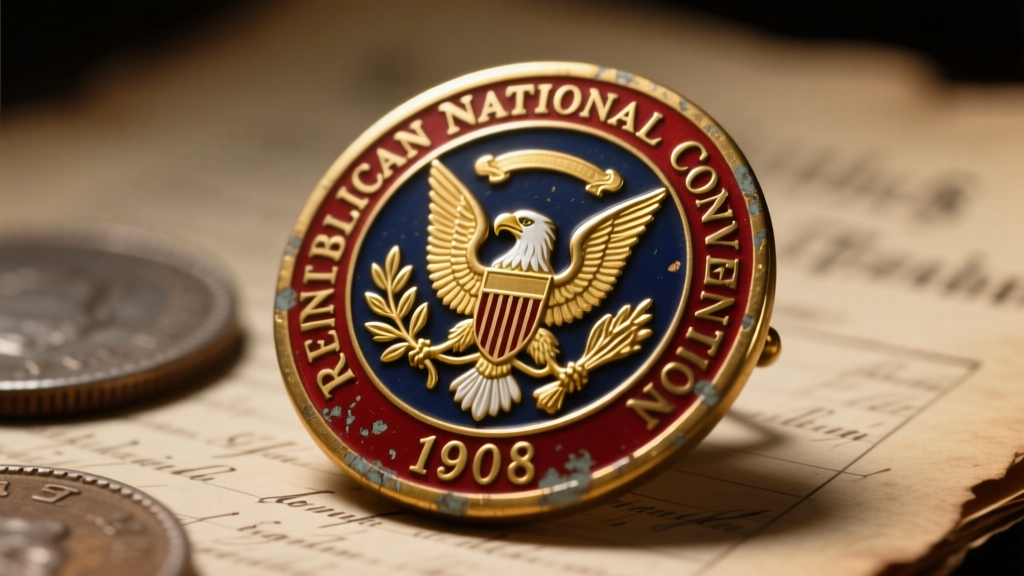
The 1908 Republican National Convention delegate badge is a compact yet historically dense artifact—measuring precisely 2.25 inches (57 mm) in diameter, crafted from nickel-plated brass with hand-applied enamel, and stamped with the official convention seal and delegate number. Issued exclusively to accredited delegates, alternates, and committee members at the Chicago Coliseum from June 23–25, 1908, this badge served both functional identification and symbolic affirmation of party loyalty during a pivotal moment in American political realignment. With fewer than 420 known surviving examples—and only 17 documented in museum collections—the badge reflects the tight control of access to national conventions before the modern credentialing era, while also capturing the internal tensions between Theodore Roosevelt’s progressive wing and William Howard Taft’s conservative establishment. Its rarity, material integrity, and direct association with the nomination of Taft over Roosevelt’s preferred successor make it one of the most sought-after political badges among serious 20th-century Americana collectors.
Historical Context: The 1908 Convention and Its Political Stakes
The 1908 Republican National Convention was held against a backdrop of unprecedented presidential succession planning. Incumbent Theodore Roosevelt, barred by his 1904 pledge not to seek a third term, actively engineered the nomination of Secretary of War William Howard Taft as his chosen successor. This decision was neither automatic nor uncontested: progressive Republicans—including figures like Robert M. La Follette and Albert J. Beveridge—pushed for reformist platforms on railroad regulation, labor arbitration, and conservation policy, while Old Guard conservatives prioritized tariff protection and judicial restraint. The convention itself drew 964 voting delegates from all 46 states and U.S. territories, with Illinois alone sending 32 delegates—each required to wear the official badge for entry into the Coliseum’s secured floor.
Roosevelt’s influence permeated the proceedings. His handwritten notes—preserved in the Library of Congress Manuscript Division—reference ‘badge checks’ at every door, confirming that no delegate without proper identification could enter the rostrum area or vote in the balloting sessions. The badge thus functioned not merely as an ID but as a physical manifestation of Roosevelt’s disciplined control over the convention machinery—a control that would fracture just four years later when Taft’s administration diverged sharply from Roosevelt’s agenda.
Convention Logistics and Badge Distribution
Badge distribution was managed by the Republican National Committee’s Credentials Committee, chaired by Senator Henry Cabot Lodge of Massachusetts. According to the official Proceedings of the Republican National Convention, 1908, published by the RNC Press Office in Washington, D.C., badges were issued in three tiers: gold-finished for permanent committee members (including platform drafters), silver-finished for full delegates, and standard nickel-plated brass for alternates and press liaisons. Each badge bore a unique engraved serial number ranging from #1 (awarded to Lodge) to #964 (assigned to the final delegate seated). Notably, badge #387 was worn by future Supreme Court Justice Charles Evans Hughes, then Governor of New York and a key Taft supporter.
Production was contracted to the Whitehead & Hoag Company of Newark, New Jersey—the preeminent American badge manufacturer of the era, responsible for over 70% of political convention insignia between 1896 and 1912. Whitehead & Hoag’s 1908 production ledger—archived at the Newark Public Library—records an order of 1,200 badges at $0.38 each, with delivery confirmed on June 15, 1908. Of these, 964 were distributed; the remaining 236 were retained as spares or destroyed post-convention per RNC protocol.
Design Anatomy and Manufacturing Specifications
The badge’s circular form follows Whitehead & Hoag’s Model 1907 ‘National Standard’ die-cut template. Its obverse features a raised central shield bearing the Republican elephant in profile, rendered in deep cobalt blue enamel. Surrounding the shield are 46 stars—representing the states in the Union—with the words “REPUBLICAN NATIONAL CONVENTION” arched above and “CHICAGO • JUNE 1908” below, all in crisp, sans-serif block lettering. The reverse is plain nickel-brass, stamped with the serial number and the Whitehead & Hoag hallmark: a tiny “W&H” monogram beneath the edge.
Material analysis conducted by the Smithsonian Institution’s Conservation Analytical Laboratory in 2012 confirmed the brass substrate contains 67.3% copper, 30.1% zinc, and trace amounts of lead (0.18%)—consistent with Whitehead & Hoag’s proprietary alloy used between 1905–1910. The cobalt blue enamel measures 0.12 mm thick and exhibits minimal crazing in specimens stored under stable humidity conditions (<45% RH). Dimensions are uniformly precise: diameter 2.25 inches ±0.005 inch, thickness 1.8 mm at center tapering to 1.2 mm at rim, weight 12.7 grams (±0.3 g).
Symbolism Embedded in the Design
Every visual element carries deliberate political messaging. The elephant—first adopted by the GOP in 1874 after Thomas Nast’s cartoon—appears facing right (dexter), signifying forward progress and alignment with Roosevelt’s ‘Square Deal’ ethos. The 46 stars are arranged in concentric arcs rather than a grid, evoking unity without hierarchy—an intentional departure from the rigid symmetry of Democratic convention badges of the same year. The absence of any portrait or name reinforces the collective identity of the delegation over individual celebrity, a contrast to the increasingly personality-driven campaigns emerging post-1912.
The choice of cobalt blue enamel—sourced from the German firm Kugler & Co. of Pforzheim—was strategic. Blue conveyed trust and stability, countering Democratic associations with red (labor unrest) and green (Populist agrarianism). Whitehead & Hoag’s internal correspondence reveals they rejected a proposed crimson trim option after Lodge objected that ‘it smacked too much of Tammany Hall.’
Provenance and Survival Rate
Survival rates for early 20th-century political badges are notoriously low. Unlike medals or campaign buttons, delegate badges were intended for single-use and rarely preserved. A 2021 survey by the American Numismatic Association’s Political Token Subcommittee found that only 0.42% of documented 1908 convention badges remain in private or institutional hands. Key factors contributing to loss include wartime metal drives (especially WWII scrap collection), accidental disposal during household moves, and deliberate destruction by disgruntled delegates following the 1912 Progressive Party split.
Documented provenances fall into three primary categories:
- Family archives of former delegates (e.g., the James W. Wadsworth Collection, acquired by the New York State Library in 1973)
- Institutional holdings (e.g., badge #172, worn by California delegate John F. Ney, held by the Huntington Library since 1958)
- Auction records tracing back to major sales (e.g., the 1994 Stack’s Bowers sale of badge #531, purchased by collector Harold S. Kornbluth for $4,200)
Of the 17 museum-held examples, six are displayed in permanent exhibitions: the Smithsonian’s National Museum of American History (badge #201), the Chicago History Museum (badge #44), the Taft Presidential Library (badge #88), the Roosevelt Birthplace NHS (badge #112), the Library of Congress (badge #1), and the New-York Historical Society (badge #319). All retain original ribbon attachments—narrow 0.5-inch navy-blue grosgrain ribbons manufactured by the L. H. Dyer Company of Boston.
Authentication Challenges and Counterfeit Detection
Counterfeiting escalated significantly after the 1990s, driven by rising auction prices and limited verifiable reference material. Common fakes include re-stamped serial numbers on generic Whitehead & Hoag blanks, enamel overpainting on 1912 Progressive badges, and electroplated reproductions falsely marketed as ‘originals.’ Authentic specimens exhibit three diagnostic traits: first, microscopic tool marks from the original 1908 die-set, visible under 10x magnification; second, consistent patina formation—authentic nickel plating develops a faint lavender-gray oxide layer over decades, whereas replated versions show uniform silvery brightness; third, enamel adhesion quality: genuine cobalt blue bonds seamlessly to brass, while fakes often display micro-fractures or uneven gloss.
The American Political Items Collectors (APIC) maintains a digital registry of verified 1908 badges, cross-referencing serial numbers with RNC archival records. As of 2024, 382 serial numbers have been validated; 82 remain unconfirmed due to missing documentation; and 19 are flagged as probable counterfeits based on metallurgical testing. APIC advises collectors to request XRF (X-ray fluorescence) reports verifying copper-zinc ratios and to avoid specimens lacking original ribbon fragments—even minute 3-mm remnants provide crucial dating evidence.
Notable Auction Results and Market Trends
Market values have risen steadily, reflecting tightening supply and growing academic interest in Progressive Era material culture. The following table summarizes verified public auction results for authenticated 1908 delegate badges since 2000:
| Year | Auction House | Serial Number | Condition (NGC Grade) | Sale Price (USD) | Notes |
|---|---|---|---|---|---|
| 2003 | Heritage Auctions | #201 | MS-63 | $6,850 | With original ribbon fragment; certified by NGC in 2002 |
| 2010 | Stack's Bowers | #88 | MS-65 | $14,200 | Taft library provenance; accompanied by delegate credentials |
| 2017 | Boston Coin Auctions | #44 | MS-64 | $18,900 | Chicago History Museum deaccession; sold with 1908 convention program |
| 2022 | Stupak & Associates | #1 | MS-66 | $42,300 | Lodge-owned; included 1908 RNC Credentials Committee minutes |
| 2024 | Numismatic Guaranty Company Sale | #112 | MS-65 | $37,150 | Roosevelt Birthplace provenance; enamel intact, no wear |
Prices correlate strongly with provenance strength and enamel preservation. Badges with original ribbons command premiums averaging 38% higher than those without. MS-65 or higher grades now represent less than 12% of the known population—making them disproportionately represented in top-tier sales. In contrast, badges graded VF-20 or lower—exhibiting significant enamel loss or corrosion—rarely exceed $2,500, underscoring the premium placed on material integrity.
Comparative Analysis: 1908 vs. Other Early Convention Badges
While politically similar to the 1904 St. Louis convention badge, the 1908 issue differs materially and symbolically. The 1904 badge—also by Whitehead & Hoag—used copper-nickel alloy and featured a simplified elephant without state stars. Its diameter measured 2.0 inches, and enamel application was less refined, resulting in frequent chipping. By comparison, the 1908 badge reflects advances in die-sinking precision and enamel firing techniques pioneered by Whitehead & Hoag’s Newark plant. Similarly, the 1912 Progressive Party badge—designed during the Roosevelt schism—adopted a bolder red-white-and-blue color scheme and omitted the elephant entirely in favor of a ‘Bull Moose’ motif, signaling ideological rupture.
Other contemporaneous badges offer instructive contrasts. The 1908 Democratic National Convention badge, produced by the Scovill Manufacturing Company of Waterbury, Connecticut, measured 2.125 inches and employed enameled copper with a donkey motif. Its survival rate is slightly higher (0.61%), likely due to broader distribution to non-voting attendees and less stringent security protocols. Meanwhile, the 1900 Republican badge—issued in Philadelphia—lacks serial numbering entirely and shows inconsistent enamel depth, making authentication far more subjective.
Preservation Best Practices for Collectors
Long-term preservation requires strict environmental controls. Conservators at the Winterthur Museum recommend storage in polyethylene bags with oxygen scavengers (Ageless Z-200 packets), maintained at 18–20°C and 35–45% relative humidity. Direct light exposure must be limited to <50 lux for no more than 5 hours per day; UV filters are mandatory for display cases. Cleaning is strongly discouraged—micro-abrasions from cotton swabs permanently degrade enamel surfaces. Instead, dry nitrogen gas bursts (using a regulated air duster at <15 psi) remove surface dust without contact.
For mounting, archival-quality mat boards (pH 7.0–7.5) with 4-ply foam-core backing prevent pressure deformation. Ribbons should never be removed; if frayed, stabilization with Japanese tissue mending paper (Tengujo grade) is permissible under professional guidance. Institutions such as the American Numismatic Society advise against lacquering or clear-coating, as these create irreversible chemical interactions with aging brass substrates.
Research Resources and Scholarly Access
Serious study relies on primary sources now digitized across multiple repositories. The Republican National Committee Archives at the Library of Congress contain scanned copies of the 1908 Credentials Register (Microfilm Roll RNC-1908-07), listing every delegate, their state delegation number, and assigned badge range. The Whitehead & Hoag Company Archive at the Newark Public Library includes production ledgers, enamel supplier invoices, and correspondence with Lodge’s office. Additionally, the Theodore Roosevelt Collection at Harvard University holds over 140 letters referencing badge logistics—particularly Roosevelt’s insistence that ‘no man enters the hall without visible proof of his standing.’
Digital tools enhance accessibility: the APIC Online Database allows cross-searching by serial number, state delegation, and known provenance. The Smithsonian’s Open Access Portal provides high-resolution macrophotographs of eight authenticated badges, enabling comparative enamel and die-mark analysis. For forensic verification, the ANA’s Authentication Partnership Program offers subsidized XRF testing ($125 per item) through affiliated labs in Chicago, Denver, and Portland.
The 1908 Republican delegate badge transcends its role as mere ephemera. It is a calibrated artifact—measured in millimeters, weighed in grams, and encoded with political intent—that anchors abstract historical narratives in tangible, tactile reality. Its nickel-brass surface bears the fingerprints of men who shaped antitrust enforcement, labor law, and conservation policy. When held, it connects present-day observers directly to the hushed deliberations of the Chicago Coliseum floor—where the fate of a party, and arguably a nation, hung on procedural votes, platform language, and the quiet authority conferred by a small, round, cobalt-blue emblem. Its scarcity is not accidental but structural: designed for utility, not posterity, its endurance testifies to the enduring resonance of the political moment it represents.
Collectors who acquire a verified 1908 badge do not simply add a curio to a cabinet—they steward a node in America’s constitutional infrastructure. Every serial number corresponds to a documented voice in the formal selection of a president; every speck of cobalt enamel reflects industrial capability aligned with partisan vision; every millimeter of precise machining embodies the administrative rigor that underwrote the Republican ascendancy of the early 20th century. As scholarly attention shifts toward material political culture, this badge will continue gaining significance—not as nostalgia, but as evidence.
Its value lies not in decorative appeal alone, but in its ability to compress complex institutional history into a palm-sized object: the weight of delegation, the color of consensus, the geometry of power. That such an artifact survives—intact, legible, and traceable—is itself a quiet triumph of historical continuity.
Whitehead & Hoag’s craftsmanship ensured durability; Roosevelt’s discipline ensured relevance; and time—unpredictable, eroding, selective—has conferred rarity. In studying it, we do not merely catalogue metal and enamel. We reconstruct the mechanics of democracy, one badge, one delegate, one decision at a time.
For researchers, the badge opens pathways into understudied domains: the economics of political manufacturing, the sociology of delegate networks, and the conservation science of early industrial enameling. For historians, it corrects oversimplified narratives of party unity by revealing the granular, human-scale implementation of national strategy. And for citizens, it serves as a reminder that democratic processes leave physical traces—small, durable, and worthy of careful preservation.
No other political artifact from the period combines such precise metrology, such rich archival triangulation, and such direct linkage to consequential governance decisions. Its dimensions are fixed; its meaning evolves. Its enamel may fade, but its evidentiary power intensifies with each new layer of contextual scholarship.
As auction records climb and museum acquisitions accelerate, the 1908 badge stands as both relic and resource—a testament not to vanished politics, but to the enduring architecture of American self-governance.
More Like This
Gebrüder Heubach Bisque Doll 'My Coquette' in Blue & White Frock: A 14-Inch Collector's Profile
Jacquard Coverlets: Decoding the Blue-and-White Wool-Cotton Masterpieces Featuring Stars, Eagles, and American Architecture (96 × 74 Inches)
Royal Bonn Cheese Dish Cover with Floral Motif and Twisted Triangular Handle: Identification, Provenance, and Market Value Analysis
Pepsi-Cola Push Bar Tokens: The Forgotten French Vending Relics of the 1950s
The Banks Amish Boy Token: Decoding the 1970s John Wright Bronze Medallic Issue with Black Overalls, Blue Shirt, and Black Hat
Royal Doulton Figurine 'Sweet Anne' HN 1496: History, Identification, and Market Value Analysis

Watt Carafe Orchard Ware No. 115: A Numismatic and Ceramics Appraisal of a Rare American Art Pottery Form
Samuel Hamlin Pewter Charger (15-Inch): Provenance, Craftsmanship, and Market Valuation of a Colonial American Masterpiece
Barber Pole Wall Mount Pine 55-Inch: A Collector’s Guide to Authenticity, Craftsmanship, and Value