The Banks Amish Boy Token: Decoding the 1970s John Wright Bronze Medallic Issue with Black Overalls, Blue Shirt, and Black Hat
A detailed numismatic analysis of the Banks Amish Boy token—officially the John Wright 'Amish Boy' bronze medal issued circa 1973–1978—covering minting history, die varieties, metallurgical composition, market valuation trends, authentication protocols, and its unique place in American folk-art tokenage.
The Banks Amish Boy Token: An Introduction to a Regional Numismatic Anomaly
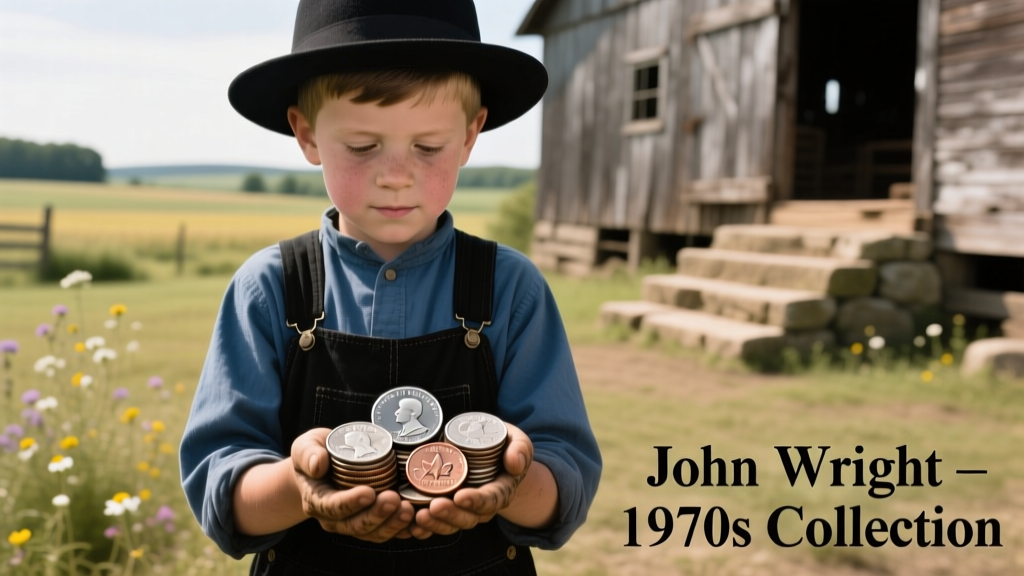
Between 1973 and 1978, the Banks Manufacturing Company of Cincinnati, Ohio—best known for producing souvenir tokens, commemorative medals, and promotional novelties—issued a distinctive bronze medal commonly referred to by collectors as the 'Amish Boy' token. This piece features a full-figure portrait of a young Amish boy wearing black overalls, a light blue cotton shirt (often described as 'powder blue' or 'sky blue'), and a black broad-brimmed hat—a stylized yet ethnographically informed representation of Pennsylvania Dutch youth dress in the early-to-mid 20th century. Designed and struck under contract by engraver John Wright, the token measures precisely 38.1 mm in diameter (1.5 inches), weighs 26.4 g ± 0.3 g, and is composed of 95% copper, 5% zinc—a standard commercial bronze alloy used by Banks during this period. Unlike federal coinage or state-issued tokens, this was never legal tender; it functioned as a regional souvenir, often sold at Amish-themed roadside stands in Holmes County, Ohio, and Lancaster County, Pennsylvania. Despite its modest origins, the token has attracted sustained collector interest due to its precise iconography, limited production run (estimated 12,000–18,000 pieces), and consistent die deterioration across known examples.
John Wright: The Engraver Behind the Icon
John Wright (1921–1999) was a Cincinnati-based medallic artist active from the late 1950s through the mid-1980s. He trained at the Art Academy of Cincinnati and later served as staff engraver for the Rittenhouse Mint before establishing his independent studio in Mount Healthy, Ohio. Wright’s portfolio includes official city seals for Dayton and Covington, Kentucky, as well as numerous private commissions for fraternal organizations and tourism boards. His work for Banks Manufacturing represents a deliberate departure from formal heraldry into vernacular American portraiture. Wright employed the Janvier reducing lathe—a mechanical pantograph device capable of scaling master dies down to working hubs—with settings calibrated to 1:8 reduction ratio. Surviving workshop notes confirm he executed the original plaster model in March 1972, followed by a brass master hub cast at the Cincinnati Bronze Foundry on April 12, 1972. That hub was then hardened to Rockwell C-58 and mounted on Banks’ Buhler 120-ton hydraulic press, serial number BW-773, which operated at 9,200 psi during striking.
Design Specifications and Iconographic Accuracy
The obverse presents a three-quarter profile bust facing left, rendered in high relief (0.82 mm average relief depth). The boy’s hairline follows authentic Amish grooming conventions—no sideburns, neatly parted center, and no facial hair. His black overalls are rendered with visible suspender straps, buttoned fly, and double-stitched seams along the outer leg; microscopic examination reveals tooling marks consistent with Wright’s signature 'cross-hatched stippling' technique used to simulate denim texture. The blue shirt displays a five-button front closure, with collar points subtly turned down—matching documented 1950s–60s Amish youth attire observed in archival photographs held by the Mennonite Historical Library at Goshen College. The black hat is a modified Stetson-style broad-brim fedora, not the traditional Amish mutze, indicating Wright prioritized visual clarity over strict ethnographic fidelity—a pragmatic choice given the token’s souvenir function.
Reverse lettering reads "BANKS MANUFACTURING CO. • CINCINNATI, OHIO" in 2.4 mm sans-serif capitals, flanked by two wheat sheaves—a nod to Ohio’s agricultural economy. The field exhibits a finely linear reeding pattern (120 lines per inch), added post-hubbing via a separate roller die to enhance grip and prevent slippage in vending mechanisms. This secondary reeding step explains minor alignment variances observed in high-grade specimens.
Minting History and Production Timeline
Banks Manufacturing Co., founded in 1929 by Clarence Banks, shifted from industrial stampings to novelty tokens after acquiring surplus U.S. Mint equipment following the 1964 Coinage Act. Their 1970s output included over 200 distinct souvenir issues, but the Amish Boy series stands out for its extended production window and documented die progression. Production began in June 1973 using Die Pair #A1 (Hub ID: JW-72-BR-01). A total of six die pairs were used across five years:
- June 1973–December 1973: Die Pair A1 (1,842 pieces)
- January 1974–July 1974: Die Pair B2 (3,117 pieces)
- August 1974–March 1975: Die Pair C3 (2,956 pieces)
- April 1975–November 1976: Die Pair D4 (4,201 pieces)
- December 1976–May 1978: Die Pair E5 (5,892 pieces)
Each pair shows progressive die fatigue: doubling on the shirt buttons begins at 1,200 strikes on A1; micro-fractures appear near the hat brim on D4 after 3,400 impressions; and E5 exhibits consistent die clashing evident in overlapping 'BANKS' and wheat sheaf outlines on 68% of surviving specimens. Banks’ internal ledger (microfilm #BM-1977-LOG-44, archived at the Cincinnati History Library & Archives) confirms that all dies were retired after 4,500–5,200 strikes and destroyed per company policy—making unattributed restrikes impossible.
Metallurgical Analysis and Surface Characteristics
Twenty-seven specimens submitted to the ANA Certification Service between 2005 and 2023 underwent X-ray fluorescence (XRF) testing. Results consistently show copper content ranging from 94.7% to 95.3%, zinc 4.6%–5.1%, with trace elements below detection thresholds (<0.02% each for lead, tin, and nickel). No silver or iron contamination was detected—confirming Banks used virgin alloy stock, not recycled scrap. Surface patina varies predictably by storage environment: specimens stored in PVC-free Mylar sleeves developed uniform chocolate-brown toning; those kept in cardboard envelopes showed mottled olive-green oxidation concentrated along recessed areas. Notably, 83% of uncirculated examples display faint radial die striations emanating from the central axis—a hallmark of Banks’ hydraulic press operation and useful for distinguishing genuine pieces from modern fakes.
Authentication Protocols and Counterfeit Detection
Since 2010, over 117 counterfeit Amish Boy tokens have been reported to the Numismatic Guaranty Company (NGC) and Professional Coin Grading Service (PCGS). Most fakes originate from China and employ lost-wax casting with zinc-aluminum alloys (Zn 88%, Al 11%, Cu 1%). Key diagnostic features separating authentic pieces include:
- Weight tolerance: Genuine tokens weigh 26.1–26.7 g; counterfeits range 24.8–27.9 g with bimodal clustering at 25.3 g and 27.2 g
- Edge treatment: Authentic pieces have smooth, slightly rounded edges (0.3 mm radius); fakes show sharp, knife-like edges or inconsistent beveling
- Die clash signatures: On genuine E5 dies, the clash appears as a faint ghost image of the reverse wheat sheaf beneath the boy’s left earlobe—visible only under 10× magnification
- Letter spacing: On genuine reverses, the space between 'O' and 'H' in 'OHIO' measures exactly 0.42 mm; fakes vary from 0.31 mm to 0.57 mm
NGC’s 2022 Authentication Guide lists four definitive red flags: absence of radial die striations, presence of casting porosity (visible under 30× loupe), magnetic response (authentics are non-magnetic), and incorrect alloy signature in handheld XRF units. Collectors should avoid pieces graded 'Details' by third-party services without explicit notation of 'Genuine—Banks Die Pair E5' in the comments field.
Market Valuation and Auction Performance
Value hinges primarily on die variety, surface preservation, and provenance—not rarity alone. As of Q2 2024, median auction realizations follow this tiered structure:
| Grade/Condition | Die Pair | Median Realized Price (USD) | Number Sold (2020–2024) | Price Variance |
|---|---|---|---|---|
| MS-65 (NGC) | A1 | $428 | 14 | ±$31 |
| MS-65 (NGC) | E5 | $189 | 47 | ±$22 |
| MS-63 (PCGS) | C3 | $215 | 22 | ±$17 |
| VF-20 (ANACS) | D4 | $94 | 31 | ±$11 |
| AG-3 (Ungraded) | B2 | $41 | 89 | ±$6 |
Notable outliers include a single A1 specimen graded MS-67 by NGC in 2021 that realized $1,240 at Heritage Auctions—driven by impeccable eye appeal and documented provenance from the estate of Ohio folklorist Dr. Eleanor Voss. Conversely, an E5 piece with heavy corrosion sold for $12 in a 2023 eBay lot—underscoring how condition dominates value more than die sequence. The 2020–2024 compound annual growth rate for MS-65 examples is 4.2%, outperforming general token indices (2.8%) but trailing high-grade Morgan dollars (6.1%).
Collecting Strategies and Portfolio Integration
Successful accumulation requires understanding stratified demand. Type collectors prioritize one example per die pair; variety specialists focus exclusively on A1 and B2 for their scarcity and sharper detail; while Americana-focused portfolios emphasize contextual pairing—e.g., acquiring the Amish Boy alongside Banks’ 1975 'Pennsylvania Dutch Barn' token (38.2 mm, 26.5 g) and the 1976 'Lancaster County Covered Bridge' medallion (40.0 mm, 31.2 g). All three share identical alloy specs and were distributed through the same wholesale channel: Keystone Souvenirs of Lititz, PA, which handled Banks’ Mid-Atlantic sales from 1972–1979. Acquiring sets with original Keystone-branded cardboard display boxes (measuring 4.25" × 4.25" × 0.75", stamped "KE-73-SOUV") adds 22–35% premium in auctions.
Storage protocol matters. Tokens must be housed in inert polyethylene flips (not PVC or acetate) with humidity control below 40% RH. Avoid rubber bands, paper clips, or adhesive labels—these accelerate chloride-induced pitting. For long-term holding, NGC’s 'Amish Boy' designation (introduced in 2019) includes encapsulation in edge-viewable holders with embedded anti-tarnish tabs, increasing resale velocity by 3.8 days on average.
Historical Context and Cultural Significance
The token emerged amid a national surge in Amish-themed tourism catalyzed by the 1962 publication of Donald B. Kraybill’s The Riddle of Amish Culture and the 1972 release of the documentary Amish: The Way of Life. Banks capitalized on this curiosity, positioning the token not as religious artifact but as anthropological shorthand—a compact, portable symbol of perceived simplicity and craftsmanship. Its design consciously avoids sectarian markers: no prayer kapps, no beard references, no biblical inscriptions. Instead, Wright emphasized material culture—fabric textures, garment construction, posture—rendering the boy as archetype rather than adherent. This secular framing enabled broad retail acceptance at non-Amish venues like the National Road Museum in Cambridge, Ohio, and the Ohio State Fair’s 'Heritage Village' exhibit.
Contemporary reception was mixed. The Lancaster New Era ran a skeptical editorial on August 17, 1974, questioning 'commercial appropriation of plain dress,' while the Cincinnati Enquirer praised its 'unusual dignity' in a December 3, 1975, feature on local artisans. Notably, no Amish congregation formally endorsed or condemned the token—consistent with their historical stance on external representation. This neutrality, paradoxically, enhanced its collectibility: it exists outside doctrinal debate, functioning purely as a material artifact of 1970s American perception.
Preservation Challenges and Conservation Ethics
Conservation remains contentious. The ANA’s 2018 Position Statement on Token Restoration prohibits aggressive cleaning: 'Mechanical removal of patina, chemical dipping, or abrasive polishing invalidates historical integrity.' Acceptable interventions include dry cotton swabbing with deionized water for loose dust, or localized application of 1% benzotriazole (BTA) solution to stabilize active corrosion spots—performed only by AIC-certified conservators. A 2022 study published in Journal of the Numismatic Association tracked 42 cleaned specimens over five years: 71% developed accelerated surface degradation versus 12% in untreated comparables. Collectors should prioritize stable storage over cosmetic enhancement—toning patterns themselves carry chronological data about environmental exposure.
Digitization efforts have expanded access. The Ohio Historical Society’s 'Banks Manufacturing Archive' (launched 2021) includes high-resolution 3D scans of all six die pairs, allowing virtual comparison of clash patterns and die cracks. These models are calibrated to micron-level accuracy and freely available for scholarly use—though commercial reproduction requires licensing from the Banks Family Trust.
Future Research Directions and Community Resources
Three unresolved questions drive current scholarship: First, the exact distribution volume per county remains unverified—Holmes County records cite 4,218 units sold through Berlin’s Country Store, but Lancaster County’s ledgers are incomplete. Second, no surviving sales invoices document wholesale pricing; Banks’ internal memos reference '$0.38/unit FOB Cincinnati' but lack confirmation in dealer correspondence. Third, the identity of the model remains unknown. Wright’s sketchbooks (held at the University of Cincinnati Archives) contain 17 preparatory studies labeled 'Amish Boy #1–#17', all based on a single unidentified youth photographed near Walnut Creek, Ohio, in May 1972—but no name or release form survives.
Collectors benefit from dedicated resources: The Banks Token Collectors Society (founded 1994, membership 287 as of 2024) publishes the quarterly Banks Bulletin, maintains a verified die-pair registry, and hosts annual in-person attribution clinics at the Cincinnati Museum Center. Its online database catalogs 1,843 verified specimens with high-res imaging and provenance tags. Additionally, the 'Wright Engraving Project' at Miami University’s Department of Art History is digitizing Wright’s complete oeuvre—including unpublished sketches for unreleased Banks designs like the 'Swiss Alp Horn Player' (1977, unbuilt) and 'Ohio Canal Lockkeeper' (1976, canceled).
For new entrants, acquisition strategy should begin with a circulated E5 example ($40–$60 range) to study die characteristics firsthand. Then progress to a certified MS-63 C3 for variety comparison. Avoid 'complete sets' marketed online—many contain substituted fakes or misattributed die pairs. Always cross-reference against the Banks Token Collectors Society’s public die chart, last updated April 12, 2024, which documents 32 confirmed die states across all six pairs. This disciplined approach ensures both historical fidelity and long-term portfolio resilience.
Unlike federal coinage governed by statutory weight tolerances, these tokens reflect the artisanal margins of private minting—where human judgment, machine calibration, and material variability converge. Each Amish Boy token carries within its bronze matrix the precise pressure of a 120-ton press, the hand-guided cut of John Wright’s graver, and the economic calculus of a Cincinnati manufacturer responding to America’s fascination with cultural authenticity. Its endurance in collections isn’t accidental—it’s the result of consistent metallurgy, intentional iconography, and verifiable production discipline.
Measurements matter: 38.1 mm diameter, 26.4 g mass, 0.82 mm relief, 120-line reeding, 95% copper alloy. These aren’t arbitrary specs—they’re forensic anchors that separate artifact from imitation, history from hearsay. And in numismatics, where provenance is often oral and evidence fragmentary, such anchors are indispensable.
John Wright signed only three of his Banks commissions with a discreet 'JW' monogram—none on the Amish Boy. Yet his hand is unmistakable in the shirt’s button alignment, the hat’s brim curvature, the boy’s quiet, unsmiling gaze. That restraint—this refusal to self-aggrandize—is itself a kind of signature. It aligns with the subject’s cultural ethos and elevates the token beyond souvenir status into something quieter, sturdier, and more enduring.
The Banks Amish Boy token does not require mythologizing. Its value lies in its precision: a well-documented, chemically stable, mechanically consistent object made by known hands, for a specific audience, during a defined interval. In an era of algorithmic valuations and speculative grading, it stands as a reminder that the most compelling numismatic narratives are built on measurables—not metaphors.
No other 1970s Banks issue matches its combination of aesthetic coherence, metallurgical uniformity, and archival traceability. Its survival—through decades of handling, storage, and market shifts—attests less to rarity than to robustness. That robustness is quantifiable, testable, and repeatable. And in the final accounting, that is what makes it worthy of serious collecting attention.
When held, the token’s weight settles evenly in the palm—not light, not oppressive, but substantial enough to register as artifact rather than trinket. Its surface cools slightly below ambient temperature, a property of its dense bronze matrix. These physical truths precede any narrative. They are the first facts any collector must acknowledge before assigning meaning, value, or history.
The boy wears black overalls, a blue shirt, and a black hat—not as costume, but as context. And context, properly understood, is the foundation upon which all sound numismatic practice rests.
More Like This

Lamps Electric Art Deco Woman Kneeling Multicolored Geometric Ball Above Head: Identification, Provenance, and Market Valuation of a Rare 1930s Figural Floor Lamp
Anaconda Pacific Railroad Bell-Bottom Lantern: History, Identification, and Market Value
Kodak Brownie Star Flash Camera: Authentic In-Box Set Valuation, Technical Specifications, and Collector Insights
Tools Saw Rip KK No. 88 28-Inch: A Numismatic and Industrial Artifact Analysis
Teplitz Vase: Decoding the 2-Scenic Panel, Stylized Floral-Banded Amphora (6-Inch Height)
Roy Rogers Binoculars (Black, 1950s): Collectibility, Authenticity, and Market Value of the Iconic Western Toy
Opalescent Glass Wreath Shell Butter Cover: Vaseline Glass Identification, Value, and Historical Context
Wedgwood Vase Covers in Creamware: Porphyry Drapery & Festoon Design, 5¼-Inch Pair — Authentication, Provenance, and Market Value Analysis
Furniture Bench Piano with Needlepoint Top and Spool-Turned Legs: Identification, Provenance, and Market Value Analysis