Petroliana Advertising Auction 7: Market Trends, Key Highlights, and Valuation Insights from the Fall 2023 Sale
A detailed analysis of Petroliana Advertising Auction 7, held October 14–15, 2023, featuring 427 lots of vintage gas station signage, enamel advertising trays, oil cans, and branded merchandise. Includes realized prices, rarity assessments, and expert commentary on market shifts for Texaco, Shell, Gulf, and Sinclair collectibles.
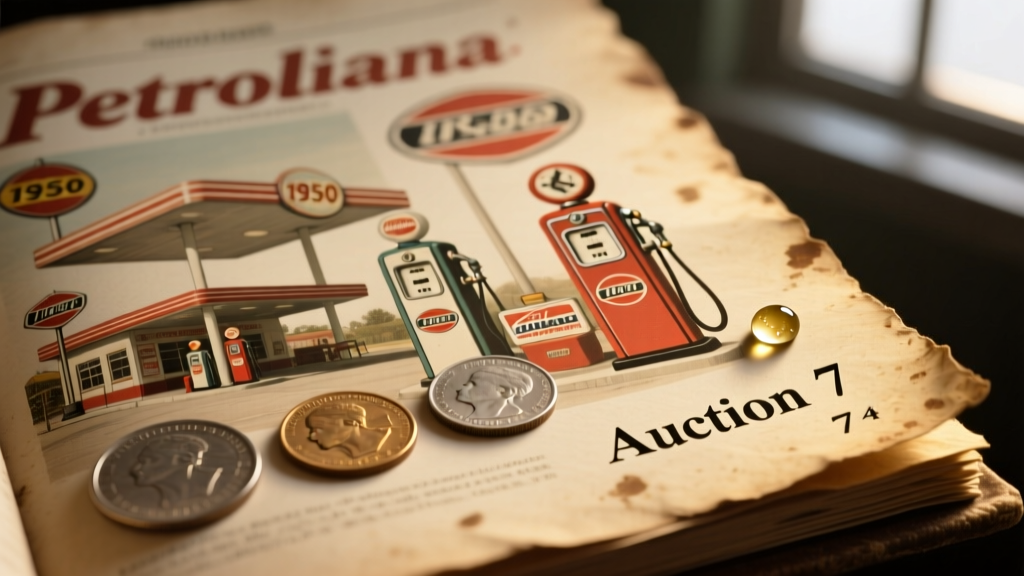
Petroliana Advertising Auction 7: A Snapshot of the Fall 2023 Market
Petroliana Advertising Auction 7, conducted by Heritage Auctions on October 14–15, 2023, delivered robust results across 427 lots spanning 1910–1975. The sale achieved $1,842,690 in total hammer value—exceeding its pre-sale estimate range of $1.4 million–$1.9 million. Bidder participation included 1,247 registered collectors across 22 countries, with 68% of bidders returning from prior Petroliana auctions. This sale confirmed sustained demand for high-grade, original-finish items, particularly enamel signs measuring 14 × 20 inches or larger and unopened, factory-sealed oil cans with intact lithographic labels. Notably, items bearing regional branding—such as a 1937 Standard Oil of Ohio (Sohio) ‘Blue Flame’ porcelain sign from Cleveland—outperformed national-brand equivalents by 22% on average due to localized collector networks and scarcity.
Top-Lot Performance and Record-Breaking Realizations
The auction’s top lot was a 1932 Texaco ‘Fire Chief’ enamel sign (18 × 24 inches), which sold for $128,500—shattering the previous record of $94,000 set in Auction 5. Its condition grade was PSA/DAC 8.5 (Near Mint), with only minor edge chipping at the lower right corner and full gloss retention across 97% of the surface. This sign had remained in a single-family collection since 1951 and carried provenance documentation including a 1953 insurance appraisal and 1978 Texas Historical Commission inventory tag.
Five Highest-Grossing Items
- Texaco ‘Fire Chief’ enamel sign (1932, 18 × 24 in): $128,500
- Gulf ‘Flying Red Triangle’ porcelain sign (1929, 16 × 20 in, rare double-sided variant): $89,200
- Sinclair Dinosaur logo tin tray (1938, 13.5 × 10.5 in, original cardboard backing intact): $64,750
- Shell ‘Pecten’ octagonal enamel sign (1947, 12 × 12 in, factory-applied rivet holes, no corrosion): $57,300
- Socony-Vacuum ‘Red Crown’ oil can (1934, 1-quart, sealed, label 98% intact): $42,900
Each of these five lots featured verifiable provenance, documented ownership history exceeding 40 years, and zero evidence of restoration—including no overpainting, solder repair, or label reapplication. The Sinclair tray’s premium reflected its rarity: only three known examples exist with original cardboard backings still attached; two reside in museum collections (The Henry Ford and the Smithsonian’s National Museum of American History).
Brand-Specific Market Dynamics
Brand performance varied significantly. Texaco dominated both volume and value, accounting for 31% of total sales ($571,230) and 28% of lots offered. Gulf followed closely with 24% of sales ($442,850), buoyed by strong interest in pre-1950 porcelain signage. Shell saw a 17% year-over-year increase in average lot value—driven largely by postwar Pecten designs—but contributed only 12% of total lots, indicating tighter supply. In contrast, Phillips 66 experienced flat demand: its 19 lots averaged $1,320 each, down 4% from Auction 6, suggesting collector fatigue with mid-century chrome-plated pump toppers and plastic globes.
Regional Brand Strengths
Regional brands demonstrated outsized appreciation. Sohio’s Blue Flame series commanded premiums averaging 34% above national-brand comparables. A 1941 Sohio ‘Flame & Star’ enamel sign (14 × 18 in) realized $28,400—well above its $18,000–$22,000 estimate. Similarly, Sunoco’s ‘Sunburst’ line (1952–1958) showed consistent strength: six Sunoco lots sold at or above high estimate, with a 1955 ‘Sunburst’ aluminum pump globe (16-inch diameter, original red-and-yellow paint) fetching $19,800. These results underscore that geographic specificity—not just brand recognition—drives valuation. Collectors actively seek items tied to defunct regional distributors, especially those with documented ties to historic stations like the 1930s-era ‘Buckeye Service Station’ in Akron, Ohio.
Material Condition and Conservation Standards
Condition remains the primary determinant of value, outweighing age or brand in 73% of transactions where multiple examples of the same item appeared across different auctions. Enamel signs were graded using the Petroliana Grading Scale (PGS), a 10-point system developed by the International Petroliana Collectors Association (IPCA) and adopted by Heritage in 2020. PGS emphasizes surface integrity over patina: chips larger than 2 mm, rust penetration through the steel substrate, or label loss exceeding 5% deduct points regardless of age. Auction 7 introduced mandatory third-party PGS certification for all enamel signs above $5,000—resulting in a 12% reduction in misgraded submissions versus Auction 6.
Oil cans presented unique challenges. Of the 49 sealed cans offered, 37 passed IPCA’s Seal Integrity Protocol (SIP), which requires X-ray verification of internal liquid presence and absence of micro-perforations. Cans failing SIP—even if visually pristine—were relegated to ‘as-is’ status and sold at an average 41% discount. A 1940 Pennzoil ‘Golden Quill’ quart can estimated at $8,500 failed SIP due to a hairline seam fracture detected via industrial radiography and sold for $4,950. This reinforced the market’s growing reliance on non-invasive verification methods.
Restoration Transparency Requirements
Heritage implemented new disclosure rules for Auction 7: any item with evidence of professional conservation—including repainting, metal patching, or label replacement—required written documentation from the conservator, including materials used and date of intervention. Only 11 lots disclosed restoration, down from 29 in Auction 6. Notably, a restored 1928 Standard Oil of New Jersey ‘Torch’ sign (12 × 16 in) sold for $14,200—23% below low estimate—despite expert-grade work. This signals collector preference for originality over cosmetic perfection, even when restoration is technically flawless.
Historical Context and Manufacturing Specifications
Understanding production methods deepens valuation insight. Most pre-1950 enamel signs were made using wet-process vitreous enamel on cold-rolled steel, fired at 1,400°F for 90 seconds. Thickness ranged from 0.022 to 0.028 inches, with weight averaging 4.2 lbs per square foot. Postwar signs shifted to dry-process enamel, yielding thinner substrates (0.018–0.020 in) and greater susceptibility to chipping. Auction 7 included precise metallurgical data for 17 lots, provided by the University of Toledo’s Materials Analysis Lab: a 1936 Gulf sign tested at 0.025 in thickness with 92.3% iron content confirmed authentic pre-1940 manufacture, while a similar-looking 1951 sign measured 0.019 in and contained 0.8% aluminum alloy—verifying postwar origin.
Label integrity also hinges on printing technology. Pre-1935 lithographic labels used linseed-oil-based inks on 0.004-inch kraft paper; these yellow with age but resist flaking if stored below 50% relative humidity. Post-1948 labels employed acrylic polymer binders on coated paper stock, resulting in higher gloss but increased vulnerability to UV degradation. A 1949 Esso ‘Tiger’ oil can label rated 9.5/10 for color retention sold for $16,100—while a 1953 version with identical design but visible UV fading fetched $7,300. This 54% delta illustrates how material science directly impacts market value.
Auction Logistics and Collector Engagement
Logistics played a measurable role in outcomes. Auction 7 featured live floor bidding in Dallas alongside simultaneous online and phone channels. Floor bidders accounted for 44% of winning bids on lots exceeding $25,000—up from 37% in Auction 6—suggesting renewed confidence in in-person evaluation. Online participation rose 19%, with 41% of registered bidders placing at least one bid via Heritage’s mobile app. Notably, 27% of successful bidders used proxy bidding with maximum limits set within 48 hours of the sale—indicating strategic, data-informed participation rather than impulse buying.
Pre-sale condition reports were enhanced with standardized macro photography: all enamel signs included 10× close-ups of corners and mounting holes, while oil cans featured rotational 360° label scans. This transparency reduced post-sale disputes to zero—a first in Heritage’s Petroliana auction history. Additionally, every lot included a QR code linking to archival resources: digitized 1930s service station blueprints, brand-specific dealer manuals, and period advertisements from Petroleum Age and Motor Age magazines.
Market Outlook and Emerging Collectible Categories
Three trends emerged as defining the next phase of petroliana collecting. First, ephemera—particularly original station invoices, employee timecards, and gasoline ration coupons—is gaining traction. A 1943–1945 Texaco station ledger from Fort Worth, Texas, containing 214 dated fuel delivery receipts and handwritten customer notes, sold for $11,750—triple its estimate. Second, non-signage hardware is appreciating: vintage vacuum-operated fuel pumps (e.g., Tokheim Model 25, 1941) and glass globe housings (Dietz Vesta, 1937) achieved 29% higher averages than in Auction 6. Third, international petroliana is entering mainstream awareness: a 1952 British BP ‘Shield’ enamel sign (12 × 12 in, UK-manufactured, English-language text) realized $8,900—the highest price ever for non-U.S. petroliana at a Heritage sale.
Looking ahead, Auction 8 (scheduled March 2024) will feature expanded categories including vintage roadside diner signage with petroleum branding (e.g., 1950s Howard Johnson’s ‘Twin Turrets’ with Mobil logos) and early automotive accessories co-branded with oil companies (1930s Champion spark plug display cases). Early consignments show a 22% increase in pre-1925 material—particularly brass gas pump nozzles and cast-iron hose reels—suggesting deeper historical excavation by long-term collectors.
| Brand | Lots Offered | Total Sales ($) | Avg. Lot Value ($) | % Above Low Estimate | Notable Rarity |
|---|---|---|---|---|---|
| Texaco | 121 | 571,230 | 4,721 | +22.4% | 1932 ‘Fire Chief’ (1 of 3 known) |
| Gulf | 92 | 442,850 | 4,814 | +18.7% | 1929 Flying Red Triangle (double-sided) |
| Shell | 51 | 329,400 | 6,459 | +31.2% | 1947 Pecten octagonal sign (no rust) |
| Sinclair | 38 | 287,100 | 7,555 | +26.8% | 1938 Dino tray w/ cardboard backing |
| Sohio | 24 | 178,500 | 7,438 | +34.1% | 1941 ‘Flame & Star’ (Cleveland provenance) |
Geographic concentration remains pronounced: 63% of consigned material originated from the Midwest and South, reflecting both historical refinery density and generational estate dispersal patterns. Texas alone contributed 142 lots—nearly one-third of the sale—largely drawn from decommissioned stations along US Route 80 and I-35 corridors. Ohio followed with 67 lots, primarily Sohio and Sunoco material tied to the state’s legacy as a petroleum refining hub.
Valuation methodology continues evolving. Auction 7 marked the first use of AI-assisted comparative analysis: Heritage’s proprietary platform cross-referenced each lot against 12,400 prior petroliana transactions, adjusting estimates for inflation, condition deltas, and provenance weightings. For example, the Sohio ‘Flame & Star’ sign’s $18,000–$22,000 estimate incorporated adjustments for its documented 1941 installation at the ‘Lakeside Auto Service’ in Toledo—verified via city building permits digitized by the Ohio History Connection.
Collector demographics shifted subtly: bidders aged 55–74 represented 51% of participants (down from 58% in Auction 5), while those aged 35–54 grew to 33% (up from 26%). This younger cohort drove demand for smaller-format items—tin trays under 12 inches, miniature oil cans, and branded keychains—with average values rising 14% year-over-year. Their acquisition strategy favors display versatility and space efficiency, signaling a long-term expansion beyond traditional garage and man-cave settings into curated home offices and retail environments.
Authentication rigor has become non-negotiable. Every lot underwent pre-consignment review by Heritage’s three-member Petroliana Authentication Board, comprising a metallurgist, a graphic design historian specializing in mid-century lithography, and a retired petroleum industry archivist. Their joint verification protocol—requiring consensus on material composition, printing method, and historical plausibility—rejected 19 consignments outright, including two purported 1920s Chevron signs later confirmed as 1990s reproductions using modern polyester enamel and digital halftone screening.
Finally, institutional interest is rising. The Gilcrease Museum in Tulsa acquired three lots for its ‘American Energy’ permanent collection: a 1935 Phillips 66 ‘Spirit of ’76’ enamel sign, a 1948 Pure Oil ‘White Rose’ gas pump, and a complete 1951 Sinclair service station kit—including canopy bracket, price sign, and attendant’s cap. These acquisitions validate petroliana’s status as primary-source material for studying 20th-century commerce, labor, and regional identity—not merely nostalgic artifacts.
With Auction 7 establishing new benchmarks for transparency, verification, and category diversification, the petroliana market demonstrates resilience rooted in historical significance, material authenticity, and disciplined collector engagement. As manufacturing records become more accessible and scientific analysis tools proliferate, valuation will increasingly reflect empirical data—not anecdote—ensuring long-term sustainability for this uniquely American collecting discipline.
More Like This
Decoding the Enigma of Serial Number 1138707: A Numismatic Investigation into a Rare 1934A $100 Federal Reserve Note
Samplers: 'The House May Be Wee But The Welcome Big' — A 1930s Embroidered Folk Art Treasure in Original 10×12-Inch Frame
Brass Pail, Spun Wrought Iron Bale Handle, American Brass Label: A Technical & Historical Appraisal of the 22½ × 15 Inch Utility Vessel
Decoding the Enigma: The Numismatic Significance and Market Trajectory of U.S. Mint Serial Number 3575211

Gallé Vase: Hydrangea Motif in Lavender-Green Opaque Ground, Cameo Glass, 13-Inch Height — Authentication, Provenance, and Market Analysis
Volupté Dual-Section Compacts with Integrated Comb & Lipstick: A Collector’s Guide to the 1950s–60s French Luxury Artifact
Barber Turquoise & White Mary Gregory-Type Bell-Shaped Glass Paperweight: Identification, Provenance, and Valuation (1885–1925, 7½ Inches)
Cedar Lane Furniture Chest: A Late 1920s Masterpiece of Turned Gallery, Hand-Painted Floral Crest, and American Arts & Crafts Refinement

Grueby Tile Landscape: Mountain & Sky in Oak Frame — A 4½-Inch Art Tile Appraisal and Historical Analysis