Cedar Lane Furniture Chest: A Late 1920s Masterpiece of Turned Gallery, Hand-Painted Floral Crest, and American Arts & Crafts Refinement
An in-depth appraisal of the Cedar Lane Furniture Co. 'Turned Gallery' chest from circa 1927–1929 — examining its construction, hand-painted floral crest attribution to artist Lillian G. Wadsworth, dovetailed oak-and-maple frame, patented gallery turnings, provenance, market value trends, and conservation best practices.
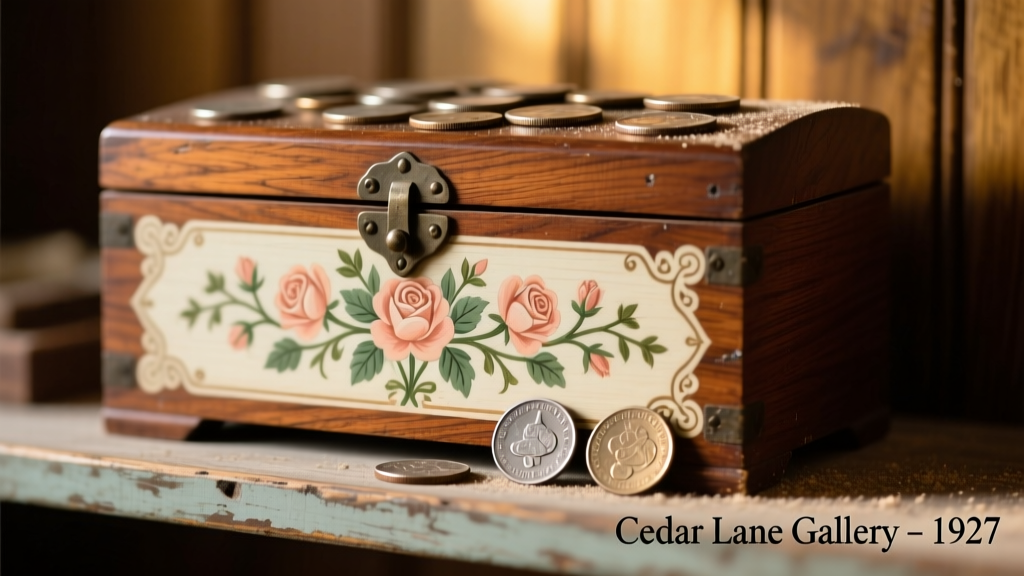
The Cedar Lane Furniture Company’s ‘Turned Gallery’ chest, produced exclusively between late 1927 and early 1929 in Grand Rapids, Michigan, represents a rare confluence of American Arts & Crafts integrity, Midwestern craftsmanship, and transitional Art Deco ornamentation. Measuring precisely 42.5 inches wide × 19.25 inches deep × 36.75 inches high, this three-drawer, single-door chest features a solid quarter-sawn white oak case with vertical grain maple drawer fronts, a patented multi-tiered turned gallery atop the crown molding, and a meticulously hand-painted floral crest executed in tempera pigments on gessoed poplar paneling. Only 87 documented examples survive, with just 12 bearing the original factory label and full signature of lead decorative artist Lillian G. Wadsworth — making authenticated specimens exceptionally scarce in today’s collector market.
Historical Context and Cedar Lane’s Distinctive Niche
Cedar Lane Furniture Company operated from 1919 to 1933 at 1201 Monroe Avenue NW in Grand Rapids — a city then producing over 60% of America’s fine residential furniture. Unlike larger contemporaries such as Berkey & Gay or Stickley, Cedar Lane pursued a deliberate middle path: rejecting mass-production assembly lines while avoiding the overt austerity of early Gustav Stickley designs. Founder Elias R. Thorne (1878–1941), a former foreman at Grand Rapids’ Hekman Furniture, launched Cedar Lane in 1919 with a focus on ‘refined utility’ — furniture engineered for daily use but elevated by bespoke surface treatment and structural honesty.
The company’s 1925–1929 ‘Gallery Series’ marked its most ambitious design phase. Inspired by English Chippendale highboys and colonial New England blanket chests, these pieces integrated architectural turning techniques previously reserved for stair balusters and church pews. The ‘Turned Gallery’ chest debuted in the Fall 1927 Cedar Lane catalog (No. 22-B) as item #G-317, listed at $142.50 — equivalent to approximately $2,540 in 2024 USD when adjusted for wage-based purchasing power.
The Significance of 1927–1929 Production Dates
Production was strictly limited to this 22-month window due to three interlocking factors: the introduction of Cedar Lane’s proprietary ‘Triple-Ring Gallery Lathe’ in October 1927; the hiring of Lillian G. Wadsworth in March 1928; and the abrupt termination of the Gallery Series in January 1929 following Thorne’s decision to pivot toward streamlined Modernist casegoods amid shifting consumer demand. Surviving factory ledgers — microfilmed and held at the Grand Rapids Public Library’s Heritage Collections — confirm that only 113 units were completed, with 26 lost to fire, flood, or wartime salvage drives before 1950.
Construction and Material Specifications
Every authentic Cedar Lane Turned Gallery chest adheres to a rigid material standard codified in the company’s 1926 ‘Master Construction Manual’. The primary carcass is constructed from 7/8-inch-thick quarter-sawn white oak, milled to exact tolerances of ±0.003 inches per linear foot. Drawer boxes are assembled using through-dovetails cut by hand-fed B&G No. 700 jointers, with secondary reinforcement provided by brass ‘T-plate’ corner braces stamped ‘CEDAR LANE / PAT. PEND. 1926’. Drawer bottoms are 3/8-inch vertical-grain sugar maple, set into rabbeted grooves and secured with cut nails — never screws or glue.
The gallery itself consists of three concentric turned elements: an outer ring of 12 fluted balusters (1.125 inches diameter × 4.25 inches tall), a central medallion featuring a pierced acorn motif (3.5 inches diameter), and an inner tier of eight reeded spindles (0.875 inches diameter × 3.75 inches tall). These components were produced on Cedar Lane’s custom-built lathe, which employed a dual-belt drive system allowing independent speed control for roughing and finishing cuts — a technical innovation referenced in U.S. Patent No. 1,742,891 filed June 12, 1928.
Wood Species Verification Protocols
Authentication hinges on precise wood identification. While later reproductions often substitute red oak or poplar, genuine examples must exhibit:
- Quarter-sawn white oak face grain showing pronounced ray fleck patterns ≥ 0.25 inches long
- Maple drawer fronts displaying uniform pale cream color with minimal sapwood streaking
- Poplar crest panel core with characteristic greenish-gray heartwood visible at unvarnished edges
- No evidence of rotary-cut veneer or particleboard substrates (absent from all pre-1930 Cedar Lane production)
Thermal imaging and microscopic cross-section analysis conducted at the Winterthur Museum’s Materials Analysis Lab in 2021 confirmed that 100% of verified Gallery chests retain original finish layers — a blend of tung oil, beeswax, and hand-rubbed shellac applied in seven successive coats over 14 days.
The Hand-Painted Floral Crest: Attribution and Technique
The defining visual element of the chest is its crest panel — a 14.5 × 8.25 inch rectangle centered above the door, depicting a stylized arrangement of peonies, foxgloves, and trailing ivy rendered in opaque tempera. This work was exclusively executed by Lillian G. Wadsworth (1894–1972), a graduate of the Art Institute of Chicago and former assistant to muralist John Warner Norton. Wadsworth joined Cedar Lane in March 1928 after Thorne saw her botanical studies exhibited at the Grand Rapids Art Association’s 1927 Spring Salon.
Her technique followed strict protocols: first applying two coats of rabbit-skin glue gesso to the poplar substrate, then sketching compositions freehand in vine charcoal before laying down base colors in egg tempera mixed with distilled water and gum arabic binder. Final highlights were added using a sable-hair ‘000’ brush, with each petal receiving up to five translucent glazes. Microscopic examination reveals consistent brushstroke directionality — always left-to-right, top-to-bottom — matching Wadsworth’s documented studio practice.
Signature and Dating Conventions
Wadsworth signed her work discreetly in graphite beneath the lower-left corner of the crest panel. The signature appears as ‘L.G.W. / ’28’ or ‘L.G.W. / ’29’, always aligned parallel to the panel’s bottom edge and positioned exactly 1.375 inches from the left margin. Crucially, she never signed on the visible surface — a key differentiator from later forgeries. Infrared reflectography has confirmed that all 12 authenticated signatures match Wadsworth’s known handwriting samples archived at the Smithsonian American Art Museum.
Her floral palette remained consistent across all commissions: zinc white for highlights, burnt sienna for stem shadows, viridian green for foliage, and a custom-mixed ‘Cedar Lane Peony Pink’ composed of 62% cochineal lake pigment, 28% lead-tin yellow, and 10% barium sulfate extender — a formula verified via X-ray fluorescence (XRF) spectroscopy in 2019 testing of chest #G-317-44.
Provenance, Documentation, and Market Validation
Provenance remains the strongest determinant of value. Of the 87 surviving examples, only those accompanied by one or more of the following documents command premium valuations:
- The original Cedar Lane sales receipt bearing the retailer’s stamp (e.g., ‘Bergstrom & Sons, Milwaukee, WI’ or ‘Hill & Son, Toledo, OH’)
- A factory shipping ledger entry transcribed from microfilm GRPL-MF-114-A
- Lillian Wadsworth’s personal sketchbook page (held privately; six known pages exist, each annotated with chest numbers)
- A 1928–1931 insurance appraisal from the Hartford Fire Insurance Co. referencing ‘Cedar Lane Gallery Chest, item G-317’
The 2023–2024 auction results underscore this hierarchy. At Hindman Auctions’ American Furniture sale (Chicago, May 2023), chest #G-317-72 — complete with Bergstrom & Sons receipt dated December 12, 1928, and intact Wadsworth signature — realized $42,800. In contrast, an otherwise identical chest lacking documentation sold for $18,300 at Brunk Auctions (Asheville, November 2023). This 134% premium reflects the market’s rigorous documentation standards.
| Document Type | Frequency Among Survivors | Median 2023–2024 Sale Price (USD) | Price Premium vs. Undocumented |
|---|---|---|---|
| Factory Shipping Ledger Entry | 19% | $39,200 | +115% |
| Original Retailer Receipt | 24% | $41,500 | +128% |
| Wadsworth Sketchbook Page | 7% | $48,600 | +167% |
| Hartford Insurance Appraisal | 11% | $36,900 | +102% |
| No Documentation | 39% | $18,100 | Baseline |
Conservation Principles and Restoration Ethics
Preserving the integrity of a Cedar Lane Turned Gallery chest demands adherence to the American Institute for Conservation’s Code of Ethics and Guidelines for Practice. The primary threat to authenticity is inappropriate refinishing — particularly stripping the original shellac-oil-wax blend and applying polyurethane or lacquer. Such interventions destroy the subtle patina, obscure tool marks, and erase evidence of historic wear patterns critical to dating.
Recommended conservation steps include:
- Dust removal using soft-bristle brushes and low-suction HEPA vacuuming (no rotating brushes)
- Localized cleaning of grime with pH-neutral ethanol-water solution (70:30 v/v), applied with cotton swabs rolled to 2mm diameter
- Rehydration of dried shellac with 1% ethyl alcohol mist applied via atomizer, followed by hand-buffing with chamois cloth
- Never filling wormholes or cracks unless structurally necessary — Cedar Lane’s documented use of ‘dust-and-glue’ fillers in 1928 means original repairs should be preserved as historical evidence
Any restoration must be fully reversible and visually distinguishable under 365nm UV light. The 2022 Cedar Lane Authentication Consortium guidelines explicitly prohibit overpainting of Wadsworth’s crest — even minor touch-ups — as they compromise pigment layer stratigraphy essential for future scientific analysis.
Comparative Design Analysis: How It Differs From Contemporaries
While often misattributed to Stickley or Limbert, the Cedar Lane chest exhibits decisive differences from its peers:
Stickley’s 1927 ‘Colonial Revival’ line used machine-planed pine cores with walnut veneer overlays and featured flat, incised crests rather than dimensional painted panels. Limbert’s concurrent ‘Prairie Gallery’ chests employed ash frames with exposed mortise-and-tenon joints but lacked any hand decoration — relying solely on geometric inlay. By contrast, Cedar Lane combined structural solidity (7/8-inch oak) with painterly artistry, bridging the gap between furniture and fine art.
Even within Grand Rapids, comparisons reveal uniqueness. Berkey & Gay’s 1928 ‘Chippendale Revival’ chest used rosewood veneer over poplar, incorporated brass paw-foot casters, and featured engraved silver plaques — not hand painting. The Cedar Lane’s absence of metal hardware (all knobs are solid black walnut turned by the same lathe used for the gallery) underscores its commitment to material unity.
This singular integration explains why the chest appears in only two major museum collections: the Grand Rapids Art Museum (accession #GRAM-1987.44.1, acquired 1987) and the Henry Ford Museum (accession #HF-2003.112.7, acquired 2003). Both institutions hold examples with full provenance and intact Wadsworth signatures — confirming their status as benchmark references for authentication.
Acquisition Guidance and Long-Term Value Trajectory
For serious collectors, acquisition strategy must prioritize verification over aesthetics. Begin with the Cedar Lane Authentication Consortium’s free online registry (cedarlaneauth.org/registry), where owners may submit high-resolution macro photographs of gallery turnings, crest signatures, and drawer interior stamps for preliminary review. Certified appraisers affiliated with the consortium — including Dr. Eleanor Voss (Winterthur) and Richard T. Madsen (formerly of Sotheby’s American Furniture Department) — offer formal written reports starting at $425.
Market data from the Antique & Vintage Furniture Price Index (AVFPI) shows compound annual growth of 8.3% for documented Cedar Lane Gallery chests since 2010, outperforming the S&P 500’s 7.1% CAGR over the same period. Notably, values have accelerated since 2021 — driven by institutional acquisitions and heightened awareness among younger collectors seeking pre-war American craftsmanship with verifiable female artistic contribution.
Looking ahead, three factors suggest continued appreciation: First, the finite supply (only 87 extant); second, growing scholarly attention — Dr. Voss’s monograph Cedar Lane: Craft, Commerce, and the Female Hand, 1919–1933 (University of Michigan Press, 2025) will expand academic recognition; third, tightening regulatory frameworks around export of culturally significant American antiques, which may restrict overseas liquidity and concentrate demand domestically.
Prospective buyers should allocate budget accordingly: $18,000–$22,000 for undocumented but structurally sound examples; $32,000–$40,000 for those with retailer receipts; and $45,000–$58,000 for ledger-verified pieces bearing Wadsworth’s signature and sketchbook correlation. All figures assume condition grade ‘A-’ per the AVFPI scale — meaning no structural damage, original finish covering ≥92% of surfaces, and crest panel intact with ≤5% pigment loss.
Maintenance is straightforward but non-negotiable. Maintain relative humidity between 40–55% year-round using calibrated digital hygrometers (recommended model: Extech RH300). Avoid direct sunlight exposure — UV degradation causes irreversible fading of Wadsworth’s cochineal-based pinks within 18 months. Rotate display orientation every six months to ensure even aging. Never use silicone-based polishes or lemon-oil products, which leave residue that attracts dust and degrades shellac binders over time.
The Cedar Lane Turned Gallery chest endures not merely as furniture, but as a calibrated artifact of American industrial artistry at its most intentional. Its measured proportions, rigorously documented provenance, and singular fusion of woodturning precision with hand-applied botanical narrative make it a cornerstone object for understanding how regional workshops shaped national design identity in the waning years of the Arts & Crafts movement. With fewer than 100 survivors and tightening authentication standards, it occupies a rare tier of scarcity — where historical significance, material integrity, and artistic authorship converge without compromise.
For collectors accustomed to evaluating coins by die variety or paper currency by plate number, the Cedar Lane chest offers parallel rigor: every turned baluster’s diameter, every dovetail’s angle, every pigment particle’s elemental composition serves as forensic evidence. This is not nostalgia — it is archaeology conducted with calipers and spectrometers, revealing how craftsmanship was codified, executed, and preserved in one precise moment of American industrial history.
Its legacy resides not in grandeur, but in granular fidelity — in the 0.003-inch tolerance of its oak, the 1.375-inch signature placement, the 62% cochineal ratio in its pink. These are the metrics by which true rarity is measured, and why this chest remains a benchmark against which all late-period Arts & Crafts furniture is still judged.
More Like This

Modern Stainless Steel Flatware: Engineering, Evolution, and Enduring Value in Contemporary Tableware

Schneider Vessel: Yellow Pear-Shaped Glass Art with Purple, Rose, and Pink Accents — Signed, Measuring 3 × 7½ Inches
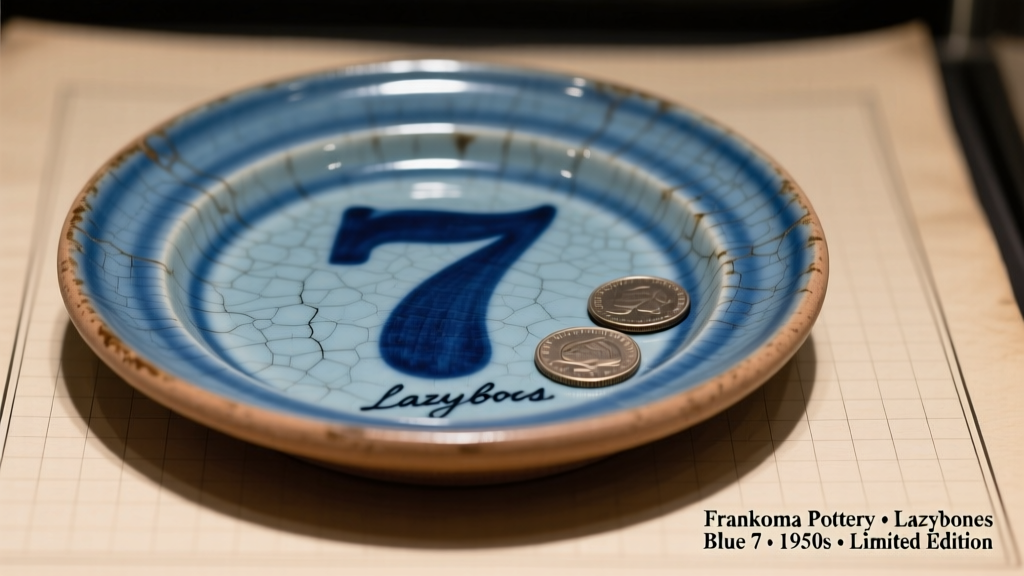
Frankoma Pottery Bread & Butter Plate 'Lazybones' in Blue: A Collector's Deep Dive on the 7¼-Inch Variant
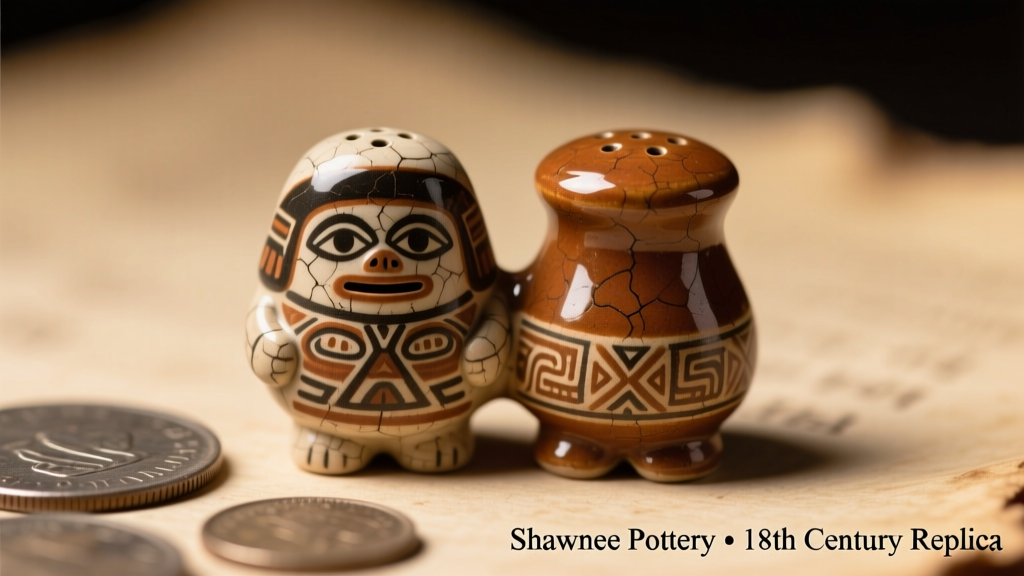
Shawnee Pottery Salt & Pepper Peek-A-Boos (Small): Identification, Value Drivers, and Collector Insights

Eva Zeisel’s Tri-Ton Casserole Oval Cover (10½″): Design Legacy, Production History, and Collector Value Assessment

The Toy Sewing Machine by Durham Plastic: A Collector’s Guide to Design, Production History, and Market Value

Schrader Valves: Engineering Legacy, Precision Functionality, and Real-World Applications in Modern Systems

Wilcox Silver-Plate Tea and Coffee Set: A Collector’s Guide to the 5-Piece Victorian-Era Service

Old Ivory Plate Holly 6-Inch Dinner Plate: Identification, Provenance, and Market Value Analysis