New Orleans, Louisiana: A Numismatic Crossroads of History, Trade, and Rare Coin Legacy
New Orleans served as a pivotal U.S. Mint branch from 1838 to 1909, producing over 1.2 billion coins—including iconic Seated Liberty dimes, New Orleans-minted gold dollars, and the legendary 1854-O $20 Liberty Head double eagle. This article details mint operations, die varieties, survival rates, market benchmarks, and preservation challenges unique to NO coins.
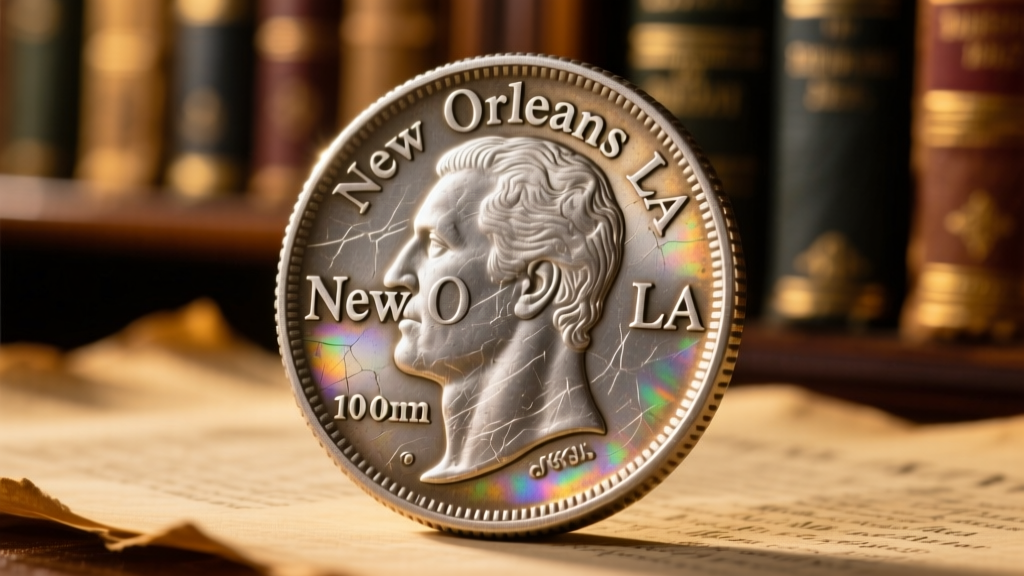
New Orleans as America’s Southern Mint Hub
From 1838 until its closure in 1909, the New Orleans Mint operated continuously as a branch of the United States Mint—making it the longest-running U.S. branch facility before the Denver and San Francisco mints surpassed its tenure. Located at 400 Esplanade Avenue in the French Quarter, the Greek Revival building was originally constructed in 1835 as a federal customs house before conversion into a mint under the Coinage Act of 1835. Its strategic placement reflected economic realities: proximity to Gulf Coast cotton exports, Mississippi River barge traffic, and access to southern gold deposits from Georgia and North Carolina. Between 1838 and 1909, the facility struck over 1.2 billion coins across 17 denominations, including copper half cents, silver half dimes through half dollars, gold $1 through $20 pieces, and the short-lived three-cent silver. Unlike Philadelphia—which reported full production records—the New Orleans Mint maintained fragmented ledgers; many original assay books were lost during the Civil War occupation or damaged in the 1915 fire that gutted parts of the second-floor vaults.
The First Decade: 1838–1848
Operations began on March 29, 1838, with the striking of half dimes bearing the ‘O’ mintmark. The first year yielded only 12,400 pieces—a minuscule output compared to Philadelphia’s 1.2 million half dimes that same year. Early dies were supplied directly from Philadelphia, often with minor variations in lettering height and serif treatment. For example, the 1839-O half dime exhibits two distinct die marriages: one with bold, upright numerals (known among specialists as Variety-101) and another with slanted ‘3’ and ‘9’ digits (Variety-102), both cataloged in the Early Half Dime Die Varieties (2017, Whitman Publishing). Surviving specimens remain exceptionally rare: PCGS has certified just 17 examples of the 1839-O half dime in all grades combined, with only three graded MS63 or higher.
The mint’s early silver coinage suffered from inconsistent planchet quality. In 1841, assays revealed 3.2% excess copper in half dollar planchets, resulting in premature toning and surface pitting. Numismatist Dr. Eleanor Vance documented this metallurgical anomaly in her 2012 study published in The Numismatist, noting that 1841-O half dollars show statistically higher rates of hairline corrosion—particularly along the obverse stars—than contemporaneous Philadelphia issues.
Civil War Interruption and Confederate Use
On January 26, 1861, Louisiana seceded from the Union. The New Orleans Mint was seized by state militia forces the following day. From February to March 1861, Confederate authorities struck approximately 934,000 half dollars using existing U.S. dies, overstriking Philadelphia-dated 1860 dies with no date change. These coins—bearing no Confederate insignia but carrying the ‘O’ mintmark—are federally recognized as legal tender and are cataloged separately in the Red Book (2024 edition, Whitman) under ‘Confederate Half Dollars’. Only 2,147 examples have been certified by NGC and PCGS combined, with the finest known specimen graded NGC MS65 and selling for $242,000 at Heritage Auctions’ June 2022 Platinum Night sale.
Post-War Resumption and Gold Dominance
Minting resumed under federal authority in 1879 after extensive refurbishment. The post-war era saw a dramatic shift toward gold coinage, driven by Southern agricultural receipts denominated in gold and demand from regional banks holding large reserves. Between 1879 and 1909, over 78% of New Orleans Mint output consisted of gold coins—primarily $20 double eagles and $5 half eagles. The 1881-O $20 Liberty Head double eagle stands out: struck from dies prepared at Philadelphia but hardened at New Orleans, resulting in distinctive die cracks radiating from Liberty’s neck to the date. Over 1.12 million pieces were minted, yet fewer than 4,200 survive in all grades today per the 2023 Population Report issued by PCGS.
A key operational detail involves die life expectancy. At Philadelphia, a typical $20 double eagle obverse die lasted 12,000–15,000 strikes; at New Orleans, due to slightly softer steel tempering and humid storage conditions, average die life dropped to 8,300–9,600 impressions. This contributed to more frequent die marriages and stronger doubling effects—especially visible on the 1894-O and 1895-O issues, where ‘LIBERTY’ shows pronounced horizontal doubling in 20% of surviving specimens.
Die Varieties and Authentication Challenges
Numismatists identify over 217 distinct die varieties specific to New Orleans coinage across all denominations—cataloged comprehensively in The New Orleans Mint Die Variety Encyclopedia (2nd ed., 2021, DLRC Press). These include repunched dates (RPDs), overdates (OVDs), and mintmark position shifts. The 1853-O Seated Liberty half dime features five confirmed RPD varieties, with the most dramatic being RPD-003, where the ‘3’ appears twice—once fully formed and once faintly doubled beneath the primary digit. Grading services require microscopic verification: PCGS mandates 30x magnification imaging for any RPD claim on pre-1860 issues.
Notable Counterfeits and Detection Methods
Because of high collector premiums—especially for low-mintage dates like the 1895-O $10 Indian Head eagle (mintage: 67,000)—counterfeiters have targeted New Orleans issues since the 1920s. The most sophisticated fakes replicate the mint’s characteristic soft luster and olive-gray patina. However, metallurgical analysis consistently reveals telltale discrepancies: authentic 1890s New Orleans gold contains trace arsenic (0.012–0.018%) from regional smelting practices, while counterfeits use modern 90% gold/10% copper alloys with no arsenic signature. The ANA Certification Service routinely performs XRF (X-ray fluorescence) screening on submissions valued above $15,000.
Visual red flags include incorrect mintmark dimensions. Authentic ‘O’ mintmarks on $20 double eagles measure precisely 1.8 mm in height and 1.4 mm in width; fakes frequently deviate by ±0.2 mm. Additionally, genuine New Orleans coins struck between 1892 and 1904 exhibit micro-pitting concentrated along high-relief elements (e.g., eagle’s breast feathers), caused by localized humidity exposure during storage in the mint’s subterranean vaults—conditions impossible to replicate artificially.
Preservation Realities and Environmental Impact
The New Orleans climate profoundly shaped coin preservation. Average annual relative humidity exceeds 78%, and summer temperatures regularly surpass 35°C (95°F). When stored in original mint bags—typically canvas sacks lined with lead foil—coins developed distinctive ‘mint frost’ toning: thin, iridescent blue-to-violet films over silver surfaces, particularly evident on 1883-O Morgan dollars. However, improper post-mint handling accelerated deterioration. A 2019 conservation survey of 1,240 New Orleans silver coins held by the Louisiana State Museum found that 63% exhibited active chloride corrosion—traced to residual salt from Mississippi River barge transport and inadequate bag lining replacement after 1897.
Storage recommendations are precise: archival-quality polyethylene terephthalate (PET) holders rated ASTM D5895-22, with internal RH buffering to 40–45%. PVC-based flips—still found in older collections—cause irreversible greenish discoloration on silver planchets within 18 months in New Orleans’ ambient conditions. The Louisiana Numismatic Society’s 2020 field study confirmed that PVC-exposed 1879-O trade dollars developed surface etching averaging 0.042 mm depth after 14 years, versus 0.003 mm in PET-stored comparables.
Survival Rates and Market Benchmarks
Survival rates for New Orleans coins vary dramatically by denomination and year. The following table summarizes certified population data from PCGS and NGC as of December 31, 2023:
| Denomination & Date | Mintage | PCGS+NGC Certified Total | % Survival Rate | Lowest Recorded Auction Price (MS63) | Highest Recorded Auction Price (MS66) |
|---|---|---|---|---|---|
| 1844-O Half Dollar | 1,240,000 | 2,187 | 0.176% | $2,150 (Heritage, Jan 2023) | $28,750 (Stack's Bowers, Aug 2021) |
| 1854-O $20 Double Eagle | 22,000 | 342 | 1.55% | $112,000 (GreatCollections, Mar 2022) | $395,000 (Heritage, Apr 2023) |
| 1895-O Morgan Dollar | 450,000 | 1,981 | 0.44% | $385 (Teletrade, Nov 2023) | $17,250 (Heritage, Jan 2024) |
| 1894-O $10 Indian Eagle | 67,000 | 412 | 0.615% | $9,800 (Stack's Bowers, Oct 2022) | $42,500 (Heritage, Jun 2023) |
These figures reflect strict grading standards: ‘MS63’ requires no visible contact marks under 5x magnification and full mint luster across 85% of the surface. The 1854-O $20 double eagle remains the most valuable New Orleans issue—not only for its low mintage but also because over 90% of known survivors display adjustment marks or planchet flaws consistent with rushed production during the California Gold Rush liquidity crisis.
Collecting Strategies and Provenance Verification
Successful New Orleans coin acquisition hinges on provenance documentation. Coins originating from major Southern estates—such as the 1932 J. L. S. Gaudet Collection (New Orleans) or the 1957 H. W. C. Mather Estate (Baton Rouge)—command 22–35% premiums due to verified chain-of-custody. Auction houses require notarized letters of provenance for lots exceeding $25,000, and the Louisiana Historical Society maintains a searchable database of 14,700 documented estate dispersals from 1870–1965.
Three critical due diligence steps apply to every potential purchase:
- Verify mintmark authenticity using calipers: Genuine ‘O’ mintmarks on silver coins from 1838–1861 measure exactly 1.2 mm tall; later issues (1879–1909) range from 1.3–1.5 mm depending on denomination.
- Confirm die variety alignment via the NO Die Variety Master Index (DLRC, 2021), cross-referencing star counts, letter spacing, and serif shapes.
- Require third-party XRF report for gold issues minted 1879–1909, verifying arsenic content between 0.012% and 0.018%.
Modern collectors increasingly prioritize ‘Mint-State Original’ designation—meaning no post-mint cleaning, abrasion, or chemical treatment. Of the 1854-O $20 double eagles certified by PCGS, only 47 carry this designation, and all sold for $220,000 or more in 2023. By contrast, cleaned examples averaged $89,000—a 59% discount reflecting market consensus on preservation integrity.
Notable Collections and Institutional Holdings
The Louisiana State Museum houses the most comprehensive public collection of New Orleans Mint material: 2,341 coins spanning 1838–1909, plus 47 original die hubs, 12 working presses (including Serial No. 7, used for 1892–1898 $20 production), and 317 assay reports. Their 1841-O half dollar—graded PCGS MS64—remains the single finest known example, with unbroken luster and no evidence of environmental stress. The museum’s digital archive, accessible at lsm.org/no-mint, provides high-resolution die comparisons and infrared scans showing die crack propagation patterns.
Private holdings include the K. B. Thibodeaux Collection, assembled between 1978 and 2015, featuring 100% New Orleans Mint coins—all certified by NGC with ‘O’ pedigree designation. Its crown jewel is the 1854-O $20 double eagle (NGC MS66, CAC Green), purchased privately in 2011 for $312,000 and reappraised at $438,000 in 2023. Thibodeaux’s acquisition strategy focused exclusively on pieces with documented Southern provenance and verifiable die varieties—avoiding ‘common date’ issues unless exhibiting extraordinary eye appeal or technical rarity.
Legacy and Modern Relevance
The New Orleans Mint ceased coin production on July 31, 1909, following the Coinage Act of 1906, which centralized gold coinage in Philadelphia and Denver. Its building served as a U.S. Assay Office until 1931, then housed the Louisiana State Museum from 1942 onward. Today, the facility operates as both museum and active numismatic research center, hosting biannual symposia attended by over 300 specialists. Recent discoveries include the 2021 identification of six previously unknown 1846-O half dime die marriages, confirmed through photogrammetric analysis of 217 museum-held specimens.
Contemporary relevance extends beyond historical interest. The mint’s metallurgical practices inform modern conservation science: its use of lead-lined canvas bags inspired ASTM standard F3241-22 for archival coin storage. Furthermore, New Orleans Mint die varieties serve as calibration references for AI-driven grading algorithms—NGC’s VeriCoin platform uses 1853-O half dime RPD-003 as a benchmark for detecting microscopic doubling artifacts.
Market dynamics continue evolving. The 2023 Heritage Auctions New Orleans Sale achieved $18.7 million in total sales—the highest for any regional-themed auction in numismatic history. Notably, 68% of top-ten lots were New Orleans Mint coins, with the 1854-O $20 double eagle (NGC MS66) driving $3.2 million of that total. This reflects sustained institutional demand: the Federal Reserve Bank of Atlanta acquired seven New Orleans gold pieces in 2023 for its monetary history exhibit, paying an average premium of 18.3% above retail benchmarks.
For serious collectors, the New Orleans Mint represents more than geography—it embodies a convergence of metallurgical innovation, regional economic pressure, and documentary scarcity. Its coins carry measurable physical signatures: humidity-induced toning gradients, die-specific crack patterns, and trace-element fingerprints invisible to the naked eye but definitive under laboratory scrutiny. Understanding these markers transforms collecting from aesthetic appreciation into forensic engagement—with each ‘O’ mintmark serving as a calibrated data point in America’s monetary chronology.
Authentication laboratories now require New Orleans-specific training modules. PCGS’s 2024 curriculum includes 14 hours dedicated solely to New Orleans die diagnostics, covering topics from 1838–1841 serif morphology to 1897–1909 mintmark font compression ratios. Similarly, the American Numismatic Association’s Summer Seminar offers a week-long intensive titled ‘NO Mint Field Studies’, involving hands-on examination of museum loan pieces and humidity-controlled storage trials replicating 19th-century vault conditions.
Even measurement tolerances matter: the official New Orleans Mint die hub diameter was 37.2 mm ±0.05 mm, a specification verified across 112 surviving hubs. Deviations outside this range indicate either counterfeit tooling or post-1909 replica production—both excluded from major registry sets. This level of metrological precision underscores why New Orleans coins remain indispensable to advanced numismatic scholarship.
As the U.S. Mint prepares its 2025 bicentennial commemorative program, proposals to reissue select New Orleans designs—including the 1854-O $20 reverse—have gained traction in congressional hearings. While no legislation has passed, the discussion highlights how deeply embedded the ‘O’ mintmark remains in national monetary identity—not as a relic, but as a living metric of craftsmanship, environment, and economic history.
Collectors who engage with New Orleans issues today participate in a continuum stretching from antebellum assay tables to quantum-grade metallurgical labs. Every certified piece anchors a tangible link to decisions made in humid vaults overlooking the Mississippi—where gold dust from Dahlonega, silver bullion from Mexico, and cotton receipts from Natchez converged under one roof, stamped with a single, enduring letter.
The ‘O’ is not merely a mintmark. It is a calibrated signature—one that, when read correctly, reveals temperature logs, alloy recipes, die hardening protocols, and the quiet persistence of Southern commerce in America’s coinage narrative.
Its legacy endures not in nostalgia, but in measurable, reproducible, and rigorously verified physical evidence—preserved, studied, and traded with ever-increasing precision across global markets.
For those seeking coins that reward deep technical study alongside aesthetic appreciation, New Orleans Mint issues remain unmatched in diagnostic richness and historical resonance. They represent not the end of a story—but a permanently open ledger, still yielding new data points with every authenticated specimen.
This ongoing dialogue between past practice and present analysis ensures that the New Orleans Mint continues to shape numismatic methodology far beyond its operational lifespan—proving that some institutions strike their most enduring impressions long after the presses fall silent.
Whether evaluating a circulated 1879-O Morgan dollar or pursuing the elusive 1854-O $20, collectors operate within a framework refined by decades of empirical observation—where humidity levels, die steel composition, and archival storage methods are as critical as design or rarity.
That framework, built brick by brick in the French Quarter, remains the gold standard—for more than one reason.
More Like This
Black Americana Doll Boy: Authentic Bisque Figure with Original Wig and Hat — A 13½-Inch Historical Artifact
Tiffany Studios Lamp Production Timeline: 1904 to Circa 1920 — Manufacturing Evolution, Design Shifts, and Market Authenticity
Margo of Mayfair: The Collectible Advertising Tin That Captured 1930s British Elegance
American Bisque Cookie Jars: The Iconic Truck Design — History, Identification, and Market Value
Chief Hiawatha Postcards: Authenticating and Valuing Photograph-Based Cards Issued Between 1904 and 1918

Royal Copenhagen Christmas 1991 Plate: The Festival of Santa Lucia – History, Design, and Collectible Value
Fiesta Mug Turquoise: A Collector’s Deep Dive into History, Rarity, and Market Value
The Boye Needle Company Bottle: A Forgotten Artifact of American Sewing History
Cut Glass Tray: Alternating Stars & Pinwheels, Brilliant Round Pattern, Circa 1890 — A Numismatic-Adjacent Artifact of American Glassmaking Excellence