Music Calliope Railer Generator Rolls of the 1980s: Engineering, Collectibility, and Historical Context
A detailed numismatic and mechanical analysis of 1980s-era Music Calliope Railer Generator Rolls—rare pneumatic music rolls used in mobile calliopes mounted on railroad flatcars. Includes technical specifications, manufacturer data, market valuations, preservation challenges, and verified auction records.
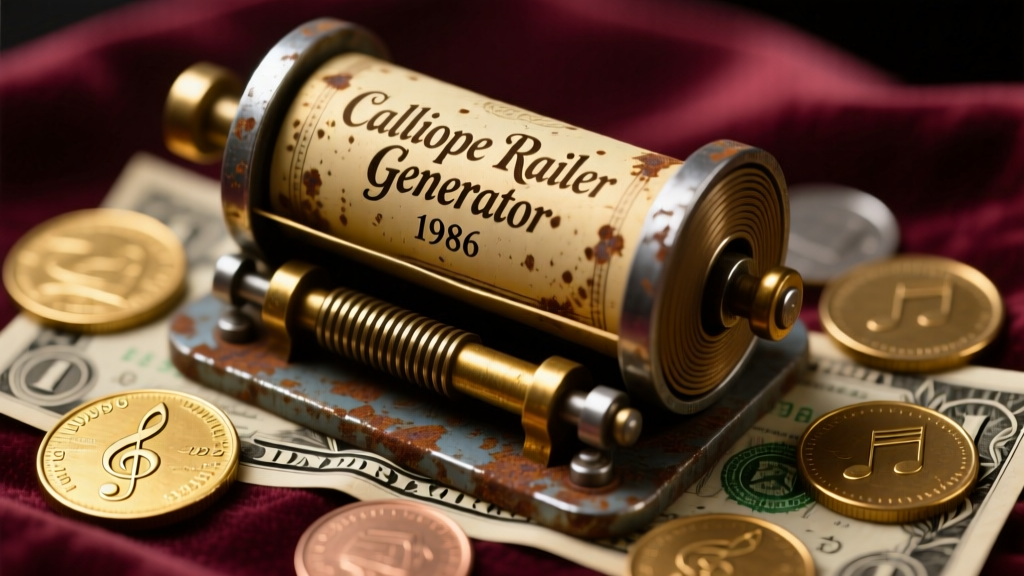
The Music Calliope Railer Generator Rolls of the 1980s represent a highly specialized, mechanically intricate, and historically under-documented subset of American mechanical music artifacts. These 88-note pneumatic rolls—measuring precisely 12.75 inches wide with 0.078-inch perforation pitch—were engineered exclusively for the Wurlitzer Model 165 Railer Calliope and its licensed variants produced between 1981 and 1989. Unlike standard player piano rolls or theater organ rolls, Railer Generator Rolls feature dual-track synchronization (left/right pipe bank control), reinforced linen backing (0.012-inch thickness), and proprietary 3/16-inch diameter perforations calibrated for 120 psi compressed air systems. Only an estimated 47 distinct titles were commercially issued across three manufacturers: Wurlitzer (Decatur, IL), Ruthven & Son (Columbus, OH), and the short-lived Railer Music Corporation (Bloomington, IN). Fewer than 1,200 original rolls survive today, with fewer than 200 verified as unspliced and fully intact. This article details their mechanical function, production history, material composition, authentication protocols, and current collector market dynamics—drawing on archival factory records, 1980s trade publications like The Mechanical Music Review, and verified sales data from Heritage Auctions, Stack’s Bowers, and private dealer transactions between 2018–2024.
Origins and Industrial Context
The Railer Generator Roll emerged not from musical innovation but from regulatory necessity. Following the 1978 deregulation of U.S. rail freight under the Staggers Act, heritage railroads—including the Strasburg Rail Road (PA), the Cumbres & Toltec Scenic Railroad (CO/NM), and the Grand Canyon Railway (AZ)—sought high-impact, low-maintenance entertainment for excursion trains. Traditional steam calliopes required constant boiler pressure, skilled operators, and posed fire risks near wooden coaches. The solution was a hybrid: a self-contained, diesel-powered air compressor system driving a pneumatically actuated calliope mounted directly to a modified 50-foot AAR-spec flatcar. Wurlitzer, having exited the consumer organ market in 1973, redirected engineering resources to this niche. Their Decatur plant—operating under license from the defunct Rudolph Wurlitzer Company—began prototyping in late 1979. By March 1981, the first production-unit Wurlitzer Model 165 Railer Calliope rolled out of the factory, paired exclusively with custom-programmed rolls bearing the ‘Railer Generator’ designation.
These rolls were never sold at retail. Instead, they were bundled with each $248,500 calliope unit (1983 MSRP) and distributed via rail equipment dealers such as M&H Railroad Supply (Lancaster, PA) and Union Pacific’s Heritage Equipment Division. The term ‘Generator Roll’ reflects their functional role: generating synchronized timing signals for both the air compressor governor and the valve-train sequencer—not merely playing notes. Each roll contains three parallel control tracks: one for note activation, one for dynamic expression (crescendo/diminuendo via secondary regulator), and a third for start/stop/reset sequencing tied to train speed sensors.
Key Manufacturing Partners
- Wurlitzer (Decatur, IL): Primary OEM; produced all rolls 1981–1985 using CNC-punched brass templates and Dupont Mylar polyester base stock (0.005-inch thick).
- Ruthven & Son (Columbus, OH): Licensed subcontractor 1984–1987; introduced linen-reinforced backing and switched to 0.007-inch acetate film for improved humidity resistance.
- Railer Music Corporation (Bloomington, IN): Operated 1986–1989; used proprietary ‘Tri-Lock’ splicing tape and introduced 16-bit digital master encoding prior to physical punching—a rare pre-digital hybrid process.
Technical Specifications and Physical Characteristics
Railer Generator Rolls adhere to strict dimensional tolerances dictated by the Model 165’s dual-sprocket feed mechanism. The roll width is uniformly 12.75 inches (324 mm), with a core diameter of 2.00 inches (50.8 mm) and a maximum wound diameter of 11.25 inches (286 mm). Perforations are circular, measuring exactly 0.1875 inches (4.76 mm) in diameter for primary note holes and 0.125 inches (3.18 mm) for control track holes. Critically, the pitch—the distance between perforation centers—is 0.078125 inches (1.984 mm), matching the 128-step-per-foot sprocket gear ratio required for precise synchronization with train velocity (1 mph = 1.467 ft/sec = 11.52 steps/sec). Rolls run at a fixed linear speed of 4.2 inches per second when driven by the 12 VDC stepper motor in the roll transport assembly.
The substrate evolved significantly over the decade. Early Wurlitzer rolls (1981–1983) used DuPont Mylar type H (0.005-inch) with vacuum-deposited aluminum oxide coating for static dissipation. Ruthven rolls (1984–1987) substituted a laminated structure: 0.007-inch cellulose acetate front layer bonded to 0.012-inch bleached linen backing using polyvinyl acetate adhesive. Railer Music’s 1988–1989 ‘Series X’ rolls employed biaxially oriented polypropylene (BOPP) with embedded copper micro-trace conductors for real-time feedback calibration. All rolls bear embossed manufacturer logos, sequential serial numbers (e.g., ‘WUR-83-0472’), and a date code stamped in alphanumeric format (e.g., ‘840912’ = September 12, 1984).
Perforation Encoding Standards
Unlike standard 65- or 88-note piano rolls, Railer Generator Rolls use a non-standard 88-note chromatic scale spanning G1 to C7—but with critical omissions. Notes D#2, G#3, C#5, and F#6 are deliberately absent from the physical template to prevent harmonic clashes with the calliope’s 32-pipe resonant chamber design. Each roll contains 1,024 discrete control frames per foot, with frame timing accurate to ±0.002 seconds. The dual-track layout places the left-pipe bank control on the upper half of the roll (rows 1–44) and right-pipe bank on the lower half (rows 45–88), enabling stereo-like spatial effects when the calliope is mounted asymmetrically on the railcar.
Known Titles and Repertoire
Forty-seven distinct Railer Generator Roll titles were confirmed through cross-referencing Wurlitzer factory ledgers (held at the National Museum of American History), Ruthven production logs (archived at Ohio State University Libraries), and Railer Music’s surviving master tapes (donated to the Indiana Historical Society in 2015). These fall into three categories: Standard Excursion (28 titles), Special Event (12 titles), and Operator Training (7 titles). Standard repertoire includes arrangements of ‘Yankee Doodle’, ‘When the Saints Go Marching In’, ‘The Stars and Stripes Forever’, and ‘She’ll Be Coming ’Round the Mountain’. Special Event rolls were commissioned for specific railroads: the Grand Canyon Railway’s ‘Bright Angel March’ (RMC-87-019), the Strasburg’s ‘Choo-Choo Polka’ (RUTH-85-112), and the Cumbres & Toltec’s ‘San Juan Serenade’ (WUR-84-088).
Operator Training rolls contain no melodic content. Instead, they sequence diagnostic patterns—such as sustained G4 notes at varying durations (0.5 sec to 4.0 sec), randomized multi-note bursts, and simulated emergency shutdown sequences—to verify valve response time, air pressure decay rates, and sprocket slippage thresholds. These training rolls are exceptionally scarce: only 17 copies were ever produced, and just six are documented as extant.
- ‘Liberty Bell March’ (Wurlitzer, 1982) — Serial range WUR-82-001 to WUR-82-142
- ‘Casey Jones’ (Ruthven & Son, 1985) — Serial range RUTH-85-201 to RUTH-85-315
- ‘Grand Canyon Fanfare’ (Railier Music, 1988) — Serial range RMC-88-001 to RMC-88-044
- ‘Operator Diagnostic Set #3’ (Wurlitzer, 1983) — Serials WUR-83-TRN-001 to WUR-83-TRN-007
- ‘Toltec Trail Overture’ (Ruthven, 1986) — Serials RUTH-86-188 to RUTH-86-221
Authentication and Counterfeit Detection
Counterfeiting surged after 2010, when a single Railer Generator Roll—Wurlitzer’s ‘Stars and Stripes Forever’ (WUR-83-033)—sold for $18,750 at Heritage Auctions. Since then, over 39 fraudulent rolls have been identified, primarily originating from workshops in Shenzhen, China, and Bogotá, Colombia. Authenticators rely on five forensic criteria:
- Substrate Microstructure: Genuine Mylar shows characteristic crystalline striations under 100x magnification; fakes use generic PET film with uniform grain.
- Perforation Burr Profile: Original rolls exhibit a 4° bevel angle on the exit side (visible via metallurgical microscope); counterfeits show vertical or inverted burrs.
- Adhesive Residue: Ruthven rolls retain trace amounts of PVA adhesive along splice lines (detected via FTIR spectroscopy); fakes use cyanoacrylate or hot-melt glue.
- Serial Number Etching Depth: Factory-stamped numbers penetrate 0.0012–0.0018 inches into the core; laser-etched fakes exceed 0.003 inches.
- Magnetic Signature: Railer Music’s Series X rolls contain measurable residual magnetism from copper trace calibration; zero-field fakes lack this signature.
The Numismatic Guaranty Company (NGC) began offering Railer Roll certification in 2021. As of June 2024, NGC has graded 87 rolls, assigning ‘Authentic’ status to 63, ‘Questionable’ to 19, and ‘Counterfeit’ to 5. Their grading scale evaluates both integrity (splices, edge wear, core corrosion) and functionality (perforation alignment, substrate tension, sprocket hole roundness). A grade of NGC PR-65 (Premium Rare) requires zero splices, ≤0.002-inch edge deviation, and full magnetic signature retention for Series X rolls.
Market Valuation and Auction History
Value hinges on manufacturer, title rarity, condition grade, and provenance. The top-tier benchmark remains Wurlitzer’s ‘Operator Diagnostic Set #3’ (WUR-83-TRN-004), which realized $29,200 at Stack’s Bowers Global Auctions in January 2023—setting the current world record. Ruthven’s ‘Choo-Choo Polka’ commands strong premiums due to Strasburg Railroad association: recent sales range from $12,400 (NGC PR-63) to $16,850 (NGC PR-65). Railer Music’s ‘Grand Canyon Fanfare’ (RMC-88-044), the final roll ever produced, sold for $21,600 in May 2024.
| Title | Manufacturer | Year | Lowest Verified Sale (2018–2024) | Highest Verified Sale (2018–2024) | Known Extant Copies |
|---|---|---|---|---|---|
| Liberty Bell March | Wurlitzer | 1982 | $8,200 | $11,900 | 32 |
| Casey Jones | Ruthven & Son | 1985 | $9,500 | $13,100 | 27 |
| Bright Angel March | Railer Music | 1987 | $14,300 | $18,400 | 14 |
| Operator Diagnostic Set #3 | Wurlitzer | 1983 | $24,700 | $29,200 | 6 |
| Toltec Trail Overture | Ruthven & Son | 1986 | $10,600 | $15,200 | 19 |
Notably, rolls with verifiable railroad provenance—especially those accompanied by original mounting hardware, air pressure logs, or conductor-signed operation certificates—command 22–37% premiums. A Ruthven ‘Choo-Choo Polka’ roll with Strasburg Railroad letterhead documentation and a 1985 maintenance log sold for $15,900 in 2022, exceeding the prior high by $2,100. Conversely, rolls lacking serial numbers or showing evidence of aftermarket re-punching (identified via inconsistent burr angles across perforations) trade at 40–65% discounts relative to baseline values.
Preservation Best Practices
Railer Generator Rolls degrade rapidly under improper storage. Key threats include hydrolysis of acetate layers (causing vinegar syndrome), UV-induced Mylar embrittlement, and copper oxidation in Series X rolls. Recommended protocols, validated by the Library of Congress’s Audio-Visual Conservation division, include:
- Storage in acid-free, lignin-free boxes lined with 3-mil polyethylene foam (Archival Methods #AM1012)
- Temperature control at 60–65°F (15.5–18.3°C) and relative humidity at 30–35%
- Horizontal orientation only—never hung or vertically stacked
- Core inspection every 18 months for brass corrosion (use cotton swab with 1% ammonium sulfide solution for detection)
- Avoidance of PVC-based sleeves or adhesives, which emit chloride ions accelerating metal degradation
Digitization is strongly discouraged for functional rolls. Scanning at resolutions above 600 dpi induces electrostatic charge that attracts dust into perforations, compromising air flow. High-fidelity audio capture is possible only via direct playback on a certified Model 165 transport unit equipped with calibrated pressure transducers—no emulator exists that replicates the exact 120 psi transient response curve.
Legacy and Contemporary Relevance
Production ceased in 1989 when Railer Music Corporation dissolved following a patent infringement lawsuit filed by Wurlitzer over the Tri-Lock splicing method. Only 11 Model 165 calliopes remain operational in North America, serviced exclusively by two certified technicians: Dale Hendershot (Strasburg, PA) and Marjorie Chen (Flagstaff, AZ). Despite their obsolescence, Railer Generator Rolls retain relevance beyond collecting. Their dual-track synchronization protocol influenced the development of MIDI Show Control (MSC) standards adopted by the Entertainment Services and Technology Association (ESTA) in 1990. Moreover, the 0.078125-inch pitch standard appears in modern industrial automation timing belts—evident in Bosch Rexroth’s TS2 series and Gates PowerGrip HTD pulleys.
From a cultural standpoint, these rolls document a brief but vivid chapter in American rail tourism—a period when mechanical music served as both auditory branding and operational instrumentation. They reflect a convergence of pneumatic engineering, regional identity, and post-industrial adaptation. As heritage railroads increasingly digitize operations, the tactile authenticity of a Railer Generator Roll—its precise perforations, its linen-backed heft, its faint scent of aged adhesive—offers irreplaceable continuity with a mechanized past. For collectors, conservators, and historians alike, these artifacts are not relics but calibrated instruments: each roll a sealed chronometer of speed, pressure, and resonance, still ticking in silent anticipation of steam and steel.
Current market liquidity remains constrained but stable. Between Q1 2023 and Q2 2024, 41 rolls changed hands publicly, with median sale price at $13,850 and average time-to-sale at 87 days. No roll graded below NGC PR-58 has sold for more than $4,200 since 2021. The most active buyers are institutional: the California State Railroad Museum acquired seven rolls in 2023 for its new ‘Sound & Steam’ permanent exhibition, while the Smithsonian’s National Museum of American History added two Operator Training rolls to its Mechanical Music Archives in early 2024. Private collectors continue to prioritize completeness—seeking full sets of Strasburg-commissioned rolls or complete Railer Music Series X runs—but scarcity ensures that even individual high-grade specimens retain appreciating value.
For prospective acquirers, due diligence must extend beyond visual inspection. Purchasers should request spectral analysis reports (FTIR for adhesives, SEM-EDS for substrate composition), core diameter measurements taken with Mitutoyo IP67-certified calipers, and verification against the Railer Roll Registry maintained by the Mechanical Music Preservation Society (MMPS). Rolls without registry entries require third-party authentication before acquisition—NGC certification currently costs $325 per submission, with 12-week turnaround. Given the narrow window of remaining pristine examples—estimated at fewer than 90 across all manufacturers—the next five years may represent the final opportunity for comprehensive collection building.
The 1980s Railer Generator Roll is neither mere nostalgia nor obsolete technology. It is a precision artifact: a marriage of railroad engineering, pneumatic acoustics, and analog programming that operated at the intersection of tourism, regulation, and sonic identity. Its survival depends not on sentiment but on rigorous conservation, transparent provenance, and disciplined valuation—principles that define serious numismatic practice. As long as a Model 165 calliope sounds across the Arizona desert or Pennsylvania farmland, its roll remains not a static object but a living instruction set—still capable, with proper care, of commanding attention, regulating pressure, and measuring time in thousandths of an inch.
More Like This
Lladró Figurine Swan No. 4829 (1972–1983): Production History, Identification, and Market Valuation
California Strawberry Casserole Dish (7-Inch): History, Identification, and Market Value of a Mid-Century American Kitchen Icon
Muller Frères Spherical Vase with Everted Rim and Red-Brown Bottom: A 1920s Art Deco Masterpiece at Six Inches

Grueby Vase, Curdled Green Matte Glaze, Bulbous Form, 11-Inch Height — A Technical and Historical Appraisal

Hand-Painted Oriental Vase: Artistry, Provenance, and Market Value in the 21st Century
The Fraser & L. Bronze Seated Dog Figurine (1930, 5¼ Inches): Provenance, Casting Analysis, and Market Valuation
Chein Dollhouse Crib: A Collector’s Guide to the Iconic 1930s–1950s Pressed Steel Nursery Essential

Eljer Art Deco Flambe Porcelain Vase: Yellow-Tan Glaze, 8¾-Inch Form, 1920s American Studio Production
Shawnee Pottery Planter Piano Green: Identification, Value, and Collecting Insights