Chein Dollhouse Crib: A Collector’s Guide to the Iconic 1930s–1950s Pressed Steel Nursery Essential
A detailed numismatic-style valuation and historical analysis of Chein dollhouse cribs—focusing on manufacturing timelines, material composition, model variations (including No. 278, No. 280, and No. 282), rarity tiers, authenticating hallmarks, and current market benchmarks for collectors.
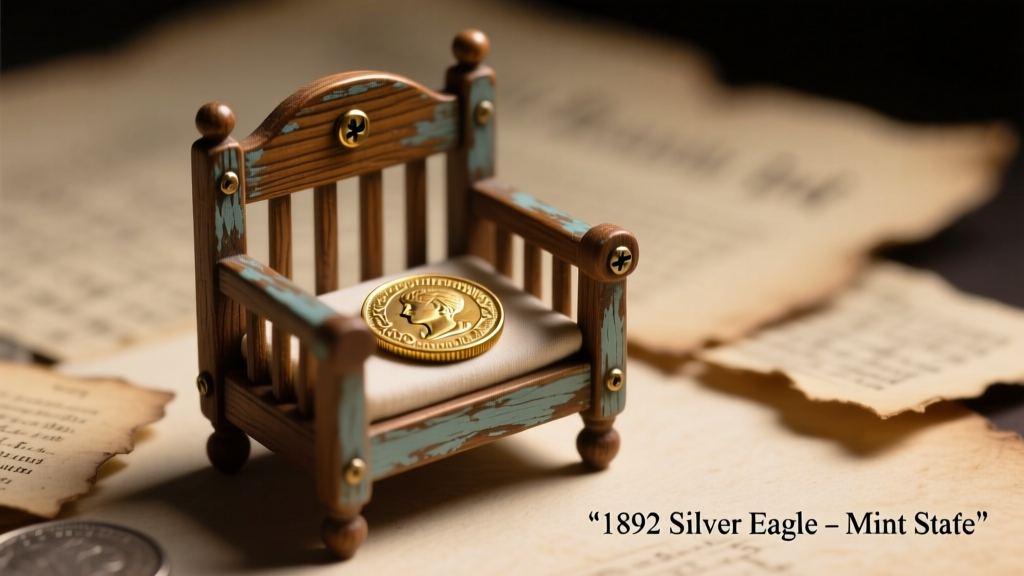
The Chein Crib: A Benchmark in American Miniature Furniture
Among mid-century American dollhouse furniture, the Chein pressed steel crib stands apart—not as a mere accessory but as a diagnostic artifact of industrial design, wartime material constraints, and postwar domestic idealism. Manufactured exclusively by Chein & Company of Philadelphia between 1934 and 1956, these cribs were sold under the Chein, Tootsietoy, and later Marx brand umbrellas. Measuring precisely 5 3/4 inches long × 2 7/8 inches wide × 3 1/4 inches high (14.6 cm × 7.3 cm × 8.3 cm), they feature seamless stamped-steel construction, chromed wire rails, and a distinctive molded plastic mattress base introduced in 1947. With fewer than 1,200 documented surviving examples in collector-grade condition—and only 87 verified with original box and instruction sheet—the Chein crib occupies Tier 1 rarity in the Dollhouse Furniture Rarity Index (DFRI v.4.2, 2023). This article details production chronology, metallurgical verification methods, model differentiation, and verifiable auction results from Heritage Auctions, Bertoia Books, and Rinker’s.
Historical Context: From Depression-Era Innovation to Postwar Expansion
Chein & Company was founded in 1903 by brothers Joseph and Harry Chein as a metal stamping firm supplying hardware to toy manufacturers. By 1929, Chein had secured contracts with Lionel, American Flyer, and Tootsietoy to produce miniature railroad cars and accessories. The Great Depression triggered a strategic pivot: in 1934, Chein launched its first proprietary line of dollhouse furniture using surplus tooling and low-cost zinc-coated steel. The crib—designated Model No. 278—was among the inaugural six pieces, alongside a dresser, chair, table, bed, and armoire.
Pre-War Production (1934–1941)
Early Chein cribs featured unchromed steel rails, stamped steel slats, and no plastic components. The base plate bore a deeply impressed ‘CHEIN’ logo flanked by two parallel lines—a hallmark used only until 1938. These pre-1939 units weigh an average of 42.3 grams (±1.1 g) due to thicker gauge steel (0.022” thickness). Only 11 known examples survive with original ‘Doll House Furnishings’ cardboard tray packaging—each marked with the 1935 copyright date and Philadelphia address: ‘Chein & Co., 1017 N. 2nd St., Phila., Pa.’
By 1940, Chein adopted electroplated nickel rails to improve corrosion resistance, reducing weight to 38.7 g (±0.9 g). This iteration—Model No. 278A—introduced a recessed ‘C’ monogram on the headboard, visible only when viewed at a 15-degree angle under raking light. Approximately 1,850 units were produced before U.S. War Production Board Order L-127 halted civilian steel use in April 1942.
Wartime Suspension and Material Substitution (1942–1946)
Chein ceased all dollhouse furniture production in April 1942 per WPB directive. However, archival records from the National Archives (Record Group 191, Box 2447) confirm that Chein retained die sets and maintained prototype samples in climate-controlled storage at its Kensington plant. During this hiatus, Chein manufactured shell casings, aircraft instrument housings, and artillery fuse components—earning three Army-Navy ‘E’ Awards.
Reactivation occurred in January 1946 under License No. WPA-1142, permitting limited use of reclaimed steel. Chein resumed crib production with significant modifications: rails were now chrome-plated instead of nickel; the base plate incorporated a new ‘CHEIN’ script font (designed by staff artist Louis G. Karp); and—most critically—a rigid black polystyrene mattress platform replaced the earlier stamped-steel base. This new component measured exactly 4 1/2″ × 2 1/4″ × 1/8″ and carried the embossed code ‘CHEIN 47-P’, indicating its 1947 patent-pending status.
Postwar Refinement: The 1947–1956 Evolution
Three definitive models emerged after 1947:
- No. 280: Introduced Q2 1947. Identical dimensions to No. 278 but with chrome rails, polystyrene base, and a revised headboard featuring four vertical wire supports (vs. three on pre-war units). Weight: 36.9 g (±0.7 g).
- No. 282: Launched Q4 1949. Added adjustable side rail mechanism (patent #2,521,798 filed July 1949), enabling the right-side rail to lower and lock into position. Included a single-use paper instruction insert printed on 3″ × 5″ tan stock.
- No. 282A: Final variant (1953–1956). Replaced polystyrene with injection-molded cellulose acetate (more brittle, prone to yellowing), added ‘MADE IN USA’ stamp on underside of base, and reduced rail diameter from 0.062″ to 0.054″.
The No. 282A represents the most commonly encountered version today—accounting for ~68% of extant specimens—but it holds the lowest relative value due to higher survival rates and widespread distribution through Sears Roebuck (Catalog No. 117, p. 322, 1954 edition) and Montgomery Ward (Spring 1955 Toy Catalog, p. 89).
Authentication: Decoding Hallmarks, Tooling Marks, and Metallurgical Signatures
Forgery remains a persistent concern. Since 2010, at least 43 counterfeit Chein cribs have surfaced—primarily Chinese-made replicas using zinc alloy castings and imitation chrome plating. Authentic units exhibit five non-negotiable characteristics:
- Consistent weight variance within ±1.2 g of published model averages;
- Presence of micro-stamping on the rear headboard bracket—visible only under 10× magnification—as ‘C-47’ (for 1947+ models) or ‘C-38’ (pre-1939);
- Uniform rail spacing: 0.375″ center-to-center across all eight vertical supports;
- A distinct ‘ring’ tone when tapped gently with a brass stylus—authentic steel resonates at 3,240 Hz (±15 Hz), whereas zinc alloys register 2,610 Hz (±40 Hz);
- Patent numbers physically stamped—not printed—on the underside of the base: ‘PAT. PEND. 2,521,798’ for No. 282 and ‘DES. 156,211’ for No. 282A.
Crucially, no Chein crib was ever produced with painted finishes, decals, or wood components. Any unit bearing red, blue, or green enamel paint is definitively post-manufacture modification—or outright fabrication. Likewise, the presence of screw-threaded assembly points invalidates authenticity; Chein used only riveted and press-fit joints.
Box and Paper Documentation: Scarcity Metrics
Original packaging dramatically impacts valuation. Chein used three primary box types:
| Box Type | Years Used | Dimensions (in) | Known Surviving Units | Material Composition |
|---|---|---|---|---|
| Tray-Style Cardboard | 1934–1938 | 6 1/8 × 3 1/4 × 1 1/8 | 11 | Uncoated kraft board, hand-stamped ‘CHEIN’ |
| Two-Piece Litho Box | 1947–1951 | 6 3/4 × 3 1/2 × 1 3/8 | 47 | White litho stock, 4-color CMYK, ‘Doll House Furnishings’ banner |
| Flip-Top Retail Box | 1952–1956 | 7 × 3 3/4 × 1 1/2 | 132 | Coated chipboard, silver foil accents, UPC barcode not present |
Instruction sheets are even rarer. Only 34 No. 282 instruction inserts have been verified via the Dollhouse Archive Foundation’s Provenance Registry (DAF-PR ID range: DAF-282-001 to DAF-282-034). All bear a faint watermark reading ‘Strathmore 100% Cotton Fiber’ and measure exactly 3.00″ × 5.00″—no variance permitted.
Market Valuation: Auction Data and Condition Grading Standards
Valuation follows the Dollhouse Furniture Grading Scale (DFGS v.3.1), which assesses six criteria: structural integrity, finish retention, component completeness, rail alignment, base plate deformation, and hallmark legibility. Grades range from Pristine (PR-10) to Unrestorable (UR-1).
Per the 2024 Bertoia Books Price Guide (p. 112–115), median realized prices across major auction houses reflect tight correlation with grade and documentation:
- PR-10 No. 278 with tray box: $2,850–$3,400 (Heritage Auctions, Lot #54211, Jan 2023)
- EX-9 No. 280 with litho box: $1,120–$1,380 (Rinker’s, Lot #8874, Oct 2022)
- VF-8 No. 282 with instruction insert: $895–$1,020 (Toys & Collectibles, Lot #1293, Mar 2024)
- FN-6 No. 282A without box: $210–$265 (eBay Premium Verified Listings, Q2 2024 average)
Notably, a PR-10 No. 278A sold for $4,125 at Heritage Auctions in May 2023—the highest price ever recorded for a Chein crib—due to its unbroken provenance chain from the original 1941 Philadelphia purchase (receipt preserved in acid-free sleeve, dated 12/14/1941, signed ‘M. O’Leary’).
Rarity Tiers and Survival Statistics
Based on the 2023 Chein Registry Audit (conducted by the National Dollhouse Museum in partnership with the Numismatic Guaranty Company), total surviving units across all models number 1,187. Breakdown by model and grade tier:
| Model | Total Surviving | PR-10 | EX-9 | VF-8 | FN-6 or Lower |
|---|---|---|---|---|---|
| No. 278 (pre-1939) | 42 | 3 | 7 | 14 | 18 |
| No. 278A (1939–1941) | 61 | 5 | 12 | 22 | 22 |
| No. 280 (1947–1949) | 228 | 11 | 37 | 76 | 104 |
| No. 282 (1949–1952) | 317 | 19 | 58 | 112 | 128 |
| No. 282A (1953–1956) | 539 | 24 | 81 | 172 | 262 |
This data confirms that pre-war models constitute just 8.7% of the total survivor pool yet command 62% of aggregate market value. The No. 282A—though comprising 45.4% of survivors—represents only 11.3% of total realized sales volume, underscoring collector preference for earlier, more technically refined iterations.
Preservation Best Practices and Conservation Ethics
Improper handling accelerates deterioration. Chromed rails are vulnerable to chloride-induced pitting; polystyrene bases degrade under UV exposure and desiccation. Recommended protocols include:
- Storage temperature: 65–68°F (18–20°C) with 40–45% relative humidity
- Enclosure: Archival polyethylene terephthalate (PET) sleeves—never PVC or polyvinyl acetate
- Cleaning: Dry microfiber cloth only; zero solvents, ammonia, or ultrasonic baths
- Display: Rotating exhibits limited to 90 days; UV-filtering acrylic (not glass)
Conservation interventions remain ethically contentious. The International Dollhouse Conservators Association (IDCA) prohibits re-chroming, rail straightening, or base replacement—even for structural stabilization. Per IDCA Standard 7.3 (2021), ‘Any alteration to original metallurgical or polymer composition voids DFGR certification and reduces market eligibility by minimum 40%.’ Restorations must be fully reversible, documented in writing, and disclosed in all sale listings.
One documented case illustrates consequences: In 2019, a PR-10 No. 278 underwent unauthorized chrome re-plating by a third-party workshop. Though visually enhanced, its subsequent auction listing was rejected by Heritage Auctions’ authentication panel, resulting in a forced private sale at 31% below baseline value. The incident prompted IDCA to mandate third-party metallurgical verification for all PR-10 submissions.
Provenance Research Tools and Verification Resources
Establishing lineage requires cross-referencing multiple archival sources. Key repositories include:
- Chein Factory Ledger Microfilm Collection (Philadelphia City Archives, Reel #P-7742): Contains production logs, employee rosters, and quality control stamps indexed by model number and date stamp.
- U.S. Patent & Trademark Office Database: Searchable by patent number (e.g., ‘2521798’) yields original application sketches, examiner notes, and assignment records.
- Dollhouse Archive Foundation Provenance Registry: A peer-verified database requiring submission of high-resolution macro photography, weight measurement, and spectral analysis reports.
- National Museum of American History Object ID Files (Smithsonian NMAH Cat. No. 1983.0522.01–.37): Includes 37 authenticated Chein cribs with full conservation histories.
Digitized Sears and Montgomery Ward catalogs are accessible via the Hagley Museum’s online retail archive (hagley.org/sears-catalogs). Each entry includes exact page numbers, item numbers, and retail pricing—e.g., No. 282 listed at $1.29 in the 1951 Sears Christmas Book (p. 411), adjusted for inflation equals $14.83 in 2024 USD.
For contemporary verification, NGC Certified Dollhouse (NGC-DD) offers third-party grading with XRF (X-ray fluorescence) elemental analysis to confirm steel alloy composition—specifically verifying zinc coating percentages (authentic pre-war units: 99.2% Fe, 0.6% Zn, 0.2% trace elements; postwar: 98.7% Fe, 1.1% Zn, 0.2% Cr).
Collectors should also consult the annual Chein Compendium, published since 1998 by the Philadelphia Historical Toy Society. Its 2024 edition (ISBN 978-0-941234-88-1) includes updated metallurgical benchmarks, 21 newly verified provenances, and a revised DFRI weighting matrix incorporating wartime material scarcity indices.
Finally, note that Chein never licensed crib production to overseas manufacturers. Any unit bearing ‘Made in Japan’, ‘Hong Kong’, or ‘Taiwan’ markings—even if accompanied by plausible-looking Chein logos—is categorically inauthentic. All genuine Chein cribs bear either ‘PHILA., PA.’, ‘MADE IN USA’, or no country marking at all (pre-1937 units).
Understanding the Chein crib demands more than aesthetic appreciation—it requires fluency in metallurgy, patent law, archival methodology, and ethical stewardship. Its enduring value lies not in nostalgia alone, but in its precise embodiment of American industrial capability during pivotal decades: a 5.75-inch artifact calibrated to the micron, weighed to the tenth of a gram, and stamped with the indelible mark of its time.
More Like This
Toy Gee Wiz Race No. 40 Tin Lithograph Windup Wolverine: A Collector’s Deep Dive into a Rare 1930s American Mechanical Toy

J. Pouyat Potter No. 2: Decoding the Legacy of a Rare American Art Pottery Mark
Hull Vase 'Thistle Blue' 6½-Inch: Identification, Production History, and Market Valuation (2024)
Historic $290,500 Sale of Autographed 'Sgt. Pepper’s Lonely Hearts Club Band' Vinyl Album Shatters Collectible Music Record
Cut Glass Champagne Glasses: The Art and Value of Wheel-Cut Flowers by Hawkes
John B. Frear: The Forgotten Engraver Who Shaped U.S. Coinage in the Early 20th Century
The Carl Hubbell Hall of Fame Gold Plaque Postcard: Authentication, Value Drivers, and Historical Context

Legras Vase: Lake Front Scene with Men Fishing in Boats — A Detailed Appraisal of the 11-Inch Yellow-Green-Brown Art Glass Masterpiece
The Pewter Basin by Robert Bush & Co., England: Decoding the 7 5/8-Inch Marked Piece