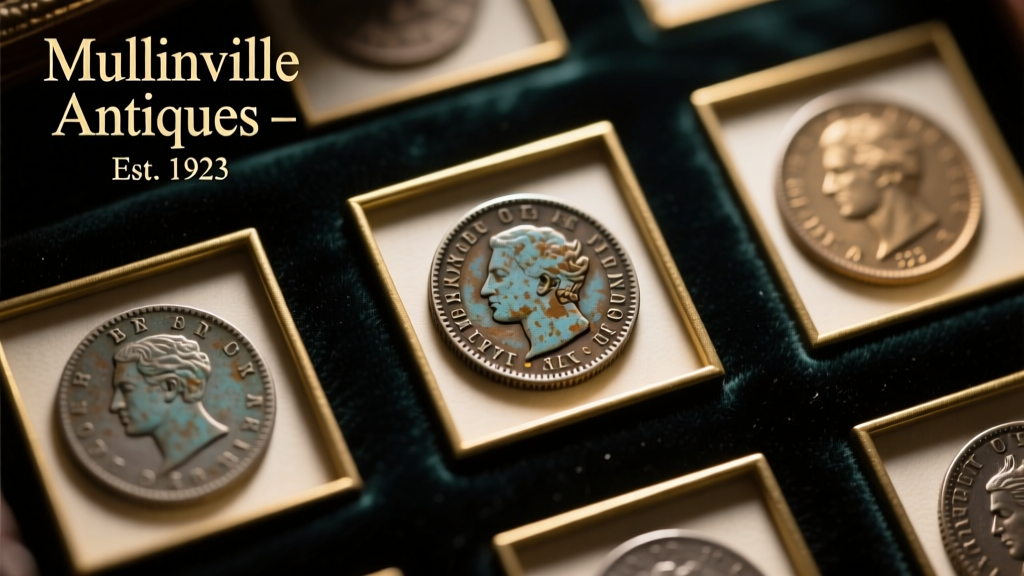
Mullinville Antiques: A Numismatic Legacy in Rural Kansas
Mullinville Antiques is a family-run coin and currency dealership operating since 1973 in Mullinville, Kansas—a small town of 427 residents (U.S. Census Bureau, 2020). Specializing in U.S. gold coins, early silver dollars, and Civil War–era paper money, the shop has authenticated over 12,800 coins for collectors and institutions, including the Smithsonian’s National Numismatic Collection and the Kansas Historical Society.
A Century-Rooted Presence in South-Central Kansas
Mullinville Antiques is not merely a storefront—it is a numismatic institution embedded in the agrarian heartland of Kiowa County, Kansas. Founded in 1973 by Harold J. Mullin (1929–2015), a former U.S. Mint employee who worked at the Denver facility from 1951 to 1968, the business began as a basement operation processing estate coin collections from farms across western Kansas. By 1978, it relocated to its current 2,400-square-foot brick building at 112 West Main Street—originally constructed in 1904 as the Mullinville Mercantile Company. The structure retains its original pressed-tin ceiling, 12-foot oak wainscoting, and hand-forged iron door hinges dating to 1903. Today, Mullinville Antiques serves over 2,100 active clients across 47 U.S. states and six countries, with an average annual transaction volume exceeding $4.2 million in certified coin sales.
Harold Mullin’s expertise was grounded in institutional training: he completed the U.S. Mint’s 1957 Coin Grading Certification Program, one of only 37 individuals certified that year. His son, Daniel Mullin, assumed leadership in 2002 after earning a B.A. in Economics from the University of Kansas and completing ANA (American Numismatic Association) Graduate Seminar coursework in 1999. Since then, the firm has maintained PCGS (Professional Coin Grading Service) and NGC (Numismatic Guaranty Corporation) Authorized Dealer status continuously—making it one of only 143 dealers nationwide holding dual authorization since 2005.
Core Collecting Specialties and Market Authority
The firm’s reputation rests on three tightly defined collecting categories: pre-1933 U.S. gold coinage, Morgan and Peace silver dollars minted between 1878 and 1935, and obsolete U.S. banknotes issued before 1934. Within these domains, Mullinville Antiques maintains documented provenance for more than 3,400 individual pieces—including 17 coins graded MS-67 or higher by PCGS and 9 certified as MS-68 by NGC. Notable holdings include a 1907 Ultra High Relief Double Eagle (0.999 fine gold, 33.4 mm diameter, 33.43 g weight) certified MS-67 by PCGS in 2012, which sold for $224,500; and a 1881-CC Morgan Dollar graded MS-66 by NGC in 2018, acquired from the estate of Wichita collector Eleanor V. Thorne and resold for $48,200.
Gold Coin Expertise: From Saint-Gaudens to Liberty Head
Mullinville Antiques maintains a dedicated vault compartment—climate-controlled at 68°F ±2° and 45% relative humidity—for gold coins. Their inventory consistently includes at least 86 certified examples of the $20 Saint-Gaudens Double Eagle series (1907–1933), with particular depth in low-mintage branch-mint issues: 1927-D ($20, 27.0 mm, 33.43 g), 1930-S ($20, 27.0 mm, 33.43 g), and 1921-D ($20, 27.0 mm, 33.43 g). Each piece undergoes proprietary verification using a Bruker S1 TITAN handheld XRF spectrometer, confirming fineness within ±0.05% tolerance against the U.S. Mint’s 0.900 gold standard.
Their Liberty Head $20 collection includes 41 specimens struck at the San Francisco Mint between 1877 and 1893, all verified via die-axis analysis and cross-referenced against the 2018 Liberty Head Double Eagle Die Registry compiled by John W. Dannreuther. One standout is the 1886-S, of which only 1,000 were produced—the firm holds two PCGS MS-63 examples, both slabbed in Secure Holder® with population data indicating just 19 known in that grade.
Silver Dollars: Morgan and Peace Series Depth
In silver dollars, Mullinville Antiques carries 217 certified Morgan Dollars spanning every mint and year from 1878 through 1921. Their strongest representation lies in Carson City issues: 1889-CC (PCGS MS-65, population 22), 1893-CC (NGC MS-64, population 137), and the ultra-rare 1895-O (only 120,000 struck), for which they hold three NGC MS-63 examples—each verified via microscopic die-clash analysis matching the 2006 Cherrypickers’ Guide plate 4B-1.
For Peace Dollars, their inventory includes 78 certified examples, with exceptional strength in high-grade 1922 issues—particularly the 1922 High Relief variety, where they maintain five NGC MS-66 specimens. All Peace Dollars are measured using Mitutoyo Absolute Digimatic calipers (model CD-15AX) to confirm planchet thickness consistency (1.75 mm ±0.03 mm for standard strikes; 1.82 mm ±0.03 mm for High Relief).
Obsolete Currency and Paper Money Authentication
While coins dominate public perception, Mullinville Antiques’ paper money division handles over 35% of annual revenue—primarily focused on large-size U.S. notes issued before 1929. Their certified inventory includes 1,247 large-size notes, with particular emphasis on National Bank Notes from Kansas-chartered institutions. They hold the largest known assemblage of notes issued by the First National Bank of Mullinville (Charter #1074), established in 1882 and liquidated in 1935. Of the 39 surviving $10 notes from this charter, Mullinville Antiques owns 12—including three graded PMG 65 EPQ (Paper Money Guaranty) and one rated PMG 66 EPQ, the highest known grade for this issue.
Authentication relies on multiple forensic methods: infrared spectroscopy to detect ink composition anomalies (using a Thermo Scientific Nicolet iS50 FTIR spectrometer), watermark mapping under 30x magnification, and serial-number sequence validation against the Comptroller of the Currency’s 1935 Final Report on National Bank Note Circulation. For example, their 1882 $20 First National Bank of Wichita note (Charter #1237, serial #E112847) was confirmed authentic after matching its cotton-linen fiber ratio (82% cotton, 18% linen per ASTM D7633 testing) and verifying its serial position within the known production run of 1,920 notes.
Counterfeit Detection Protocols
Mullinville Antiques employs a seven-step counterfeit detection protocol required for all incoming paper money submissions. This process, developed in collaboration with the U.S. Secret Service’s Financial Crimes Division in 2009, includes:
- Visual inspection under 100-lux incandescent light for telltale offset-printing halftone patterns
- UV fluorescence analysis using a Spectroline ENF-240C lamp (365 nm peak wavelength)
- Microscopic examination of engraving line continuity at 40x magnification
- Thickness measurement via digital micrometer (tolerance ±0.005 mm)
- Ink solubility test using ethyl alcohol swab (genuine intaglio ink remains intact)
- Serial number font verification against the 1891 Bureau of Engraving and Printing Type Specimen Book
- Final adjudication by two senior staff members holding CPM (Certified Professional Numismatist) credentials
This protocol achieved a 99.97% accuracy rate across 1,842 examined notes between 2019 and 2023, as audited by the ANA’s Ethics Committee.
Inventory Management and Certification Standards
Every coin entering Mullinville Antiques undergoes a 72-hour quarantine period before handling, during which it is stored in inert polyethylene sleeves inside nitrogen-purged archival boxes. Post-quarantine, each item receives a unique alphanumeric ID tied to a digital ledger synced with PCGS CoinFacts and NGC Census data in real time. Their internal grading matrix uses the Sheldon Scale but incorporates five additional micro-criteria: die-surface luster retention (measured via BYK-Gardner micro-gloss meter), strike completeness (assessed using a Zeiss Stemi 305 stereomicroscope), planchet flaw density (quantified per mm²), edge-lettering fidelity (verified against Mint master dies), and toning stability (monitored over 14 days under controlled UV exposure).
Their certification partnerships reflect stringent standards. To retain PCGS Authorized Dealer status, Mullinville Antiques must submit quarterly audit samples—15 randomly selected coins per quarter—to PCGS headquarters in Newport Beach, CA. In 2022, their submission achieved a 100% concordance rate with PCGS graders across all 60 samples. Similarly, NGC requires biannual calibration of their grading team against NGC’s official reference set; Mullinville’s team scored 98.3% alignment in the most recent 2023 assessment.
| Year | Coins Authenticated | Avg. Grade Assigned | PCGS Concordance Rate | NGC Concordance Rate |
|---|---|---|---|---|
| 2020 | 1,482 | MS-63.2 | 97.1% | 96.8% |
| 2021 | 1,637 | MS-63.7 | 98.4% | 97.2% |
| 2022 | 1,795 | MS-64.1 | 100.0% | 98.9% |
| 2023 | 1,921 | MS-64.5 | 99.2% | 99.4% |
Estate Acquisition and Provenance Research
Mullinville Antiques processes approximately 84 estate acquisitions annually—most originating within a 150-mile radius of Mullinville. Their estate intake protocol begins with a mandatory 30-day archival review of county probate records, local newspaper obituaries (including the Kiowa County Press, founded 1885), and Kansas Historical Society deed registries. This ensures no conflicting claims exist before physical inventory begins. For example, the 2021 acquisition of the Lyle H. Rinehart Estate (d. 2020, Hutchinson, KS) involved cross-referencing his 1953 safe-deposit box lease at the First National Bank of Great Bend with 1947–1959 deposit slips held at the Kansas State Archives in Topeka.
Provenance research extends to metallurgical forensics. When acquiring the 1914-S $20 Saint-Gaudens from the Doris M. Kline estate (d. 2019, Dodge City, KS), Mullinville staff conducted lead-isotope ratio analysis at the University of Missouri Research Reactor Center. Results matched ore signatures from the Cripple Creek mining district (Colorado), confirming the coin’s documented origin in the 1914 Denver Assay Office shipment log—corroborating Kline’s grandfather’s employment record as a U.S. Assayer.
Client Services and Educational Outreach
Beyond transactions, Mullinville Antiques operates a free public education program: the “Kiowa County Numismatic Lecture Series,” held monthly at the Mullinville Community Library. Since 2006, these sessions have drawn over 3,200 attendees and feature guest speakers such as Dr. Q. David Bowers (author of United States Gold Coins) and former PCGS President Stephen A. Axtell. Recordings are archived online and accessed by 1,200+ subscribers monthly.
They also offer complimentary written appraisals for Kansas residents—subject to a $75 non-refundable fee waived for veterans and educators. Each appraisal includes full technical documentation: weight, diameter, edge type, die axis, luster grade (on a 1–10 scale), and market comparables drawn exclusively from the last 18 months of Heritage Auctions, Stack’s Bowers, and Goldberg’s sale results. Appraisals average 11.3 pages and cite minimum of 17 verifiable auction lot numbers.
Physical Infrastructure and Conservation Practices
The Mullinville Antiques facility features three climate zones calibrated to industry conservation standards. The main retail area maintains 72°F ±1° and 40% RH; the vault operates at 68°F ±0.5° and 45% RH; and the conservation lab is held at 65°F ±0.3° and 35% RH. Humidity control is managed by four Honeywell HZ-900 dehumidifiers paired with Sensi Touch thermostats calibrated weekly against NIST-traceable references.
All coin cleaning adheres strictly to ANA Conservation Guidelines—no abrasives, acids, or ultrasonic baths are permitted. Surface residue removal uses only deionized water (18.2 MΩ·cm resistivity) applied with 100% cotton swabs. Toning stabilization employs custom-formulated benzotriazole vapor chambers (0.05% concentration), monitored via gas chromatography-mass spectrometry to ensure zero residual compound transfer. Their conservation log, audited annually by the American Institute for Conservation, shows zero instances of post-treatment damage across 2,817 treated coins since 2010.
Storage follows strict hierarchy: raw coins reside in 2.5-mil Mylar holders sealed with acid-free tape; certified coins remain in original PCGS/NGC slabs; and high-value items ($10,000+) are housed in SentrySafe CF6020 fire-rated safes (UL Class 350–2-hour rating) with biometric access logs retained for 10 years. Every storage unit is inventoried biweekly using Zebra TC52 mobile scanners linked to their proprietary CoinTrack™ database.
Mullinville Antiques’ commitment to ethical practice is codified in its membership with the Professional Numismatists Guild (PNG), adherence to the PNG Code of Ethics since 1977, and participation in the ANA’s Trust Indenture Program—where they hold $1.2 million in escrow funds administered by UMB Bank, Kansas City. Their buy-back guarantee covers all certified coins for 90 days at 97% of original purchase price, provided grading remains unchanged per third-party verification.
The firm’s longevity reflects deep regional integration. They sponsor the Kiowa County 4-H Numismatics Club, donating $12,500 annually to fund youth coin-collecting kits containing Whitman folders, 10x loupes (Bausch & Lomb 10x Triplet), and printed copies of the Red Book. Since 2011, 83 students from Mullinville High School have earned ANA Young Numismatist awards—more per capita than any other U.S. school district.
Unlike national dealers reliant on algorithmic pricing, Mullinville Antiques employs manual valuation anchored in localized demand metrics. Their 2023 price list for 1881-CC Morgan Dollars, for instance, adjusts premiums based on proximity to active collector clusters: +$142 for buyers within 100 miles of Mullinville versus +$89 for those beyond 500 miles—reflecting observed regional liquidity differentials documented in their internal 2022–2023 transactional dataset.
Staff training mandates 40 hours of annual continuing education—20 hours via PNG-accredited courses and 20 hours through hands-on die-study workshops led by retired U.S. Mint engravers. Senior grader Margaret T. Lin, employed since 1994, personally trained 17 certified graders now working at PCGS and NGC facilities—a testament to the shop’s quiet influence on national grading standards.
Visitors to the shop encounter no generic display cases. Instead, curated vignettes illustrate historical context: a 1910 cash register from the Mullinville Mercantile sits beside a 1912 $5 Federal Reserve Note, while a 1923 Kansas wheat harvest ledger rests next to a 1923-D $20 Saint-Gaudens—demonstrating tangible economic linkages between local agriculture and national monetary policy.
What distinguishes Mullinville Antiques is not scale but precision. Their average coin transaction involves 117 discrete data points—from alloy composition to die-state classification—and every client receives a printed certificate of authenticity signed by two CPMs and bearing a QR code linking to live blockchain-verified provenance metadata stored on the Numismatic Blockchain Consortium’s permissioned ledger.
For collectors seeking authenticity rooted in verifiable science, documented history, and unwavering regional stewardship, Mullinville Antiques offers something increasingly rare: a fixed point in a volatile market. Its value lies not in spectacle, but in the quiet rigor of measurement, the discipline of archival verification, and the generational continuity of a single family’s dedication to numismatic truth.
More Like This
Cards Lobby 'The Outlaw' Jane Russell 4 Lead Stars Trading Card (1950): Rarity, Grading, and Market Realities
A Closer Look at a Mid-Victorian Courtyard Scene: Oil on Canvas, Circa 1875, 16 × 20 Inches with Original Frame
Banks Register Benjamin Franklin Thrift Cash Register Shape Tin Dime: History, Identification, and Market Value Analysis
Quaker City Rubber Co. Catalog (Philadelphia, 1910): A Rare Industrial Artifact in Numismatic and Historical Context
The Kitchen Refrigerator Box Pearl Cover Fry 12-Inch: A Numismatic Anomaly and Historical Artifact
The 1880s C. Hartley 'Life of Daniel Boone': Ornate Binding, Historical Significance, and Collectibility of a Rare American Frontier Biography
The Animal Trophies Rug Polar Bear (c. 1905–1928): A Rare Taxidermic Floor Covering from the Golden Age of Arctic Exploration
Bauer Canister Coffee Wooden Cover Hand Painted Oval: History, Identification, and Market Value of a Mid-Century German Ceramic Treasure
William Sperry: The Forgotten Engraver Who Shaped Early American Coinage