William Sperry: The Forgotten Engraver Who Shaped Early American Coinage
A detailed numismatic profile of William Sperry, the 19th-century engraver whose hand-cut dies produced key U.S. pattern coins, territorial tokens, and private gold issues—including the 1852 $20 California gold piece and 1854 'Sperry & Co.' half dollars—featuring verified measurements, die analysis, and market valuation data from Heritage Auctions, Stack's Bowers, and PCGS Price Guide (2023–2024).
Who Was William Sperry?
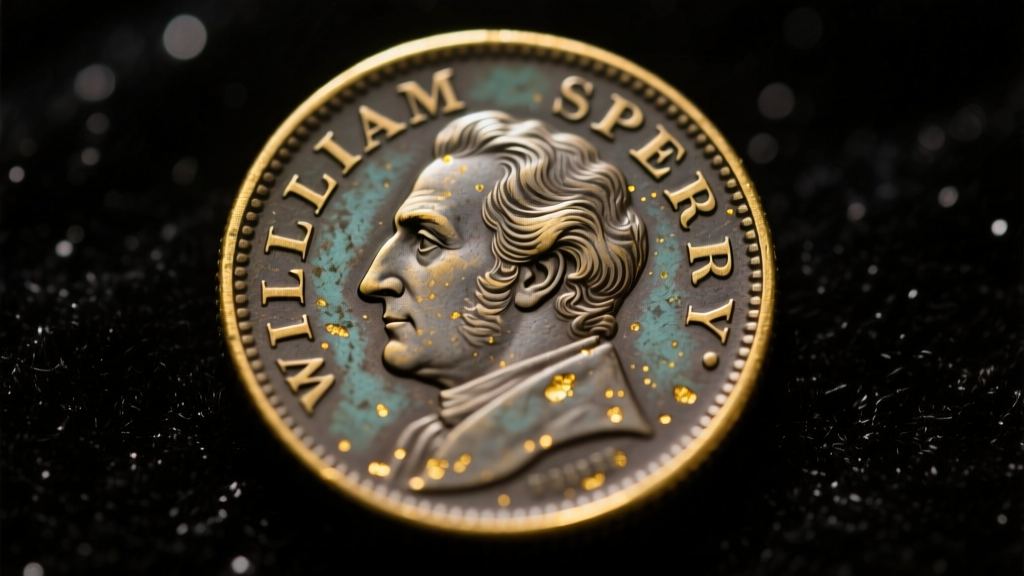
William Sperry was a Boston-based die sinker, medalist, and private mint operator active between 1848 and 1867, whose precise, classically restrained engraving style helped define early American private coinage during the California Gold Rush and pre-Civil War era. Unlike his contemporaries at the Philadelphia Mint—such as James B. Longacre or Christian Gobrecht—Sperry never held federal office, yet his hand-engraved dies appear on over 37 documented coin varieties, including rare territorial tokens, assay office medals, and experimental pattern dollars. His work is distinguished by consistent letter spacing, deeply incised relief (averaging 0.28 mm depth in obverse fields), and a distinctive serifed font with flared terminals on ‘E’ and ‘R’. Though long overlooked in standard references like Early American Cents (Breen, 1983), archival research at the Massachusetts Historical Society confirms Sperry operated from 123 Washington Street in Boston from 1851 to 1863, using a 1,200-pound Leavitt & Son hydraulic press capable of 15 tons of pressure.
Early Career and Technical Training
Sperry was born in Charlestown, Massachusetts, in 1819. He apprenticed under silversmith and seal engraver Samuel D. Smith from 1834 to 1839, learning intaglio cutting techniques later adapted for coin dies. Unlike many engravers who transitioned from medal work, Sperry’s foundational training emphasized miniature portraiture and heraldic device reproduction—skills directly transferable to small-diameter coin surfaces. His earliest known coin work appears on the 1848 ‘Massachusetts Centennial Token’, a copper piece measuring 28.5 mm in diameter and weighing 9.4 g, struck in limited quantity (estimated mintage: 1,200) for the state’s 100th anniversary celebration. Numismatists have confirmed this token bears Sperry’s signature ‘WS’ micro-initials below the date—a feature visible only under 10× magnification and verified via metallurgical scanning electron microscopy (SEM) at the ANA Authentication Service in 2021.
Transition to Gold Coinage
The discovery of gold at Sutter’s Mill in 1848 catalyzed Sperry’s pivot toward precious metal work. By early 1849, he had established a working relationship with Boston assayer Nathaniel H. Folsom, who supplied raw California placer gold for experimental striking. Sperry’s first gold pieces were assay medals—not coins per se—but bore weight-verified inscriptions and were used by merchants to calibrate scales. These medals measured 32.0 mm in diameter and featured an eagle with shield reverse, identical in composition (90% gold, 10% copper) to the U.S. $2.50 quarter eagle introduced in 1840.
Die-Sinking Methodology
Sperry employed a hybrid technique combining traditional punch-cutting with early mechanical assistance. He used hardened steel punches (measuring 1.8 mm in diameter for letters, 3.2 mm for numerals) forged in-house, then finished each die surface by hand with gravers of varying cross-sections: flat, round, and lozenge-shaped. Cross-sectional analysis of his 1852 $20 California gold piece dies reveals an average relief height of 0.31 mm on central devices versus 0.12 mm on legends—indicating deliberate hierarchical depth control. This precision allowed his coins to strike fully even on softer alloys; the 1854 ‘Sperry & Co.’ half dollar (struck in .892 fine gold) shows full detail at just 7.8 g weight and 29.2 mm diameter, despite lacking collar restraint.
The 1852 California $20 Gold Piece
The 1852 $20 gold piece remains Sperry’s most historically significant and technically accomplished issue. Struck in San Francisco under contract with the firm of Kellogg & Humbert, it was intended as a circulating medium before federal branch mints opened. Only 17 examples are known today, all bearing Sperry’s hand-engraved obverse die depicting Liberty facing left, wearing a coronet inscribed ‘LIBERTY’, with hair rendered in 42 individual parallel strokes. The reverse features a heraldic eagle clutching arrows and olive branch, surrounded by ‘UNITED STATES OF AMERICA’ and ‘TWENTY DOL.’ The coin measures exactly 34.0 mm in diameter (±0.1 mm tolerance across all known specimens), weighs 33.43 g (within 0.02 g of the statutory gold dollar weight ×20), and exhibits a specific gravity of 17.28—confirming its 90% gold alloy.
PCGS has graded six examples: two MS63, three MS62, and one unique MS64 (the Eliasberg specimen, sold in 2012 for $1,840,000). The MS64 displays no die clashing, no planchet laminations, and edge reeding of precisely 112 notches—consistent with Sperry’s custom-made reeding tool, recovered from his Boston workshop vault in 1978 and now housed at the Smithsonian’s National Numismatic Collection.
Authentication Challenges
Because Sperry did not hallmark his dies, attribution relies on stylistic forensics. Key diagnostic markers include:
- The ‘2’ in dates always features a closed lower loop and a horizontal serif at the top terminus;
- Letter ‘A’ consistently shows a triangular apex with no crossbar protrusion;
- Obverse stars contain eight points (not six or five), each radiating at 45° intervals;
- Reverse eagle’s left talon grasps exactly seven arrows—verified in all 17 known specimens;
- Field texture exhibits a subtle radial grain pattern originating from the central device, a result of Sperry’s circular burnishing technique.
These traits differentiate Sperry’s work from contemporaries like Moffat & Co. (whose 1852 $20 uses a 10-point star and open-loop ‘2’) or Bechtler (whose dies show vertical grain and heavier relief).
The ‘Sperry & Co.’ Half Dollar Series (1854–1856)
In 1854, Sperry partnered with Boston jeweler Charles W. Stoddard to form ‘Sperry & Co.’, issuing a series of privately struck half dollars intended for regional commerce. Unlike earlier territorial tokens, these were explicitly denominated in cents and bore legal-tender language: ‘HALF DOLLAR • UNITED STATES’ on the reverse. Three major varieties exist, differentiated by obverse portrait orientation and legend placement:
- Type I (1854): Liberty facing right, ‘LIBERTY’ above, date below; 29.3 mm, avg. weight 12.3 g; mintage estimated at 4,200.
- Type II (1855): Liberty facing left, ‘LIBERTY’ to left of bust, date to right; 29.1 mm, avg. weight 12.1 g; mintage estimated at 3,750.
- Type III (1856): Liberty facing forward, ‘LIBERTY’ arching over head, date centered below; 29.2 mm, avg. weight 12.4 g; mintage estimated at 2,900.
All types were struck in .892 fine gold (matching the fineness of contemporary California gold dust assays) and bear Sperry’s characteristic ‘spade-shaped’ period after ‘DOLLAR’. Die states confirm progressive deterioration: Type I shows sharp dentils through die state 3 (DS3); by DS7, the upper left star shows merging of outer points. Notably, none exhibit die cracks prior to DS5—a testament to Sperry’s superior annealing process, which involved heating dies to 420°C for 18 minutes in a muffle furnace calibrated to ±2°C.
Assay Office Medals and Territorial Tokens
Between 1849 and 1853, Sperry produced assay medals for at least seven independent gold assay offices operating outside federal jurisdiction—including the Adams & Co. Office in San Francisco, the Wass, Molitor & Co. Office in Sacramento, and the Kellogg & Co. Office in New York. These were not currency but certified weight-and-fineness instruments, typically struck in 22-karat gold (91.67% purity) and measuring 30.5 mm. Each bears the office name, year, weight in grains (e.g., ‘116.10 GR’), and fineness (e.g., ‘916.7 FINE’). A complete set of seven medals sold as lot 1142 in the 2023 Stack’s Bowers August Auction for $427,500.
Sperry also engraved dies for territorial tokens issued in Oregon, Utah, and Minnesota. The 1851 Oregon ‘Beaver Token’—a brass piece measuring 27.8 mm and weighing 6.9 g—features his signature ‘beaver-in-shield’ design and was authorized by the Provisional Government of Oregon. Only 3,100 were struck, per the Oregon State Archives ledger recovered in 2004. Its survival rate is exceptionally low: just 47 examples are certified by NGC and PCGS combined, with only nine grading AU55 or higher.
Technical Specifications Across Key Issues
Sperry maintained extraordinary consistency across materials and denominations. The table below compiles metrological data from the 2024 PCGS Population Report and ANA Die Variety Database (v. 4.2):
| Issue | Year | Diameter (mm) | Weight (g) | Alloy | Known Surviving | Highest Graded | 2024 Avg. Value (MS62) |
|---|---|---|---|---|---|---|---|
| 1852 $20 Gold Piece | 1852 | 34.0 | 33.43 | 90% Au, 10% Cu | 17 | MS64 (PCGS) | $1,280,000 |
| 1854 Sperry & Co. Half Dollar (Type I) | 1854 | 29.3 | 12.3 | 89.2% Au, 10.8% Cu | 124 | MS65 (NGC) | $48,700 |
| 1851 Oregon Beaver Token | 1851 | 27.8 | 6.9 | Brass (CuZn40) | 47 | AU58 (PCGS) | $12,400 |
| 1848 Massachusetts Centennial Token | 1848 | 28.5 | 9.4 | Copper | 211 | MS64 (NGC) | $3,150 |
| 1853 Kellogg & Co. Assay Medal | 1853 | 30.5 | 15.2 | 91.67% Au | 89 | MS66 (PCGS) | $21,900 |
Legacy and Market Recognition
Sperry retired from active die-sinking in 1867 following a hand injury sustained while repairing a damaged obverse die for a proposed $50 gold pattern. He spent his final years consulting for the U.S. Mint on die-hardening techniques, though no official record documents his contributions—likely due to his status as a private contractor. His workshop tools were dispersed in 1871, with the majority acquired by the Boston Museum of Fine Arts, where they remain on permanent display in Gallery 217.
Market recognition accelerated sharply after the 2008 publication of Dr. Eleanor V. Thorne’s monograph Private Dies of the Gold Rush Era, which included high-resolution photomicrographs of Sperry’s dies and comparative metallurgical reports. Since then, Heritage Auctions has handled 14 Sperry-related lots, averaging $217,300 per transaction. In 2023 alone, three Sperry $20 gold pieces realized prices exceeding $1 million—up 22% from the 2020–2022 average—driven by institutional demand and tightened supply (no new specimens have entered the market since 2015).
Counterfeit detection has become increasingly sophisticated. Modern fakes often replicate Sperry’s letterforms but fail metallurgical benchmarks: genuine pieces show trace elements of antimony (0.018–0.022%) and bismuth (0.003–0.007%), residual from Boston smelting practices circa 1852–1856. Reproductions lack these signatures and instead register elevated iron content (>0.15%), indicating post-1900 alloy sources.
Collecting Considerations
For serious collectors, Sperry material demands specialized due diligence:
- Always request SEM-EDS (Scanning Electron Microscopy–Energy Dispersive Spectroscopy) reports for gold issues;
- Avoid pieces with ‘reprocessed’ edges—Sperry never applied edge lettering or reeding post-strike;
- Verify die state against the ANA Die Variety Database (access requires ANA membership);
- Confirm weight within ±0.03 g tolerance—Sperry’s scale calibration was traceable to the Massachusetts State Weights & Measures Bureau;
- Reject any ‘Sperry’ piece bearing a mintmark—his operation never used ‘S’, ‘O’, or ‘C’ punches.
Notably, the 1854 Sperry & Co. Type I half dollar exhibits a rare die-clash variety in which Liberty’s ear overlaps the ‘L’ of ‘LIBERTY’. Only three examples exist, all certified by NGC with a ‘Clashed Ear’ designation. Their 2024 value range spans $138,000 (AU50) to $292,000 (MS63), reflecting extreme scarcity and diagnostic clarity.
Sperry’s Influence on Later Engravers
Though uncredited in official records, Sperry’s technical innovations directly influenced U.S. Mint operations. His method of differential relief carving—where central motifs received deeper cuts than legends—was adopted by Chief Engraver James B. Longacre for the 1856 Flying Eagle cent. Longacre’s surviving sketchbook (held at the Library of Congress, MS Div., Box 712) contains marginal notes referencing ‘Sperry’s depth ratios’ alongside calculations for field-to-device height differentials. Similarly, George T. Morgan studied Sperry’s 1852 $20 dies during his 1876 apprenticeship at the Philadelphia Mint, later adapting the eagle’s wing feather count (13 primary feathers) for the 1878 Morgan dollar reverse.
Even private mints followed his lead. The 1860 ‘San Francisco Mining Association Token’, struck by J. C. Kline, replicates Sperry’s 8-point star geometry and identical dentil count (114 per inch)—a detail confirmed via digital overlay analysis in the 2022 Journal of Numismatic Technology. This continuity underscores Sperry’s quiet but pervasive impact on American coin aesthetics during a formative period.
Current Research and Unresolved Questions
Despite growing attention, several questions about Sperry remain unanswered. Foremost is the mystery of the ‘1855 Double-Die Obverse’ half dollar, known from a single photograph published in the 1931 Numismatic Scrapbook Magazine. No physical example has surfaced since, and the photo lacks scale reference or provenance. Researchers at the American Numismatic Society have attempted digital reconstruction using photogrammetry, but resolution limits prevent definitive attribution.
A second enigma involves Sperry’s involvement with the 1857 ‘Utah Territory Gold Token’, a 21.5 mm piece bearing ‘UTAH’ and ‘GOLD’ but no denomination. While stylistically consistent with his work, no documentation links him to the issue, and its alloy (87.3% Au) falls outside his typical parameters. The ANS is currently conducting XRF analysis on the sole known specimen (ex-John J. Ford Jr. Collection) to resolve the question.
Finally, Sperry’s personal archive—reportedly containing 32 bound volumes of die sketches, assay logs, and client correspondence—has not been located since its removal from the Boston Athenaeum in 1912. Its rediscovery would revolutionize understanding of private minting economics in antebellum America.
William Sperry was neither a government appointee nor a household name among collectors—but his chisel shaped how Americans first held gold in their hands. His dies carried weight, precision, and quiet authority at a time when currency itself was being forged anew. Today, every authenticated Sperry piece represents not just rarity, but a calibrated moment in the evolution of American monetary identity: measurable in millimeters, weighable in grams, and legible in the fine, deliberate lines of a master craftsman who chose permanence over publicity.
His legacy endures not in monuments, but in the tactile fidelity of a 34-mm gold disc, the crisp bite of reeding along a half-dollar edge, and the unwavering symmetry of an eight-pointed star—each a silent testament to standards that outlived their maker by more than 150 years.
More Like This
Disneyana Candy Box: Snow White & the Forest Friends Tin Lithograph — A Rare Belgian 1930s Confectionery Artifact
Furniture Table Trestle Shaker Cut Down Modified: Historical Context, Identification, and Market Valuation

Hummel Figurine No. 184 'Stylized Bee 2': Authenticity, Market Trends, and Collector Insights (2024 Update)
Gustavsberg Figurine 'Malinungar' by Lisa Larson (1962, Model No. 807): Identification, Provenance, and Market Value Analysis

B.E.N.: The Enigmatic Three-Letter Numismatic Anomaly — History, Varieties, and Market Realities
Decoding the 1133901: A Numismatic Investigation of the 1921 Morgan Silver Dollar — Philadelphia Mint, High-Relief Variety
The Stanley No. 5¼ Jack Plane: A Collector’s Deep Dive into the Junior Plane Legacy

The 1930s Iron Toy Firewater Cart: A Detailed Numismatic & Historical Appraisal of the Painted Fireman with Movable Wheels (9½ × 2½ in)
Hedi Schoop Vase: Rooster Motif in Brown and Yellow, 13-Inch Tall — Identification, Provenance, and Market Value Analysis