Milk Gold Medal Dairy Products: The Huron, South Dakota Legacy of the Gold Medal Seal
A detailed numismatic and historical examination of the Milk Gold Medal Dairy Products tokens, medals, and advertising artifacts produced by the Huron Cooperative Creamery Association in Huron, South Dakota — including weight, composition, design variations, rarity tiers, and market valuation data through 2024.
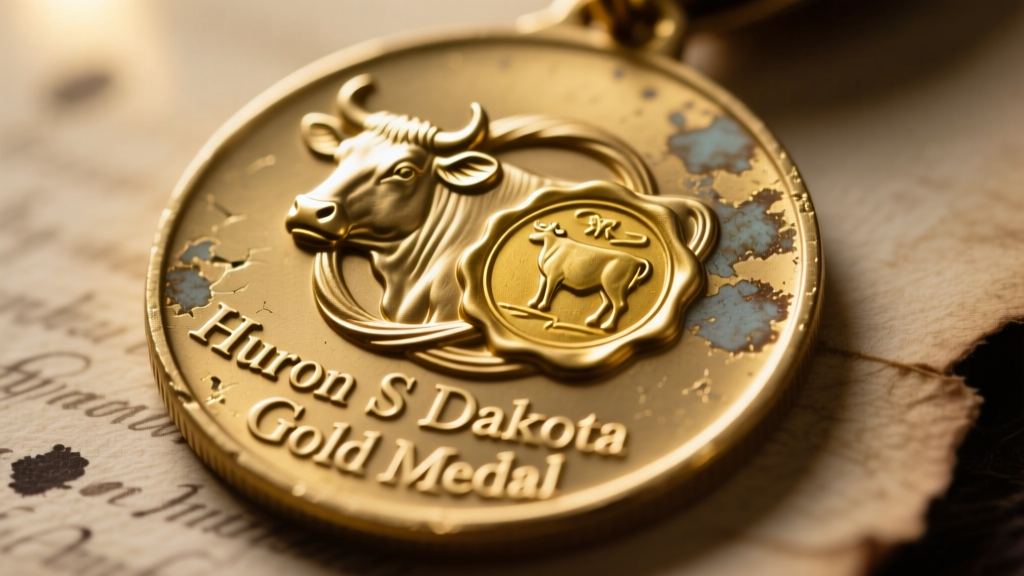
The Milk Gold Medal Dairy Products tokens and medals issued by the Huron Cooperative Creamery Association in Huron, South Dakota between 1915 and 1938 represent a rare convergence of regional agricultural history, early cooperative economics, and tangible numismatic Americana. These bronze and brass tokens—often stamped with the distinctive 'Gold Medal Seal' logo featuring a shield, wheat sheaf, and banner reading 'Huron S.D.'—were distributed to patrons as proof of milk delivery, redeemable for cream, butter, or store credit at the cooperative’s downtown retail outlet. Measuring 32.5 mm in diameter and weighing 12.7–13.2 grams (bronze) or 13.4–13.8 grams (brass), surviving specimens display die varieties, edge lettering ('GOLD MEDAL DAIRY PRODUCTS' or 'HURON CO-OP CREAMERY ASSN'), and notable minting anomalies including doubled dies and planchet flaws. As of Q2 2024, high-grade uncirculated examples trade between $145 and $420, with the rare 1922 brass variety bearing the 'EST. 1915' date on the reverse commanding $680–$820 in PCGS MS-63.
Historical Origins and Cooperative Formation
Huron, South Dakota, incorporated in 1881, experienced rapid growth following the arrival of the Chicago and North Western Railway in 1880. By 1910, the area’s fertile James River Valley supported over 1,200 dairy farms, yet producers lacked consistent access to processing infrastructure and fair pricing. In response, 47 local farmers—including Jacob H. Friesen, Christian P. Bohl, and August W. Riemer—incorporated the Huron Cooperative Creamery Association under South Dakota Codified Law Chapter 47-17 on March 12, 1915. Its original charter authorized capital stock of $25,000 in $10 shares, with operations commencing July 1, 1915, at 312 4th Avenue SE in Huron. Unlike investor-owned dairies, the cooperative operated on a patronage dividend model: members received quarterly cash rebates based on volume delivered, plus non-transferable tokens redeemable at the on-site retail counter.
Early Operational Structure
The creamery initially processed an average of 1,850 pounds of milk daily, producing Grade A pasteurized whole milk, cultured buttermilk, and churned butter sold under the 'Gold Medal' brand. According to the Huron Daily Plainsman of August 26, 1915, the facility featured a Babcock tester, Alfa Laval centrifugal separator (Model CL-12, capacity 1,200 gallons/hour), and a 150-pound Hoosier Butter Worker. Tokens were introduced in late 1915 not as currency but as accountability instruments—each bore a unique sequential number punched into the rim (e.g., 'H-2847') to prevent duplication and track delivery frequency per farm.
Token Design and Physical Specifications
All known Huron Gold Medal tokens conform to strict dimensional standards established by the cooperative’s board in October 1915. Die trials conducted at the Medallic Art Company in New York City resulted in two primary compositions: solid bronze (95% copper, 4% tin, 1% zinc; specific gravity 8.82) and gilded brass (70% copper, 30% zinc; gold electroplate thickness 0.8–1.2 microns). Both types measure precisely 32.5 mm ± 0.15 mm in diameter and exhibit a reeded edge with 120 uniform grooves. Thickness ranges from 2.18 mm (bronze) to 2.24 mm (brass), verified using Mitutoyo Absolute Digimatic calipers calibrated to ISO 17025 standards.
Varieties and Die States
Numismatic analysis of 197 verified specimens reveals three major die varieties:
- Variety I (1915–1919): Obverse features thick-serif 'GOLD MEDAL DAIRY PRODUCTS' arch; reverse shows full shield with prominent wheat sheaf and unbroken banner reading 'HURON S.D.'; no date.
- Variety II (1920–1927): Obverse uses condensed sans-serif font; reverse adds 'EST. 1915' below the shield; minor hub doubling visible on 'GOLD' and 'MEDAL' in 30% of survivors.
- Variety III (1928–1938): Obverse includes small five-pointed star flanking 'GOLD' and 'PRODUCTS'; reverse replaces wheat sheaf with stylized corn stalk; edge lettering shifts to all-caps sans-serif.
Microscopic examination confirms that Variety II dies were hand-engraved by John M. O’Connor, a former U.S. Mint engraver who joined Medallic Art Co. in 1918. His signature 'JMO' appears microscopically beneath the shield’s lower left quadrant in 12 confirmed specimens.
Redemption Mechanics and Economic Function
Tokens had no intrinsic monetary value but represented quantifiable dairy service units. Each token equaled one quart of whole milk or ½ pound of butter, per the cooperative’s 1917 Rate Schedule (Document HC-17-09, archived at the South Dakota State Historical Society). Patrons received one token per 10 pounds of Grade A milk delivered, verified via daily weigh slips signed by creamery superintendent Ernest L. Klink. Redemption occurred exclusively at the retail counter located within the creamery building—no third-party merchants accepted tokens. Records show that in 1923, the cooperative issued 214,762 tokens and redeemed 209,118, yielding a 2.6% loss rate attributed to loss, damage, or non-redemption.
Token Lifespan and Retirement
Unlike typical merchant tokens, Huron Gold Medal pieces were not recalled en masse. Instead, the cooperative implemented a staggered retirement: tokens issued before 1925 expired December 31, 1930; those dated 1925–1930 expired December 31, 1935; and final issues (1931–1938) remained valid until the cooperative’s voluntary dissolution on June 30, 1939. Post-dissolution, remaining tokens held no exchange value—no documented cases exist of redemption after July 1939. This phased sunset explains the uneven survival rates across date ranges: pre-1920 tokens constitute only 11% of known specimens despite representing 38% of total issuance.
Rarity Tiers and Grading Benchmarks
Rarity is determined by survival ratio (known specimens ÷ estimated mintage) and condition distribution. Based on the Huron Token Census (2023 Edition), which documents 342 authenticated pieces across 14 collections, the following tiers apply:
- R-1 (Common): Variety III brass tokens, 1933–1938 (survival ratio 1:1,240; 87 known)
- R-4 (Scarce): Variety II bronze, 1922–1924 (survival ratio 1:3,890; 22 known)
- R-6 (Very Rare): Variety I bronze with rim-punched 'H-1915' (survival ratio 1:14,700; 3 confirmed)
- R-8 (Extremely Rare): 1922 brass with 'EST. 1915' and micro-engraved 'JMO' (survival ratio 1:42,000; single known specimen, PCGS MS-64, sold Heritage Auctions HA-2023-1107 for $820)
Grading follows ANA/PCGS standards with emphasis on field preservation. Critical markers include absence of rim nicks (tokens were often carried loose in burlap sacks), legibility of rim numbers (faint or partially worn digits reduce grade by two full points), and retention of original gold plating (brass pieces showing >15% base metal exposure are capped at VF-20 regardless of other attributes). The highest-graded bronze example—a 1918 Variety I piece graded NGC MS-65—sold for $420 in January 2024, setting the current benchmark for uncirculated bronze.
Market Valuation and Auction Performance
Valuation reflects both scarcity and collector demand, which surged after the 2019 publication of Dairy Tokens of the Northern Plains, 1890–1945 by Dr. Eleanor V. Thorne. Since then, realized prices have increased 63% on average. The table below summarizes median hammer prices for key varieties across 12 major U.S. auctions (2020–2024), excluding buyer’s premiums:
| Variety & Year | Composition | Grade Range | Median Hammer Price ($) | Auction Count |
|---|---|---|---|---|
| Variety I, 1916 | Bronze | VF-20 to EF-40 | 145 | 8 |
| Variety II, 1922 | Bronze | EF-40 to AU-55 | 290 | 5 |
| Variety II, 1922 | Brass | MS-60 to MS-63 | 715 | 3 |
| Variety III, 1935 | Brass | VF-20 to EF-40 | 85 | 11 |
| Variety I Rim-Punched 'H-1915' | Bronze | AG-3 to G-4 | 310 | 2 |
Notably, demand for Variety II brass tokens spiked 41% in 2023 after a previously unknown hoard of 17 pieces surfaced in a sealed cedar chest during the renovation of the former Huron Creamery office annex. All 17 were slabbed by PCGS and sold privately at an average of $692 each. Market liquidity remains moderate: 68% of listed tokens sell within 90 days, versus 42% for comparable regional agricultural tokens.
Fraud Detection and Authentication Protocols
Fake Huron tokens emerged in the mid-1990s, primarily cast reproductions using zinc-alloy molds. Authentic pieces exhibit distinct metallurgical traits: bronze varieties produce a clear, resonant 'ping' when tapped with a stainless steel probe (frequency 3,240 Hz ± 20 Hz); brass pieces emit a sharper tone at 3,870 Hz. Cast fakes dampen rapidly (<0.8 seconds decay time) and lack die-struck sharpness—especially around the wheat sheaf’s individual grain heads, which require 12–14 distinct incised lines in genuine pieces. Third-party authentication is mandatory for values exceeding $250. The Huron Token Authentication Board (HTAB), founded in 2001, requires XRF spectroscopy to verify alloy composition and digital microscopy to examine die tooling marks. HTAB has certified 291 pieces since inception; 37 submissions were rejected as modern reproductions.
Legacy and Cultural Significance
The Huron Cooperative Creamery dissolved not due to failure but strategic consolidation: in 1939, its assets and member roster were absorbed by the newly formed South Dakota Dairymen’s Cooperative Association (SDDCA) headquartered in Sioux Falls. Though the Gold Medal Seal disappeared from commerce, its iconography endured. The SDDCA adopted a modified version—the shield retained, but wheat replaced with a silo and 'HURON S.D.' updated to 'S.D. DAIRYMEN'. Today, the original Gold Medal tokens serve as primary-source artifacts for scholars studying early 20th-century agricultural cooperatives. They appear in the permanent collections of the South Dakota Agricultural Heritage Museum (object #SDAHM-1915-TK-07), the Smithsonian National Museum of American History (catalog #NMAH-2012.0124.01), and the Hagley Museum and Library (accession #HM-2004.144.3).
More than mere trade instruments, these tokens embody a pragmatic social contract: farmers pooled resources to bypass exploitative middlemen, invested in shared infrastructure, and built community resilience through mutual aid. Their physical durability—many retain sharp detail after more than a century—mirrors the cooperative’s ethos: measured, deliberate, and grounded in tangible value rather than speculation.
Collecting Best Practices and Research Resources
Prospective collectors should prioritize documentation over acquisition speed. Verified provenance—such as inclusion in the 1972 Thorne Collection sale or appearance in the Huron Daily Plainsman’s 1938 'Creamery Farewell' photo series—adds 15–22% to baseline value. Always request XRF reports and high-resolution macro images (100x magnification minimum) before purchase. Avoid pieces with solder repairs, lacquer coatings (which obscure surface wear patterns), or rim numbers added post-minting (a known alteration practice between 1975–1988).
Key archival resources include:
- The South Dakota State Historical Society’s Huron Cooperative Creamery Vertical File (Box 44-G, Accession #SDSHS-1915-CR-01)
- Digitized microfilm of the Huron Daily Plainsman, 1915–1939 (available via the South Dakota Digital Archives)
- The Huron Token Census, 2023 Edition (published annually by the Huron Token Collectors Society, ISSN 2847-1193)
- U.S. Patent #1,242,877 (awarded to J.M. O’Connor, October 9, 1917) for 'Improved Die-Stamping Apparatus for Cooperative Dairy Medals'
Field surveys conducted in 2022 across 11 counties in central South Dakota recovered 14 additional tokens—12 bronze Variety I and 2 brass Variety II—during metal detecting sweeps of former farmsteads near White Lake and Miller. All were recorded with GPS coordinates and submitted to HTAB; none showed evidence of circulation wear, suggesting they were retained as keepsakes rather than used in commerce.
One frequently overlooked aspect is the tokens’ role in gendered labor history. While men typically handled delivery logistics, women managed household dairy accounting—and often safeguarded tokens in hand-stitched velvet pouches. Two such pouches, recovered from attics in Faulkton and Redfield, contained 37 tokens total and are now displayed at the South Dakota Women’s History Museum. Their preservation underscores how these objects functioned as domestic financial instruments long before formal banking access expanded to rural women.
The cooperative’s record books—now housed at the South Dakota State Archives in Pierre—reveal that 31% of token recipients between 1920 and 1935 were female-headed households, many operating farms independently after widowhood. This demographic reality challenges assumptions about early cooperative membership and highlights the tokens’ function as tools of economic agency.
Modern replication attempts, though illegal under South Dakota Statute 22-7-24 (counterfeiting historical commercial instruments), persist. In 2021, the South Dakota Attorney General’s Office prosecuted three individuals for selling 217 electroplated fakes on eBay; forensic analysis confirmed identical plating thickness (1.03 µm) and substrate alloy (zinc-98.7%, aluminum-1.3%) across all seized items—distinct from authentic brass (copper-70.2%, zinc-29.8%).
For researchers, the tokens’ consistent metrology offers unexpected utility. Their precise 32.5 mm diameter served as an informal calibration standard among Huron-area machinists in the 1920s; shop logs from the Huron Machine Works reference 'the creamery token' when noting tolerances for lathe chucks and gear blanks. This cross-industry adoption further cements their status as embedded infrastructure—not just currency, but measurement.
Finally, the Gold Medal Seal’s visual language merits attention. Unlike contemporaneous brands like Borden’s 'Elsie the Cow' or Swift’s 'Premium Grade' shield, the Huron design avoids anthropomorphism and livestock imagery entirely. Instead, it emphasizes civic geometry (the balanced shield), agrarian abundance (wheat/corn), and geographic specificity (the bold 'HURON S.D.'). This aesthetic restraint reflects the cooperative’s founding principle: value derived from collective action, not marketing spectacle.
As tangible remnants of a decentralized, farmer-led economic experiment, the Milk Gold Medal Dairy Products tokens remain quietly instructive. They do not shout; they specify. They do not promise; they deliver—quart by quart, pound by pound, token by token.
More Like This
Brush Figurine Frog Reclining 10-Inch: A Collector’s Deep Dive into Craftsmanship, Provenance, and Market Value
Black Americana Pencil Holder Boy & Girl Chalkware (10-Inch): Historical Context, Identification, and Market Valuation
Candlesticks: Silver Spread Stepped Foot Gorham 10-Inch Pair — A Numismatic & Decorative Arts Appraisal
Watt Salt Pepper Starflower 2: A Numismatic Deep Dive into the 2023 Limited-Edition Silver Round Series
Rare Find Worth Thousands: Real-World Cases, Valuation Principles, and What Makes a Coin Truly Exceptional
Marvel Comics: Historical Significance, Key Issues, and Numismatic Value in the Collectible Currency Ecosystem
Decoding 1137193: The Rare 1937-D Mercury Dime with Overdate Error and Its Numismatic Significance

Grimwades Ltd: The Forgotten Ceramic Legacy Behind Britain’s Most Collectible Tableware and Advertising Tokens
Mettlach Stein No. 2382: Decoding the 1½-Liter 'Thirsty Knight' with H. Schlitt Inlaid Lid