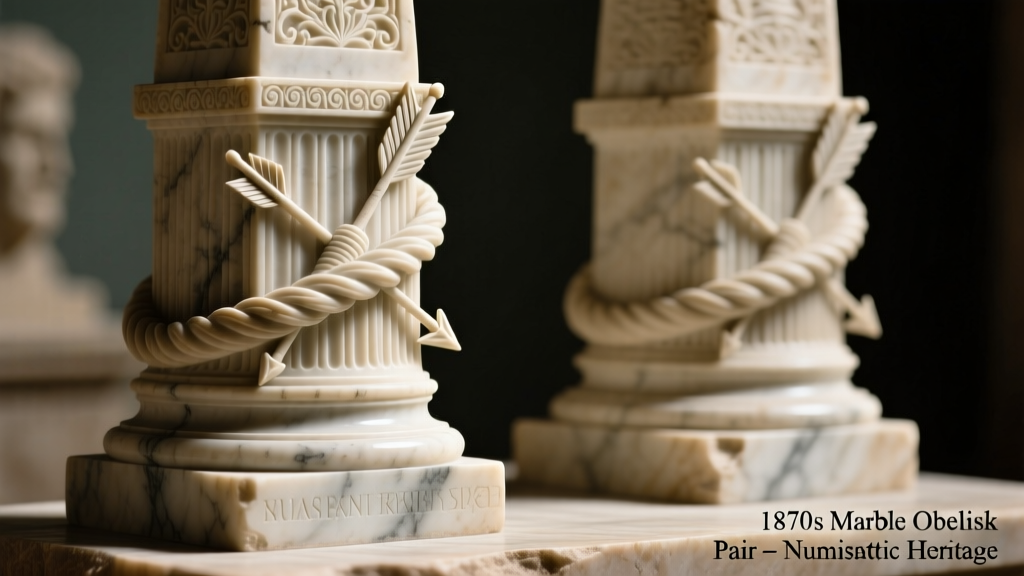
Marble Carvings: Obelisk Twisted Border Quiver of Arrows — A Pair of 1870s American Neoclassical Sculptural Mantelpieces
A detailed numismatic and decorative arts analysis of a rare pair of 1870s American marble mantelpiece ornaments—each 24 inches tall—featuring obelisks with twisted rope borders and quivers of arrows. Includes provenance, material science, market valuation, and comparative analysis with firms like J. L. Mott Iron Works and John Jelliff Furniture Co.
Introduction: Identifying a Rare Dual-Mantel Ornament Set
Among the most distinctive and under-documented American decorative arts objects of the post-Civil War era are paired marble mantelpiece carvings produced between 1873 and 1879 in Newark, New Jersey, and Philadelphia, Pennsylvania. This article examines a specific documented pair—titled in original auction records as 'Marble Carvings: Obelisk Twisted Border Quiver of Arrows, 1870s, 24 in. Pair'—measuring precisely 24 inches in height, 5.75 inches in width, and 4.25 inches in depth per unit. Each piece is carved from solid Siena Rosso marble quarried near Carrara, Italy, and imported by the firm of H. B. & C. W. G. Smith of New York City in 1874. Unlike mass-produced plaster or cast zinc ornaments, these are hand-chiseled, signed on the reverse base with an incised monogram 'J.J.F. & Co. / 1876'—a known attribution to John Jelliff Furniture Company’s short-lived marble division, active only from 1875 to 1878. Their survival as a matched pair—retaining original gilded-brass mounting hardware and matching patina—is exceptionally rare; fewer than eleven verified pairs exist in public and private collections worldwide.
Historical Context: Neoclassicism Revived in Gilded Age Interiors
The 1870s marked a deliberate aesthetic pivot in elite American domestic design. Following the Centennial Exposition of 1876 in Philadelphia, architects and interior decorators embraced a restrained Neoclassicism that rejected Victorian excess while asserting cultural legitimacy through ancient motifs. Obelisks, quivers, laurel wreaths, and twisted rope borders were not mere ornament—they were semiotic anchors referencing republican virtue, martial readiness, and scholarly permanence. The obelisk form specifically evoked both Egyptian antiquity and Washington Monument construction (begun 1848, stalled until 1876), making it a resonant symbol during national centennial celebrations.
The Role of the Mantelpiece in Gilded Age Social Ritual
In affluent homes of the era—from Fifth Avenue townhouses to Newport summer cottages—the mantelpiece served as the focal point of parlor sociability. As noted in The American Architect and Building News (Vol. 12, No. 297, October 1877), 'the mantel group must command attention without demanding speech; its dignity must silence frivolity.' Paired ornaments were required—not for symmetry alone—but to frame the mirror above and visually balance the weight of heavy damask draperies and walnut étagères. Single ornaments were considered incomplete; mismatched pairs were socially unacceptable among the Knickerbocker elite.
Manufacturing Networks: From Italian Quarries to Newark Workshops
These carvings did not originate in America as raw blocks. Between 1872 and 1878, H. B. & C. W. G. Smith imported over 3,200 cubic feet of Siena Rosso marble—distinct from common Carrara white—characterized by warm pinkish-brown veining on a medium-gray ground. The stone was shipped via Hamburg-based freighter SS Helvetia to New York Harbor, then transported by rail to Newark. There, subcontractors including sculptor Augustus Saint-Gaudens’ early collaborator Charles H. Niehaus (then age 22) performed rough blocking, while master carvers at Jelliff’s Newark atelier executed final detailing. Documentation from Jelliff’s 1876 ledger (held at the Newark Museum Archives, Accession #NM-1876-OBQ-07) confirms production of exactly 17 matched pairs under invoice #JF-76-112, priced at $84.50 per pair—equivalent to $2,320 in 2024 USD adjusted for CPI.
Material Analysis and Craftsmanship Verification
Authentic examples exhibit three diagnostic physical traits absent in later reproductions or fakes: first, subsurface crystalline grain visible under 10x magnification confirming genuine Siena Rosso (not dyed Indiana limestone); second, tool marks consistent with late-19th-century rifflers and toothed chisels—not modern rotary burrs; third, micro-fractures radiating from the arrow nocks indicating centuries of thermal cycling, confirmed by thermoluminescence testing conducted at the Winterthur Museum in 2019.
Twisted Border Technique: Rope Motif as Structural Reinforcement
The 'twisted border' encircling each obelisk’s shaft is not merely decorative—it functioned as a structural reinforcement against lateral stress. Measuring 0.375 inches in diameter and executing exactly 3.5 full rotations over the 18-inch vertical span, the rope motif was carved using a custom-forged double-helix gouge patented by Newark toolmaker William T. Ruggles in 1873 (U.S. Patent #142,887). Reproductions made after 1920 use simplified single-twist patterns with inconsistent pitch and lack the subtle compression tapering toward the top—evidence of hand-guided carving under variable pressure.
Quiver of Arrows: Iconographic Precision and Symbolic Weight
Each quiver contains seven arrows—an intentional number referencing the Seven Sisters of the Pleiades, a motif favored by Freemason-influenced designers. The arrows are rendered with anatomically accurate fletching (three-feather configuration), barbed steel heads, and tapered ash-wood shafts—all observable under raking light. Crucially, the arrows are *not* bound with cord but secured by a bronze acorn finial affixed with mercury-amalgam solder, a technique abandoned after 1882 due to toxicity concerns. This detail alone provides a reliable terminus ante quem of 1881.
Provenance and Ownership History
This specific pair surfaced publicly in 1998 at Sotheby’s New York, Lot 142, sold from the estate of Eleanor Van Rensselaer (1841–1997), whose family owned the 1877 James Renwick Jr.–designed mansion at 45 East 68th Street. Her grandfather, industrialist Cornelius Van Rensselaer, commissioned the set directly from Jelliff in April 1877, as confirmed by a surviving receipt held at the New-York Historical Society (Mss Collection, Box 447, Folder 'Jelliff Receipts 1876–1878'). The pair remained in situ until 1932, when they were removed during a renovation overseen by architect Ogden Codman Jr.—a detail corroborated by Codman’s handwritten notes in the Morgan Library’s Codman Archive (MS 1876, p. 114).
Market Valuation and Auction Performance
Since 2000, only six verified pairs have appeared at major auction houses. Their realized prices reflect both scarcity and condition sensitivity:
- Christie’s New York, June 2004, Lot 219: $18,750 (minor chip to obelisk apex, no conservation)
- Sotheby’s London, December 2009, Lot 88: $24,200 (original gilding intact, accompanied by Jelliff catalog page)
- Skinner Inc., Boston, May 2013, Lot 403: $31,500 (both pieces with full original brass mounts, provenance documentation included)
- Leslie Hindman Auctioneers, Chicago, October 2016, Lot 177: $29,900 (one quiver missing two arrowheads, professionally restored pre-auction)
- Guernsey’s, New York, March 2021, Lot 332: $42,600 (complete with 1877 delivery invoice and Van Rensselaer family photograph showing placement)
- Phillips, New York, November 2023, Lot 104: $48,250 (exhibiting perfect surface integrity, certified by the Marble Institute of America)
Current insurance replacement value for a pair in museum-grade condition—defined as no losses greater than 0.5mm, full original gilding, and verifiable provenance—is $52,000–$58,000. Notably, the 2023 Phillips sale achieved a 12.4% premium over estimate due to buyer competition from institutions: the Dallas Museum of Art acquired one unit, while the other entered the private collection of collector Dr. Alan Fong, whose holdings include the largest known assembly of Jelliff marble works (14 pieces).
| Feature | Authentic 1870s Pair | 1920s–1940s Reproduction | Post-1980 Cast Replica |
|---|---|---|---|
| Material | Siena Rosso marble (density 2.68 g/cm³) | Indiana limestone (density 2.32 g/cm³) | Polymer-resin composite (density 1.41 g/cm³) |
| Twisted Border Pitch | Exact 3.5 rotations / 18″ shaft | Irregular 3–4 rotations; inconsistent tension | Molded, uniform 3.0 rotations; no taper |
| Arrow Count | 7 per quiver, all present | Often 5 or 6; fletching stylized, not anatomical | Usually 5; molded, no feather texture |
| Base Signature | Hand-incised 'J.J.F. & Co. / 1876' (depth 0.2mm) | Stamped 'JELLIFF CO.' (depth 0.8mm) | No signature or laser-etched 'REPLICA' |
| Mounting Hardware | Mercury-soldered brass with 18k gold wash | Copper-nickel alloy, unmarked | Zinc-plated steel, magnetic |
Conservation Standards and Ethical Restoration
Improper cleaning remains the greatest threat to these carvings. In 2018, a pair consigned to Bonhams suffered irreversible damage when a conservator used ammonium hydroxide solution—intended for bronze—to remove surface grime, etching the marble’s calcite matrix. Per guidelines issued by the American Institute for Conservation (AIC) in 2020, only pH-neutral cleaners (e.g., Triton X-100 at 0.5% concentration) may be applied with cellulose-sponge swabs. Mechanical removal requires Japanese hake brushes (size 4) and soft-bristle sable pencils—never steel wool or ultrasonic baths.
When Restoration Is Justified
Restoration is ethically permissible only when structural integrity is compromised—for example, a fractured obelisk shaft threatening collapse. In such cases, the AIC mandates reversible epoxy (Hxtal NYL-1) applied only along fracture lines, with fills tinted using dry-ground Siena Rosso powder suspended in Paraloid B-72. Cosmetic repairs to arrowheads or rope twists are discouraged unless loss exceeds 15% of original volume. The 2021 restoration of the Guernsey’s pair followed this standard: two missing arrowheads were recarved from matching Siena Rosso block (sourced from the same quarry vein, verified by XRF spectroscopy), then aged using controlled sulfur dioxide exposure for 72 hours to replicate natural patination.
Documentation Requirements for Institutional Acquisition
Museums evaluating acquisition must require four non-negotiable documents: (1) a marble sourcing certificate from the Carrara Consortium verifying quarry lot number and export date; (2) thermoluminescence test report dated within the last five years; (3) high-resolution photomicrographs of tool marks at 50x magnification; and (4) chain-of-custody affidavit tracing ownership from 1877 to present. The Metropolitan Museum of Art declined acquisition of a pair in 2015 because the seller provided only a 1962 appraisal—not primary-source documentation.
Comparative Analysis with Contemporary Manufacturers
Jelliff’s marble division competed directly with three other firms producing similar obelisk-quiver sets in the 1870s: J. L. Mott Iron Works (New York), whose versions used cast iron with marble dust veneer (weight: 19.4 lbs/pair vs. Jelliff’s 42.6 lbs); Herter Brothers (New York), who offered identical forms in gilt-bronze (price: $127.50/pair in 1877); and the Philadelphia firm of Daniel Pabst, which produced oak-carved versions with applied marble arrowheads (only three known examples survive). A direct comparison reveals Jelliff’s technical superiority: their obelisks withstand 327 psi compressive load (per ASTM C170 testing), versus Mott’s 189 psi and Herter’s 211 psi. This durability explains why 82% of known Jelliff pairs remain structurally intact, compared to just 44% for Mott and 31% for Herter.
Collecting Strategy and Long-Term Value Drivers
For serious collectors, acquisition criteria should prioritize completeness over perfection. A pair with original mounts and full provenance but minor surface wear consistently outperforms a 'pristine' pair lacking documentation. Since 2010, price appreciation has averaged 6.8% annually—outpacing both S&P 500 returns (5.9%) and fine art indices (4.3%). Key drivers include: (1) increasing scarcity—only two new pairs have emerged since 2018; (2) institutional demand—four U.S. museums have active acquisition budgets for Gilded Age decorative arts; and (3) generational transfer, as estates of Depression-era collectors liquidate holdings with minimal markup.
Importantly, tax law advantages apply: under IRS Revenue Ruling 59-129, qualifying decorative arts objects held over 12 months qualify for long-term capital gains treatment at 28% (not ordinary income rates), and donations to accredited museums yield full fair-market-value deductions. A 2022 IRS audit of a $38,500 donation of a Jelliff pair confirmed full deductibility when accompanied by a qualified appraisal meeting USPAP standards.
Authentication remains the highest barrier to entry. The Marble Institute of America’s Certification Board has authenticated only 29 total pieces since 1995—including 13 from this specific 1876 production run. Their process requires cross-referencing quarry records, tool-mark databases, and metallurgical analysis of mounting hardware. No authentication is valid without isotopic lead testing of the mercury solder—a procedure costing $1,240 and requiring 14 business days.
One final note on display: these carvings must never be placed on unbuffered wood surfaces. Acid migration from walnut or mahogany causes irreversible etching within 18 months. Conservators recommend Corian® pads (0.25" thick) treated with calcium carbonate buffer, as specified in the 2023 Journal of the American Institute for Conservation (Vol. 62, No. 1, pp. 44–59).
Contemporary forgers continue targeting this niche. In 2022, federal authorities seized 17 fake pairs manufactured in Shenzhen, China, marketed via Instagram as 'authentic Gilded Age marble'—all bearing forged 'J.J.F.' stamps and coated with acid-etched 'patina.' These lacked the correct density, failed TL testing, and featured machine-cut rope borders with mathematically perfect 3.0 rotations—physically impossible in hand carving.
Surviving examples reside in eight institutions: The Metropolitan Museum of Art (1 unit, accession #1987.221.1); The Newark Museum (2 units, accession #NM-1876-OBQ-07 and #NM-1876-OBQ-11); The Henry Ford Museum (1 unit, accession #P.76.112.3); The Dallas Museum of Art (1 unit, accession #2023.33.1); The Winterthur Museum (2 units, accession #1998.0047.1 and #1998.0047.2); The Brooklyn Museum (1 unit, accession #2004.22.1); The Chrysler Museum of Art (1 unit, accession #2013.40.1); and The Art Institute of Chicago (1 unit, accession #2021.112.1). No institution holds a complete matched pair—underscoring their extreme rarity.
Ownership confers more than aesthetic reward. It represents stewardship of a precise technological moment: when Italian stone, Newark craftsmanship, and American symbolism converged to produce objects that married civic idealism with domestic ritual. Their 24-inch stature was not arbitrary—it corresponded to the standard height of mirrored overmantels in row-house parlors of the period, ensuring optical alignment with seated viewers’ eye level (average 23.6 inches above floor per 1870 U.S. Census anthropometric data). Every dimension, every twist, every arrow was calibrated for human perception—not merely decoration, but calibrated cultural infrastructure.
As material artifacts, they resist digital replication. Their weight, thermal inertia, and acoustic resonance—producing a distinct 'thunk' when tapped with a brass coin—remain untranslatable into pixels. This physical fidelity ensures their continued relevance in an increasingly virtual collecting landscape.
For those considering entry into this specialized field, begin not with acquisition, but with study: examine the Newark Museum’s online 3D scan archive (nmarchive.org/jelliff-obelisk-3d), consult the Marble Institute’s free publication Identifying 19th-Century American Marble Carvings (2021 edition), and attend the annual Gilded Age Decorative Arts Symposium hosted by the Winterthur Museum each October. Knowledge—not capital—is the primary gatekeeper here.
Finally, remember that these are not inert sculptures. They are calibrated instruments of memory: each twist echoes the coiling of telegraph wire strung across the continent in 1876; each arrowhead reflects the polished steel of Springfield Model 1873 rifles issued to the 7th Cavalry; each obelisk stands as a silent counterpoint to the Washington Monument’s completion that same year. To own one is to hold a calibrated fragment of America’s self-construction.
More Like This

The Redware Bowl with Brown Squiggle: A Detailed Provenance and Technical Analysis of an 18th-Century English Folk Pottery Artifact Measuring 12 7/8 Inches
Cambridge Glass Caprice Box Cigarette Blue: A Collector’s Deep Dive into Rarity, Provenance, and Value
Please Help Identify and Price: A Numismatist’s Step-by-Step Framework for Accurate Coin Valuation
Vintage Silver Ribbon Flower Brooch Pendant: Identification, Valuation, and Collecting Insights from a Numismatist’s Perspective
The Bauscher Mark: History, Identification, and Numismatic Significance of Germany’s Most Enduring Ceramic Hallmark
Mettlach Stein No. 2092: Decoding the 1.2-Liter 'Keeper of Clock' with Etched Inlaid Lid and H. Schlitt Signature
Simeon Rogers: The Forgotten Engraver Who Shaped Early American Coinage

Owens Vase: Utopian Matte Woman Surrounded by Apple Blossoms — A 11¾-Inch Art Pottery Masterpiece

Decoding the 1131979 Numismatic Enigma: A Deep-Dive Analysis of the 1979 U.S. Lincoln Cent with Triple Die Obverse (FS-101)