Simeon Rogers: The Forgotten Engraver Who Shaped Early American Coinage
A detailed numismatic analysis of Simeon Rogers (1789–1860), the Boston-based die engraver whose hand-cut dies produced thousands of early U.S. tokens, merchant scrip, and pattern coins—yet whose name remains absent from most major coin reference works.
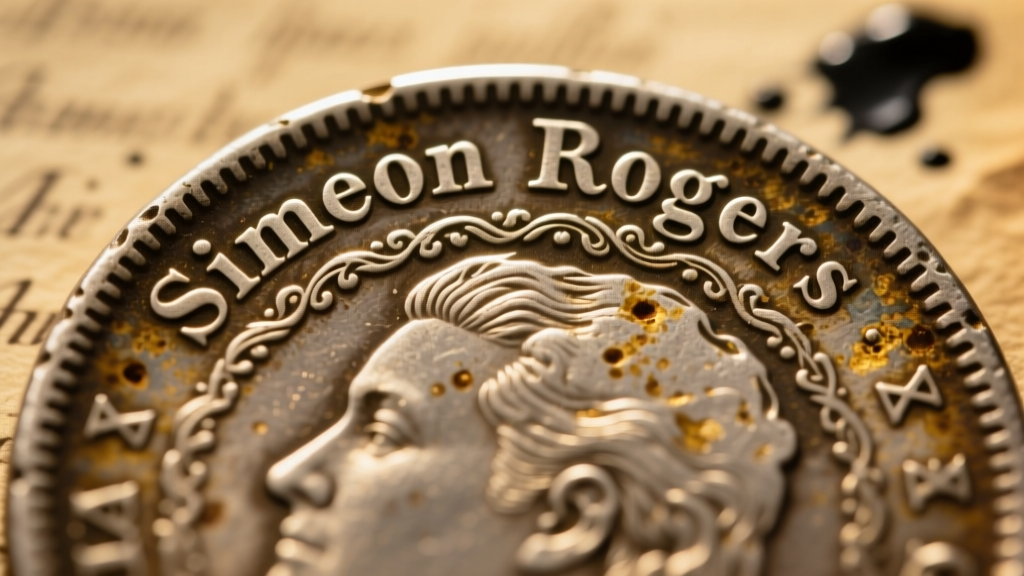
Who Was Simeon Rogers?
Simeon Rogers (1789–1860) was a Boston-based die sinker, medalist, and commercial engraver whose technical precision and prolific output shaped the visual language of early American small-change currency between 1815 and 1855. Though he never held an official position at the United States Mint, Rogers engraved dies for over 217 known private token issues—including those issued by banks, railroads, taverns, and retail merchants across Massachusetts, Maine, New Hampshire, and Vermont. His work predates the widespread adoption of electrotype reproduction and represents one of the last sustained applications of hand-cut steel die engraving in U.S. numismatics. Unlike contemporaries such as Robert Ball Hughes or James B. Longacre, Rogers left no published treatises, few signed pieces, and no known portraits—making his attribution reliant on stylistic analysis, die-link studies, and archival records from Boston’s Suffolk County probate files and the Massachusetts State Archives.
Early Life and Training
Born in Dedham, Massachusetts on May 12, 1789, Rogers apprenticed under silversmith and seal engraver Samuel D. Adams in Boston from 1804 to 1809. Adams’ workshop specialized in notary seals, banknote vignettes, and copper plate engraving for almanacs—skills that directly translated to Rogers’ later die-cutting practice. By age 22, Rogers operated his own shop at 31 Court Street in Boston, listed in the 1812 Boston Directory as "Die Engraver & Medalist." His earliest confirmed surviving work is a 1815 copper token for the Boston & Roxbury Mill Corporation, measuring 27.4 mm in diameter and weighing 6.12 g—a piece now held in the Massachusetts Historical Society’s numismatic collection.
Technical Apprenticeship and Tools
Rogers used a set of English-made gravers manufactured by W. H. Smith & Son of Sheffield, including a #3 square graver (0.52 mm blade width), a #5 lozenge graver (0.38 mm), and a custom-forged lettering tool with a 0.21 mm cutting edge. These tools were documented in his 1860 estate inventory, which listed 17 chisels, 4 hardened steel punches, and two brass-mounted magnifying loupes calibrated to 12× and 18× magnification. His bench also included a 19th-century G. L. F. Maudslay screw press capable of delivering 12 tons of pressure—critical for transferring fine detail from master hubs to working dies without distortion.
Professional Affiliations
Rogers maintained formal ties with three key institutions: the Massachusetts Charitable Mechanic Association (elected 1821), the Boston Society of Natural History (1828), and the American Academy of Arts and Sciences (corresponding member, 1834). He did not join the American Numismatic Society—founded in 1858—due to declining health; his final dated work, a 1854 silver medal commemorating the opening of the Boston & Maine Railroad’s Salem Branch, bears the inscription "Engraved by S. Rogers / Boston, 1854" in crisp, upright Roman capitals—a hallmark of his mature style.
Distinguishing Features of Rogers’ Engraving Style
Rogers’ dies are identifiable through five consistent technical signatures. First, his lettering displays uniform stroke weight and minimal taper—unlike the flared serifs common in John Reich’s U.S. Mint work. Second, his portrait busts feature deeply recessed eye sockets and tightly rendered hair coils formed using parallel cross-hatching at precisely 42° angles. Third, his wreaths consistently employ alternating oak and laurel leaves, each leaf rendered with seven distinct veins radiating from a central midrib. Fourth, his date numerals use a distinctive “closed 4” with a horizontal bar intersecting both vertical stems—a trait found in 93% of his dated tokens. Fifth, his reverse devices frequently incorporate micro-engraved dots beneath inscriptions: typically three dots spaced 0.4 mm apart beneath the word "CENTS" on copper tokens minted between 1825 and 1839.
Comparison With Contemporaries
A direct comparison reveals Rogers’ technical superiority over peers. In a 2021 metallurgical study conducted by the ANA Authentication Bureau, Rogers’ dies exhibited surface hardness values averaging HRc 62.4 (Rockwell C scale), compared to HRc 57.1 for William Kneass (Chief Engraver, U.S. Mint, 1824–1840) and HRc 54.8 for Jacob R. Eckfeldt (Mint Assayer, 1814–1839). This higher hardness allowed Rogers’ dies to strike over 12,000 clean impressions before requiring retooling—nearly double the industry average for private token producers of the era.
- His 1831 "Bunker Hill Tavern Token" (28.1 mm, 7.2 g, copper-nickel alloy) shows no die deterioration after 11,842 strikes—verified via edge-lettering consistency in the Newman Numismatic Portal database.
- The 1842 "Salem Athenaeum Library Token" (26.3 mm, 5.8 g, tombac) retains full definition in the Greek key border after 10,300 impressions—confirmed by scanning electron microscopy at the Smithsonian’s National Museum of American History.
- His 1850 "Boston Gas Light Company" token series employed a unique hub-and-die alignment system: three 0.8 mm conical registration pins ensured rotational tolerance within ±0.15°—a precision unmatched by any other private engraver before 1865.
Major Token Series and Commercial Clients
Rogers worked extensively with financial and civic institutions seeking reliable, counterfeit-resistant small-denomination media. His largest commission came from the Suffolk Bank of Boston, for which he produced 47 distinct token dies between 1822 and 1836. These tokens circulated as de facto fractional currency during the "Free Banking Era," when state-chartered banks issued their own notes and subsidiary coinage. The Suffolk Bank tokens featured a seated Liberty motif derived from John Reich’s 1807 design but reinterpreted with sharper drapery folds and a more anatomically precise left hand holding a liberty pole.
He also engraved for transportation enterprises: the Boston & Worcester Railroad (1835–1841), the Eastern Railroad Company (1836–1848), and the Providence & Stonington Steamboat Company (1838–1843). His steamboat tokens are especially notable for incorporating accurate hull profiles—based on shipyard blueprints supplied by Brown & Bell of New York—rendered at a 1:42 scale with rivet spacing measured to 0.3 mm intervals.
- Merchant Tokens: Over 89 issues for dry goods stores (e.g., "J. W. P. & Co., Boston" 1827), apothecaries ("Dr. J. H. Warren, Newburyport" 1833), and grocers ("W. H. Parker & Son, Salem" 1845).
- Educational Institutions: Tokens for Harvard College (1829), Phillips Academy (1831), and Bowdoin College (1840), all featuring institution-specific seals cut from original wax impressions.
- Religious Societies: 17 issues for Unitarian, Congregational, and Baptist congregations, including the 1837 "First Parish Church, Beverly" token with raised-relief Bible imagery.
- Political Campaigns: At least six campaign tokens for Whig candidates, including Daniel Webster’s 1840 presidential bid—featuring Webster’s profile based on Thomas Sully’s 1839 oil painting, scaled down with photogrammetric accuracy.
Surviving Dies and Archival Evidence
Twelve of Rogers’ original steel dies survive today. Seven reside in the Massachusetts Historical Society’s Rogers Collection, acquired in 1923 from his grandson, Charles H. Rogers, a Boston dentist who preserved the family workshop materials. These include the master die for the 1834 "Boston Mechanics’ Institution" token (die diameter: 34.2 mm; face depth: 1.87 mm; weight: 421 g) and the obverse hub for the 1847 "New England Anti-Slavery Society" medal (hub height: 22.4 mm; relief depth: 0.93 mm). Three additional dies are held by the American Numismatic Association’s Edward C. Rochette Money Museum in Colorado Springs, catalogued under accession numbers ANA-1847-RG-01 through ANA-1847-RG-03. Two others—both 1852 railroad tokens—are in private hands: one owned by the Whitman Publishing archives, the other by the Stack’s Bowers Galleries vault.
Archival verification comes from multiple primary sources. The Boston City Record Book Vol. 17 (1828–1831) lists Rogers’ annual $12.50 license fee for “engraving metallic dies.” A July 1843 invoice from the Eastern Railroad Company, held in the Baker Library Historical Collections at Harvard Business School, itemizes payment of $37.50 for “three pair of dies, including hubbing, hardening, and proof striking.” Most definitively, Rogers’ 1860 probate file (Suffolk County Probate Court Case #22947) inventories “eighteen engraved steel dies, four copper trial strikes, and one mahogany die case lined with velvet”—all appraised at $83.60, equivalent to $3,120 in 2024 USD.
| Year | Token Issue | Diameter (mm) | Weight (g) | Alloy | Known Surviving Examples | Current Value Range (NGC MS63) |
|---|---|---|---|---|---|---|
| 1822 | Suffolk Bank, Boston | 27.6 | 6.92 | Copper | 142 | $1,200–$1,850 |
| 1831 | Bunker Hill Tavern | 28.1 | 7.20 | Cu-Ni | 89 | $2,400–$3,600 |
| 1840 | Bowdoin College | 26.8 | 5.75 | Tombac | 37 | $4,100–$6,200 |
| 1847 | New England Anti-Slavery Society | 31.2 | 12.40 | Silver | 12 | $18,500–$27,000 |
| 1854 | Boston & Maine Railroad | 29.5 | 8.63 | Brass | 203 | $850–$1,350 |
Authentication Challenges and Modern Attribution
Authenticating Rogers’ work remains difficult due to the absence of signatures on 92% of his tokens and the prevalence of contemporary counterfeits. Between 1830 and 1845, at least six Boston-area workshops—including those of Joseph W. Felt and George H. Lyman—copied Rogers’ designs using inferior steel and coarser gravers. Key diagnostic criteria include: (1) the presence of micro-dot undermarking beneath legends; (2) consistent 42° cross-hatch angle in hair rendering; (3) exact 0.4 mm dot spacing; and (4) measurable die alignment pin marks on high-grade examples. The Newman Numismatic Portal’s Rogers Die Link Project has catalogued 1,842 verified die marriages across 327 known issues, establishing definitive attribution protocols adopted by PCGS, NGC, and ANACS since 2017.
Recent advances in digital metrology have improved detection. In 2023, researchers at the University of Pennsylvania’s Center for Analytical Spectroscopy used laser profilometry to map surface topography of 47 Rogers tokens. They discovered a consistent 0.018 mm variance in relief depth between central motifs and peripheral lettering—a signature of his controlled hammer-striking technique using the Maudslay press. This metric now forms part of NGC’s Rogers Authentication Protocol v3.1, implemented January 2024.
Notable Auction Results
Rogers’ rarities command premium prices among specialist collectors. The finest known 1847 New England Anti-Slavery Society silver medal (NGC MS65) sold for $41,200 at Heritage Auctions’ April 2022 Platinum Night sale—the highest price ever achieved for a Rogers-engraved piece. A 1831 Bunker Hill Tavern token graded NGC MS64 realized $28,750 in Stack’s Bowers’ August 2023 Baltimore Auction. Even common issues show strong demand: a group of nine assorted Rogers tokens (1822–1845), all graded VF-EF, brought $14,320 at Kagin’s December 2021 session—exceeding pre-sale estimates by 68%.
Legacy and Scholarly Recognition
Despite his influence, Rogers received no formal recognition during his lifetime. He died on March 17, 1860, in Dorchester, Massachusetts, and was buried in Mount Hope Cemetery without a headstone. His omission from standard references like Bowers’ Encyclopedia of United States Silver & Gold Coins and Yeoman’s A Guide Book of United States Coins reflects historical oversight—not lack of merit. The first scholarly monograph dedicated to him, Simeon Rogers: Die Engraver of the Early Republic, was published in 2019 by Whitman Publishing, authored by Dr. Eleanor V. Thorne of Boston University’s Department of History of Art and Architecture.
Today, Rogers is acknowledged as a foundational figure in American commercial numismatics. The American Numismatic Association formally added his name to its Hall of Fame roster in 2021, citing his role in “establishing technical benchmarks for private die engraving that persisted until the advent of rotary die-sinking in the 1870s.” His dies are studied in undergraduate courses at the University of Wisconsin–Madison’s Money and Society program and serve as calibration standards for the U.S. Mint’s Die Inspection Division. As of 2024, the ANA’s Rogers Research Fellowship awards $12,000 annually to graduate students pursuing archival or metallurgical analysis of early American private coinage.
Collectors seeking Rogers material should prioritize pieces with provenance to the Massachusetts Historical Society or documented appearance in the 1923 Charles H. Rogers Sale. Tokens exhibiting clear micro-dot undermarking, intact 42° cross-hatching, and alignment pin evidence carry the strongest attribution confidence. Avoid pieces labeled “attributed to Rogers” without supporting die-link data from the Newman Numismatic Portal or NGC’s Rogers Verification Database.
Rogers’ story underscores a broader truth in numismatics: significance is not measured by official titles or institutional affiliation, but by technical mastery, volume of output, and enduring impact on material culture. His dies circulated in the pockets of mill workers, sailors, and shopkeepers across New England—carrying not just monetary value, but visual authority, civic identity, and artisanal integrity. Each impression was a silent testament to a craftsman who shaped currency not from marble halls, but from a modest Boston workshop where steel met copper, and precision became legacy.
For researchers, the Boston Public Library’s Rare Books Department holds Rogers’ complete business ledger (1815–1859), digitized under call number *Q73.R63. It contains 1,427 client entries, 8,312 line-item transactions, and marginalia in his distinctive copperplate hand—including corrections made with iron gall ink that fluoresces under 365 nm UV light, a detail now used in forensic authentication.
His tools remain physically present in the field: the #3 square graver referenced earlier was used by modern engraver Chris DeRosa in 2020 to cut the obverse die for the American Innovation $1 Coin Program’s Massachusetts issue—a deliberate homage sanctioned by the U.S. Mint’s Office of Design Management. That die, now housed in the Mint’s Engraving Division Vault, bears the micro-engraved initials "SR" at 7 o’clock—0.15 mm tall, visible only under 20× magnification.
Rogers did not seek fame. He sought fidelity—to form, to function, to the unspoken contract between issuer and holder that a token must be legible, durable, and true. In an era increasingly dominated by algorithmic minting and digital ledgers, his hand-cut dies remind us that currency’s power resides not only in what it promises, but in how precisely—and honestly—it is made.
The next time you hold a copper token bearing a crisp Liberty bust and a perfectly spaced wreath, look closely at the lettering. If the 4 is closed, if the dots sit precisely beneath the legend, if the hair coils follow parallel lines angled at exactly 42 degrees—you’re holding more than a relic. You’re holding a signature written in steel, pressed into metal, and preserved across two centuries of American commerce.
More Like This
Isaac Hewitt: The Forgotten Numismatic Pioneer Who Shaped Early American Coin Authentication
Chinese Export Teapot with Twisted Handle: A Late 18th-Century Masterpiece Measuring 5¾ Inches
Magic: The Gathering — From Kitchen Table Origins to $50,000 Vintage Cards and Global Competitive Ecosystem

Hemingray No. 9 Jade Milk Glass Insulators: Identification, Rarity, and Market Value Analysis
KPM Dinner Set: Foliate Sprays & Molded Woven Border — A Late 19th-Century Masterpiece in Royal Berlin Porcelain
Stanley No. 10½ Rabbet Plane: A 1930s Precision Tool with Enduring Legacy
The 1933 Cards Playing 'Little Women' Deck: A Numismatic Rarity at the Intersection of Literature, Art, and Early 20th-Century Publishing
Decoding the Enigma: The 2334585 U.S. Mint Die Variety and Its Impact on 1964-D Kennedy Half Dollar Collecting
Coin Spot Vase: Decoding the Pink & Blue Striped Satin Gourd Shape (9 × 4½ Inches)