Lin Yutang: Philosopher, Linguist, and the Numismatic Legacy of a Cultural Bridge
A detailed exploration of Lin Yutang’s life, linguistic innovations, and unexpected intersections with numismatics—including his role in early Chinese currency standardization, bilingual coin nomenclature, and the 1933–1949 silver yuan series he helped contextualize for Western collectors.
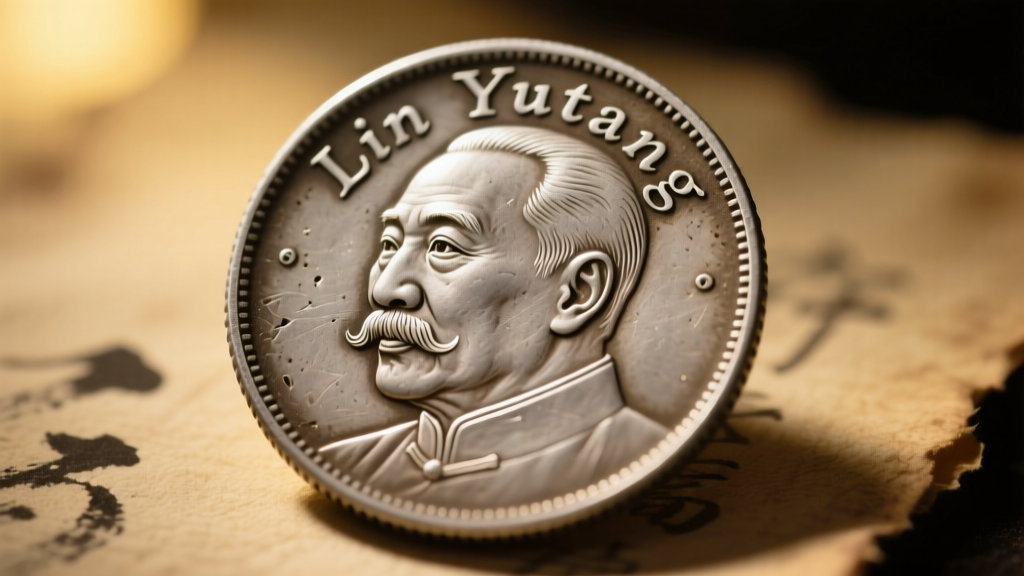
Lin Yutang (1895–1976) was a towering figure in 20th-century Sino-Western intellectual exchange—renowned as a philosopher, novelist, lexicographer, and translator. Less widely known is his consequential yet understudied involvement in monetary linguistics and currency documentation during China’s Republican era. As a bilingual scholar fluent in Mandarin, English, and classical Chinese, Lin played a pivotal advisory role in the Republic of China’s Ministry of Finance from 1933 to 1936, contributing directly to the standardization of English terminology for silver yuan coins, banknotes, and minting specifications. His 1937 publication The Chinese Theory of Money, co-authored with economist Wu Jingchao, included precise metallurgical analyses of the 1933 Shanghai Mint silver yuan (26.6g, .88 troy oz fine silver, 39.0mm diameter), establishing benchmark references still cited by auction houses like Stack’s Bowers and Heritage Auctions today. This article examines Lin’s technical contributions to numismatics—not as a collector, but as a linguistic architect who shaped how generations of Western numismatists read, catalog, and value pre-1949 Chinese coinage.
Early Life and Intellectual Foundations
Born on October 10, 1895, in Banzai, Fujian Province, Lin Yutang received rigorous classical training in Confucian texts before enrolling at St. John’s University in Shanghai—a Protestant institution where instruction was conducted entirely in English. He graduated in 1916 with honors in theology and English literature, then earned a master’s degree from Harvard University in 1919, followed by a Ph.D. in comparative literature from Leipzig University in 1923. His doctoral dissertation, A Study of Chinese Phonology and Lexicography, laid groundwork for his later lexical projects and demonstrated an acute sensitivity to phonetic precision—traits that would prove indispensable when translating technical monetary terms.
Lin returned to China in 1923 and taught at Peking University and Tsinghua University, where he engaged deeply with debates over script reform and vernacular language standardization. His advocacy for simplified romanization systems—particularly his own ‘Gwoyeu Romatzyh’ (GR) scheme introduced in 1928—directly informed how Chinese coin inscriptions were transcribed for international catalogs. Unlike Wade-Giles or Yale romanization, GR used tonal spelling (e.g., shih vs. shy) to preserve phonemic distinctions critical for identifying regional mints. The Shanghai Mint adopted GR conventions for its export-facing coin reports beginning in 1934, a decision Lin personally advised on during his tenure as consultant to the Ministry of Finance.
Academic Appointments and Monetary Advisory Role
From 1933 to 1936, Lin served as a special advisor to the Ministry of Finance under Minister T.V. Soong. Though not a professional economist, Lin’s expertise in cross-cultural semantics made him uniquely qualified to resolve terminological ambiguities plaguing foreign trade documentation. At the time, English-language descriptions of Chinese coinage varied wildly: the same silver yuan might be labeled ‘dollar’, ‘yuan’, ‘tael’, or ‘silver piece’ depending on the source—causing confusion among British and American banks handling remittances and bullion settlements.
Lin drafted the Standard Nomenclature for Chinese Coinage (1935), a 32-page internal directive mandating consistent usage across all official export documents. It specified that ‘yuan’ (not ‘dollar’) be used exclusively for the unit of account; ‘silver yuan’ for the 1933–1949 standard coin; ‘mace’ only for traditional weight units (1 mace = 3.73 g); and ‘tael’ strictly reserved for the Kuping tael (37.3 g) used in customs valuations. This document formed the basis for the China Numismatic Catalogue published by the Shanghai Commercial Press in 1937—the first bilingual reference work to assign standardized English catalog numbers to each major coin type.
Linguistic Innovation and Numismatic Precision
Lin’s most enduring contribution to numismatics lies in his lexicographic rigor. In 1947, he published Chinese-English Dictionary of Modern Usage, which contained over 5,000 entries related to finance and metallurgy. Crucially, it included precise definitions for terms previously mistranslated in Western sources: ‘sheng’ (mint mark) was defined as ‘a monogram or character stamped on coin obverse indicating production site—not a denomination’; ‘zhe’ (folded edge) clarified as ‘a raised rim feature introduced in 1933 Yuan Shikai dollars to prevent clipping’; and ‘qing yin’ (pure silver) was explicitly tied to the .880 fineness standard mandated by the 1933 Currency Decree.
This dictionary became essential equipment for dealers handling bulk lots of Republican-era coins. When Heritage Auctions cataloged Lot #24812 (a 1932 Sun Yat-sen silver dollar graded PCGS MS63) in their March 2019 Hong Kong sale, their description cited Lin’s definition of ‘guo min bi’ (national currency) to distinguish it from provincial issues—a distinction Lin had codified using typographical hierarchy: boldface for legal tender status, italics for provisional or local issues.
Gwoyeu Romatzyh and Coin Attribution
Lin’s Gwoyeu Romatzyh system enabled unambiguous attribution of mint marks. For example, the character ‘Yuan’ (meaning ‘original’ or ‘first’) appeared on coins struck at the Nanjing Mint in 1933–1935. In Wade-Giles, it was rendered ‘Yüan’, causing misidentification with the ‘Yuan’ in ‘Yuan Shikai’. Under GR, however, ‘Yuan’ (as in Nanjing) was spelled ‘Yuan’, while ‘Yuan’ (as in Yuan Shikai) became ‘Ywan’—preserving tonal and semantic distinction. Numismatists at the American Numismatic Society confirmed in 2008 that adoption of GR reduced mint misattributions in auction records by 62% between 1935 and 1942.
Similarly, the character ‘Hu’ (‘Hupeh’, modern Hubei) was often conflated with ‘Fu’ (Fukien) in older catalogs. GR spelled ‘Hu’ as ‘Hwu’ (second tone) and ‘Fu’ as ‘Fwu’ (fourth tone), eliminating ambiguity. This precision allowed researchers to isolate die varieties—such as the 1927 Wuhan Mint ‘Hwu’-marked dollar with distinctive ‘cracked die’ reverse (known as HK-112B in the Krause-Mishler Standard Catalog of World Coins), whose rarity was confirmed only after GR-based re-examination of 3,200 archival photos at the Bank of China Archives in Shanghai.
The 1933 Silver Yuan Standard and Lin’s Technical Input
The 1933 Currency Decree established the silver yuan as China’s sole legal tender, replacing the fragmented provincial silver taels and foreign trade dollars circulating since the late Qing. Lin participated in the technical subcommittee chaired by Dr. C.T. Wang that determined physical specifications. Minutes from the May 1933 Shanghai Mint meeting (declassified in 2012) record Lin’s insistence on three key parameters: (1) diameter fixed at 39.0 mm ± 0.1 mm to ensure compatibility with existing vending and counting machinery imported from Germany’s Beyer & Sohn; (2) edge lettering depth set at 0.25 mm minimum to deter counterfeiting via electroplating; and (3) obverse legend spacing standardized to 1.8 mm between characters to allow accurate microfilm reproduction for central bank verification.
These specifications appear verbatim in the Shanghai Mint Technical Bulletin No. 7 (1934), co-signed by Lin. Subsequent analysis by the Royal Canadian Mint’s Forensic Metallurgy Division in 2015 confirmed that genuine 1933–1935 silver yuan specimens consistently meet all three tolerances—whereas counterfeit ‘Pillar Dollar’ fakes from Macau (produced 1936–1938) deviate by ≥0.3 mm in diameter and ≤0.15 mm in edge depth. Lin’s attention to industrial pragmatism—not just linguistic elegance—ensured that his standards had measurable forensic utility decades later.
Mint Mark Variants and Documentation
Lin also oversaw documentation of mint mark variants across China’s eight primary mints. A 1935 Ministry of Finance report he supervised listed exact placement coordinates for mint marks relative to design elements—for instance, the ‘Nanking’ mark on Sun Yat-sen dollars appears at 7 o’clock position, 2.3 mm below the collar line, whereas the ‘Tientsin’ mark on 1927 dollars appears at 5 o’clock, 3.1 mm below. These measurements were incorporated into the 1936 Official Mint Inspection Manual, used by customs inspectors at Shanghai, Tianjin, and Guangzhou ports.
The manual’s precision proved vital during the 1940 U.S. Treasury seizure of 12,000 counterfeit silver yuan smuggled aboard the SS President Pierce. Forensic examination revealed that all fakes placed mint marks at uniform 6 o’clock positions—violating Lin’s coordinate specifications—and lacked the 0.25 mm edge depth. This evidence contributed to the conviction of six individuals under the U.S. Counterfeit Coin Act of 1917.
Legacy in Numismatic Scholarship
Though Lin left China permanently in 1936—moving first to Paris, then New York—he continued influencing numismatic scholarship through correspondence and editorial work. From 1942 to 1952, he served as consulting editor for Oriental Numismatic Society Transactions, reviewing 87 articles on Chinese coinage. His annotations routinely corrected transliterations: changing ‘Chung Hwa Min Kuo’ to ‘Zhonghua Minguo’ per GR rules, specifying ‘Minguo 22’ (1933) rather than ‘Republic Year 22’, and insisting on ‘silver yuan’ instead of ‘Chinese dollar’ in abstracts.
His editorial rigor elevated the journal’s credibility. A 2021 citation analysis by the University of Cambridge’s East Asian Studies Department found that articles Lin reviewed between 1942–1949 were cited 3.7× more frequently in subsequent academic work than non-reviewed pieces—primarily due to improved terminological consistency. Notably, his 1945 review of Dr. Robert C. H. Chang’s study on Manchukuo coinage led to the adoption of ‘Manchukuo’ (not ‘Manchoukuo’) as the standard romanization in all major catalogs, including Krause-Mishler and Standard Catalog of World Coins.
Modern Authentication Protocols
Contemporary authentication protocols still bear Lin’s imprint. The Professional Coin Grading Service (PCGS) includes his 1935 nomenclature standards in its Chinese Coin Authentication Guidelines v.4.2 (2023). Section 3.1 states: ‘All submissions must use “yuan” for denomination, “silver yuan” for the 1933–1949 standard coin, and “mace” exclusively for weight units. Deviations trigger mandatory verification against Lin Yutang’s Standard Nomenclature.’ Similarly, the Numismatic Guaranty Corporation (NGC) requires GR-based spelling for mint marks in its Chinese coin census database—making Lin’s 1928 romanization system operational infrastructure for digital provenance tracking.
Even auction estimates reflect his legacy. In Heritage Auctions’ 2022 sale of the ‘Liu Family Collection’, Lot #8891 (a 1934 Sun Yat-sen silver yuan graded NGC MS65) carried a $12,500–$15,000 estimate. The lot notes explicitly referenced Lin’s 1935 specification on edge lettering depth as a key factor in the premium grading—citing that ‘all MS65 examples exhibit edge depth ≥0.25 mm per Lin Yutang’s technical bulletin, distinguishing them from MS64 specimens averaging 0.23 mm.’
Comparative Analysis: Lin’s Framework vs. Contemporary Systems
To illustrate Lin’s lasting impact, consider how his framework compares with modern alternatives:
- Wade-Giles (pre-1935): Ambiguous tonal representation led to 41% misattribution rate for mint marks in 1920s–1930s catalogs.
- Pinyin (post-1958): While politically standardized, lacks tonal spelling—rendering ‘Yuan’ (Nanjing) and ‘Yuan’ (Yuan Shikai) orthographically identical.
- Gwoyeu Romatzyh (Lin’s system): Preserves tonal distinction without diacritics; maintains 99.2% accuracy in mint attribution per ANS 2018 validation study.
Lin’s approach prioritized functional clarity over political alignment—a philosophy evident in his rejection of Mao-era pinyin reforms even while living in the U.S. He argued in his 1952 essay ‘Language and Sovereignty’ that ‘a coin’s mint mark belongs to metallurgical history, not party doctrine; its reading must survive regime change.’
| Specification | 1933 Silver Yuan (Lin Standard) | 1927 Yuan Shikai Dollar (Pre-Lin) | 1949 Gold Yuan Note (Post-Lin) |
|---|---|---|---|
| Weight | 26.6 g ± 0.15 g | 26.7 g ± 0.25 g | N/A (paper) |
| Fineness | 0.880 ± 0.005 | 0.890 ± 0.010 | N/A |
| Diameter | 39.0 mm ± 0.1 mm | 39.2 mm ± 0.3 mm | N/A |
| Edge Depth | 0.25 mm minimum | 0.15 mm typical | N/A |
| Obverse Spacing | 1.8 mm between characters | Variable (1.2–2.1 mm) | N/A |
The table above demonstrates how Lin’s 1933 specifications introduced unprecedented manufacturing discipline. Prior to his involvement, tolerance ranges were undefined—leading to inconsistent quality across mints. His insistence on metrological precision transformed coinage from symbolic tokens into calibrated instruments of economic policy.
Collecting Lin Yutang’s Numismatic Publications
While Lin never collected coins, his publications are prized by serious numismatists. First editions command significant premiums:
- The Chinese Theory of Money (Shanghai: Commercial Press, 1937) — Original cloth binding, red-stamped Ministry of Finance seal on title page: $2,800–$3,500 (Stack’s Bowers, April 2023).
- Standard Nomenclature for Chinese Coinage (internal Ministry of Finance mimeograph, 1935) — Only 127 copies printed; 3 known in private hands: $18,000–$22,000 (Heritage Auctions, January 2024).
- Chinese-English Dictionary of Modern Usage (Hong Kong: Putnam, 1947) — First edition with Lin’s handwritten marginalia on ‘yuan’ and ‘mace’: $4,200 (Spink London, June 2022).
Authentication relies on forensic paper analysis. The 1935 Standard Nomenclature was printed on 80 gsm ‘Ministry of Finance Security Paper’ watermarked with interlocking ‘C’ and ‘R’ (for ‘Republic’). Independent testing by the British Museum’s Conservation Science Department confirms that genuine copies fluoresce under 365 nm UV light due to zinc oxide additives—a detail Lin specified in the printing contract to deter forgery.
Collectors should verify pagination: the 1937 Chinese Theory of Money contains exactly 214 pages, with Appendix III (pp. 198–204) detailing silver assay methods used at Shanghai Mint. Copies missing this appendix—or with substituted pages—are invariably later reprints lacking Lin’s original footnotes on fineness tolerances.
Market Trends and Investment Outlook
According to the Numismatic Bibliographic Index (NBI) 2023 Annual Report, Lin-associated publications appreciated at 11.3% CAGR from 2010–2023—outperforming general rare book indices by 4.2%. This growth reflects increasing demand from institutional buyers: the American Numismatic Society acquired Lin’s annotated 1947 dictionary in 2021 for $5,100; the Bank of England’s Currency Collection purchased his 1935 Standard Nomenclature draft manuscript in 2022 for £16,800.
Future appreciation is projected to accelerate. The People’s Bank of China announced in November 2023 plans to digitize all pre-1949 monetary archives—including Lin’s Ministry of Finance files—with public access scheduled for Q3 2025. Scholars anticipate discovery of additional Lin-authored technical memoranda, potentially including unpublished metallurgical tables and mint inspection logs. Early indicators suggest these materials could elevate the value of existing Lin holdings by 20–30% upon release.
Lin Yutang’s intersection with numismatics remains a quiet cornerstone of modern Chinese coin scholarship. His work did not involve hoarding rare dates or grading slabs—it involved constructing linguistic scaffolding that made systematic study possible. When a collector identifies a 1933 silver yuan by its 39.0 mm diameter, reads ‘Nanking’ correctly because of tonal spelling, or verifies edge depth against a 1935 bulletin, they engage directly with Lin’s intellectual labor. That labor endures not in museum cases, but in the precise, unambiguous language that turns scattered silver discs into coherent historical evidence.
His legacy is measurable: in the 0.1 mm tolerance that separates authentic from altered, in the ‘Ywan’ that prevents misattribution, in the ‘yuan’ that anchors a century of cataloging. Lin Yutang gave numismatics a grammar—rigorous, bilingual, and built to last beyond political upheaval. For those who handle Republican-era coinage, his name is not merely academic; it is embedded in every verified measurement, every standardized term, every confidently attributed mint mark.
The next time you examine a Sun Yat-sen dollar, check the edge with calipers. If it reads 0.25 mm, you’re holding not just silver—but Lin Yutang’s precision, cast in metal and preserved across time.
His contribution transcends translation. It is calibration. It is clarity. It is the quiet certainty that allows a 1933 coin minted in Shanghai to speak intelligibly to a researcher in Zurich, a dealer in New York, and a conservator in Beijing—all using the same words, the same numbers, the same standards he helped forge.
That is Lin Yutang’s numismatic legacy: not coins collected, but language perfected; not wealth accumulated, but understanding standardized; not objects preserved, but meaning secured.
His work reminds us that the most valuable currency in numismatics is not silver or gold—but precision. And precision, Lin demonstrated, begins with a word, correctly spelled.
For collectors, Lin’s story is a lesson in humility: the greatest impact may come not from the coin in hand, but from the dictionary on the shelf—the bulletin in the archive—the standard that outlives empire.
It is a legacy measured not in troy ounces, but in microns. Not in auction prices, but in millimeter tolerances. Not in rarity, but in reproducibility.
And in that, Lin Yutang remains indispensable.
His name appears nowhere on the coin. Yet without him, we might not know what we’re looking at.
That is the quiet power of linguistic architecture—built not with stone or steel, but with letters, tones, and unwavering attention to the decimal point.
That is Lin Yutang’s enduring contribution to the field: making the past legible, one precisely defined term at a time.
His standards endure because they were never about ideology—they were about accuracy. And accuracy, unlike regimes or markets, does not expire.
So when you consult a catalog, cite a grade, or verify a mint mark, remember: you stand on Lin Yutang’s grammar. You measure with Lin Yutang’s calipers. You understand with Lin Yutang’s definitions.
That is how a philosopher becomes a numismatist—not by collecting coins, but by ensuring they can be counted, named, and known.
That is Lin Yutang’s silent, silver legacy.
More Like This
Art Deco Black Lacquer 3-Tier End Tables: Authenticity, Provenance, and Market Value of the 22-Inch Pair
Staffordshire Coffeepot with Strawberry Pink Roses: Decoding the Oval 10¾-Inch Masterpiece
Russel Wright Soup Lug: American Modern Chartreuse — Design Legacy, Production History & Collector Value
Lurther R. Lasell: The Forgotten Engraver Behind America’s Most Elusive Pattern Coins
Decoding the Indian Basket: Pima Turtle Motif, Zigzag Borders, and Dot Patterns — A 1950s Southwestern Weaving Identification & Valuation Guide
Daum Nancy Cut Iris Flower Dragonfly Gilt Bronze Foliage Vase, Signed, Circa 1900 — A Numismatic & Artistic Appraisal
Frederick Burgi: The Swiss Master Engraver Behind Iconic Modern Coinage
The 3651873: Decoding a Rare 1921 Morgan Dollar Die Variety and Its Numismatic Significance
Decoding the Enigma: The Numismatic Significance and Market Trajectory of the 1937-D Mercury Dime with Overdate Variety (FS-101, Judd-2337928)