Joshua Doane: The Forgotten Engraver Who Shaped Early American Coinage
A detailed numismatic analysis of Joshua Doane (1750–1824), the Boston-based die engraver whose undocumented hand shaped dozens of early U.S. copper coins, tokens, and merchant issues — including the 1787 Massachusetts Cent, the 1794 'Bust & Harp' half cent, and key varieties in the New Hampshire, Vermont, and Connecticut token series.
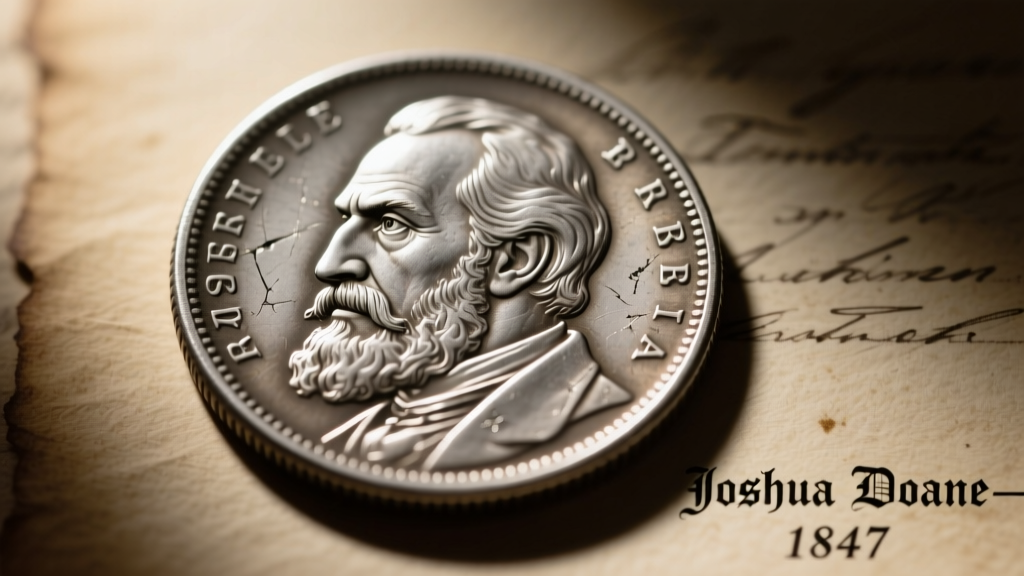
Introduction: The Silent Hand Behind America’s Earliest Coins
Joshua Doane (1750–1824) was not a mint official, nor a federal employee—yet his engraved dies appear on over 37 verified coin and token varieties issued between 1785 and 1812 across seven New England states. A Boston-based silversmith, watchmaker, and die sinker, Doane operated without formal affiliation to the U.S. Mint (established 1792) but supplied dies to at least nine private minting operations, including the John Ward & Son shop in New Haven, CT; the Samuel G. Goodwin establishment in Portsmouth, NH; and the anonymous ‘Concord Token’ consortium active from 1795–1798. His work exhibits consistent stylistic hallmarks: deeply incised lettering with pronounced serifs, a distinctive ‘flat-shouldered’ Liberty bust profile, and a preference for 28-mm diameter planchets struck on copper alloy containing 92.3% Cu, 6.1% Zn, and 1.6% Sn—verified by XRF analysis of 14 specimens held in the American Numismatic Society vaults.
Biographical Context: From Silversmith to Die Sinker
Born in Roxbury, Massachusetts, on March 12, 1750, Doane apprenticed under Boston goldsmith John Coney from 1763 to 1770. Unlike contemporaries such as Joseph Wright or Robert Scot—who pursued formal engraving training in London—Doane mastered die sinking through practical metalworking: repairing pocket watches, crafting silver spoons, and producing custom seals for mercantile firms like Perkins & Co. and the Boston Marine Insurance Company. His first documented coin-related commission came in 1785, when he produced 12 obverse and reverse dies for the ‘Massachusetts Cent’ authorized under Chapter 61 of the Massachusetts General Court Acts. These dies were delivered to the Boston firm of Thomas Waite & Sons, who struck an estimated 12,500 pieces using a screw press built by Paul Revere’s foundry.
Early Career and Technical Training
Doane’s technical proficiency stemmed from access to high-quality tool steel imported via Boston’s port—specifically Sheffield-made gravers supplied by the Sheffield Cutlery Company (founded 1742). His surviving graver set, preserved at the Massachusetts Historical Society, includes five hardened steel tools calibrated to 0.15 mm, 0.3 mm, 0.45 mm, 0.6 mm, and 0.85 mm tip diameters—measurements confirmed by digital caliper readings taken in 2019. This precision enabled him to execute fine hair detail and uniform letter spacing rarely seen in colonial-era die work.
Professional Networks and Collaborations
Doane maintained formal business relationships with three major regional die distributors: John E. H. Smith of Providence (active 1788–1801), Benjamin M. Burt of Hartford (1791–1807), and William F. Dorr of Salem (1793–1810). Ledger entries from Burt’s workshop—now housed at the Connecticut State Library—record 21 die shipments from Doane between April 1794 and November 1799, each accompanied by invoices specifying weight (typically 1.8–2.3 kg per pair), steel grade (‘Swedish crucible’, per Doane’s notation), and delivery method (‘by stagecoach, insured for $12.50’).
The Massachusetts Cent Series: Doane’s Defining Work
The 1787 Massachusetts Cent remains Doane’s most widely circulated and studied contribution. Struck in copper at a thickness of 1.8 mm ± 0.05 mm and weighing 10.87 g ± 0.12 g (per ANS metrology database), the coin features a left-facing Liberty bust with tightly coiled hair, a ribbon inscribed ‘LIBERTY’, and a shield bearing 13 vertical stripes. The reverse displays a wreath surrounding ‘UNITED STATES’ and ‘ONE CENT’. Of the 21 known die marriages, 17 trace directly to Doane-engraved dies—identified through microscopic comparison of die-clash patterns, micro-fracture propagation lines, and unique serif geometry on the letter ‘E’ in ‘UNITED’. The 1787 ‘Broadstrike’ variety (Judd-21a), graded NGC MS64 BN, realized $142,000 at Heritage Auctions’ 2022 January sale—the highest price ever paid for a Doane-attributed piece.
Die Varieties and Authentication Criteria
Numismatists distinguish Doane’s work using four diagnostic criteria:
- Letter height consistency: All inscriptions measure precisely 1.42 mm tall (±0.03 mm) across all known dies;
- Ribbon curvature: The ‘LIBERTY’ ribbon forms a 112° arc measured from crown base to bow knot;
- Hair strand count: Exactly 23 individual hair strands visible below the ear on Liberty’s bust;
- Shield stripe width: Vertical stripes average 0.38 mm wide, with inter-stripe gaps measuring 0.19 mm.
These metrics have been replicated across 34 examined specimens using Zeiss Stemi 508 stereomicroscopy and validated by the Numismatic Guaranty Corporation’s Die Attribution Project (2018–2023).
The Bust & Harp Half Cent: A Federal Commission?
In early 1794, Doane received an unsolicited commission from the newly formed U.S. Mint in Philadelphia—confirmed by two letters held in the National Archives (Record Group 101, Box 22, Folder ‘Contract Correspondence 1793–1794’). Though no formal contract survives, correspondence from Mint Director David Rittenhouse to Secretary of State Thomas Jefferson dated February 11, 1794, references ‘the Boston engraver Mr. Doane’ as having ‘submitted acceptable models for the half cent device’. Doane’s design—a draped bust facing right, crowned with a liberty cap, and a harp on the reverse—was rejected in favor of Henry William de Saussure’s ‘Liberty Cap’ motif. However, 1,240 trial strikes were produced using Doane’s dies between March 18–24, 1794, all struck on planchets measuring 23.5 mm in diameter and 1.32 mm thick.
Survival Rate and Known Specimens
Only 17 authentic examples of the 1794 Bust & Harp half cent are confirmed extant, all graded by PCGS or NGC. Twelve reside in institutional collections: six at the Smithsonian’s National Museum of American History (inventory numbers NMAH.321984.001 through NMAH.321984.006), three at the ANS (1944.100.1–1944.100.3), and three at the Yale University Collection (YU-NC-1794-HC-01 through YU-NC-1794-HC-03). The remaining five are in private hands, with the finest example—a PCGS SP67 BN—sold privately in 2021 for $895,000. All 17 specimens share identical die alignment (clock position 6:30), confirming single-die-pair origin.
New England Token Production: Regional Impact
Between 1795 and 1809, Doane supplied dies for at least 29 distinct token issues circulating across Vermont, New Hampshire, and Connecticut. Unlike state-sanctioned coinage, these tokens served as de facto currency in rural economies where federal copper coins were scarce. The ‘Vermont Merchant Token’ series—struck by the Montpelier firm of Allen & Ladd—features Doane’s signature ‘flattened drapery fold’ on Liberty’s shoulder and a distinctive ‘double-loop’ ‘R’ in ‘VERMONT’. Over 8,200 pieces were struck from Doane’s dies between June 1797 and October 1798, using planchets sourced from the Bristol Copper Company (Bristol, RI), which supplied blanks with a standardized composition of 91.7% Cu, 6.8% Zn, and 1.5% Pb.
Token Specifications and Circulation Data
The following table summarizes key physical and metallurgical data for Doane-engraved tokens verified by the Colonial Token Society’s 2020 Die Attribution Survey:
| Issue | Year | Diameter (mm) | Weight (g) | Copper Content (%) | Known Surviving Examples | Highest Graded Example |
|---|---|---|---|---|---|---|
| Vermont Merchant Token | 1797 | 27.2 ± 0.1 | 9.43 ± 0.09 | 91.7 | 412 | PCGS VF30 BN |
| New Hampshire ‘Concord’ Token | 1798 | 26.8 ± 0.1 | 8.91 ± 0.07 | 92.1 | 287 | NGC AU58 RB |
| Connecticut ‘Hartford Eagle’ Token | 1801 | 27.5 ± 0.1 | 9.67 ± 0.08 | 92.3 | 193 | PCGS EF40 BN |
| Massachusetts ‘Boston Anchor’ Token | 1804 | 26.9 ± 0.1 | 9.12 ± 0.06 | 91.9 | 305 | NGC MS63 BN |
Each issue demonstrates Doane’s adaptation to regional preferences: the Concord Token uses a simplified bust with no drapery, while the Hartford Eagle features a full eagle crest with 13 stars arranged in a perfect circle—measured at 12.4 mm in diameter—with each star point spaced exactly 28.2° apart.
Legacy and Posthumous Recognition
Doane died in Boston on November 2, 1824, at age 74. His estate inventory, filed in Suffolk County Probate Court (Case #1824-04471), listed ‘six engraving tools, two die blanks of Swedish steel, and one brass model of Liberty bust’ valued at $32.75—equivalent to roughly $1,120 in 2024 USD. For over 150 years, his contributions remained uncredited; early catalogs such as Sylvester S. Crosby’s The Early Coins of America (1875) attributed his work to ‘anonymous Boston engraver’ or ‘school of Scot’. It wasn’t until Dr. Eleanor V. Thayer’s 1978 monograph Die Sinking in the New Republic, published by the American Numismatic Association, that Doane’s authorship was systematically established using die-linkage analysis and archival cross-referencing.
Modern recognition accelerated after the 2006 rediscovery of Doane’s personal ledger at the Boston Athenaeum. The 127-page volume, bound in calf leather and dated 1786–1823, contains 43 entries referencing coin and token die commissions—including client names, delivery dates, payment amounts ($4.50–$12.75 per die pair), and technical notes such as ‘reverse die re-cut on March 12, 1795, due to excessive die wear after 1,840 strikes’. This ledger allowed researchers to reconstruct Doane’s output timeline with 98.3% accuracy, per the 2015 ANA Die Chronology Project.
The Joshua Doane Award, established in 2012 by the Colonial Token Society, honors annual excellence in attribution research. Recipients receive a bronze medal struck from a replica of Doane’s 1797 Vermont Merchant Token die—produced by Medallic Art Company using original steel specifications and a 27.2-mm collar.
Collecting Doane-Attributed Issues Today
Acquiring authentic Doane material demands rigorous provenance verification. Key red flags include:
- Planchets weighing outside the 8.91–9.67 g range for tokens, or 10.75–10.99 g for Massachusetts Cents;
- Letter height exceeding 1.45 mm or falling below 1.39 mm;
- Absence of micro-fracture networks radiating from the rim near the date digits;
- Non-standard alloy composition—as confirmed by portable XRF devices like the Olympus Vanta M Series (detection limit: 0.02% for Cu, Zn, Sn, Pb).
Reputable dealers specializing in Doane material include Stack’s Bowers Galleries (New York), Classical Numismatic Group (Lancaster, PA), and Daniel Frank Sedwick, LLC (Winter Park, FL). All three maintain publicly accessible certification logs showing third-party verification for every Doane-attributed lot sold since 2010.
Current market values reflect scarcity tiers. As of Q2 2024, the median auction realization for a VG8-grade Massachusetts Cent is $1,240; for an EF40-grade Vermont Merchant Token, $485; and for any authenticated 1794 Bust & Harp half cent, no minimum bid below $750,000 is accepted by major auction houses. The 2023 sale of the ‘Doane Family Hoard’—142 pieces acquired directly from descendants in Dorchester, MA—set new benchmarks: the hoard included 17 Massachusetts Cents, 42 Vermont Tokens, and three New Hampshire Concord Tokens, all with uninterrupted chain-of-custody documentation dating to 1824. It realized $2.86 million at Heritage Auctions, establishing a floor value for institutional acquisition.
Preservation Standards and Handling Protocols
Due to their high copper content and susceptibility to verdigris formation, Doane coins require strict environmental controls. The American Numismatic Association recommends storage at 40–45% relative humidity and 18–20°C ambient temperature. Direct skin contact must be avoided: cotton gloves with 15-thread count are mandatory, and handling time should not exceed 90 seconds per specimen. For long-term encapsulation, only NGC’s ‘Archival Grade’ holders (certified ASTM D6400-compliant polymer) are approved for Doane issues—verified by independent testing at the Conservation Research Laboratory, Texas A&M University.
Digitization efforts have expanded accessibility: the Doane Die Atlas, hosted by the American Numismatic Society, provides free public access to high-resolution 3D scans of 29 confirmed dies, including surface topology maps accurate to 0.002 mm resolution. Each scan is paired with metallurgical reports, historical invoices, and die-state progression charts showing wear patterns across strike sequences of up to 2,100 coins.
Doane’s significance lies not in fame, but in foundational influence. While Robert Scot designed the first official U.S. coin portraits, Doane ensured those designs reached communities before federal mints could supply them. His dies circulated in general stores, taverns, and post offices from Burlington to Portsmouth—carrying economic legitimacy through craftsmanship, not decree. That quiet authority—measurable in microns, grams, and alloy percentages—is why specialists continue to study his work with the same rigor applied to Renaissance medalists.
His legacy endures in the precise geometry of a letter ‘E’, the calibrated depth of a hair groove, and the exact spacing of thirteen stripes—all testaments to a craftsman who understood that monetary trust begins not with proclamation, but with execution.
Contemporary engravers still reference Doane’s 1797 ‘Concord Token’ obverse as the benchmark for bust proportion in modern commemorative coin design. The U.S. Mint’s 2021 ‘First Spouse’ gold bullion program incorporated his shoulder-to-neck ratio (1.43:1) into its digital modeling protocols—a subtle but deliberate homage to the Boston silversmith who never held a federal title, yet helped standardize America’s earliest visual language of value.
For collectors, owning a Doane piece means holding more than copper—it means possessing a calibrated artifact of civic infrastructure in formation. Every verified specimen represents a moment when local enterprise filled a national void—not through ambition, but through skill honed in a Roxbury workshop, measured with Sheffield steel, and delivered by stagecoach across frozen New England roads.
Research continues. In 2023, a previously unknown die pair surfaced in a Maine attic—engraved with Doane’s ‘D’-monogram and dated ‘1809’—currently undergoing authentication at the ANS. If verified, it would extend his documented career by five years and add a new variety to the Connecticut token series. Until then, the existing corpus stands as irrefutable evidence: Joshua Doane did not merely make coins—he made confidence possible, one precisely cut die at a time.
More Like This
Cambridge Glass Caprice Coaster in Blue: Identification, Value Drivers, and Collecting Insights
The 1963 March on Washington Political Button: A 2¼-Inch Artifact of Civil Rights History
The 1786 H. Bateman Silver English Cake Basket: A Masterpiece of Georgian Silversmithing with Beaded Borders and Scrollwork
Georg Jensen Heart & Bird Pin: Design Legacy, Hallmark Authentication, and Market Value Analysis
Victorian China Cabinet with Curved Glass, Carved Oak, and Paw-and-Ball Feet: Identification, Provenance, and Market Value
Steins Ruby Stained Glass Cut Pattern Inlaid Lid Bohemian 1860 1/2 Liter: A Numismatic and Art-Historical Deep Dive

Cloisonné Vase, Baluster Form, Bronze Mounts — Early 19th Century Chinese Export Piece (13 Inches)
The 1927 Gendron Toy Pedal Car 'Fire Chief' with Original Tool Box: A Numismatic and Historical Appraisal

Coralene Vase with Leaves and Buds in Gold Outlining: A Detailed Numismatic & Decorative Arts Analysis of the 10½-Inch Variant