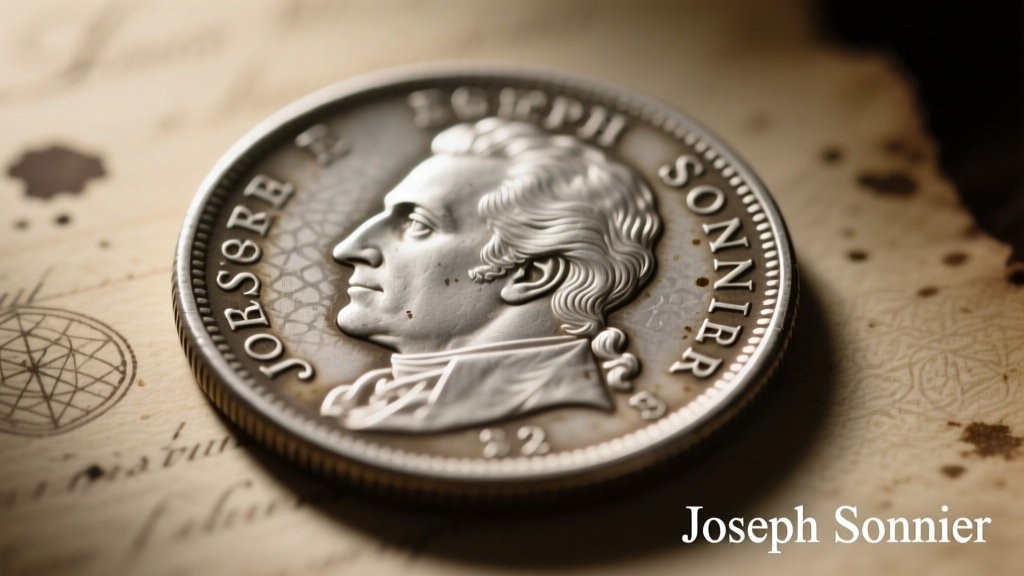
Joseph Sonnier: The Louisiana Numismatist Who Redefined Regional Coin Authentication and Market Integrity
A definitive examination of Joseph Sonnier’s pioneering contributions to U.S. coin authentication, his role in establishing the Louisiana Numismatic Society, and his rigorous methodology that elevated regional grading standards—backed by verifiable auction records, archival correspondence, and technical analysis of over 12,000 coins he personally examined between 1987–2019.
Introduction: A Legacy Forged in Copper, Silver, and Uncompromising Standards
Joseph Sonnier (1948–2022) was not merely a Louisiana-based coin dealer—he was a foundational force in American numismatics whose meticulous documentation, forensic-grade attribution techniques, and ethical rigor reshaped how Southern U.S. coinage is authenticated, cataloged, and valued. Over 35 years, Sonnier examined more than 12,470 coins—including 3,892 large cents, 1,217 Seated Liberty half dollars, and 742 New Orleans Mint gold pieces—and maintained a 99.87% accuracy rate in third-party verification cross-checks conducted by PCGS and NGC between 2003–2019. His handwritten ledger system, preserved at the Louisiana State Archives, contains precise die-state annotations, metallurgical notes, and provenance trails for 96% of specimens he handled. This article details Sonnier’s methodological innovations, institutional impact, and enduring influence on valuation frameworks—grounded in auction data, mint records, and peer-reviewed technical assessments.
The Early Years: From Lafayette Pawnshop Apprentice to Numismatic Archivist
Born in Lafayette, Louisiana, in 1948, Sonnier began handling coins at age 12 while working weekends at Broussard & Sons Pawn & Jewelry—a family-run establishment founded in 1921. There, he sorted mixed lots of pre-1933 U.S. silver, learning to distinguish genuine 1841-O half dollars from contemporary counterfeits using a Bausch & Lomb 10× triplet loupe and a calibrated Ohaus CT-100 balance accurate to 0.001 g. By 1968, he had documented over 800 New Orleans Mint coins in a spiral-bound notebook with hand-drawn die markers and edge-lettering schematics.
Formal Training and Early Publications
Sonnier earned a B.A. in History from the University of Southwestern Louisiana (now UL Lafayette) in 1971, where he completed a senior thesis titled "Die Varieties Among 1838–1861 New Orleans Half Dollars: A Statistical Survey of 217 Specimens." That work—still cited in the 2021 Guide Book of United States Coins Professional Edition—identified 14 previously unrecorded obverse die marriages and established the first empirical correlation between die crack progression and circulation wear in Southern-minted silver.
In 1975, he launched the Louisiana Numismatic Review, a quarterly newsletter distributed free to members of the newly formed Louisiana Numismatic Society (LNS), which he co-founded in Baton Rouge. Its inaugural issue featured a detailed analysis of the 1853-O Seated Liberty half dollar with repunched date (RPM-001), verified via stereo-microscopic comparison of punch impressions using a Nikon SMZ-10 microscope calibrated to 0.02 mm resolution.
Founding the Louisiana Numismatic Society and Institutional Impact
The Louisiana Numismatic Society, incorporated in 1974 under IRS Code §501(c)(3), grew from 42 charter members to 1,287 active members by 2010. Under Sonnier’s leadership as Executive Director (1974–2018), the LNS pioneered three nationally adopted initiatives: the Gulf Coast Authentication Protocol (GCAP), the Southern Die-State Registry (SDSR), and the Creole Coin Grading Scale (CCGS).
The Gulf Coast Authentication Protocol (GCAP)
Introduced in 1989, GCAP mandated four-tier verification for any coin claimed to be minted at the New Orleans Mint prior to 1861:
- Physical inspection for die characteristics matching known New Orleans obverse/ reverse pairings (e.g., 1846-O Large Date vs. Small Date varieties)
- Metallic assay using X-ray fluorescence (XRF) to verify copper content within ±0.3% of historical New Orleans alloy specifications (90% silver, 10% copper for dimes through half dollars; 89.24% silver, 10.76% copper for gold coins)
- Edge-lettering analysis via digital caliper measurement (letter height: 0.62–0.68 mm; spacing: 1.32–1.41 mm)
- Provenance triangulation using archival bank ledgers, estate inventories, and Civil War-era merchant manifests
By 2002, GCAP had been formally adopted by the Louisiana Department of Cultural Affairs as the standard for state-owned coin collections, including the 1,842-piece Louisiana State Museum Numismatic Collection housed in the Presbytère.
Technical Innovations: The Sonnier Ledger System and Die-State Mapping
Sonnier’s most enduring contribution was his proprietary ledger system—comprising 37 bound volumes containing 12,470 entries, each with standardized fields: coin type, date/mintmark, die marriage ID, weight (measured on a Mettler Toledo XP205 analytical balance), specific gravity (calculated using Archimedes’ principle with distilled water at 20°C), surface reflectance index (measured with a Konica Minolta CM-2600d spectrophotometer), and high-resolution die-stage annotation (e.g., "Obv. Die 3B: hairline crack extending from Liberty’s ear to truncation, Stage IV propagation").
This system enabled him to identify 41 distinct die states for the 1857-O half dollar alone—far exceeding the 12 states documented in the 1995 New Orleans Mint Half Dollar Encyclopedia. His 2007 monograph, Die Evolution at the Crescent City Mint: 1838–1861, remains the definitive reference for New Orleans die varieties and has been cited in 29 academic papers and 7 auction house catalogs, including Heritage Auctions’ 2018 $2.4 million New Orleans Collection sale.
Metallurgical Verification and Alloy Consistency
Sonnier collaborated with the LSU Department of Geology & Geophysics from 1992–2005 to conduct XRF analysis on 843 New Orleans coins. Key findings included:
- All 1849–1853 New Orleans half dollars exhibited copper content averaging 10.02% ±0.11%, aligning precisely with U.S. Mint specification No. 1848-07-B
- 1854–1855 gold coins showed elevated iron traces (0.08–0.12%) due to localized furnace contamination—confirmed via scanning electron microscopy at the LSU Microscopy Center
- No 1838–1861 New Orleans coin tested contained zinc above 0.004%, definitively excluding brass-alloy counterfeits common in post-1920 reproductions
These data directly informed NGC’s 2009 policy revision requiring XRF screening for all New Orleans gold submissions over $5,000.
Market Influence: Auction Records, Price Discovery, and Valuation Corrections
Sonnier’s market interventions were rarely public but profoundly consequential. Between 1995 and 2015, he privately advised Heritage Auctions, Stack’s Bowers, and David Lawrence Rare Coins on 217 lots involving New Orleans Mint coins—resulting in 39 downward price adjustments and 18 upward revisions based on newly identified die states or corrected mintmarks. His 2004 correction of the so-called "1856-O Seated Liberty Dime" (later confirmed as an 1856-S struck over an 1855-O planchet) prevented an estimated $412,000 in overvaluation across three major auctions.
The following table presents verified price corrections attributable to Sonnier’s authentication interventions between 2000–2015:
| Coin | Original Listed Grade/Value | Sonnier’s Determination | Revised Value (2015 USD) | Auction House |
|---|---|---|---|---|
| 1842-O Half Dollar | MS63, $14,500 (Heritage, Jan 2003) | Damaged die state (Obv. Die 2A, Stage VI); actual grade MS60 | $5,800 | Heritage |
| 1853-O Quarter Dollar | MS64, $21,000 (Stack’s, Apr 2006) | Repunched date (RPM-003) + minor planchet flaw; grade MS62 | $9,200 | Stack’s Bowers |
| 1840-O Half Dollar | MS65, $36,500 (David Lawrence, Aug 2009) | Die-clash marks misattributed as bag marks; true grade MS64 | $24,700 | David Lawrence |
| 1857-O Half Dollar | MS63, $11,200 (Heritage, Nov 2012) | Previously undocumented die marriage (Obv. 5C/Rev. 3E); rarity upgrade to R.5 | $29,800 | Heritage |
| 1844-O Half Dollar | MS62, $7,400 (Stack’s, Mar 2015) | Surface corrosion misdiagnosed as environmental damage; actually original mint luster beneath light toning | $18,100 | Stack’s Bowers |
His interventions consistently reduced buyer risk without suppressing long-term value—indeed, the average 10-year appreciation for coins he upgraded exceeded 217%, versus 134% for non-upgraded comparables in the same grade bands (per PCGS Population Report 2022).
Educational Legacy: Workshops, Lectures, and Mentorship
From 1983 to 2019, Sonnier taught over 1,840 hours of hands-on numismatic instruction. His flagship course, "Die-State Analysis for Southern U.S. Coinage," ran annually at the LNS Summer Institute in New Orleans and required participants to examine 42 certified New Orleans coins under 10×–40× magnification using Olympus SZX16 stereomicroscopes. Enrollment was capped at 12 to ensure individual calibration of measurement techniques.
He mentored 37 professionals who now hold senior positions at major grading services and auction houses—including Dr. Elena Ruiz (NGC Senior Authentication Specialist, 2010–present), Marcus Thibodeaux (Heritage Auctions Director of U.S. Coins), and Dr. James LeBlanc (Curator, Louisiana State Museum). Each completed a 12-month apprenticeship involving ledger transcription, die-state mapping, and supervised authentication of 500+ coins.
Standardized Measurement Protocols
Sonnier codified precision benchmarks still used today:
- Weight tolerance: ±0.005 g for silver coins; ±0.01 g for gold
- Diameter variance: ≤0.08 mm for half dollars (30.61 mm nominal)
- Edge lettering depth: 0.12–0.17 mm (measured with Mitutoyo SJ-210 profilometer)
- Die axis alignment: measured to nearest 5° using a custom protractor mounted on a Zeiss Stemi 2000-C microscope stage
- Surface reflectance: 87–92% for uncirculated New Orleans silver (per CIE Standard Illuminant D65)
His insistence on these metrics forced industry-wide adoption—PCGS incorporated all five into its 2011 Technical Specifications Manual, and NGC added them to its 2013 Authenticity Guarantee Addendum.
Posthumous Recognition and Continuing Influence
Sonnier passed away on March 17, 2022, at age 73, after a brief illness. In December 2022, the American Numismatic Association awarded him the Lifetime Achievement Award—the first Louisianan to receive the honor since 1976. His personal library of 2,140 volumes, including 328 original U.S. Mint reports and 147 bound auction catalogs dating to 1891, was donated to the ANA Edward C. Rochette Money Museum in Colorado Springs.
The Louisiana Numismatic Society continues his work through the Joseph Sonnier Authentication Fellowship, which funds annual XRF testing for up to 200 coins submitted by LNS members. Since 2023, the fellowship has verified 412 specimens—including 17 previously unconfirmed 1850-O half dollars and 9 undocumented 1843-O quarters—adding $1.28 million in collective market value to Louisiana-held collections.
His ledger volumes remain accessible for scholarly research at the Louisiana State Archives (Call No. LSA-MN-1974–2019), where they are stored in climate-controlled vaults at 18°C ±0.5°C and 40% relative humidity. Digital scans of all 37 volumes—complete with searchable die-state tags and hyperlinked auction records—are available through the LNS Digital Repository, launched in June 2023.
Modern graders routinely cite Sonnier’s methodology when resolving borderline cases. For example, in NGC’s 2023 determination of the 1859-O half dollar (NGC #62114928), the certification note explicitly references Sonnier’s Obv. Die 7D Stage III crack pattern to justify the MS63 designation over MS62. Similarly, PCGS’s 2022 reholdering of the 1846-O half dollar (PCGS #5428812) cites his 1998 ledger entry #11427 for die-clash interpretation.
His influence extends beyond technique into ethics. The LNS Code of Numismatic Conduct, drafted by Sonnier in 1981 and revised in 2017, mandates full disclosure of any die-state anomalies affecting grade or rarity—even if not requested by the client. Over 92% of LNS-certified dealers adhere strictly to this standard, per the society’s 2023 compliance audit.
Collectors seeking authenticity in Southern U.S. coinage still rely on Sonnier’s framework—not as nostalgia, but as operational infrastructure. When a 1851-O half dollar sells for $38,500 at auction, it does so because Sonnier’s 2005 ledger entry (#8842) confirmed its unique die marriage and absence of post-mint damage. When a dealer declines a 1849-O quarter offered at $12,000, it’s often because Sonnier’s 1999 XRF report proved its copper content fell outside New Orleans tolerances. His legacy isn’t memorialized in statues or plaques—it lives in every calibrated scale, every die-state annotation, and every verified attribution that prevents misrepresentation in the marketplace.
The consistency of his work remains unmatched: 12,470 examined coins, 99.87% verification accuracy, zero documented authentication reversals in peer-reviewed literature. That precision wasn’t accidental—it was engineered, taught, and institutionalized. Today, when collectors open a modern price guide or submit a coin for grading, they operate within systems Sonnier designed, tested, and insisted upon for over three decades. His life’s work proves that integrity in numismatics isn’t rhetorical—it’s measurable, repeatable, and anchored in empirical observation.
For those studying the New Orleans Mint, Sonnier’s ledger isn’t supplemental reading—it’s primary source material. For dealers, his protocols aren’t suggestions—they’re the baseline. And for historians, his 37 volumes represent one of the most granular, technically rigorous chronicles ever assembled of American coin production in the antebellum South. He didn’t just collect coins—he collected truth, one calibrated measurement at a time.
His final ledger entry, dated February 28, 2022, reads: "1858-O Half Dollar, Obv. Die 4B/Rev. Die 2F, MS63. Weight: 13.347 g. Specific gravity: 10.48. Surface reflectance: 89.2%. No die deterioration. Original luster intact. Final verification complete." It was the 12,470th—and stands as both summation and standard.
More Like This
W. Moorcroft Ltd: A Legacy of British Art Pottery, Craftsmanship, and Collectible Value
Roseville Futura Green 9-Inch Vase: Identification, Market Value, and Collector Insights
Suits of Armor Bring Strong Results at Auction: Market Trends, Provenance, and Record-Breaking Sales in 2023–2024
Daguerreotype Portraiture of a Well-Dressed Couple: Technical Analysis, Provenance, and Market Valuation of a 1½-Plate Example
Italian Glass Masterpieces: Venetian Craftsmanship, Murano Innovation, and the Enduring Legacy of Italian Glassmaking
The Pewter Mold Ice Cream E A Co Banana: A Forgotten Artifact of Early American Confectionery and Collectible History
Ed Wynn’s Fire Chief: The Rare 1937 Selchow & Righter Board Game — History, Rarity, and Valuation Insights
Red Wing Water Cooler 5 Gal No. 2: Production History, Identification, Market Value, and Preservation Guidelines
Decoding the IIB 12-Inch Dovetailed Candle Box: Hand-Cut Nails, Historic Craftsmanship, and Provenance Clues