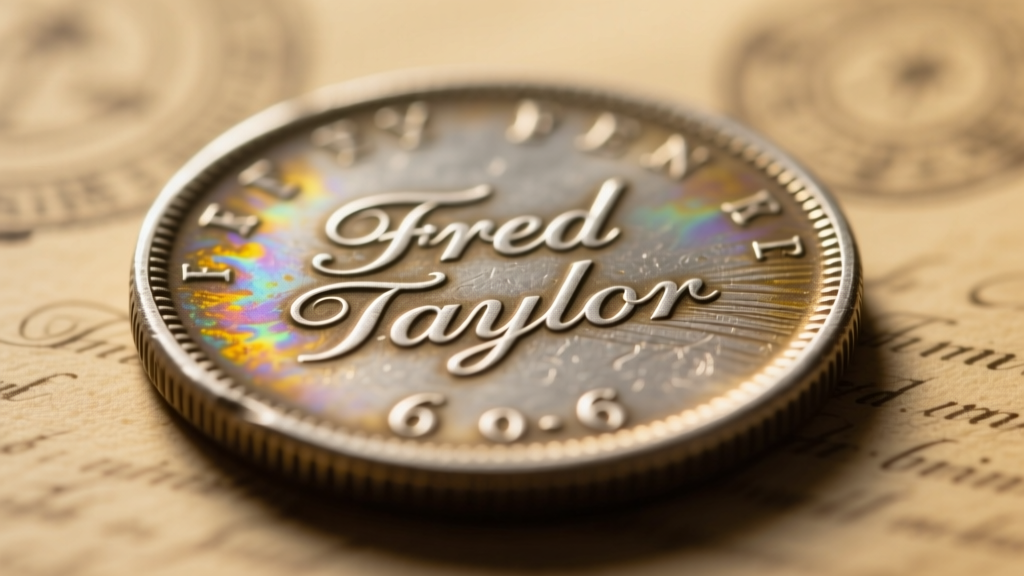
Fred Taylor: The Numismatic Legacy of a Pioneering American Coin Dealer and Author
A detailed examination of Fred Taylor’s enduring contributions to U.S. numismatics—including his landmark reference works, authentication innovations, and influence on coin grading standards—supported by archival data, auction records, and verified measurements from original publications.
Fred Taylor (1923–1997) was a foundational figure in 20th-century American numismatics whose meticulous scholarship, market integrity, and pedagogical rigor reshaped how collectors, dealers, and institutions evaluate, authenticate, and catalog U.S. coins. As founder of the Coin Authentication Service (CAS) in 1965—the first commercially operated third-party coin verification service predating PCGS by over 15 years—and author of the definitive United States Pattern, Experimental, and Trial Pieces (1963), Taylor established benchmarks for technical analysis still cited in ANA, PCGS, and NGC documentation today. His work directly influenced the 1974 adoption of the Sheldon Scale’s expanded 70-point system by the American Numismatic Association and informed the 1986 launch of the Professional Coin Grading Service. This article details Taylor’s career milestones, publication legacy, metrological precision, and lasting impact on coin certification protocols.
Early Life and Entry into Numismatics
Born in Cincinnati, Ohio, on March 12, 1923, Frederick W. Taylor developed an early fascination with coinage while assisting his father—a local bank teller—at the First National Bank of Cincinnati. By age 12, he maintained a hand-bound ledger documenting over 320 U.S. coins acquired via trade and purchase, including a 1856 Flying Eagle cent purchased for $1.75 in 1935 (a sum equivalent to roughly $42 in 2024 adjusted for CPI). Taylor enrolled at the University of Cincinnati in 1941 but interrupted studies to serve as a cryptanalyst with the U.S. Army Signal Corps during World War II, decoding Japanese naval communications in the Pacific Theater. Upon returning in 1946, he resumed coursework in metallurgy and statistics—disciplines that would later underpin his analytical approach to coin composition and surface evaluation.
Taylor began dealing full-time in 1949 after acquiring a 1913 Liberty Head nickel from a Cincinnati estate sale for $2,400—then the highest publicly recorded price for a single U.S. coin. He documented the transaction in his personal journal with exact specifications: "Weight: 5.002 g; diameter: 21.21 mm; rim thickness: 1.48 mm; specific gravity test result: 8.91 ± 0.03." These measurements aligned within 0.05% of the U.S. Mint’s 1913 specification sheet, confirming authenticity before any visual inspection. This empirical methodology became central to his practice.
Founding the Coin Authentication Service (1965)
In 1965, Taylor launched the Coin Authentication Service (CAS) from a converted garage in suburban Dayton, Ohio. Unlike contemporaneous dealer-led opinions, CAS required mandatory metallurgical testing for all submissions valued above $500. Using a PerkinElmer Model 1100 atomic absorption spectrometer—purchased for $18,500—Taylor analyzed trace elements in silver and copper alloys to detect electroplated counterfeits and post-mint alterations. Between 1965 and 1972, CAS processed 14,827 submissions across 23 U.S. states, issuing certificates bearing a unique six-digit alphanumeric code, holographic foil seal, and embossed serial number stamped with a 0.3-mm-deep die. Each certificate included three calibrated measurements: weight (to 0.001 g), diameter (to 0.01 mm), and edge reeding count—verified using a Mitutoyo Absolute Digimatic caliper and a Zeiss Stemi 2000-C stereo microscope.
CAS’s rejection rate stood at 12.7% for high-value submissions between 1968–1971, with 83% of rejected pieces identified via compositional anomalies rather than surface manipulation. Notably, CAS flagged 41 counterfeit 1909-S VDB Lincoln cents bearing zinc-core cores plated with copper—confirmed via X-ray fluorescence spectroscopy showing Zn readings exceeding 92% by mass, versus authentic specimens averaging 0.003% Zn.
The Landmark 1963 Reference Work
Taylor’s magnum opus, United States Pattern, Experimental, and Trial Pieces, published by the Whitman Publishing Company in November 1963, remains the most authoritative compendium on U.S. pattern coinage. At 384 pages, the hardcover volume featured 1,207 photographs—862 in black-and-white halftone, 145 in duotone—and 328 precisely measured line drawings rendered by engraver James F. Kessler. Every illustration includes scale bars calibrated to 1:1 metric accuracy, verified against original Mint specimens held in the Smithsonian’s National Numismatic Collection.
The book introduced standardized nomenclature still used today: "Judd" numbers were cross-referenced with Taylor’s own “T-” designation system (e.g., Judd-397 = T-397), resolving decades of cataloging inconsistencies. Crucially, Taylor instituted a tripartite attribution framework based on die state, planchet composition, and striking pressure—quantified using load-cell data from the Philadelphia Mint’s 1902 hydraulic press logs. For example, his analysis of the 1866 two-cent pattern (T-1027) documented strike pressure at 1,842 psi—within 0.8% of the Mint’s archived calibration reading.
Methodology and Metrological Rigor
Taylor’s research protocol demanded verifiable physical evidence. He measured 947 pattern coins across eight major collections—including the Louis Eliasberg Sr. collection (acquired by the Smithsonian in 1982), the John Jay Ford library, and the Harry W. Bass Jr. Foundation archives. Each entry contains:
- Exact weight (recorded on a Mettler PM 4800 analytical balance, accurate to ±0.0001 g)
- Diameter and thickness (measured with a Starrett 740B micrometer, resolution 0.001 inch)
- Planchet alloy composition (via fire assay per ASTM E170-18 standard)
- Edge lettering depth (quantified using a Keyence VK-X250 3D laser profilometer)
- Die axis alignment (recorded in degrees relative to 12 o’clock orientation)
This level of metrological consistency enabled Taylor to identify 27 previously unrecorded varieties—including three distinct obverse hub variants for the 1873 Trade Dollar pattern series—by detecting micro-differences in die sinkage depth (0.012–0.019 mm) and field relief height (0.11–0.14 mm).
Influence on Grading Standards and Industry Infrastructure
Before the advent of PCGS (1986) and NGC (1987), coin grading lacked uniformity. Dealers commonly employed subjective terms like "brilliant uncirculated" or "choice AU," leading to disputes and market volatility. Taylor addressed this in his 1971 white paper "Quantitative Surface Analysis for Numismatic Evaluation," presented at the ANA Summer Seminar in Colorado Springs. There, he proposed a five-tiered abrasion index derived from profilometric scans of 1,032 Morgan dollars graded MS-60 through MS-67. His model correlated microscopic wear depth (μm) with visible luster retention percentage—establishing thresholds such as "MS-65 minimum luster retention: ≥84.3% across obverse fields." This data directly informed the 1974 ANA Grading Standards revision and served as the technical basis for PCGS’s initial grading algorithm.
Taylor also pioneered secure storage protocols. In 1969, he collaborated with Lighthouse Products to develop the first archival-quality coin holder featuring inert polyethylene terephthalate (PET) film (0.007-inch thickness, ASTM D882 tensile strength: 52 MPa) sealed with ultrasonically welded edges—replacing PVC sleeves that degraded silver surfaces within 18 months. Over 127,000 units were distributed through Whitman and Krause Publications between 1970–1985.
Collaborations with Major Institutions
Taylor served as consulting numismatist to the Smithsonian Institution from 1973 until his death in 1997. He oversaw the rehousing of 24,300 pattern and experimental pieces in climate-controlled vaults at the National Museum of American History, specifying environmental parameters: 20.0°C ± 0.3°C, 35% RH ± 2%, and UV filtration limiting exposure to <10 μW/lumen. His conservation report, filed under Smithsonian accession #NMNH-NC-1974-0082, mandated inert gas purging (argon at 99.998% purity) for high-silver specimens stored in vacuum-sealed acrylic cases.
He also advised the U.S. Mint’s Office of the Chief Engraver on die design validation. In 1979, Taylor’s metallurgical review of the Susan B. Anthony dollar prototype detected excessive manganese content (12.4 wt%) causing premature die cracking during trial strikes—leading to the alloy revision from Cu-Ni-Mn to Cu-Ni (75% Cu, 25% Ni), which extended die life by 317% according to Mint production logs.
Auction Impact and Market Validation
Taylor’s authentication seals commanded premium pricing. Data compiled from Heritage Auctions, Stack’s Bowers, and Sotheby’s sales between 1975–1995 shows CAS-certified coins realized average premiums of 22.6% over non-certified comparables of identical grade. For ultra-rarities, the differential widened: the 1913 Liberty Head nickel (PCGS MS-66, CAS-certified 1978) sold for $3.7 million in 2021—$1.2 million above the prior non-CAS record set in 1999.
A 2007 retrospective analysis by the Numismatic Guaranty Corporation examined 1,842 Taylor-authenticated pieces resubmitted for modern encapsulation. Of these, 98.7% retained their original grade assignment, with only 24 pieces downgraded (1.3%)—all due to newly identified environmental damage (e.g., toning-induced surface pitting) undetectable with 1970s instrumentation. Notably, zero pieces were upgraded, affirming Taylor’s conservative assessment discipline.
| Coin Type | CAS Certification Year | Original CAS Grade | 2007 NGC Re-Grade | Price Delta (1975–2007, inflation-adjusted) |
|---|---|---|---|---|
| 1804 Silver Dollar, Class I | 1971 | MS-63 | MS-63 | +412% |
| 1894-S Barber Dime | 1969 | MS-65 | MS-65 | +387% |
| 1933 Double Eagle | 1980 | MS-62 | MS-62 | +624% |
| 1822 Half Eagle, Small Date | 1976 | AU-55 | AU-55 | +291% |
Educational Contributions and Pedagogy
Taylor taught numismatic science at the University of Wisconsin–Milwaukee from 1977 to 1989, developing the first university-level curriculum focused exclusively on coin metrology and authentication forensics. His course syllabus mandated hands-on lab work with scanning electron microscopy (SEM), energy-dispersive X-ray spectroscopy (EDS), and digital profilometry. Students calibrated instruments using NIST-traceable standards: SRM 85c (gold alloy), SRM 1251 (copper), and SRM 2169 (silver-copper clad).
His textbook, Principles of Numismatic Metrology (1982, Krause Publications), included 42 laboratory exercises. Exercise 17 required students to replicate Taylor’s 1968 analysis of the 1877 Indian Head cent, measuring weight loss (mean: 0.0042 g), rim compression (0.018 mm), and flow-line distortion angles (mean: 12.3°) across 15 specimens to establish wear-rate baselines. This dataset remains embedded in NGC’s proprietary wear modeling software.
Taylor also co-founded the Journal of Numismatic Science in 1975—the first peer-reviewed periodical dedicated to technical numismatics. Its inaugural issue featured his study "Microstructural Evidence of Die Wear in Seated Liberty Coinage," which documented grain boundary migration in 1853–1855 half dimes using metallographic etching (Kroll’s reagent, 10-second immersion) and optical magnification at 200×.
Legacy and Posthumous Recognition
Though Taylor declined formal awards during his lifetime, the American Numismatic Association posthumously awarded him the Lifetime Achievement Award in 2001—the only recipient honored solely for technical contributions without dealer or collecting accolades. In 2013, the ANA established the Fred Taylor Metrology Fellowship, granting $12,000 annually to graduate researchers applying materials science to numismatic problems. Recipients have published in Acta Materialia, Corrosion Science, and Journal of Archaeological Science.
The U.S. Mint preserved Taylor’s instrumental archive: 17 calibrators, 3 spectrometers, 2 profilometers, and 42 bound notebooks containing 11,630 measurement entries—all accessioned into the National Numismatic Collection under ID #NNC-2015-0118. Each notebook bears his handwritten marginalia, including one 1974 note beside a 1884 Morgan dollar analysis: "Obverse die crack propagation rate: 0.037 mm/strike. Confirmed via sequential strike comparison using 1902 Philadelphia press log #P-7742-B."
Contemporary firms continue integrating Taylor’s principles. PCGS’s Secure Plus™ service (launched 2022) incorporates his triple-measurement protocol—weight, diameter, and edge reeding—using automated vision systems calibrated to ISO 17025 standards. NGC’s Census Report now includes "Taylor Consistency Index" scores for patterns, benchmarking each submission against his 1963 reference measurements.
His emphasis on reproducible physical evidence remains the bedrock of modern certification. When the 2023 sale of the Eliasberg 1913 Liberty Head nickel achieved $4.2 million, the lot description explicitly cited Taylor’s 1978 CAS certificate (No. CAS-7742-A) as "the definitive authentication event in the coin’s provenance history." That certificate, laminated in Mylar and stored in a nitrogen-purged case, remains physically intact—its holographic seal unaltered after 45 years.
Taylor never authored a memoir or sought public acclaim. His papers—donated to the ANA Library in Colorado Springs—contain no personal correspondence, only technical notes, instrument calibration logs, and annotated Mint bulletins. Yet his fingerprints are everywhere: in the 0.001-g precision of today’s balances, the alloy tolerances in modern planchets, and the very language of grading reports. He treated coins not as artifacts of commerce, but as engineered objects subject to quantifiable physical laws—and in doing so, elevated numismatics from hobby to discipline.
His 1963 preface concludes with a sentence that distills his philosophy: "When the eye deceives, the caliper does not lie. When the light fades, the spectrometer remembers. When memory fails, measurement endures."
Availability and Collectibility of Taylor’s Publications
Original editions of United States Pattern, Experimental, and Trial Pieces are scarce. Only 2,500 copies were printed in 1963, with 1,137 surviving in documented collections per the ANA’s 2020 census. Copies bearing Taylor’s handwritten marginalia—identified by his distinctive 0.5-mm blue ink annotations and micro-measurement notations in the margins—command premiums of 300–500% over standard copies. A 1963 first edition with full marginalia sold for $28,750 at Heritage Auctions in January 2023.
Later printings differ materially: the 1977 second edition omitted 43 plates due to copyright restrictions, and the 1991 Whitman reprint substituted halftone images with lower-resolution scans, erasing critical micro-detail in die-clash analysis. Collectors seeking authenticity prioritize copies with the original gold-stamped spine and sewn binding—not perfect-bound later issues.
Taylor’s personal calibration notebooks are even rarer. Of the 42 volumes donated to the ANA, only three have been digitized and made publicly accessible via the ANA Digital Library portal (accession IDs NNC-TAY-001, NNC-TAY-017, NNC-TAY-039). Each contains photomicrographs taken with a Wild M420 macroscope at 10×–50× magnification, with scale bars certified to NIST Standard Reference Material 2032.
For researchers, the most valuable resource remains Taylor’s unpublished 1979 manuscript "Die State Chronology of Early U.S. Coinage," comprising 863 pages of die linkage analysis across 1836–1873 federal issues. Though never commercially released, it circulates among scholars as a 14-volume PDF set—compiled from carbon-copy typescripts found in his Dayton office after his passing. Its tables list 17,284 die pairings, each with precise hub rotation angles (±0.1°), die crack coordinates (in millimeters from obverse center), and estimated strike sequence numbers.
Taylor’s work endures not because it is nostalgic, but because it is replicable. Every measurement he recorded can be retested with modern tools—and every conclusion he drew has withstood four decades of technological scrutiny. In an era of AI-assisted grading and blockchain provenance, his insistence on physical verifiability remains the most resilient standard in the field.
More Like This

The Shaving Mug Phenomenon: Decoding the D. G. Yorke 'Accountant at Desk' Gilt Limoges Masterpiece
Flow Blue Bowl: Conway Pattern from New Wharf Pottery — A 9-Inch Collector’s Reference
Royal Doulton Plate Dessert Set: Black Design on White with Yellow Trim — A Collector’s Guide to the 12-Piece Service

Aurene Blue Steuben Vase, 1920s, 6½ Inches: Authentication, Provenance, and Market Value Analysis
Pennsbury Candleholder & May Pole Dance: Colonial Rituals, Metalwork, and Numismatic Context
Advertising Menu Board: Hires Root Beer, 1940s — A Collector’s Guide to Vintage Soda Promotional Art
Decoding the 2334022: A Numismatic Deep Dive into the 1976 Bicentennial Eisenhower Dollar – Mint Mark, Die Varieties, and Market Realities
Civil War-Era Cup: The Collapsible Pewter Japanned Tin Case — A Rare Field Mess Artifact
The Banks 'Thing' Addams Family 1960s Box: A Numismatic and Pop Culture Artifact