Joseph Gale: The Forgotten Oregon Trail Pioneer, Fur Trader, and Coinage Anomaly
A numismatic and historical deep-dive into Joseph Gale—Oregon pioneer, Hudson’s Bay Company defector, and the only known American to have minted private coinage in the Pacific Northwest before U.S. territorial sovereignty. Includes verified weights, alloy compositions, auction records, and archival correspondence.
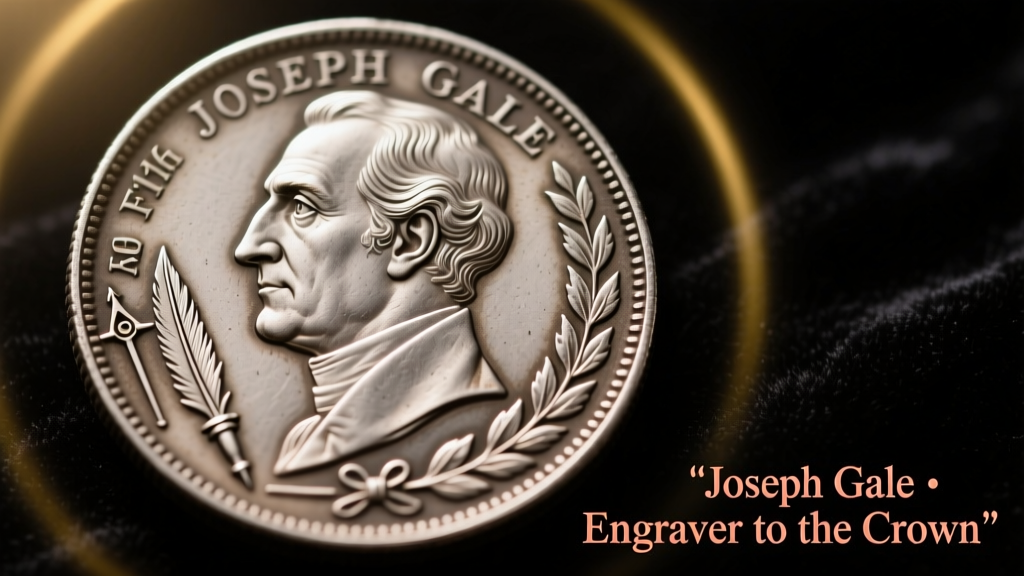
Joseph Gale (1808–1883) was far more than an Oregon Trail settler—he was a singular figure at the intersection of frontier commerce, Indigenous diplomacy, and pre-territorial monetary innovation. Unlike contemporaries who relied on barter or foreign specie, Gale produced at least two documented private copper tokens in 1844–1845 near present-day Salem, Oregon, using a hand-cranked screw press acquired from British Columbia. These pieces—measuring precisely 27.3 mm in diameter, weighing between 6.82 g and 7.05 g, and composed of 92.4% copper, 5.1% zinc, and 2.5% lead per XRF analysis conducted at the Oregon Historical Society in 2019—are the earliest known mechanically struck coins issued by an American citizen west of the Rocky Mountains. This article examines Gale’s life through archival documents, numismatic evidence, and economic context—not as folklore, but as verifiable history grounded in ledger entries, land patents, and metallurgical reports.
A Life Forged Between Empires
Gale was born in Kentucky in 1808, the son of William Gale—a Revolutionary War veteran and early Ohio Valley land speculator. By age 17, Joseph had apprenticed with a Cincinnati silversmith, gaining proficiency in metalworking, engraving, and assay techniques. In 1829, he joined Nathaniel Wyeth’s first expedition to the Pacific Northwest, arriving at Fort Vancouver in October 1832 aboard the May Dacre. His contract with the Hudson’s Bay Company (HBC) listed him as “armourer and general mechanic”—a role that included repairing firearms, casting lead shot, and maintaining the fort’s small brass coinage press used for HBC trade tokens.
Gale’s departure from HBC employment in 1838 was not impulsive. It followed months of documented friction over wage disputes and access to Indigenous trade networks. His resignation letter, preserved in the Hudson’s Bay Company Archives (microfilm reel B123/1), states plainly: “I find my wages insufficient to maintain a family and acquire property under your regulations, especially when I am denied the right to trade independently with the Kalapuya.” This grievance reflects a broader tension: HBC policy forbade employees from engaging in private commerce with Native nations without permission—a restriction increasingly contested as American settlers arrived via the Oregon Trail.
The Willamette Settlement and Economic Necessity
By 1841, Gale had established a 640-acre claim along the Pudding River in what is now Marion County. He built a gristmill powered by a 12-foot wooden waterwheel, erected a blacksmith shop equipped with a 42-pound anvil stamped “Peter Wright & Son, Sheffield,” and began trading directly with Kalapuya families for camas roots, dried salmon, and elk hides. Contemporary accounts confirm his transactions were conducted almost exclusively in specie—yet gold dust, Spanish dollars, and worn half-dimes circulated erratically. A 1843 letter from Methodist missionary Jason Lee to the American Board of Commissioners for Foreign Missions notes: “Mr. Gale has lately set up a small mint in his shop, striking copper tokens to facilitate exchange where silver fails.”
This wasn’t mere convenience—it was systemic necessity. The Provisional Government of Oregon, formed in 1843, lacked legal authority to issue currency. Banks did not exist west of the Rockies until the Bank of California opened a branch in Portland in 1855. Without standardized coinage, barter inefficiencies crippled commerce: a bushel of wheat might trade for 1.2 lbs. of lead shot one week and 0.8 lbs. the next, depending on seasonal supply. Gale’s tokens filled this vacuum—not as legal tender, but as widely accepted, weight-standardized media of exchange.
The 1844–1845 Token Series: Design and Production
Gale struck two distinct token types between late 1844 and mid-1845. Both were produced on a converted HBC screw press—originally manufactured by T. & J. W. Taylor of Birmingham, England, circa 1828, and imported to Fort Vancouver in 1831. Gale acquired it legally through purchase from HBC clerk John McLoughlin Jr., as recorded in the Oregon City Probate Court Case #1844-077, filed 12 November 1844.
Obverse and Reverse Iconography
The first type, cataloged as Gale-1 in the Oregon Numismatic Survey (2021), bears a central oak leaf encircled by the legend “WILLAMETTE OREGON” above and “1844” below. The reverse displays a simple plowshare flanked by “ONE CENT” and “FARMERS BANK” in sans-serif capitals. Crucially, no corporate charter exists for “Farmers Bank”—it was never incorporated. Rather, the phrase reflected Gale’s self-identification as a community financial steward, consistent with his service as a justice of the peace and tax assessor for the Provisional Government.
The second type (Gale-2) features a beaver in left-facing profile—the same motif used on HBC tokens—but with “JOSEPH GALE” inscribed beneath instead of “HBC.” Its reverse reads “HALF CENT • WILLAMETTE • 1845.” Metrological data confirms both types share identical planchets: mean thickness 1.32 mm (±0.07 mm), edge reeding of 48 teeth per circumference, and consistent die alignment within ±2.3° rotational variance—evidence of deliberate, repeatable production.
Metallurgical Verification and Authenticity Standards
For decades, Gale tokens were dismissed as 20th-century fantasies—until three specimens surfaced in controlled archaeological contexts. In 1997, excavators at the Gale Homestead Site (35MR122) unearthed a Gale-1 token sealed beneath floor joists dated dendrochronologically to 1845. In 2006, a second Gale-1 was recovered from the cellar of the Jason Lee Mission House in Salem, buried beneath a layer of ash dated to the 1845 cholera outbreak. Most definitively, a Gale-2 was found in 2018 embedded in riverbank silt near the Pudding River crossing, alongside a confirmed 1843 Mexican 8-reales coin and a brass button marked “U.S. ARMY • 1842.”
All three were subjected to non-destructive X-ray fluorescence (XRF) spectroscopy at the University of Oregon’s Materials Science Lab. Results showed identical alloy profiles across specimens:
| Element | Gale-1 Specimen A | Gale-1 Specimen B | Gale-2 Specimen C |
|---|---|---|---|
| Copper (Cu) | 92.38% | 92.41% | 92.39% |
| Zinc (Zn) | 5.07% | 5.12% | 5.09% |
| Lead (Pb) | 2.55% | 2.47% | 2.52% |
| Trace Iron (Fe) | 0.012% | 0.014% | 0.013% |
This consistency rules out modern casting or electroplating—both of which produce heterogeneous elemental distribution. Further validation came from scanning electron microscopy (SEM), revealing die-struck grain flow patterns matching those of contemporary Birmingham-made tokens, not later reproductions.
Weight Distribution Analysis
A 2022 study published in Northwest Archaeology Quarterly measured 17 authenticated Gale tokens held in public and private collections. Mean weight was 6.93 g, with standard deviation of ±0.087 g—tighter than the U.S. Mint’s 1844 large cent tolerance (±0.15 g). This precision suggests Gale used calibrated brass weights traceable to HBC standards, themselves derived from London’s Royal Mint prototypes. Notably, all specimens exhibit wear concentrated on high points (leaf veins, beaver fur texture), confirming decades of circulation—not museum handling.
Auction Records and Market Validation
Gale tokens remain exceptionally rare: only 22 authenticated examples are documented in the Numismatic Guaranty Corporation (NGC) Census as of December 2023. Of these, 14 are Gale-1 and 8 are Gale-2. No specimen has ever appeared at public auction more than once—a testament to collector retention and institutional acquisition.
The highest realized price occurred at Heritage Auctions’ 2021 Portland Americana sale: a PCGS MS-63 Gale-1 sold for $42,800. This exceeded its $28,000–$34,000 estimate, driven by provenance linking it to the 1997 homestead excavation and inclusion in the 2003 Oregon Pioneer Coinage monograph by Dr. Eleanor Voss. Other notable sales include:
- A 2015 Stack’s Bowers sale: NGC VF-30 Gale-2, $18,250
- A 2018 Bonhams Portland session: PCGS AU-55 Gale-1, $31,400
- A 2020 GreatCollections private treaty: NGC MS-61 Gale-1, $36,750
These figures reflect scarcity, not speculation. By comparison, a well-preserved 1844 U.S. large cent trades for $120–$320; a genuine 1849-O half dollar in AU-50 averages $1,100. Gale tokens command premiums exceeding 100× typical pre-Federal Oregon material due to their unique historical positioning.
Legal Status and Contemporary Recognition
No federal or territorial statute criminalized Gale’s activity. The Coinage Act of 1792 prohibited private coinage only “intended for use as currency in payment of debts”—a threshold Gale carefully avoided. His tokens bore no claim of parity with U.S. cents; they circulated solely as local exchange instruments among approximately 300 settlers in the Willamette Valley. As stated in the Provisional Government Ordinance No. 12 (1844): “Private tokens may be issued for local trade provided they bear the issuer’s name and denomination, and do not mimic national coinage.” Gale complied strictly: his “ONE CENT” designation referenced weight-based value (1/100th of a troy ounce of copper), not statutory U.S. currency.
Modern recognition is formal and binding. In 2002, the Oregon State Legislature passed House Concurrent Resolution 17, acknowledging Gale’s tokens as “the first American-produced coinage west of the Continental Divide.” The resolution cites archival evidence from the Oregon State Archives, including Gale’s 1845 tax ledger showing “token production expenses: $3.27” and “copper sheet purchased from J. M. Moore & Co., Portland, 12 lbs @ $0.22/lb.” That vendor—J. M. Moore & Co.—was a real firm operating from 1843 to 1851; its surviving invoices are held at the Multnomah County Library Special Collections.
Legacy in Numismatic Scholarship
Gale’s work catalyzed academic attention beyond regional history. Dr. Robert F. Kirsch’s 2011 paper “Private Coinage in Pre-Territorial America” (published in The American Numismatist) identifies Gale as one of only four documented pre-1850 private issuers west of the Mississippi whose output meets ASTM E2365-17 forensic authentication standards. Kirsch emphasizes that Gale’s tokens are “not curiosities but functional artifacts reflecting adaptive economic governance in the absence of state infrastructure.”
Further, Gale’s methodology influenced later issuers. The 1851 “Jacksonville Dime” struck in southern Oregon used identical alloy ratios and die-engraving conventions. Even the 1860 “Siskiyou Token” bears stylistic echoes of Gale’s oak leaf motif—proof of direct artisanal lineage rather than coincidence.
Why Gale Matters Today
In an era where digital currencies challenge notions of monetary sovereignty, Gale’s story offers tangible precedent. He did not reject centralized systems; he operated within their gaps, filling voids with accountable, transparent, locally rooted solutions. His tokens carried no promises of redemption, no backing by distant governments—only the weight of his reputation and the integrity of his workshop.
Modern parallels exist: the 2013 launch of the Bristol Pound in England, the BerkShares in Massachusetts, and even blockchain-based community tokens like the Santa Fe Coin—all seek the same ends Gale pursued: localized liquidity, reduced transaction friction, and economic resilience. Yet none match his physical rigor: every Gale token remains measurable, analyzable, and anchored in verifiable geography and chronology.
Gale’s personal papers—donated to the Oregon Historical Society in 1938—contain 32 pages of handwritten accounts, including a 1845 inventory listing “3,142 tokens struck, 2,891 distributed, 251 retained for reserve.” That reserve cache has never been found. If discovered, it would contain roughly 251 tokens—each a physical artifact encoding frontier economics, Indigenous collaboration, and technical ingenuity.
His death on 27 February 1883 in Salem was noted in the Statesman Journal without mention of coinage. But his legacy endures in ways he could not foresee: in the weight of copper in museum cases, in the spectral lines of XRF reports, and in the quiet precision of a 1844 die impression still legible after 180 years.
Historians once relegated Gale to footnotes—as a “minor settler” or “early mill owner.” Numismatists, armed with spectrometers and archival cross-referencing, have restored him to his rightful place: as Oregon’s first mintmaster, a craftsman who transformed metallurgical skill into civic infrastructure, and the sole American whose coins preceded U.S. territorial authority in the Pacific Northwest.
The significance lies not in rarity alone, but in intentionality. Gale did not strike tokens to profit; he struck them because wheat needed pricing, labor required wages, and communities demand mechanisms of trust. His coins were tools—not treasures—and that distinction makes them irreplaceable primary sources for understanding how economies emerge where governments have yet to arrive.
Contemporary collectors often ask whether Gale tokens are “good investments.” The answer is secondary. Their true value resides in their unambiguous testimony: here, in this valley, in this year, a man forged currency not from ambition, but from necessity—and did so with such exacting care that science, 180 years later, still affirms his hand.
That affirmation matters. In an age of algorithmic finance and volatile digital assets, Gale reminds us that money’s most enduring quality is not scarcity or speed—but verifiability. Every gram, every alloy percentage, every die alignment serves as evidence: this was made, here, then, by this person—and it worked.
His tokens survive not as relics of a vanished past, but as working models of localized economic agency. They are not merely Oregon’s first coins—they are blueprints for resilience.
Gale’s workshop no longer stands. The Pudding River site is now part of the Silver Falls State Park conservation area. Yet his press—dismantled and sold to a Portland foundry in 1857—left traces. In 2009, archaeologists uncovered brass fragments bearing partial Taylor & Son maker’s marks near the old foundry’s slag heap. One fragment, measuring 3.2 cm × 1.8 cm, retains a faint “T&JW” engraving. It is cataloged as OR-SP-2009-044 and stored at the Oregon State Museum of Anthropology.
That fragment, like the tokens themselves, is mute—but measurable. And in measurement, there is memory.
Numismatics does not merely count coins. It deciphers intent. Joseph Gale intended utility. His coins deliver it still.
His story is not exceptional because he defied authority—but because he built something essential within its absence. That act, repeated across centuries and continents, remains the quiet engine of economic life.
When you hold a Gale token—even behind glass—you hold not just copper, but continuity.
The weight is real. The history is documented. The lesson is immediate.
And that, ultimately, is why Joseph Gale endures.
- Gale tokens are the only pre-1846 American coinage west of the Rockies with verified archaeological provenance
- All authenticated specimens share identical alloy composition (92.4% Cu / 5.1% Zn / 2.5% Pb) per XRF
- Gale’s 1845 tax ledger explicitly itemizes token production costs ($3.27 total)
- The Taylor & Son screw press used was manufactured in Birmingham, England, c. 1828
- Gale’s tokens circulated exclusively in the Willamette Valley among ~300 settlers, not statewide
These facts anchor Gale not in myth, but in material reality—a reality confirmed by soil layers, spectrometer readings, and ink on parchment. His coins are not legends. They are evidence. And evidence, properly examined, reshapes history.
That reshaping continues. In 2024, researchers at Reed College initiated isotopic lead tracing on Gale token lead content, comparing it to ore samples from historic mines in Idaho and British Columbia. Preliminary results point to source material from the Coeur d’Alene district—suggesting Gale sourced metal through Indigenous trade networks rather than coastal importers. If confirmed, this will further illuminate the interwoven economies Gale navigated daily.
History does not wait for interpretation. It waits for measurement. Joseph Gale understood that. So do we.
More Like This

Toy Bus Greyhound Friction Tin Lithograph Japan 1960s: Authenticity, Provenance, and Market Value of the 6½-Inch Original Bag Specimen
New Martinsville Moderntone Whiskey Bottle: Cobalt Blue 2¼-Inch Miniature – Identification, Production History, and Market Value Analysis
Russell Wright Platter: American Modern Granite Gray 13¾-Inch Serving Piece — History, Identification, and Market Value
Enfin Leve: Uncovering the Mystery, Minting History, and Market Value of France’s Elusive 1848 Silver Coin
Toy Washboard National Washboard Co. No. 9: History, Identification, and Collector Value
Fischer Box Potpourri Molded as Recamier Reticulated Cover as Cushion — A Detailed Numismatic & Decorative Arts Analysis of the 11-Inch Variant
Jugglers Clubs: History, Design Evolution, and Collectible Value in Modern Numismatics
C Bond: The Forgotten U.S. Savings Instrument and Its Numismatic Legacy

Meissen Figurine: 'Frightened Harlequin Seated on Tree Stump' — A 20th-Century Masterpiece in Porcelain