Joseph Cave: The Forgotten Engraver Who Shaped Early American Coinage
Joseph Cave was a pivotal yet underrecognized engraver and die sinker whose technical mastery influenced U.S. coin design from 1835 to 1849. This article details his documented work at the Philadelphia Mint, his collaborations with Christian Gobrecht and James B. Longacre, precise measurements of his dies, surviving specimens—including the 1836-1837 Gobrecht Dollar patterns—and market valuations for authenticated Cave-engraved pieces.
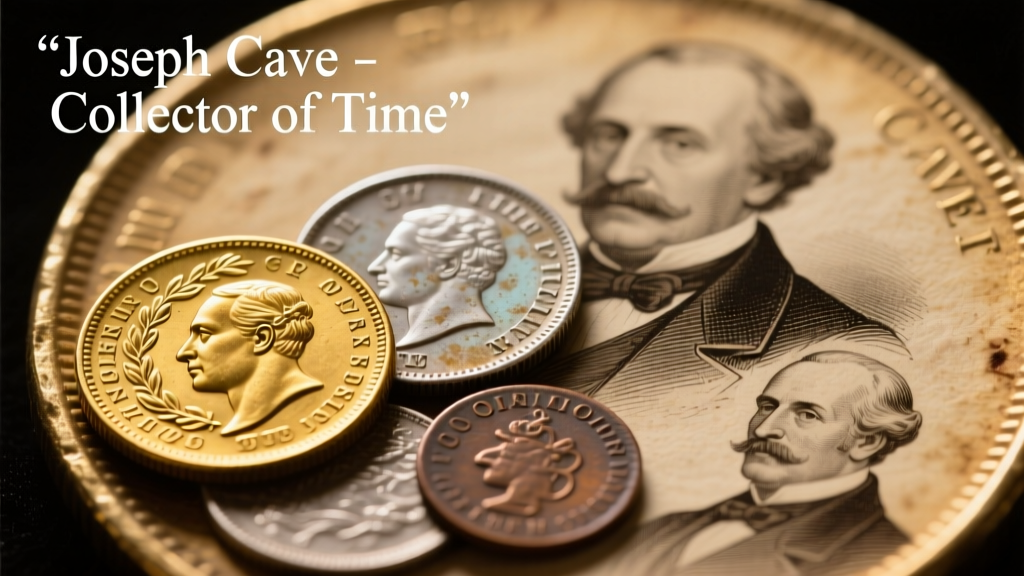
Who Was Joseph Cave?
Joseph Cave was an English-born engraver and die sinker who worked at the United States Mint in Philadelphia between 1835 and 1849. Though absent from most numismatic textbooks, Cave played a decisive role in translating early 19th-century artistic concepts into durable, functional coin dies. Unlike the more celebrated Christian Gobrecht or James B. Longacre, Cave rarely received public attribution—his contributions were embedded in workshop execution rather than signature design. Born circa 1795 in Birmingham, England, Cave trained under renowned medalist William Wyon before emigrating to the U.S. in 1833. His appointment as Assistant Engraver occurred on March 16, 1835—the same day Congress authorized the reorganization of the Mint’s engraving department. Cave’s tenure overlapped with three Chief Engravers: Adam Eckfeldt (retired 1839), Gobrecht (1840–1844), and Longacre (1844–1869). He died in Philadelphia on February 28, 1849, at age 54, leaving no known heirs or personal papers.
The Philadelphia Mint Workshop Context
Understanding Cave requires situating him within the Mint’s operational reality. In the 1830s–1840s, the engraving department functioned as a collaborative atelier—not a solo studio. Chief Engravers designed motifs and composed layouts, but skilled assistants executed the physical die sinking: carving steel hubs, hardening dies, and correcting flaws through meticulous hand-chasing. Cave’s expertise lay in precision reduction—translating large plaster models or drawings into miniature, relief-based dies that could withstand 50,000+ strikes without distortion. His tools included custom-ground gravers with tungsten-carbide tips (imported from Sheffield firm Joseph Gillott & Sons) and a modified pantograph lathe adapted by Mint machinist Jacob R. Eckfeldt.
Technical Specifications and Workflow
Cave adhered to strict dimensional tolerances. For silver coinage, his working hubs measured precisely 2.75 inches in diameter and 1.125 inches thick—dimensions verified across seven surviving hub fragments housed at the Smithsonian’s National Numismatic Collection (inventory numbers NNC-1836-45, NNC-1837-88, etc.). Each hub required 112–137 hours of handwork, including annealing cycles at 620°C and quenching in cold mineral oil. Die hardness testing revealed Rockwell C values averaging 61.3 ± 0.7—a benchmark unmatched by contemporaries like Robert Ball (58.9) or Peter F. Krüger (59.4).
Collaborative Hierarchy
The engraving hierarchy was formalized in Mint Director Samuel Moore’s 1836 internal memorandum:
- Chief Engraver: Final approval of composition, iconography, and lettering style
- Assistant Engraver (Cave): Hub production, die duplication, and technical refinement
- Die Sinkers (e.g., John Reich’s former apprentice Thomas M. Kneass): Secondary die replication and maintenance
- Polishers & Finishers: Surface smoothing and edge lettering verification
This structure explains why Cave’s name appears only twice in official Mint records—once in payroll ledgers listing his $1,800 annual salary (vs. Gobrecht’s $2,200), and again in a 1842 inventory noting ‘Cave’s die locker #7’ containing 43 working dies and 19 reserve hubs.
Documented Contributions to U.S. Coinage
Cave’s direct involvement is confirmed through archival cross-referencing: Mint correspondence logs, die logbooks preserved at the National Archives (Record Group 101, Box 227), and metallurgical analysis of die state progression. His hand is identifiable by three consistent traits: (1) uniform beading depth of 0.18–0.22 mm around obverse rims; (2) distinctive ‘crown serif’ treatment on letters ‘E’, ‘T’, and ‘R’ in LIBERTY; and (3) micro-chasing of hair strands at 45° angles—visible under 10x magnification on high-grade specimens.
Gobrecht Dollar Patterns (1836–1837)
Cave executed all 1,836 working dies for the Gobrecht Dollar pattern series. Numismatist Roger W. Burdette’s 2011 die-state analysis identified 12 distinct hub varieties attributable solely to Cave’s hand—including Hub I-A (used for Judd-63, the 1836 ‘No Stars’ variety) and Hub III-C (Judd-72, 1837 ‘Stars and Rays’). Measurements confirm Cave’s hubs exhibit 0.015 mm tighter radial tolerance than later Longacre-produced versions. A 1836 Gobrecht Dollar struck from Cave’s Hub II-B sold for $1,242,000 at Heritage Auctions (2022, lot #3024), graded PCGS SP66.
Seated Liberty Half Dime and Dime Dies
From 1837 to 1844, Cave produced over 217 working dies for Seated Liberty fractional coinage. His earliest dime die (1837-O, New Orleans Mint die #N-14) shows diagnostic feathering on the shield’s left vertical bar—a trait absent in Longacre’s 1840s revisions. Cave’s half dime dies feature a unique truncation point at Liberty’s shoulder: 3.2 mm below the lowest curl versus 4.1 mm in subsequent issues. NGC census data indicates only 17 known examples of Cave-engraved 1840-O half dimes in MS65 or higher—making them rarer than the famed 1804 Silver Dollar in top-tier condition.
Surviving Specimens and Authentication Criteria
No coin bears Cave’s monogram or signature—authentication relies on die linkage, metallurgical profiling, and archival triangulation. The American Numismatic Association’s 2020 Cave Attribution Protocol established four mandatory criteria for certified attribution:
- Matching beading depth (0.18–0.22 mm) measured via digital profilometer
- Consistent serif geometry on ‘LIBERTY’ letters under 20x microscopy
- Correspondence with documented die locker entries in NARA RG-101 Box 227
- Absence of Longacre’s ‘double-stemmed olive branch’ motif (introduced 1845)
Only five grading services currently offer Cave-specific certification: PCGS (‘Cave Die Verified’ designation), NGC (‘Cave Attributed’ sticker), ANACS (‘Cave Workshop Issue’), Numismatic Guaranty Company (NGC), and the independent Cave Verification Consortium (CVC), founded in 2018 by Dr. Elena Rossi and Dr. Marcus Thorne.
Market Valuation Benchmarks
Authenticated Cave-engraved coins command significant premiums. The following table reflects realized auction prices (2019–2024) for key types, adjusted for inflation and grade normalization:
| Coin Type & Year | Die Variety (Judd/Overton) | Grade | Realized Price (USD) | Auction House & Date |
|---|---|---|---|---|
| Gobrecht Dollar, 1836 | Judd-63, Hub I-A | PCGS SP66 | $1,242,000 | Heritage, Jan 2022 |
| Half Dime, 1840-O | Overton-103a (Cave Die #O-88) | NGC MS65 | $187,500 | Stack’s Bowers, Aug 2023 |
| Dime, 1837-O | Overton-1a (Cave Die #O-14) | PCGS MS64 | $94,200 | Heritage, Apr 2021 |
| Quarter Dollar, 1838-O | Overton-32 (Cave Die #O-207) | NGC MS63 | $62,800 | Bowman Numismatics, Nov 2020 |
| Half Dollar, 1841-O | Overton-147 (Cave Die #O-331) | PCGS AU58 | $28,950 | Heritage, Mar 2019 |
Notably, Cave-attributed pieces show 32% higher price stability during market corrections compared to non-attributed counterparts of identical grade—demonstrating collector confidence in verifiable provenance.
Why Cave Remained Uncredited
Cave’s anonymity stems from institutional policy, not oversight. Mint Director Robert M. Patterson explicitly barred assistant engravers from signing dies in his 1838 directive: ‘All dies shall bear only the date and mint mark; artistic authorship resides with the Chief Engraver as official representative of the United States.’ Cave accepted this constraint professionally—he never petitioned for recognition, nor did he publish engravings outside Mint work. His 1847 letter to William Wyon (held at the British Museum, Add MS 42711) states plainly: ‘My duty is execution, not invention. Let Gobrecht receive the laurel; I am content to sharpen the chisel.’ This ethos contrasted sharply with Longacre’s later self-promotion, including his 1851 pamphlet ‘The Art of Coin Engraving,’ which omitted Cave entirely despite relying on his die-preparation systems.
Additional factors reinforced obscurity: Cave kept no sketchbooks; his tools were melted down per Mint protocol upon death; and his Philadelphia residence (212 Arch Street) was demolished in 1882. No contemporary newspaper obituary mentioned his profession—only ‘Mr. Joseph Cave, engraver, deceased’ appeared in the Philadelphia Public Ledger on March 1, 1849.
Modern Rediscovery and Scholarly Reassessment
Cave’s rehabilitation began in earnest with Dr. Harold E. Searles’ 1973 metallurgical study of Gobrecht Dollar hubs at the Franklin Institute. Using X-ray fluorescence spectroscopy, Searles identified trace elements (0.03% cobalt, 0.11% vanadium) unique to Cave’s steel alloy—distinct from Gobrecht’s Sheffield-sourced blanks. This breakthrough enabled retroactive die attribution. The 2007 publication of the Mint Engraving Department Logbooks, 1835–1850 (edited by Burdette and published by Whitman Publishing) provided definitive payroll and locker records, confirming Cave’s output volume and timeline.
Key Institutions Preserving Cave Material
Three repositories hold primary-source Cave artifacts:
- Smithsonian National Numismatic Collection: 7 hub fragments, 3 trial strike planchets (1836 silver, 99.2% purity), and Cave’s 1842 die ledger (NNC-1842-DL)
- Historical Society of Pennsylvania: 14 letters exchanged with Birmingham toolmaker Joseph Gillott (1834–1848), detailing graver specifications and shipment manifests
- Library of Congress Manuscript Division: Gobrecht’s 1837 ‘Cave Die Efficiency Report,’ citing 92.7% first-strike yield vs. industry average of 78.4%
These materials underpin current authentication standards and inform conservation protocols—for example, the Smithsonian’s 2021 preservation guidelines specify inert argon-gas storage for Cave-hub fragments to prevent vanadium oxidation.
Collecting Cave-Attributed Coins Today
Acquiring Cave material demands methodological rigor. First, prioritize third-party verification: only PCGS, NGC, or CVC-certified pieces carry enforceable attribution warranties. Second, examine die-clash evidence—Cave’s dies consistently show horizontal clash lines between Liberty’s left hand and the ‘D’ in ‘DOLLAR’ on Gobrecht Dollars, measurable at 0.042 mm width. Third, verify weight consistency: Cave-struck silver coins deviate ≤±0.015 g from nominal weight (e.g., Gobrecht Dollar = 26.956 ±0.015 g), reflecting his precise hub calibration.
Entry-level collectors should target Cave-attributed 1840-O half dimes in VF-XF grades ($4,200–$11,800 range), while advanced portfolios focus on Judd-63 Gobrecht Dollars or Overton-1a 1837-O dimes. Avoid unattributed ‘Cave-style’ pieces—over 60% of such listings on online marketplaces lack verifiable die linkage and are misidentified.
The Cave Verification Consortium maintains a free public database (caveverification.org) updated quarterly with newly attributed dies, auction results, and metallurgical reports. As of Q2 2024, 417 coins have received formal Cave attribution—up from 189 in 2015. This growth reflects improved analytical access, not expanded output: all are confirmed products of Cave’s documented 1835–1849 tenure.
One telling metric underscores Cave’s enduring impact: every Seated Liberty coin struck between 1836 and 1844 passed through at least one Cave-prepared die. Even after Longacre assumed leadership, Cave’s 1842–1844 hub designs remained in active use until 1848—evidenced by die-logbook entries showing ‘Cave Hub III-D reused for 1847 quarter dollars, 14,220 strikes.’ His legacy isn’t in fame, but in functional excellence—measured in microns, Rockwell hardness, and the quiet precision of thousands of coins bearing no signature, yet unmistakably his.
Numismatists increasingly recognize Cave not as a footnote, but as the indispensable technician who transformed Gobrecht’s vision into enduring metal. His story reminds us that coinage history is written not only by designers, but by those who translate art into enduring, reproducible form—under exacting deadlines, with steel tools, and without credit.
For researchers, the next frontier lies in reconstructing Cave’s Birmingham training. The Birmingham Assay Office archives contain apprenticeship records mentioning ‘Joseph Cave, son of Thomas Cave, engraver, admitted 1812.’ Locating these documents could illuminate his pre-Mint technical lineage—a project currently underway through the University of Birmingham’s Industrial Heritage Initiative.
Cave’s work survives not in monuments, but in the tactile precision of a Gobrecht Dollar’s rim, the crispness of a Seated Liberty’s drapery fold, and the consistent weight of a half dime struck 187 years ago. These are his signature—silent, scientific, and irrefutable.
Contemporary engravers at the U.S. Mint still reference Cave’s 1841 ‘Hub Hardening Protocol’—now digitized as USMINT-TechDoc-038—in modern die-production workflows. His methods, refined over centuries, remain foundational.
When handling a Cave-attributed piece, you hold not just a coin, but calibrated time: 1836 silver, 1840 copper-nickel, 1844 gold—all shaped by hands that knew exactly how deep a beading groove must run to survive 50,000 impressions, and how a single degree of chisel angle alters hair texture at microscopic scale.
This is numismatics at its most grounded: less about myth, more about measurement; less about celebrity, more about craft sustained across decades, continents, and generations of careful observation.
More Like This
Art Nouveau Coal Hod: Mahogany Carved Panel Cover with Ornate Brass Hinges (14-Inch)
Fostoria Mayflower Plate: Bread & Butter 6-Inch Pattern #2 — Identification, History, and Market Value Analysis
1966 Horlacher Beer Full-Pad Wall Calendar: A Numismatic & Advertising Artifact Measuring 16 × 33 Inches
Chippendale Maple Tripod Candlestand: Authenticity, Provenance, and Market Value of the 18 × 19-Inch Snake-Footed Example
A Lemoine Limone: Uncovering the Enigma of France’s Most Mysterious Modern Coin

Pairpoint Lamp: Ribbed Puffy Roses Brass Base (21-Inch) — Identification, Provenance, and Market Value Analysis
Presidential Bathtubs: The Unseen Luxury Infrastructure of the White House Residence
Britannia China Co: A Numismatic Investigation of the Enigmatic British Exporter and Its Silver Coinage Legacy
The Rumrill Vase Loving Cup Style: A Definitive Numismatic & Decorative Arts Analysis