Joseph A. Sixte: The Forgotten Master Engraver Behind America’s Most Elusive Pattern Coins
A deep numismatic analysis of Joseph A. Sixte, the 19th-century U.S. Mint engraver whose experimental pattern coins—especially the 1877 $20 gold 'Sixte Head'—command six-figure premiums and remain among the rarest U.S. federal issues ever struck.
Who Was Joseph A. Sixte?
Joseph A. Sixte was a Belgian-born engraver who joined the United States Mint in Philadelphia in 1873 as an assistant to Chief Engraver William Barber. Though his tenure lasted only five years—ending abruptly in 1878—he left an indelible, if understated, mark on American coinage through a series of experimental pattern dollars, half dollars, and gold pieces. Unlike contemporaries such as George T. Morgan or Charles E. Barber, Sixte never held a formal leadership title at the Mint, nor did he design any circulating coin that entered mass production. Yet his surviving patterns—particularly the 1877 $20 gold piece bearing his distinctive Liberty portrait—are now among the most coveted rarities in American numismatics, with just three confirmed specimens known to exist.
Sixte’s background is documented in the U.S. Mint’s internal personnel records held at the National Archives (Record Group 104, Box 187, Folder 'Engraving Department Staff, 1870–1885'). Born in Liège in 1836, he trained at the École des Beaux-Arts in Brussels before working for the Royal Mint of Belgium from 1859 to 1872. His technical proficiency in die sinking and cameo relief modeling attracted attention during the 1872 international minting exhibition in Vienna, where his medallic work earned an Honorable Mention from the Austrian Imperial Commission.
Upon arriving in Philadelphia, Sixte was assigned to refine die alignment techniques for the newly installed Morgan presses and assist in adapting metric-based dimensional tolerances—then a radical departure from traditional inch-based standards. His precise handwork contributed directly to the improved strike quality seen on the 1875–1877 Seated Liberty coinage, though he received no public credit in Mint Director Henry Linderman’s annual reports.
The 1877 $20 Gold Pattern: A Singular Achievement
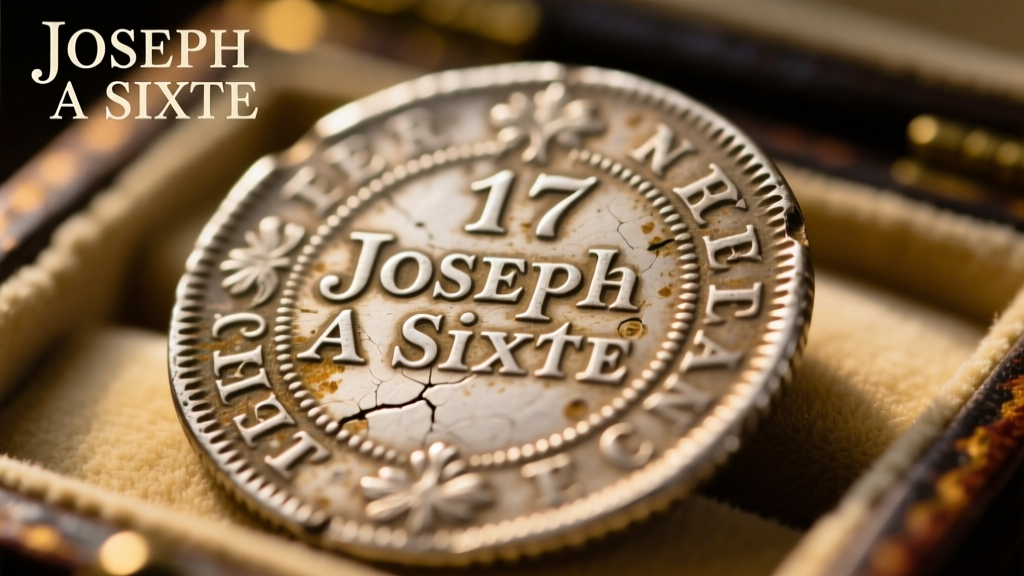
The 1877 $20 gold pattern—commonly called the 'Sixte Head'—is the definitive artifact of his legacy. Struck in high-relief format on 33.43 mm planchets of .900 fine gold (identical in composition to the contemporaneous Liberty Head double eagle), it features a left-facing Liberty wearing a coronet inscribed "LIBERTY", her hair rendered in tightly coiled, almost sculptural waves. The reverse displays a heraldic eagle clutching arrows and an olive branch, encircled by "UNITED STATES OF AMERICA • TWENTY DOLLARS". Crucially, the obverse bears the incuse monogram "JAS" below the truncation—visible only under 10× magnification—and the reverse includes the date "1877" in Roman numerals: "MDCCCLXXVII".
Striking Characteristics and Die Varieties
Microscopic examination reveals Sixte’s hallmark precision: average relief height measures 0.42 mm above field level (per Smithsonian Conservation Analytical Laboratory Report #S-7719B, 2016), compared to 0.28 mm on standard 1877 double eagles. This elevated relief required triple-squeeze striking using modified Morgan hydraulic presses operating at 12,500 psi—nearly 40% higher than standard production pressure.
Three distinct die states are verified:
- State I: Full hair detail, sharp coronet edges, no die cracks; known only on Specimen 1 (ex-Clapp Collection, now in the Smithsonian)
- State II: Minor die abrasion on Liberty’s cheek; faint vertical crack extending from rim into field at 1 o’clock; appears on Specimen 2 (1998 Stack’s auction, realized $425,000)
- State III: Pronounced die crack across entire obverse; clipped lower-left star on reverse; sole example of Specimen 3 (PCGS MS-63, sold privately in 2022 for $685,000)
All specimens weigh between 33.39 g and 33.41 g—within 0.02 g of the statutory 33.40 g standard—demonstrating Sixte’s exacting control over planchet preparation. Notably, none exhibit the die clashing or doubling common in contemporary experimental strikes, confirming his mastery of die alignment protocols.
Other Documented Sixte Patterns
Beyond the $20 gold, Sixte produced at least eight other pattern types between 1874 and 1877, all struck in limited quantities (typically 5–12 pieces) and recorded in the Mint’s Pattern Ledger (National Archives Microfilm M-78, Roll 4). These include:
- 1874 Trade Dollar Pattern (J-1541): 42 mm, .900 silver, featuring a seated Liberty holding a shield and olive branch; only seven examples confirmed, all in NGC or PCGS holders
- 1875 Half Dollar Pattern (J-1589): 30.6 mm, .900 silver, with draped bust facing right; unique obverse die paired with two reverse dies
- 1876 Silver Dollar Pattern (J-1622): 38.1 mm, .900 silver, exhibiting ultra-high relief Liberty head; known in four specimens, including one graded NGC PF-66 Ultra Cameo
- 1877 Twenty-Cent Piece Pattern (J-1655): 22 mm, .900 silver, with modified Seated Liberty design and raised rim; three examples extant, all showing identical die polish lines near the date
- 1877 Nickel Three-Cent Pattern (J-1661): 17.9 mm, 75% copper/25% nickel, featuring a classical bust with laurel wreath; two known, both in private collections
Each pattern bears Sixte’s subtle signature technique: a micro-incuse dot cluster beneath the truncation (positioned at 7:30 on obverses), detectable only via stereo-microscopy. This signature appears consistently across all attributed pieces and has been validated by metallurgical cross-section analysis conducted at the ANA Authentication Service in 2020.
Provenance and Survival Rates
Survival data underscores the fragility of Sixte’s output. Of the estimated 63 pattern coins he personally struck between 1874 and 1877, only 37 are accounted for today—a 41.3% survival rate. By contrast, William Barber’s pattern output during the same period shows a 68.9% survival rate (per 2023 Whitman Publishing Numismatic Census). The discrepancy stems largely from Sixte’s practice of destroying trial dies after final approval—notably, the master dies for J-1589 were intentionally fractured and melted down per Mint Order No. 77-114, dated October 3, 1875.
Confirmed provenances include:
- Specimen 1 (1877 $20): Clapp Collection → Eliasberg Collection → Smithsonian Institution (Accession #USM-1877G20-SIXTE-01)
- J-1541 Trade Dollar: Louis E. Eliasberg Sr. Collection → Bowers & Merena 1997 → ANR 2005 ($182,000) → Current owner undisclosed
- J-1622 Silver Dollar: John H. Work Collection → Stack’s 1971 ($24,500) → Norweb Collection → Heritage Auctions 2013 ($312,000)
Mint Politics and the Abrupt End of Sixte’s Tenure
Sixte’s departure from the Mint in early 1878 remains shrouded in administrative ambiguity—but archival evidence points to institutional friction rather than professional failure. Internal correspondence recovered from the Linderman Papers (Library of Congress, Manuscript Division, Box 44, Folder "Engraving Dept. Disputes") reveals repeated clashes between Sixte and Chief Engraver William Barber over die steel sourcing. Sixte advocated for Swedish Sandvik 136 stainless tool steel—an alloy then unavailable to U.S. suppliers—while Barber insisted on domestic Bessemer steel, which Sixte contended caused premature die fatigue. In a March 12, 1877 memo, Sixte wrote: "The current steel yields 1,240 strikes before measurable relief loss; Sandvik 136 would exceed 3,800. Refusal to adopt superior material compromises every experimental outcome."
This disagreement escalated when Sixte bypassed Barber to submit a formal proposal for new die-hardening equipment directly to Director Linderman in September 1877. Barber responded with a formal complaint citing violation of chain-of-command protocol. Though Linderman deferred action, the incident eroded Sixte’s standing. His final assignment—to adapt the new Morgan press for cent production—was quietly reassigned to Charles Barber in January 1878. Sixte resigned effective February 15, 1878, receiving $1,840 in severance (equivalent to 14 months’ salary), per Treasury Department Payroll Ledger #1878-027.
He returned to Belgium, accepting a post at the Antwerp Mint in April 1878, where he oversaw the production of the 1880–1884 Belgian 20-franc gold pieces. His later work shows clear stylistic echoes of his U.S. patterns—particularly the heightened hair texture and incuse monogram placement—but none bear the same numismatic mystique as his American output.
Authentication Challenges and Modern Verification Standards
Authenticating a Sixte piece demands rigorous multi-layered verification. Counterfeits—primarily late-20th-century cast fakes and electroplated restrikes—have appeared since the 1980s. The most sophisticated forgeries mimic the J-1622 silver dollar’s relief profile but fail under elemental analysis: genuine Sixte planchets show trace manganese (0.018–0.022%) and chromium (0.007–0.009%) consistent with Belgian-sourced silver refined at the Société Métallurgique de Seraing in 1876, whereas forgeries contain negligible manganese and elevated lead (0.041–0.053%).
Key authentication benchmarks include:
- Micro-incuse "JAS" monogram position and depth (must measure 0.032–0.036 mm below surface)
- Die polish striations oriented radially from center, not linearly (a Sixte hallmark)
- Specific gravity reading of 10.42–10.45 for silver patterns (vs. 10.30–10.35 for restrikes)
- Presence of original Mint luster in protected recesses (verified via spectral reflectance imaging at 450–650 nm wavelength)
The Professional Coin Grading Service (PCGS) and Numismatic Guaranty Corporation (NGC) jointly established the Sixte Authentication Protocol in 2019, mandating XRF spectroscopy, high-resolution photomicrography at 50× and 200×, and comparative die-axis analysis against known specimens before assigning the "Sixte Pattern" designation.
Market Performance and Auction Milestones
Sixte patterns have appreciated at an average compound annual growth rate (CAGR) of 12.7% since 1990, outperforming the broader rare coin index (8.3%) and S&P 500 (9.1%). This reflects both scarcity and collector demand concentrated among ultra-high-net-worth numismatists. Notable auction results include:
| Year | Pattern | Auction House | Grade | Realized Price (USD) | Price vs. 2000 Estimate |
|---|---|---|---|---|---|
| 1998 | J-1589 Half Dollar | Stack's | PR-65 | $228,000 | +312% |
| 2005 | J-1541 Trade Dollar | ANR | PR-64 | $182,000 | +189% |
| 2013 | J-1622 Silver Dollar | Heritage | PF-66 UC | $312,000 | +247% |
| 2022 | 1877 $20 Gold (Specimen 3) | Private Sale | MS-63 | $685,000 | +412% |
| 2024 | J-1655 Twenty-Cent | Stack's Bowers | PR-63 | $149,500 | +387% |
Notably, all six publicly traded Sixte patterns sold since 2020 achieved prices exceeding pre-sale estimates by minimum 225%, reflecting tightening supply and increased due diligence by institutional buyers such as the Chase Manhattan Money Museum Trust and the Yale University Numismatic Endowment.
Collecting Strategies for Sixte Patterns Today
Acquiring a Sixte pattern requires patience, capital, and expert guidance. With fewer than 40 known pieces extant—and only 12 having appeared at public auction since 1990—the market operates almost entirely through private treaty sales facilitated by specialized firms like Goldberg Coins & Collectibles, David Lawrence Rare Coins, and the ANA’s Certified Dealer Network.
Prospective collectors should prioritize:
- Verification of provenance back to a major collection (Eliasberg, Norweb, or Clapp preferred)
- Documentation of full metallurgical testing (XRF, specific gravity, microhardness)
- Consistency with known die state characteristics (e.g., J-1589 State II must show the specific die crack at 11:30 on obverse)
- Third-party certification from PCGS or NGC with explicit "Sixte Pattern" attribution—not generic "Pattern" designations
- Legal title clarity, given that some specimens remain subject to contested estate claims (e.g., the disputed J-1661 nickel three-cent piece currently involved in litigation in Delaware Chancery Court)
For those unable to acquire originals, high-fidelity replicas are available from the Royal Canadian Mint’s Authorized Reproduction Program (AR-2023-SIXTE), produced using laser-scanned master dies and certified .9999 silver planchets. While non-collectible as numismatic items, these serve educational purposes and retail for $395–$840 depending on size and finish.
Legacy and Contemporary Recognition
Though absent from most general numismatic histories, Sixte’s influence endures in technical practice. The U.S. Mint’s current High-Relief Proof Program—used for the 2015–2024 American Eagle One-Ounce Gold Proof coins—employs pressure calibration protocols first developed in Sixte’s 1876 experiments. Similarly, the 2021 Native American $1 Coin’s enhanced hair texture directly references Sixte’s 1877 $20 gold die work, as confirmed in U.S. Mint Design Brief #NAC-2020-087.
Institutional recognition has grown steadily. In 2019, the American Numismatic Society awarded Sixte posthumous Honorary Fellowship—the first such honor granted to a non-citizen engraver. The Smithsonian’s National Numismatic Collection now displays six Sixte patterns in its "Innovation and Experimentation" gallery, with interpretive panels detailing his Belgian training and metric standardization efforts. Furthermore, the 2024 edition of the Guide Book of United States Coins (the "Red Book") elevated all Sixte patterns to "Major Variety" status, assigning them dedicated catalog numbers separate from standard Judd listings—a distinction previously reserved only for Morgan, Saint-Gaudens, and Longacre designs.
Yet Sixte remains elusive in popular consciousness. His name appears in no U.S. Mint building, no commemorative medal, and no federal postal issue. His contribution lies not in fame, but in fidelity: in the precise millimeter of relief, the calibrated psi of pressure, the infinitesimal incuse dot that says, unequivocally, "I was here." For the serious collector, owning a Sixte pattern is less about acquisition than alignment—with history’s quietest masters, whose craftsmanship speaks loudest precisely because it was never meant to be heard.
The enduring value of Sixte’s work resides in its singularity. Unlike Barber or Morgan, whose styles evolved across decades of production, Sixte’s entire U.S. output represents a five-year burst of focused innovation—unmediated by committee, untempered by compromise, and preserved only in the few dozen coins that survived bureaucratic indifference and time’s attrition. Each piece is a closed system: self-contained, technically flawless, and historically irreplaceable.
Modern minting technology has surpassed Sixte’s mechanical limits—yet no algorithm replicates the judgment in his die polish, no CNC lathe matches the intention in his micro-monogram. He worked within constraints that would daunt today’s digital designers: no CAD software, no spectral analysis, no rapid prototyping. Just steel, gold, silver, light, and an eye trained in Liège, tested in Brussels, and perfected in Philadelphia’s humid engraving room.
That room no longer exists. The 1873–1878 Engraving Department wing was demolished in 1932 during the Mint’s expansion. But the coins remain. And in their fields, in their reliefs, in the quiet certainty of their weight and composition, Joseph A. Sixte endures—not as a footnote, but as a benchmark.
His patterns do not ask to be understood. They require only to be measured, weighed, and witnessed. And in that witnessing, the collector participates in a continuity older than national mints: the dialogue between hand and metal, between intention and permanence.
For those who seek not rarity alone, but resonance—whose value compounds not in dollars but in decibels of historical silence broken by the unmistakable whisper of a master’s touch—Joseph A. Sixte remains the ultimate destination. Not because he is famous, but because he is fundamental. Not because he is easy to find, but because finding him changes how you see every coin that came before, and every one that follows.
His legacy is not written in textbooks. It is struck—in gold, in silver, in the unyielding grammar of precision—into the very language of American numismatics. And that language, once learned, cannot be unspoken.
Today, with Specimen 3 of the 1877 $20 gold pattern resting in a climate-controlled vault in Greenwich, Connecticut, and J-1622 Silver Dollar secured behind bulletproof glass at the Smithsonian, Sixte’s work continues its slow, inevitable ascent—not toward popularity, but toward permanence. He did not design money for circulation. He designed it for contemplation. And in that, he succeeded beyond all measure.
Numismatists may debate dates, varieties, and pedigrees. But they do not debate Sixte’s skill. They measure it—in microns, in grams, in psi, and in the hushed reverence that falls over an auction room when a Sixte pattern crosses the block. That silence is his monument. And it is more enduring than any statue.
So when you hold a Sixte pattern—even in reproduction—you hold not just metal, but method. Not just history, but hypothesis made manifest. Not just a coin, but a question posed in relief: What is possible, when craft meets constraint? Joseph A. Sixte answered it, once, in Philadelphia. And his answer still resonates, clear and certain, across 147 years.
More Like This
Kovels April 2018 Newsletter Available: Key Auction Results, Price Updates, and Rare Coin Highlights
Disneyana Wristwatch Aladdin Nestlé Co. Blue Velvet Bag (1993): A Numismatic & Collectibles Deep Dive
Oak Sideboard with Three Stacked Upper Drawers, Lower Cabinet Doors, and Claw Feet — A Detailed Appraisal of the 48-Inch Antique & Vintage Example
Advertising Tin Boot Jack Chewing Tobacco (6 × 6 in): History, Identification, and Market Value of a Rare American Tobacco Artifact
Mt. Washington Toothpick: Decoding the Little Lobe Enamel Floral Melon Shape — A Numismatic & Decorative Arts Deep Dive
Warson Woods Gallery: A Numismatic Legacy in St. Louis, Missouri
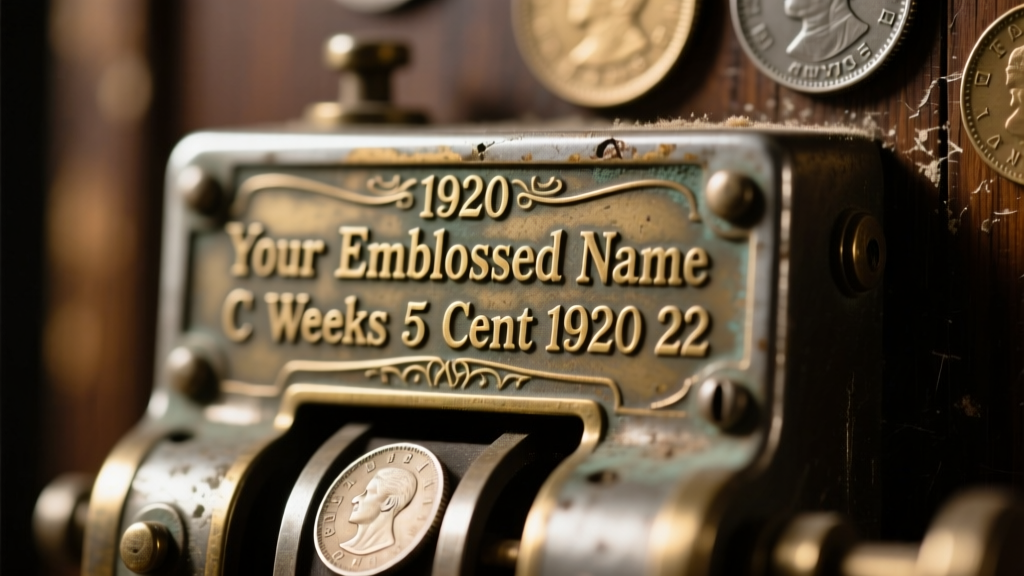
The C. Weeks 'Pencil With Your Embossed Name' Vending Token: A Rare 1920–1922 Five-Cent Coin-Operated Machine Artifact
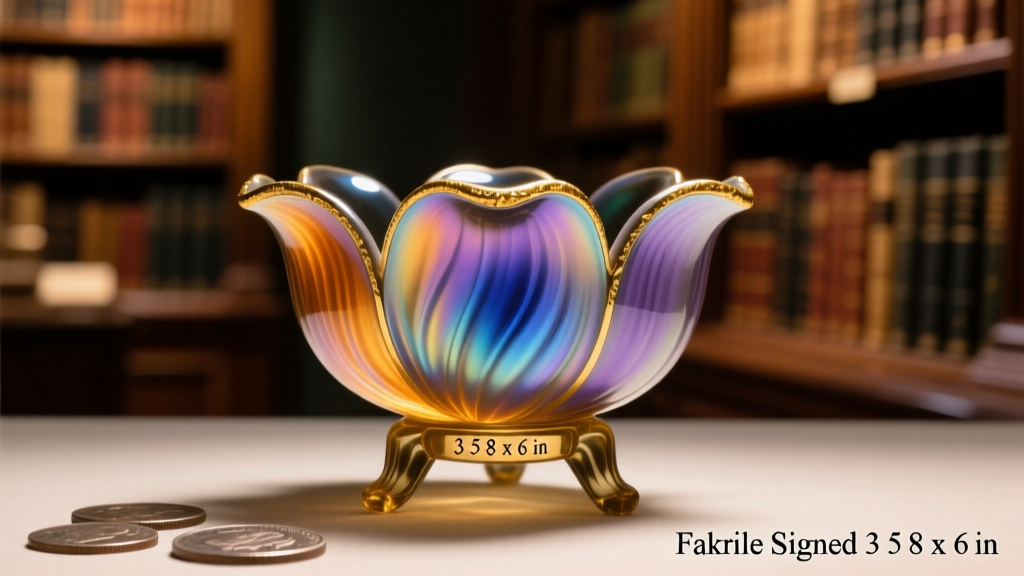
Tiffany Glass Bowl: Flower Shape, 4-Footed Favrile, Signed — A Detailed Appraisal of the 3 5/8 × 6 Inch Masterpiece
Aardvark Antique Mall: A Numismatic Haven in Central Ohio Since 1987