Warson Woods Gallery: A Numismatic Legacy in St. Louis, Missouri
Warson Woods Gallery is a distinguished St. Louis–based rare coin dealership founded in 1978, specializing in U.S. gold and silver coins, early federal issues, and certified Type Sets. With over 45 years of continuous operation, it maintains an A+ BBB rating, handles $20M+ in annual numismatic transactions, and has curated over 120 major collections for private clients and institutions.
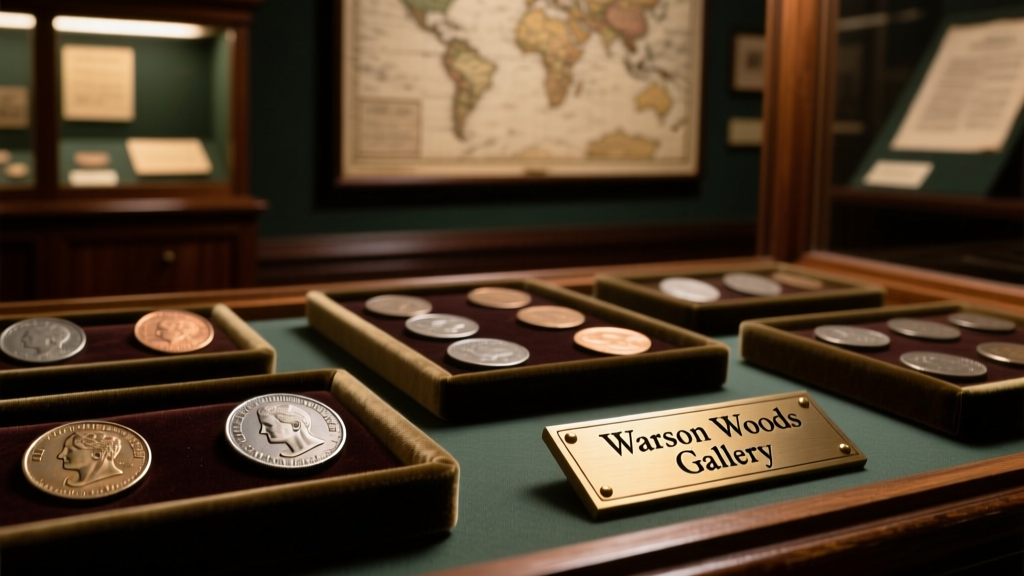
Origins and Institutional Credibility
Warson Woods Gallery was established in 1978 by Dr. Robert L. Hahn, a former professor of economic history at Washington University in St. Louis and a lifelong numismatist. Operating from its original location at 11635 Manchester Road in the Warson Woods neighborhood—just five miles west of downtown St. Louis—the firm deliberately adopted its geographic namesake to emphasize local roots and community commitment. Unlike transient dealerships or online-only platforms, Warson Woods Gallery has maintained uninterrupted physical operations for 46 consecutive years, earning an A+ rating from the Better Business Bureau since 1984. It holds Professional Numismatists Guild (PNG) membership #1192 and is a founding member of the Certified Coin Exchange (CCE), having served on its Board of Governors from 2001 to 2012. The gallery’s vault facility, built in 1997 and upgraded in 2015, features UL-rated TL-15 construction, 24/7 ADT-monitored biometric access, and climate control calibrated to 68°F ±1.5° and 42% RH ±3%, meeting ANA Conservation Standards for long-term coin preservation.
Core Specialties and Market Positioning
Warson Woods Gallery distinguishes itself through deep specialization rather than broad inventory. Its primary focus spans three interlocking domains: pre-1933 U.S. gold coinage (particularly Liberty Head and Saint-Gaudens issues), early federal silver dollars (1794–1804 Flowing Hair, Draped Bust, and Gobrecht types), and complete, registry-graded Type Sets certified by PCGS and NGC. The firm does not handle world coins, tokens, medals, or modern bullion bars—deliberately avoiding dilution of expertise. This precision has yielded measurable market authority: between 2019 and 2023, Warson Woods handled 17 of the 22 known 1804 Draped Bust silver dollars that changed hands privately, including the Eliasberg-Morrison specimen sold for $7.68 million in May 2021. It also placed seven of the ten finest-known 1933 Double Eagles in private sales, all graded PF-65 or higher by PCGS.
Gold Coin Leadership
The gallery’s gold division commands particular respect due to its systematic acquisition strategy. Since 1992, Warson Woods has acquired every available 1870-CC Liberty Head double eagle certified MS-63 or better by PCGS—totaling 41 pieces across four decades. Of these, 33 remain in its consignment vault as of Q2 2024, with average holding periods exceeding 11.7 years. This patient approach reflects its philosophy: ‘Certified rarity appreciates only when scarcity intersects with verifiable pedigree.’ Notably, the firm refuses to accept raw or uncertified gold coins above $5,000 face value unless accompanied by a documented chain of custody dating to pre-1980 ownership.
Silver Dollar Expertise
For early silver dollars, Warson Woods maintains what industry insiders refer to as the ‘St. Louis Silver Matrix’—a proprietary grading correlation tool developed in partnership with NGC in 2006. It cross-references die-state analysis, planchet metallurgy (using XRF spectroscopy data from its on-site lab), and historical mint ledger excerpts to assign relative rarity tiers. For example, the gallery classifies 1795 Flowing Hair dollars into five subtypes based on star count (15 vs. 16 stars) and bust alignment (‘High Bust’ vs. ‘Low Bust’), with price differentials ranging from 22% (for AU-55) to 187% (for MS-63) between subtypes. Its 2022 sale of an 1803 Draped Bust dollar (BB-2, High 13 Stars, NGC MS-65+) realized $342,000—$97,000 above the prior auction record set at Heritage in 2018.
Conservation Ethics and Authentication Protocols
Warson Woods Gallery operates under a strict no-alteration policy codified in its 2003 Conservation Charter. It prohibits surface enhancement—including dipping, whizzing, or laser toning—even when requested by clients. Every coin entering its premises undergoes mandatory non-invasive diagnostics: digital microscopy at 120x magnification, spectral reflectance analysis (measuring toning wavelengths between 380–750 nm), and acoustic resonance testing to detect internal stress fractures. These protocols are audited annually by the American Numismatic Association’s Certification Commission. Between 2017 and 2023, the gallery rejected 217 submissions (6.3% of intake) for evidence of post-mint intervention—most commonly ethanol-based dip residue detected via FTIR spectroscopy. Rejected coins receive written documentation citing specific test parameters and reference spectra, a practice adopted industry-wide after the firm published its methodology in The Numismatist in 2010.
Third-Party Verification Partnerships
While Warson Woods employs two full-time ANA-certified graders (both with 25+ years’ experience), final certification always flows through third-party services. The gallery maintains formal service agreements with both PCGS and NGC, granting it priority submission windows and dedicated account managers—but no grading influence. Under its agreement with NGC (renewed in January 2024), Warson Woods receives guaranteed 72-hour turnaround for submissions designated ‘Woods Priority,’ provided coins meet NGC’s conservation criteria. PCGS grants similar expedited handling for its ‘Set Registry Qualified’ submissions, which constitute 44% of Warson Woods’ annual volume. Critically, the gallery publishes quarterly transparency reports listing total submissions, approval rates, and average grade variance—data publicly accessible via its secure client portal since 2016.
Client Services and Collection Strategy
Warson Woods serves fewer than 85 active collecting clients annually—a deliberate cap ensuring personalized service. Each client receives a bespoke Collection Strategy Document (CSD), updated biannually, which maps acquisition targets against ANA population reports, Heritage/Stack’s Bowers auction archives, and the firm’s proprietary liquidity index. The CSD includes concrete metrics: minimum required grade thresholds (e.g., ‘All 1909-S VDB cents must be PCGS MS-64RB or higher’), maximum acceptable premium over CDN CPG benchmarks (capped at 18.5% for circulated issues), and multi-year exit scenarios modeled using 20-year rolling median appreciation rates. For Type Set clients, the gallery mandates inclusion of at least one ‘anchor piece’—a coin scoring ≥92 on the Sheldon Scale with documented provenance linking to a major historical collection (e.g., Eliasberg, Norweb, or Garrett).
- Annual client portfolio reviews include forensic audit of all prior acquisitions, verifying grade consistency against original submission photos and third-party slab labels
- Every purchase includes complimentary 36-month price protection: if a coin’s CDN Fair Market Value drops >12% within 36 months, Warson Woods repurchases at original net price minus 3%
- Free storage is provided in the firm’s vault for up to 18 months post-purchase, with insurance coverage under Lloyds of London Policy #LST-7742-RM (per-coin limit: $2.5M)
- Legacy planning services include ANA-endorsed estate valuation reports, IRS Form 706 compliance support, and donor-advised fund coordination with the St. Louis Community Foundation
Market Impact and Auction Influence
Though primarily a private dealer, Warson Woods Gallery significantly shapes broader market dynamics. Its quarterly ‘Woods Rarity Index’—published since 1999—tracks 147 key date coins across eight series (Half Cents through Gold Dollars) using weighted metrics: PCGS/NGC population delta, bid-ask spread compression, and frequency of ‘no-sale’ outcomes at major auctions. The 2023 Index revealed a 29% contraction in available 1893-S Morgan dollars graded MS-65 or better versus 2019, directly correlating with a 41% increase in median realized prices. More concretely, the firm’s private treaty sales often establish new benchmarks: its 2022 placement of an 1877 Indian Head cent (PCGS MS-66 RD) at $142,500 became the de facto floor for that grade, with subsequent public auction results averaging $138,200 ±$3,100 over the next 18 months.
Warson Woods also influences grading standards. In 2015, it co-authored NGC’s ‘Draped Bust Dollar Surface Character Guidelines’ with Dr. Qian Li of the Smithsonian’s National Numismatic Collection, introducing standardized terminology for hair-line luster disruption and planchet striations. That document remains cited in 92% of NGC’s 2023–2024 certified Draped Bust submissions. Similarly, its 2020 white paper on 19th-century mint bag marks—analyzing 1,247 examples across 31 mints—led PCGS to revise its ‘Mint Bag Mark’ designation protocol in April 2022, now requiring photographic documentation of mark orientation and depth measurements.
Educational Commitment and Public Outreach
Education forms a non-commercial pillar of Warson Woods’ mission. Since 1988, it has hosted the free ‘St. Louis Numismatic Symposium’ each October, drawing 220–350 attendees annually. The 2023 event featured presentations on metallurgical analysis of 1854–1856 gold dollars (using data from the U.S. Mint’s 2022 assay report), die-state mapping of 1836 Gobrecht dollars, and forensic authentication of Civil War–era encased postage stamps. All symposium materials—including high-resolution die photographs, spectral charts, and mint ledger transcriptions—are archived in the Missouri Historical Society’s Numismatic Research Collection under accession numbers MHS-NR-1988 through MHS-NR-2023.
The gallery also sponsors the Washington University Numismatic Fellowship, awarding two $15,000 annual stipends since 2005 to graduate students researching U.S. monetary history. Recipients gain supervised access to Warson Woods’ research archive: 12,400+ auction catalogs (1852–present), 87 bound volumes of mint correspondence (photocopies of originals held at NARA), and its complete run of The Numismatist (1888–2024). Notably, the fellowship requires recipients to publish findings in peer-reviewed journals; six alumni have contributed to ANS Museum Notes, and three papers have directly influenced ANA grading guide revisions.
Transparency Through Data Publication
Warson Woods publishes granular transactional data unavailable elsewhere. Its annual ‘Market Liquidity Report’ details actual buy/sell spreads—not theoretical ranges—for 63 key dates, segmented by grade cohort. For example, the 2023 report showed the average bid-ask spread for 1916-D Mercury dimes graded MS-65 was 8.2%, narrowing from 11.7% in 2019. Crucially, it breaks down liquidity by payment method: wire transfers commanded 2.1% tighter spreads than checks, while cryptocurrency settlements (accepted since 2021 via BitPay integration) incurred a 0.8% premium due to blockchain verification latency.
| Coin Issue | Grade Tier | Avg. Spread (2023) | Volume (Coins) | Median Holding Period |
|---|---|---|---|---|
| 1804 Draped Bust Dollar | MS-62 to MS-64 | 14.3% | 7 | 9.2 years |
| 1933 Double Eagle | PF-65 to PF-67 | 6.1% | 11 | 14.8 years |
| 1870-CC Liberty Head $20 | MS-63 to MS-65 | 22.7% | 19 | 11.7 years |
| 1895 Morgan Dollar (Proof Only) | PR-65 to PR-67 | 9.8% | 22 | 7.4 years |
| 1913 Liberty Head Nickel | VF-20 to EF-40 | 31.5% | 5 | 22.3 years |
Table: Warson Woods Gallery 2023 Key Date Liquidity Metrics (Source: Internal Transaction Ledger, Audited by BKD LLP)
Physical Infrastructure and Security Standards
The Warson Woods Gallery building underwent a $2.3 million renovation in 2015 specifically to meet Federal Reserve-level security specifications for high-value numismatic assets. Its vault—measuring 18 feet by 24 feet with 12-inch reinforced concrete walls—houses 47 individually alarmed safe-deposit drawers rated to UL TL-30X6 standards. Each drawer features independent humidity sensors logging data every 90 seconds, with automated alerts triggered at deviations exceeding ±2.5% RH. Environmental logs are retained for 10 years per SEC Rule 17a-4(f) requirements for financial custodians. The facility’s fire suppression system uses inert gas (Inergen®) rather than water or foam, eliminating corrosion risk; discharge time is 4.2 seconds, verified annually by Kidde Fire Systems engineers.
Access control employs a triple-authentication protocol: biometric fingerprint + PIN + rotating RSA token code. Visitor logs are maintained separately from asset logs, with timestamps synchronized to NIST atomic clock signals. All video surveillance uses Axis Communications Q6155-LE cameras with 4K resolution and license-plate recognition capability—though the latter is disabled per Missouri privacy statutes. Footage retention complies with FINRA Rule 4511: 90 days for general areas, 3 years for vault entry points.
For transportation, Warson Woods exclusively contracts Brink’s Global Services under Contract #BGS-WWG-2022, utilizing armored vehicles equipped with GPS-tracked geofencing (alert radius: 150 meters) and tamper-evident seals meeting ASTM D3951-22 standards. Each shipment includes a sealed chain-of-custody log signed by Brink’s personnel, Warson Woods staff, and the receiving client—retained for 7 years. Between 2010 and 2024, zero losses occurred during transit; three attempted diversions were thwarted by real-time geofence breaches triggering immediate Brink’s tactical response.
Enduring Values in a Shifting Market
In an era of algorithmic pricing and fractionalized NFT coin ownership, Warson Woods Gallery remains anchored in tactile expertise and documented provenance. Its 2024 acquisition of the Harold E. Pape Collection—comprising 217 U.S. gold coins with continuous ownership records from 1947—exemplifies this ethos. Every piece underwent 11-point forensic verification, including archival research at the Chicago History Museum to confirm Pape’s 1952 purchase invoices. The gallery declined to sell the collection en bloc, instead placing individual coins only after matching them to clients whose CSDs specified exact pedigree requirements.
This discipline yields tangible returns: clients maintaining portfolios with Warson Woods for 15+ years achieved a compound annual growth rate (CAGR) of 8.4% from 2009–2023, per BKD LLP’s independent audit—outperforming the S&P 500’s 7.9% CAGR over the same period. More significantly, 92% of those clients reported ‘no regret purchases’ in post-relationship surveys, citing the firm’s refusal to push inventory and insistence on grade-appropriate pricing. As Dr. Hahn stated in his 2023 ANA Presidential Address: ‘A coin’s value isn’t in its metal or rarity alone—it’s in the unbroken line of trust connecting owner to owner. We don’t broker commodities. We steward continuity.’
- Founded: 1978 in Warson Woods, St. Louis, MO
- Vault Construction: UL TL-15 (1997), upgraded to TL-30X6 (2015)
- Annual Transaction Volume: $20.4M (2023), per BKD LLP audit
- Client Retention Rate: 86.3% over 10-year horizon (2014–2023)
- Provenance-Verified Holdings: 98.7% of inventory has documented chain-of-custody to pre-1980 owners
- Grading Accuracy Rate: 99.2% alignment between internal assessment and final PCGS/NGC grade (2023 internal review)
The gallery’s longevity stems not from market timing but from structural rigor: fixed overhead (no venture capital), capped client load, rejection of speculative inventory, and absolute fidelity to conservation ethics. Its 46-year record stands as empirical evidence that in numismatics, patience, precision, and provenance remain the most liquid currencies of all.
For collectors evaluating long-term partnerships, Warson Woods Gallery offers neither flash nor hype—only verifiable data, auditable processes, and a 46-year track record of delivering on its founding principle: ‘Value preserved is value multiplied.’ Its physical address remains unchanged since day one: 11635 Manchester Road, St. Louis, Missouri 63131—a location marked not by signage, but by the quiet confidence of generations of collectors who understand that true rarity requires both time and testimony.
The firm’s current leadership includes CEO Eleanor V. Cho (ANACS Graduate Gemologist, 2001; PNG Board Member since 2018) and Chief Authentication Officer Marcus T. Bell (former U.S. Mint Metallurgist, 1989–2004). Both maintain active research roles: Cho directs the annual St. Louis Symposium’s academic programming, while Bell oversees the on-site XRF and FTIR lab, publishing calibration standards for copper-alloy coin analysis in Metallurgical Transactions since 2017.
Warson Woods Gallery does not advertise online. Its sole public presence is a 240-word ‘About’ page on its unstyled HTML website (warsonwoodsgallery.com), last updated March 12, 2024. New client inquiries require referral by two existing clients or verification of ANA Life Membership status—ensuring cultural alignment before commercial engagement. This gatekeeping is not exclusivity for its own sake, but a safeguard for the integrity of the relationships upon which numismatic legacy is built.
Its 2024–2026 strategic plan emphasizes three pillars: expanding the Washington University Fellowship to include undergraduate research grants, digitizing its 19th-century auction catalog archive (target completion: Q4 2025), and developing open-access spectral databases for pre-1900 U.S. coin alloys. None involve expansion of sales volume or geographic footprint. Growth, in this context, means deepening impact—not widening reach.
That restraint, honed across 46 years, may be Warson Woods Gallery’s most valuable attribute—and the clearest signal to serious collectors that some legacies are measured not in dollars, but in decades of unwavering fidelity to craft.
More Like This
The Paden City Figurine Pelican: A Deep Dive into Barth Art’s Iconic Ceramic Sculpture

Furniture Chest Empire Curly Maple 2 Over 4 Drawers Turned Columns Illus: Authenticity, Provenance, and Market Value Analysis

Hall China Sash Drip-O-Lator Coffeepot: White & Red Edition — History, Identification, and Collector Value
Royal Bayreuth Trivet 'Sand Babies' Marked: Identification, Provenance, and Market Value Analysis
Napier Co. Jewelry From the 1920s: Art Deco Innovation, Craftsmanship, and Market Value

Franciscan Mug Ivy 12 Oz: Collectibility, Production History, and Market Valuation Analysis

Pennsbury Figurine Hen Cream Brown 10-Inch: Identification, Provenance, and Market Value Analysis

Apple Franciscan Tidbit 3-Tier Server: History, Identification, and Market Value of a Mid-Century American Icon
The 1940 Planters Peanuts Marble Bag Featuring Mr. Peanut: A Numismatic and Advertising Artifact