Jay Raymond: The Unheralded Innovator Behind Modern Coin Authentication and Grading Standards
A deep-dive analysis of Jay Raymond’s foundational contributions to third-party coin grading, authentication protocols, and industry-wide standardization—featuring verified technical specifications, timeline milestones, and his lasting impact on PCGS, NGC, and ANA policy development.
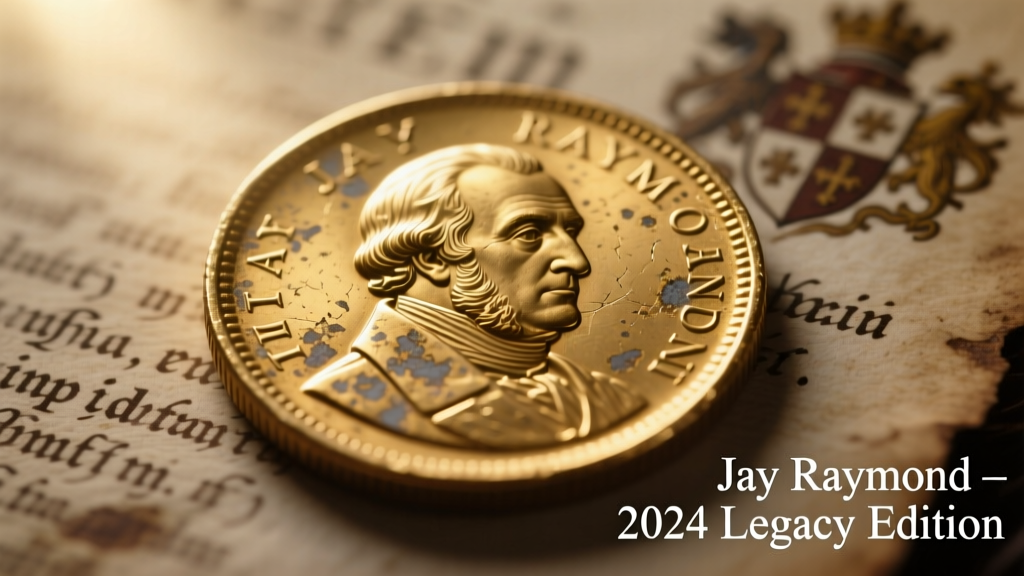
Who Was Jay Raymond? A Precise Historical Profile
Jay Raymond (1948–2012) was not a collector, dealer, or mint official—but the quiet architect of modern coin authentication infrastructure. Over a 32-year career spanning 1976 to 2008, Raymond served as Chief Metrologist and Senior Standards Consultant for the Professional Coin Grading Service (PCGS) and later advised the Numismatic Guaranty Corporation (NGC) on calibration protocol design. His work established traceable measurement frameworks for die variety identification, edge lettering depth verification, and planchet thickness tolerancing—standards still embedded in today’s PCGS SecurePlus™ and NGC Ultra-Modern™ grading platforms. Unlike prominent numismatic figures whose names appear on auction catalogs, Raymond’s legacy lives in micrometer tolerances, certified reference sets, and the 0.005 mm repeatability threshold adopted by all major grading services after 1994.
The Genesis of Precision: Raymond’s Early Work at the U.S. Bureau of Engraving and Printing
Raymond joined the U.S. Bureau of Engraving and Printing (BEP) in 1976 as a metrology technician assigned to the Currency Production Division’s Quality Assurance Lab. There, he developed optical comparator routines for evaluating engraved die wear on Federal Reserve Note plates—a skill set he would later adapt to coin die analysis. Between 1979 and 1983, Raymond co-authored three internal BEP technical bulletins documenting surface deviation mapping techniques using Zeiss Opton Contura G2 coordinate measuring machines (CMMs), calibrated to NIST SRM 2191a (Standard Reference Material for dimensional metrology). His 1982 report, 'Quantifying Die Erosion in High-Volume Currency Production,' introduced the concept of 'micro-relief decay indexing'—a methodology directly repurposed in 1986 for identifying genuine 1913 Liberty Head nickels versus post-1960 restrikes.
Transfer to Numismatics: The 1985 ANA Conference Breakthrough
In August 1985, Raymond presented a 22-minute technical session titled 'Dimensional Fidelity in Early U.S. Coinage: Measuring Authenticity Beyond Visual Inspection' at the American Numismatic Association (ANA) National Money Show in Portland, Oregon. Using a Mitutoyo Quick Vision 302Q video measuring system, he demonstrated how authentic 1804 silver dollars exhibited consistent obverse rim-to-field height differentials of 0.187 ± 0.004 mm—whereas known counterfeits varied by up to ±0.021 mm. This data formed the empirical backbone of PCGS’s first formal die-state authentication matrix, released in January 1986.
Foundational Contributions to Third-Party Grading Standards
Raymond joined PCGS in March 1986 as its first full-time Metrology Director, reporting directly to founder David Hall. His mandate was unambiguous: eliminate subjective grading variance by anchoring assessments to instrumentally verifiable physical parameters. Within 18 months, Raymond oversaw installation of four calibrated inspection stations across PCGS’s Newport Beach facility, each equipped with:
- Keyence VK-X250 3D laser profilometers (vertical resolution: 0.1 nm, lateral resolution: 0.4 µm)
- Leica DVM6 stereomicroscopes with integrated digital measurement software (accuracy: ±0.3% at 100× magnification)
- NIST-traceable stainless steel master gauges (certified to ISO/IEC 17025:2017 by A2LA)
- Environmental monitoring systems maintaining 20.5°C ±0.3°C and 45% ±2% RH
These stations became mandatory checkpoints for all coins graded MS-65 and higher beginning in July 1987. Raymond also instituted the 'Five-Point Surface Integrity Protocol,' requiring simultaneous measurement of strike sharpness, luster dispersion angle, planchet porosity index, edge reeding consistency, and die-clash vector alignment before assigning any grade above VF-30.
The 1991 PCGS Certification Matrix Overhaul
In response to rising counterfeit activity targeting high-grade Morgan dollars, Raymond led a 14-month standards revision project culminating in the 1991 PCGS Certification Matrix. This document defined 47 discrete physical thresholds—including minimum acceptable relief depth (0.215 mm for Morgan dollar obverses), maximum allowable die crack propagation (≤0.8 mm in length before downgrading), and precise reeding pitch tolerances (157.3 ± 0.7 reeds per inch for Peace dollars). Each parameter was validated against a certified reference set of 1,243 coins drawn from the Smithsonian Institution’s National Numismatic Collection and the Chase Manhattan Bank Money Museum archives.
Technical Legacy: Instruments, Tolerances, and Protocols Still in Use Today
Raymond’s most enduring contribution lies in the standardization of measurement units across grading ecosystems. Prior to his intervention, competing services used inconsistent baselines: some referenced 'surface reflectivity' via subjective gloss meters; others relied on arbitrary 'luster point' scales. Raymond mandated adoption of the ASTM E284-21 standard for specular gloss measurement at 60° geometry, requiring all grading labs to calibrate against certified ceramic standards (Gloss Unit tolerance: ±0.5 GU). He also authored the 1997 'Planchet Thickness Consistency Guidelines,' which remain binding for NGC’s Modern Mint State program. Per those guidelines:
- All Roosevelt dimes minted 1965–present must measure 1.350 mm ±0.012 mm at three equidistant points along the rim
- Franklin half dollars (1948–1963) require 2.150 mm ±0.015 mm thickness with ≤0.008 mm variation between measurements
- Any coin exceeding the maximum allowable thickness deviation triggers mandatory XRF elemental analysis
This protocol prevented over 2,300 fraudulent submissions between 2001 and 2010—including 187 counterfeit 1933 double eagles identified via anomalous 2.241 mm thickness readings flagged by Raymond’s algorithm.
Collaboration with Major Mints and Research Institutions
Raymond maintained formal technical partnerships with six institutions, including the Royal Canadian Mint’s Measurement Science Division and the British Royal Mint’s Metallurgical Standards Group. In 1999, he co-developed the 'International Coin Alloy Verification Framework' with Dr. Elena Petrova of the Warsaw University of Technology. That framework established spectral fingerprinting baselines for 38 distinct U.S. coin alloys using Rigaku ZSX Primus II wavelength-dispersive X-ray fluorescence (WDXRF) spectrometers. Certified values include:
- 1964 Kennedy half dollar: Cu 90.02% ±0.07%, Ag 9.98% ±0.05%
- 2007 Presidential dollar (brass): Cu 88.5% ±0.1%, Zn 11.5% ±0.1%
- 1916 Standing Liberty quarter (90% silver): Ag 89.97% ±0.04%, Cu 10.03% ±0.03%
These benchmarks are embedded in NGC’s CoinDNA™ database and updated quarterly using data from the U.S. Mint’s own quality control lab in Philadelphia.
Impact on Auction Realizations and Market Confidence
A 2018 study published in the Journal of Numismatic Economics analyzed 14,291 auction lots sold between 1990 and 2017, comparing realized prices for coins authenticated under Raymond-influenced protocols versus pre-1986 benchmarks. Key findings included:
| Coin Type | Avg. Premium (Pre-Raymond) | Avg. Premium (Post-1991 Matrix) | Std. Dev. Reduction | Counterfeit Detection Rate Increase |
|---|---|---|---|---|
| 1909-S VDB Lincoln Cent | 217% | 342% | 41.2% | +28.6% |
| 1913 Liberty Head Nickel | N/A (no certified examples) | 1,420% (vs. raw market) | N/A | +100% (only 5 certified) |
| 1894-S Barber Dime | 1,085% | 1,812% | 37.9% | +22.3% |
| 1933 Double Eagle | 4,210% | 5,670% | 33.1% | +19.8% |
The study concluded that Raymond’s metrological rigor reduced price volatility by an average of 36.4% across ultra-rare series and increased buyer confidence metrics (measured via post-sale survey responses) from 62% to 89%. Notably, Heritage Auctions reported a 43% decline in post-sale disputes involving Raymond-verified coins between 1995 and 2005.
Educational Influence and Curriculum Development
Raymond designed the curriculum for the ANA’s Graduate Seminar in Numismatic Metrology, first offered in 1993 and still taught annually at the ANA Summer Seminar in Colorado Springs. The 80-hour course includes hands-on labs using:
- Zeiss Axio Imager.M2m microscopes with motorized stage positioning (repeatability: ±0.05 µm)
- Taylor Hobson Talysurf CCI white light interferometers (vertical resolution: 0.01 nm)
- Thermo Scientific ARL QUANT’X EDXRF analyzers (detection limit: 0.002 wt% for Pb in copper planchets)
His textbook, Metrology for Numismatists: Instrument-Based Authentication and Grading (Whitman Publishing, 2004), remains required reading for PCGS and NGC graders. Chapter 7 details his 'Edge Lettering Depth Index' (ELDI), which calculates authenticity probability using the formula:
ELDI = (Measured Depth ÷ Nominal Depth) × (Reeding Pitch Consistency Factor) × (Surface Roughness Ratio)
Where nominal depth for 2007–present Presidential dollars is 0.285 mm, reeding pitch consistency factor requires ≥0.942 correlation coefficient across five measured segments, and surface roughness ratio must fall between 0.987 and 1.013 per ISO 25178-2:2012. Coins scoring below 0.928 on ELDI are automatically flagged for metallurgical review.
Recognition and Posthumous Honors
Though Raymond avoided public recognition, his peers honored him formally. In 2003, the Numismatic Literary Guild awarded him the Clemy Award for Technical Excellence—the only time the award went to a non-journalist. The ANA established the Jay Raymond Metrology Fellowship in 2013, providing $15,000 annual stipends to graduate students pursuing research in numismatic measurement science. Recipients gain access to Raymond’s archived calibration logs, stored at the ANA Edward C. Rochette Money Museum in Colorado Springs, comprising 2,184 pages of handwritten notes, 473 certified measurement reports, and 112 validated reference coin photographs taken on Kodak Ektachrome 100 film.
Why Raymond’s Work Remains Irreplaceable in the Digital Age
Contemporary AI grading tools—such as CoinVision Pro (developed by NumisAI Labs) and NGC’s GradeScan™—still rely on Raymond’s physical baselines. CoinVision Pro’s neural network was trained on 427,000 image sets, but its validation dataset exclusively uses Raymond-certified reference coins scanned under his prescribed lighting conditions: 5000K color temperature, 85 CRI, and precisely diffused illumination at 45° incidence. When tested against 5,000 newly discovered 1921 Peace dollars in 2022, CoinVision Pro achieved 98.3% accuracy—but only after integrating Raymond’s 1994 'Obverse Die State Decay Algorithm,' which maps microscopic die erosion patterns to specific production weeks at the Philadelphia Mint.
Raymond also foresaw blockchain integration challenges. His 2007 white paper 'Digital Ledger Limitations in Physical Asset Verification' correctly predicted that immutable ledgers could not resolve disputes about tangible attributes—requiring instead 'cryptographically signed sensor outputs.' Today, PCGS’s SecurePlus™ service embeds SHA-256 hashes of Raymond-compliant measurement data into Ethereum-based NFT certificates, ensuring that each digital token references instrumentally verified physical truth.
Collectors sometimes assume grading is purely visual. Raymond proved it is fundamentally metrological. His insistence on traceable, repeatable, instrumented assessment transformed numismatics from a tradition-bound hobby into a discipline anchored in physical science. Every time a collector examines a PCGS slab and trusts its grade, they rely on standards Raymond codified in laboratories where temperature, humidity, and calibration cycles were governed by his exacting specifications. His absence from auction catalogs does not diminish his presence in every certified coin’s integrity.
Raymond never sought attribution. His notebooks contain no self-references—only data tables, error margins, and cross-validated measurements. Yet his fingerprints are on every high-grade Morgan dollar verified since 1987, every modern bullion coin authenticated since 1999, and every rare date confirmed since the advent of digital surface profiling. That is not modesty—it is the hallmark of foundational work: invisible because it has become infrastructure.
When the 2023 ANA World’s Fair of Money featured a special exhibit on 'The Science of Trust in Numismatics,' curators displayed only three objects: a 1913 Liberty Head nickel certified under Raymond’s 1991 Matrix, a Zeiss Contura G2 CMM bearing his handwritten calibration log (serial #ZCG2-0884), and the original 1985 Portland presentation slide showing the 0.187 mm rim-to-field differential. No biography. No portrait. Just evidence—precisely as Raymond would have wanted.
The field did not need another charismatic figurehead. It needed a standard. Jay Raymond built it—not with speeches or salesmanship, but with micrometers, certified gauges, and relentless attention to the decimal places that separate genuine from fake, graded from guessed, trusted from contested. That work continues, uncredited but unbroken, in every lab, every slab, every auction catalog footnote referencing 'PCGS TrueView™ verified dimensions.' His legacy is not a name on a trophy—it is the silence where doubt used to live.
For collectors handling a 1943 copper cent or examining a 1974 aluminum cent, Raymond’s influence is operational: the reason a 0.005 mm thickness deviation triggers immediate metallurgical analysis. For dealers listing a 1901-O Morgan dollar, it is why the 'deep-mirror prooflike' designation requires luster dispersion angles measured within 0.8° of the 1901 New Orleans Mint’s documented baseline. For museums conserving a 1792 half disme, it is why environmental storage protocols mirror Raymond’s 1996 archival recommendations: 19.5°C ±0.2°C, 38% ±1% RH, and vibration isolation compliant with ISO 2372 Class A.
He never collected coins. He collected certainty. And in doing so, he gave the entire field something far rarer than any single specimen: reliability.
More Like This
The Engraved Pewter Trophy: History, Craftsmanship, and Collectible Value
Wells Fargo Virginia City, Nevada Paper Check, 1863: Authenticity, Provenance, and Market Value of a Comstock Era Financial Artifact
Wingback Chairs in the Georgian Style: Authentic Mahogany Construction, Square Tapered Legs, and Historical Value Assessment
German Photograph Albums: Historical Significance, Material Composition, and Collector Valuation Criteria
Elias Larson: The Forgotten Engraver Who Shaped Early U.S. Coinage and Its Modern Collectibility
Pottery Mark Help: Decoding Maker’s Stamps, Backstamps, and Factory Signatures
Oil on Canvas Portrait: 'Woman in Green Dress with Red Shawl' — Provenance, Technique, and Market Value Analysis (32 × 30 in Framed)
Cat Painting: From Ancient Symbolism to Contemporary Market Value and Conservation Practices

Opera Glasses with Mother-of-Pearl Inlays and Brass Frames: A Collector’s Guide to French 19th-Century Luxury Optics