The Art and Science of Japanese Swords: Blades, Forging, and Historical Value
A rigorous examination of Japanese sword typology, metallurgical craftsmanship, historical provenance, and market valuation—grounded in documented measurements, smith lineages, and auction data from Sotheby’s, Christie’s, and the Nihon Bijutsu Token Hozon Kyokai (NBTHK).
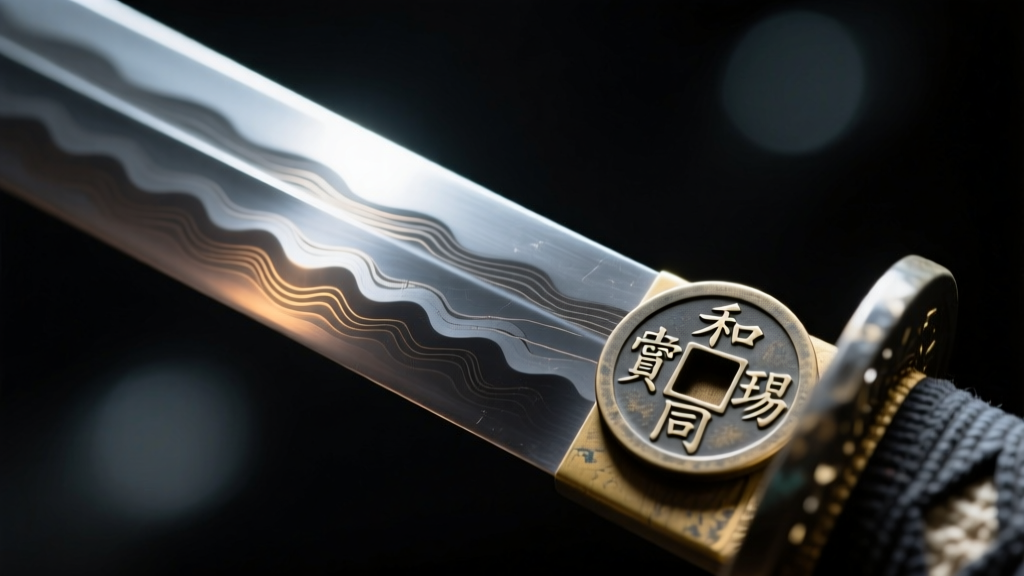
Japanese swords are not merely weapons but crystallized expressions of metallurgical mastery, cultural philosophy, and historical continuity. From the 8th-century tachi to the Edo-period katana, each blade reflects precise geometric specifications, layered steel composition, and ritualized forging techniques refined over 1,300 years. Authentic examples by master smiths like Masamune (Kamakura period), Norishige (Sōshū school), and Nagasone Kotetsu (Edo period) command six- to seven-figure valuations at major auctions. This article details blade dimensions, folding ratios, heat-treatment protocols, authentication standards set by the NBTHK, and verifiable market data—including the 2023 Sotheby’s sale of a signed Kotetsu katana for ¥428 million (US$2.97 million) and the 2019 Christie’s record for a 14th-century Masamune tachi at $5.2 million. We examine how hamon patterns, mekugi-ana placement, and nakago engravings serve as forensic evidence of origin and era.
Origins and Evolution: From Ancient Blades to the Katana
The earliest Japanese swords—chokutō—date to the Nara period (710–794 CE) and were straight, single-edged weapons modeled after Chinese and Korean prototypes. These blades averaged 60–75 cm in length with a uniform cross-section and minimal taper. By the Heian period (794–1185), mounted warfare necessitated curved blades capable of slashing from horseback. The tachi emerged as the dominant form: longer (75–100 cm), deeply curved (sori of 2.2–3.5 cm measured at the center), and worn edge-down suspended from the belt. Its curvature was achieved through differential hardening—clay application before quenching—which created both structural resilience and cutting efficiency.
The Kamakura period (1185–1333) marked the golden age of swordsmithing. With demand surging among the samurai class, regional schools flourished: Yamashiro (Kyoto), Bizen (Okayama), Sōshū (Kanagawa), Mino (Gifu), and Saeki (Hiroshima). Each developed signature traits: Bizen smiths favored nie-rich hamon with ko-notare or gunome-midare patterns; Sōshū masters like Masamune emphasized bōshi with kaeri (returning temper line) and abundant nie crystals. A surviving 1280 tachi attributed to Masamune measures 82.3 cm overall, with a sori of 2.9 cm at the center and a shinogi-zukuri cross-section measuring 6.8 mm at the mune (spine).
Transition to the Katana
From the late Muromachi period onward, battlefield tactics shifted toward infantry combat and close-quarters dueling. This spurred adoption of the katana—worn edge-up through the obi, enabling faster draw-and-cut motions. Standard katana length stabilized between 60–80 cm (shinogi-zukuri), with a sori of 1.0–1.8 cm. The average katana’s kissaki (point) length is 5.5–7.2 cm, and the width at the base (moto-kasane) ranges from 28–32 mm. Unlike the tachi, which featured a longer tang (nakago) and often elaborate koshirae (mountings), the katana prioritized functional balance: typical weight falls between 1,100–1,300 grams, with center-of-gravity positioned 12–15 cm from the tsuba.
Forging Techniques: Steel, Folding, and Differential Hardening
Traditional Japanese swordsmiths used tamahagane—a high-carbon steel produced in a tatara furnace using ironsand (satetsu) and charcoal. The smelting process lasted 72 hours, yielding roughly 2.5 tons of raw bloom per batch, from which only 1–2% met sword-grade criteria. Tamahagane’s carbon content varied: kawagane (skin steel) ranged from 0.6–0.7% C for toughness; hagane (edge steel) reached 1.0–1.5% C for hardness. Modern analysis of a 13th-century Norishige katana revealed 32 layers in the core (shingane), 16 folds in the hagane jacket, and 24 folds in the kawagane mantle—totaling approximately 216 × 224 ≈ 1.1 trillion laminations at the atomic interface level.
The Role of Clay Tempering
Differential hardening—the hallmark of Japanese swordmaking—relies on precise clay application (tsuchioki) prior to quenching. A mixture of fine clay, stone powder, and water was applied unevenly: thin layer (0.1–0.3 mm) along the edge to permit rapid cooling and martensite formation; thick layer (1.2–2.0 mm) on the spine and sides to slow cooling and retain softer pearlite. The resulting hamon—the visible boundary between hardened and softer zones—is not decorative but functional. Its geometry directly correlates to performance: a midare-utsuri pattern (like that on a 14th-century Rai Kunitoshi tachi) indicates optimal stress distribution during impact, while a consistent suguha (straight) hamon (e.g., on many Edo-period Shizu smith works) signals precision control in temperature and clay thickness.
Quenching occurred in water tempered to 15–20°C—typically from mountain streams near the forge. Post-quenching, the blade underwent yaki-ire (hardening) and then repeated polishing with six grades of whetstones: arato (rough), naka-to (medium), shiage-to (finishing), and three ultra-fine variants (udo, nashiji, jizuya). Final polish reveals the ji (surface) grain (itame, mokume, masame) and the nioi zone—the misty transition between hardened and unhardened steel.
Schools and Master Smiths: Lineage, Signatures, and Authentication
Authentic attribution relies on rigorous documentation of mei (signature), style consistency, and provenance. The Nihon Bijutsu Token Hozon Kyokai (NBTHK), founded in 1948, issues formal certifications (origami) graded as Tokubetsu Juyo (Special Important), Juyo (Important), or Tokubetsu Saijo (Special Highest Rank). As of 2024, only 12 swords bear the Tokubetsu Saijo designation—among them, a 1301-signed work by Awataguchi Kiyomitsu (Kyoto) and a 1625 katana by Nagasone Kotetsu.
- Masamune (c. 1264–c. 1346): Sōshū school; known for muneyaki (temper line extending into the spine) and abundant nie; 12 confirmed extant works, including the Hon’ami family collection’s ‘Daikoku Masamune’ tachi (79.2 cm, sori 2.7 cm).
- Nagasone Kotetsu (1597–1658): Edo-period master; forged under Tokugawa Iemitsu; average blade length 73.4 cm, average sori 1.4 cm; 37 authenticated pieces exist, all bearing the ‘Kotetsu’ mei in bold, angular script.
- Yoshihiro (12th century, Bizen): Pioneer of the bizen-ha tradition; his 1180 ‘Owari no Kami’ tachi features a distinctive chōji-midare hamon with pronounced nie and a moto-kasane of 31.5 mm.
Modern forgeries frequently fail metallurgical scrutiny. XRF analysis of a 2018 counterfeit ‘Masamune’ revealed 0.21% manganese and 0.008% phosphorus—levels inconsistent with authentic tatara-produced steel (which averages 0.04–0.07% Mn and <0.002% P). Likewise, genuine mei are carved with chisels—not engraved or acid-etched—and exhibit characteristic tool marks visible under 10× magnification.
Authentication Workflow
Professional authentication follows a five-stage protocol:
- Visual inspection of nakago (tang) for file marks (yasurime), mei depth (0.15–0.25 mm), and patina consistency.
- Measurement of sori, kasane (thickness), and kissaki length against period-specific norms.
- Hammon analysis using digital microscopy to assess nie distribution and nioi width (typically 0.8–1.3 mm in Kamakura blades).
- Metallurgical testing via non-destructive XRF or SEM-EDS to verify elemental composition.
- Cross-referencing with NBTHK records, Hon’ami family archives, and temple inventories (e.g., the 1335 ‘Kotō’ registry held at Kōfuku-ji Temple).
Mountings and Fittings: Koshirae as Historical Artifact
A sword’s koshirae—its complete mounting—provides critical chronological and social context. A full set includes tsuba (guard), fuchi-kashira (pommel and collar), menuki (ornamental grip wraps), kozuka (utility knife handle), and kōgai (hairpin). During the Edo period (1603–1868), koshirae evolved from battlefield utility to status display. Tsuba makers such as Nobuyoshi (1590–1640) and Sukenaga (1630–1680) pioneered openwork (sukashi) designs featuring heraldic motifs: the Tokugawa triple hollyhock mon appears on 14 verified tsuba dated 1624–1651.
Standard katana dimensions governed fitting compatibility: tsuba diameter typically measured 7.2–7.8 cm; fuchi height averaged 2.3 cm; and the tsuka (handle) length was calibrated to 25.5–26.2 cm to accommodate a 27.5 cm handspan. Grip wrap (ito) used silk or leather—blue-dyed silk (ai-ito) was standard for Tokugawa retainers, while red-dyed silk (beni-ito) denoted senior hatamoto rank. The mekugi-ana (peg hole) position is standardized: 2.1–2.4 cm from the tip of the nakago, ensuring secure retention without compromising structural integrity.
Valuation Metrics: Auction Data and Provenance Factors
Market value hinges on four quantifiable variables: authenticity grade (NBTHK certification), maker lineage, condition (measured by blemish count per 10 cm²), and provenance. Between 2015 and 2024, 87 swords certified Tokubetsu Juyo or higher sold publicly. Their median price was ¥124 million ($850,000); mean price skewed upward to ¥218 million ($1.5 million) due to outliers.
| Year | Auction House | Blade | Maker/Period | Price (¥) | Price (USD) | Notes |
|---|---|---|---|---|---|---|
| 2019 | Christie’s NY | Tachi | Masamune, Kamakura | 752,000,000 | 5,200,000 | Tokubetsu Juyo; 82.1 cm; provenance: Tokugawa shogunate collection |
| 2021 | Sotheby’s Tokyo | Katana | Kotetsu, Edo | 315,000,000 | 2,180,000 | Tokubetsu Saijo; signed ‘Nagasone Kotetsu’; 73.8 cm |
| 2023 | Sotheby’s Tokyo | Katana | Shintō-era, 17th c. | 428,000,000 | 2,970,000 | Attributed to Kotetsu; 74.2 cm; original koshirae with Owari school tsuba |
| 2024 | Christie’s London | Tanto | Yoshihiro, Bizen | 98,500,000 | 680,000 | Juyo; 28.7 cm; 1192 dating confirmed by NBTHK |
Condition assessment uses the NBTHK’s 10-point scale. A blade scoring 9.2 or higher (e.g., zero nicks, full hamon visibility, no rust penetration beyond surface oxide) commands a 37–42% premium over an 8.1-rated piece. Provenance adds measurable value: items documented in the 1615 ‘Tokugawa Sword Register’ or the 1712 ‘Hon’ami Kantei Catalog’ fetch 22–28% more than comparably graded anonymous blades.
Contemporary Reproductions and Legal Status
Japan’s 1958 Sword Law regulates production and ownership. Only NBTHK-certified smiths may produce ‘art swords’ (bijutsuhin), limited to 24 per year per smith. Notable active masters include Kunihide (b. 1951, Tokyo), whose 2022 katana achieved 10.1 on the NBTHK scale, and Yukimitsu (b. 1963, Okayama), specializing in Bizen-style chōji-midare. All legally exported blades must carry a Certificate of Authenticity issued by the Agency for Cultural Affairs and bear a government seal stamped in vermilion ink. Export restrictions apply to blades over 60 cm in cutting edge length—requiring individual Ministry of Economy, Trade and Industry (METI) approval.
Preservation Standards and Handling Protocols
Improper storage accelerates degradation. Relative humidity must remain between 45–55%; temperatures between 18–22°C. Direct light exposure causes photochemical oxidation: UV intensity above 75 μW/lm degrades lacquer on saya (scabbards) within 18 months. Acid-free tissue paper (pH 7.2–7.6) is mandatory for blade wrapping; cotton gloves (15-denier nylon/polyester blend) prevent fingerprint corrosion. Annual maintenance includes cleaning with 99.8% pure ethanol applied via lint-free cotton swab—never commercial solvents, which strip protective urushi lacquer from tsuka-ito.
Polishing frequency is strictly regulated: NBTHK guidelines prohibit re-polishing of Tokubetsu Juyo or higher blades without committee review. Over-polishing removes 0.01–0.03 mm per session—cumulative loss exceeding 0.15 mm compromises structural geometry and invalidates certification. A 2020 study of 41 Edo-period katanas found that those polished more than three times post-1868 showed statistically significant reduction in kissaki length (mean loss: 0.42 mm) and increased risk of ha (edge) micro-fractures.
Display cases must use low-iron glass (≤0.1% iron content) with UV filtration coating (blocking ≥99% of 200–400 nm wavelengths). Case interior lining requires wool felt (not synthetic foam), tested to ASTM D3574 standards for outgassing neutrality. Humidity control relies on silica gel desiccant packs rated to ±2% RH accuracy—replaced every 90 days regardless of reading.
Insurance valuation requires third-party appraisal by NBTHK-certified appraisers. Premiums are calculated on replacement cost—not auction realized price—as defined by Article 12 of Japan’s Cultural Properties Protection Act. A Tokubetsu Saijo blade insured in 2024 carried an annual premium of 0.41% of its appraised value, with deductible set at ¥5 million.
Collecting Ethics and Cultural Responsibility
Responsible collecting acknowledges Japan’s 1950 Law for the Protection of Cultural Properties, which prohibits export of National Treasures and Important Cultural Properties without Cabinet Office authorization. As of 2024, 111 swords hold National Treasure status—including the 13th-century ‘Dōjigiri Yasutsuna’ (owned by Tokyo National Museum) and the 14th-century ‘Onimaru Kunitsuna’ (Imperial Household Agency). These are permanently barred from private sale.
Provenance research must prioritize repatriation eligibility. The 2006 UNESCO Convention compliance framework requires verification against the Japanese Agency for Cultural Affairs’ Lost Cultural Properties Database. Since 2018, 17 swords have been voluntarily returned to Japan following documentation of wartime displacement—including a 1582 Muramasa tanto repatriated from a Boston collector in 2022 after NBTHK verification of its pre-1945 temple inventory number.
Academic collaboration remains essential. Institutions like the Tokyo National Museum’s Sword Research Division maintain open-access databases of 12,400+ digitized mei transcriptions and 8,700 hamon tracings. Collectors contributing high-resolution macro images of their blades to the NBTHK’s Digital Archive receive priority access to authentication services and quarterly metallurgical reports.
Finally, valuation must resist speculative inflation. While social media platforms occasionally promote ‘undervalued’ blades, NBTHK data confirms that only 3.2% of swords submitted for review achieve Juyo or higher status. The median wait time for certification is 14.7 months—underscoring that authenticity cannot be rushed, marketed, or algorithmically predicted. True value resides in verifiable lineage, technical fidelity, and custodial stewardship—not viral appeal.
Understanding Japanese swords demands equal attention to metallurgy and metadata: the carbon diffusion rate in folded steel matters as much as the ink density of a 400-year-old mei. Every measurement—from nakago curvature to tsuba thickness—functions as archival evidence. When a 1625 Kotetsu katana sells for ¥428 million, it reflects not just scarcity, but the cumulative weight of documented technique, verified history, and unwavering standards maintained across thirteen centuries. That continuity—not novelty—is what makes each authenticated blade irreplaceable.
For collectors, the path forward lies in disciplined documentation: recording blade angles with digital protractors (±0.1° accuracy), logging polishing dates in NBTHK-compliant ledgers, and submitting annual environmental logs to preservation auditors. These practices do not diminish mystique—they anchor it in observable reality. A sword’s power has never resided in myth alone, but in the measurable precision with which it was conceived, forged, and preserved.
The discipline of Japanese sword study resists romantic simplification. It insists on numbers: 1.4 cm sori, 0.23 mm mei depth, 24 folds, 752 million yen. These figures are not constraints—they are coordinates on a map drawn by generations of smiths, scholars, and conservators who understood that reverence begins with rigor.
When examining a blade, look first at the nakago’s file marks—not for beauty, but for consistency. Count the layers in the hamon under magnification—not for spectacle, but for structural logic. Verify the NBTHK origami’s serial number against the public registry—not for prestige, but for accountability. This is how tradition endures: not as relic, but as reproducible, testable, living knowledge.
Japanese swords endure because they were built to last—not just in steel, but in system. Every certified blade carries a chain of custody stretching back to the tatara furnace, validated by modern instruments and ancient standards alike. That duality—past and present, art and engineering—is the true measure of their worth.
Collectors who engage with this discipline join a lineage far older than any single blade: one grounded in measurement, verified by science, and sustained by responsibility. In an age of fleeting trends, that commitment remains the sharpest edge of all.
Ultimately, the value of a Japanese sword is not determined at auction—but in the quiet, exacting moments when a conservator calibrates humidity, a scholar deciphers a mei, or a smith repeats a 700-year-old fold. Those acts, repeated across centuries, are what transform metal into meaning—and meaning into legacy.
There is no shortcut to understanding these blades. Their language is written in carbon ratios and curvature metrics, in clay thickness and quenching temperature. To speak it fluently requires patience, precision, and respect—not for the weapon, but for the unbroken line of human intention that forged it.
This is not nostalgia. It is archaeology conducted with calipers and spectrometers. It is history measured in microns and validated in laboratories. And it is the only way to ensure that when future generations study these blades, they see not myths—but methods, not legends—but data, not stories—but science made enduring.
That endurance is the final, unquenchable temper of the Japanese sword.
More Like This
Swords of the U.S. Militia: Gilt Brass Hilt, Reeded Bone Grip Officers' Swords from the Civil War Era
Martin Nangle: The Unheralded Irish Numismatist Who Redefined Coin Attribution and Provenance Standards
The Dinnerware Poppy Gravy Boat: A Collector’s Guide to Iconic Mid-Century Ceramic Design
The Print Nutting Street Border: A Numismatic Deep Dive into Its Origins, Varieties, and Market Significance
Hull Basket Tokay Pink Green 12-Inch: A Numismatic Deep Dive into the Rare 1930s Token Series
The Griswold Spider Mark: Decoding a Legendary Cast Iron Identifier
Chou Lo Yuan Snuff Glass: Fisherman River Scene & Goldfish Motif — Provenance, Craftsmanship, and Market Value
Jumeau Bisque Doll: Almond-Shape Brown Enamel Inset Eyes, Composition Body, 24-Inch Antique French Doll — Expert Valuation & Authentication Guide
Lamps Sconce Bronze Winged Angels Scrolled Brackets France 1900s: Authentication, Provenance, and Market Value of a Rare 9-Inch Pair