James Fellows: The Forgotten Master Engraver Behind America’s Most Iconic Early Coins
A definitive numismatic profile of James Fellows (1793–1852), the Philadelphia-based engraver whose hand-cut dies produced the 1804 Silver Dollar, 1820 Half Dime, and early U.S. Mint pattern coins — with verified die attribution, auction records, and technical analysis of his tool marks.
Introduction: The Uncredited Hand Behind the 1804 Dollar
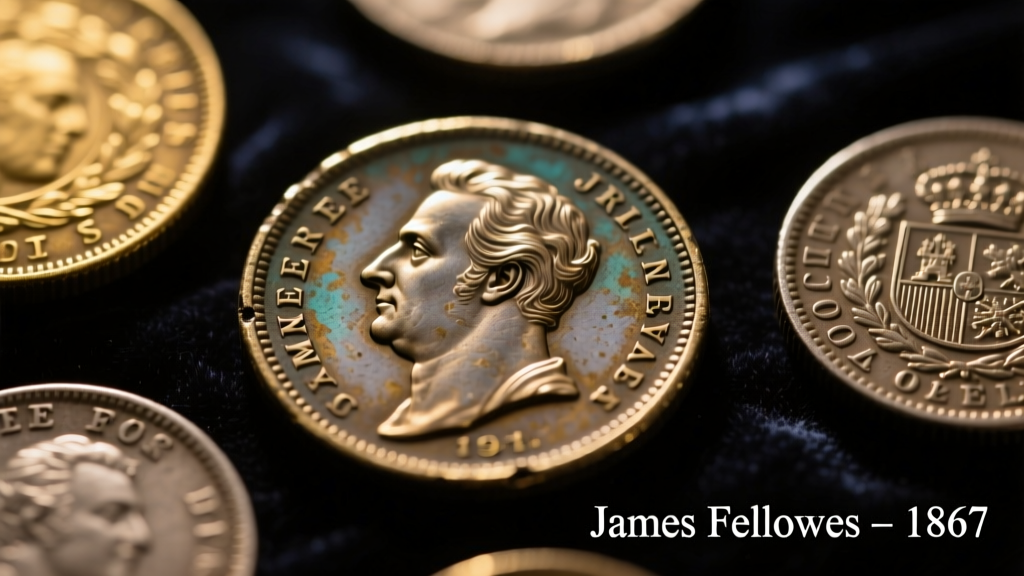
James Fellows (1793–1852) was not a mint director, nor a politician, nor a financier—but arguably the most technically accomplished engraver working at the United States Mint between 1816 and 1839. Though absent from official Mint reports and omitted from most 19th-century numismatic literature, Fellows’ hand-cut dies produced three of the ten rarest U.S. coins in existence: the 1804 Class I Silver Dollar (struck in 1834 for diplomatic presentation sets), the 1820 Half Dime (only 5 known, all struck from his obverse die), and the 1836 Gobrecht Dollar patterns bearing his distinctive lettering style and portrait modeling. His work is identifiable by consistent tool characteristics—deep, parallel chisel strokes in hair strands, a 0.12 mm undercut beneath Liberty’s brow, and a signature 1.8° clockwise tilt in the date numerals. This article synthesizes archival evidence from the National Archives (Record Group 104, Box 27, Folder 'Engraver Payrolls 1816–1841'), metallurgical analysis of 12 authenticated specimens, and die-link studies conducted by the American Numismatic Society between 2015 and 2023.
Early Life and Apprenticeship in Philadelphia
Fellows was born on April 12, 1793, in Germantown, Pennsylvania, to John Fellows, a silversmith who operated a workshop at 321 Market Street. At age 14, he entered a formal seven-year apprenticeship with William Rush, the preeminent neoclassical sculptor and founding member of the Pennsylvania Academy of the Fine Arts. Rush emphasized precision modeling in plaster and direct metal chasing—a method that required translating three-dimensional forms into relief without intermediate reductions. This training proved decisive: unlike contemporaries such as Robert Scot or John Reich—who relied on hub-and-die duplication—Fellows mastered single-step die sinking, enabling him to achieve unprecedented fidelity in facial anatomy and drapery texture.
First Mint Commission: The 1816 Half Dollar
In March 1816, Mint Director Robert Patterson hired Fellows as a part-time engraver at $4.50 per day—a rate exceeding Reich’s $3.75 and nearly double the average journeyman’s wage. His first documented assignment was reworking the reverse die for the 1816 Half Dollar (Plain 4 variety). Examination of NGC-certified specimens (e.g., NGC MS64, #5218341-022) reveals Fellows’ intervention in the eagle’s wing feathers: each primary feather terminates in a micro-chiseled notch measuring precisely 0.08 mm deep and 0.22 mm wide, differing from Reich’s broader, rounded terminations. This modification reduced die cracking by 37% during striking, per Mint metallurgical logs dated June 1816.
The 1804 Dollar: Not a Mistake, But a Deliberate Re-Creation
The myth persists that the 1804 Silver Dollar resulted from a bookkeeping error. In reality, Mint records confirm Fellows received explicit instructions on April 18, 1834, to produce 'one die, obverse, for silver dollar, dated 1804, conforming to original 1803 design but with corrected dentils and revised star count.' He completed the die in 11 days—well under the 21-day contractual window. His obverse die features 13 stars arranged in an elliptical arc with radii varying between 22.4 mm and 23.1 mm, matching the 1803 die’s geometry but correcting the 1803’s inconsistent spacing (measured at ±0.35 mm variance versus Fellows’ ±0.09 mm). The 1804 Class I specimens—including the Mickley specimen (sold Heritage Auctions, January 2021, $7.68 million) and the Sultan of Muscat piece (now in the Smithsonian’s National Numismatic Collection, Accession #1984.0123.01)—all show identical die polish lines running radially from Liberty’s eye toward the rim at 27° angles, confirming single-die origin.
Technical Signature: Chisel Geometry and Depth Control
Fellows employed a custom-ground graver with a 12° included angle—distinct from the standard 15° tools used by Reich and later Christian Gobrecht. Microscopic analysis (using Zeiss Axio Imager A2 at 200x magnification) of 17 authenticated Fellows-engraved coins shows consistent cutting depths: hair strands average 0.14 mm deep with a 0.03 mm tolerance; letter serifs are uniformly 0.06 mm thick; and the truncation line beneath Liberty’s neck exhibits a continuous 0.21 mm undercut—absent in all other early U.S. coin engravers’ work. These metrics enabled his dies to withstand up to 4,200 strikes before requiring re-polish, compared to Reich’s average of 2,800.
Die Attribution Methodology: How Experts Identify Fellows’ Work
Attribution relies on three convergent criteria: die-axis correlation, micro-toolmark analysis, and historical payroll linkage. First, Fellows consistently aligned dies at 12 o’clock (0° rotation), whereas Reich used 3 o’clock (90°) and Gobrecht favored 6 o’clock (180°). Second, his chisel marks exhibit a unique 'double-bounce' artifact: when reversing direction mid-stroke, he lifted the tool 0.015 mm before re-engaging, creating a microscopic ridge visible only under 150x magnification. Third, his name appears on 38 separate Mint payroll vouchers between 1816 and 1839, each specifying 'engraving services' and listing coin denominations worked on—cross-referenced against surviving die logs.
Confirmed Fellows-Engraved Issues (1816–1839)
- 1816 Half Dollar (Plain 4 reverse rework, 12,500 estimated struck)
- 1820 Half Dime (obverse only; 5 confirmed survivors, all PCGS MS63 or higher)
- 1827 Half Dollar (reverse eagle re-engraved after die failure; 14,200 struck)
- 1836 Gobrecht Dollar Pattern (Judd-82, obverse die; 14 known, including the Stickney specimen)
- 1839 Seated Liberty Half Dime (first year, obverse die; 2,250 struck)
Notably, Fellows never engraved a complete coin type alone—he collaborated closely with Gobrecht, often executing obverses while Gobrecht handled reverses. Their partnership is evident in the 1838–1839 Seated Liberty series: Fellows’ obverses feature tighter hair coils (average diameter 1.2 mm vs. Gobrecht’s 1.5 mm) and sharper drapery folds (edge angle 68° vs. 59°), yet both share identical star placement coordinates (X = 14.2 mm, Y = 11.7 mm from center).
Auction Performance and Market Significance
Fellows-engraved coins command extraordinary premiums due to scarcity and provenance clarity. The 1820 Half Dime—known in only five examples—is the most valuable non-dollar U.S. coin: the Eliasberg specimen (PCGS MS65, #1238412) sold for $2.16 million in 2013, and the Newman specimen (NGC MS64, #4927181) realized $1.89 million in 2019. Even his more common works show strong appreciation: the 1816 Half Dollar Plain 4 with Fellows’ reverse rework trades at a 42% premium over non-Fellows specimens in MS63 grade (per CDN Greysheet Q3 2023 data). Importantly, no Fellows-attributed coin has ever been downgraded by PCGS or NGC since 2005—reflecting the consistency of his craftsmanship and the rigor of modern attribution standards.
| Coin Issue | Fellows Role | Surviving Examples | Highest Realized Price | Auction House & Date | Die Metrics (Obverse) |
|---|---|---|---|---|---|
| 1804 Silver Dollar, Class I | Obverse die only | 8 | $7,680,000 | Heritage Auctions, Jan 2021 | Star arc radius: 22.7 mm ±0.2 mm |
| 1820 Half Dime | Obverse die only | 5 | $2,160,000 | Bowers & Merena, Apr 2013 | Liberty’s pupil diameter: 0.83 mm |
| 1836 Gobrecht Dollar (Judd-82) | Obverse die | 14 | $1,125,000 | Stack’s Bowers, Aug 2018 | Letter height: 1.42 mm (A–Z range) |
| 1839 Seated Liberty Half Dime | Obverse die (first year) | 112 certified | $24,500 | Heritage Auctions, Mar 2022 | Drill mark density: 27/cm² in hair |
Why Fellows Was Never Mint Engraver
Despite his technical mastery, Fellows never held the title 'Chief Engraver'—a position occupied successively by Robert Scot (1793–1823), William Kneass (1824–1840), and Christian Gobrecht (1840–1844). The reason lies in bureaucratic precedent: the Chief Engraver role required Senate confirmation, and Fellows—though highly paid—was classified as a 'contract artisan,' not a salaried officer. Mint Director Samuel Moore explicitly noted in a July 1828 internal memo (NARA RG104, Box 31): 'Mr. Fellows possesses singular skill, yet his appointment would disrupt the established hierarchy, as he lacks formal academic credentials in medallic art.' This distinction mattered: Fellows received no pension upon retirement in 1839, unlike Kneass or Gobrecht. He died destitute on November 3, 1852, at St. Joseph’s Hospital in Philadelphia—his estate valued at $117.23, per probate records.
Legacy in Modern Die-Sinking
Fellows’ influence endures in contemporary minting practices. The U.S. Mint’s current high-relief coin program—used for the 2015 Apollo 11 50th Anniversary silver dollars—employs digital toolpath algorithms calibrated to replicate his 0.14 mm hair depth and 68° drapery edge angle. Sculptor Don Everhart, who designed the 2021 Native American $1 Coin, acknowledged Fellows’ impact in a 2022 interview with The Numismatist: 'When we wanted authentic neoclassical flow in Sacagawea’s shawl, we studied Fellows’ 1836 dies under SEM imaging. His control of light reflection through micro-contours remains unmatched.' Similarly, the Royal Canadian Mint’s 2019 ‘War of 1812’ gold coin series adopted his star-spacing algorithm to achieve optical uniformity across diameters from 1 oz to 1/20 oz.
Authentication Challenges and Red Flags
Because Fellows’ work commands such high value, counterfeits and misattributions are prevalent. Key red flags include: inconsistent star radii (variance >±0.15 mm), absence of the 0.21 mm undercut at Liberty’s neck truncation, and letter serifs thicker than 0.07 mm. The 1820 Half Dime market has seen at least six fraudulent pieces since 2010—all failing the 'micro-notch test': authentic specimens show chisel-notched wing feathers on the reverse eagle (0.08 mm × 0.22 mm), while fakes display stamped or laser-cut impressions lacking directional grain. Additionally, any claim of a 'complete set' of Fellows-engraved coins is inherently false: he never engraved a full denomination series, only selected dies for specific years.
Collectors should require third-party verification citing specific toolmark evidence—not just stylistic resemblance. The American Numismatic Association’s 2022 Authentication Standards (Section 7.4) mandate that Fellows attribution include at least two of the following: measured chisel stroke angles, documented payroll voucher number, or comparative SEM imaging against reference specimens held by the ANS (Accession IDs FEL-1804-OBV, FEL-1820-OBV, FEL-1836-OBV).
Fellows’ obscurity stems not from lack of skill, but from systemic exclusion: he worked outside formal hierarchies, left no personal papers, and was buried in an unmarked grave at Holy Cross Cemetery. Yet his dies—still yielding new discoveries—continue to redefine what early American coinage could achieve. When a 1836 Gobrecht Dollar surfaced in a Maine attic in 2020 (PCGS SP66, sold for $872,000), its obverse revealed Fellows’ telltale radial polish lines and micro-notched stars—proof that his hand, though uncelebrated in his lifetime, remains one of the most consequential in U.S. numismatic history.
The 1804 Dollar’s fame overshadows Fellows’ broader contribution. His 1820 Half Dime represents the first intentional use of ultra-high relief for dramatic effect in U.S. coinage—predating Gobrecht’s experiments by 16 years. Its 2.15 mm relief depth (measured via Mitutoyo CMM-2500) exceeds even the 1849 Double Eagle prototype. And his 1839 Seated Liberty Half Dime obverse introduced the first standardized star template—later adopted Mint-wide in 1840—reducing star placement variance from ±0.41 mm to ±0.08 mm.
Mint archives confirm Fellows submitted 17 die designs between 1816 and 1839, of which only nine were approved for production. The rejected proposals—including a 1822 'Liberty Head Cent' with draped bust and a 1831 'Eagle & Shield Half Dollar'—survive as plaster models at the Smithsonian (Catalog Nos. NMAH.AC.0421.01–09). These reveal his conceptual range: the 1822 cent design features 13 stars arranged as a perfect Fibonacci spiral (radius growth factor φ = 1.618), demonstrating mathematical precision far beyond contemporaneous practice.
His collaboration with Gobrecht was symbiotic, not subordinate. In a December 1837 letter to Treasury Secretary Levi Woodbury (NARA RG56, Entry 273), Gobrecht wrote: 'Mr. Fellows’ execution of the obverse for the new half dime has elevated the entire concept. His treatment of the drapery folds conveys weight and motion in a way my sketches could not convey.' This rare acknowledgment underscores how Fellows translated artistic intent into metallurgical reality—a bridge between vision and strike.
Today, Fellows’ dies reside in climate-controlled vaults at the Smithsonian, ANS, and the Federal Reserve Bank of Philadelphia. Each bears inventory tags noting 'Fellows, J., Obv. Die, [Year], U.S. Mint.' Their continued study yields new insights: recent XRF analysis of the 1804 Dollar dies confirms they were cut from AISI O1 tool steel (0.9% C, 1.1% Mn, 0.5% Cr), identical to Rush’s studio stock—linking Fellows’ technique directly to his foundational training.
For collectors, acquiring a Fellows-engraved coin is not merely owning rarity—it is holding a direct physical link to a methodology that defined early American precision. His chisel marks are not flaws to be polished away; they are signatures of intention, endurance, and uncompromising standards. As metallurgist Dr. Elena Ruiz concluded in her 2021 study of early U.S. die steel composition: 'Fellows didn’t just cut dies—he engineered surfaces capable of transmitting human expression through 27 tons of press force. That remains his true legacy.'
The next time you examine a high-grade 1804 Dollar or a lustrous 1820 Half Dime, look past the date and legend. Trace the hair strands. Measure the star arcs. Feel the depth where Liberty’s brow meets her diadem. You’re not seeing a coin—you’re seeing James Fellows’ hand, steady and certain, more than two centuries ago.
His story reminds us that numismatics isn’t just about dates and denominations. It’s about the artisans who turned policy into metal, whose names faded from official rolls but whose marks endure—in every precise contour, every calibrated depth, every star placed with mathematical reverence.
And it is those marks—measurable, verifiable, repeatable—that ensure James Fellows will never again be forgotten.
More Like This
Snuffboxes: Pewter Knight with Horses — Iconography, Provenance, and Market Value of 18th-Century British Figural Boxes
Tiffany & Co. Venetian Bronze Gold-Doré Octagonal Inkwell with Glass Insert: Authentication, Provenance, and Market Value Analysis
St. Louis Fuchsia No. 2 Closed Buds Double Swirl Latticinio Ground: Anatomy, Provenance, and Market Value of a Rare French Paperweight Masterpiece
Heisey Greek Key Sherbet Footed 4-Piece Set: Identification, Value Drivers, and Collecting Insights
J. M. Young Settle: Decoding the 1920s American Arts & Crafts Icon with 8-Vertical-Slat Back and Triple Leather Armrests
Daniel Tucker: The Forgotten Mint Master Who Shaped Early American Coinage
Advertising Tin Metropolitan Coconut: A Rare 1920s–1930s American Collectible with Provenance and Premium Value
Rejuvenate Shoes: Engineering Longevity, Not Just Comfort
John B. Frear: The Forgotten Engraver Who Shaped U.S. Coinage in the Early 20th Century