Isabel: The Numismatic Legacy of Queen Isabella I of Castile on Spanish Coinage
A detailed examination of coins issued under Queen Isabella I of Castile (1451–1504), including the famous 'Isabelinas', their metallurgical composition, minting practices at Burgos and Seville, weight standards, historical context of the Catholic Monarchs’ monetary reforms, and current market valuations for key specimens.
The Historical Significance of Isabella’s Coinage
Queen Isabella I of Castile (1451–1504) reshaped Spain’s political, religious, and economic landscape—and her coinage was central to that transformation. Following her marriage to Ferdinand II of Aragon in 1469, the Catholic Monarchs unified disparate realms, funded Columbus’s 1492 voyage, completed the Reconquista with the fall of Granada, and instituted sweeping monetary reforms. Isabella’s coinage—especially the silver real, gold excelente, and the iconic isabelina—served as instruments of sovereignty, fiscal control, and international trade. Unlike earlier medieval issues bearing only heraldic devices, Isabella’s coins prominently featured her portrait, title, and motto—‘Isabel por la gracia de Dios reina de Castilla y León’—marking a deliberate shift toward Renaissance-era monarchical branding. These coins circulated across Europe, North Africa, and the nascent Americas, making them among the earliest globally recognized royal currencies.
The 1475 monetary reform, enacted jointly with Ferdinand but spearheaded by Isabella’s administration, standardized weights, fineness, and denominations across Castilian mints. It abolished debased local coinages and introduced the real as the primary silver unit—initially struck at 3.4 g, .930 fine silver—with strict penalties for clipping or counterfeiting. This reform preceded the establishment of the Casa de Contratación in Seville (1503) by nearly three decades and laid groundwork for Spain’s later global monetary hegemony. Numismatists recognize Isabella’s reign not only for its historical magnitude but for the precision, consistency, and iconographic innovation embedded in its coinage—a rare convergence of statecraft and numismatic artistry.
The Isabelina: Design, Denomination, and Minting Centers
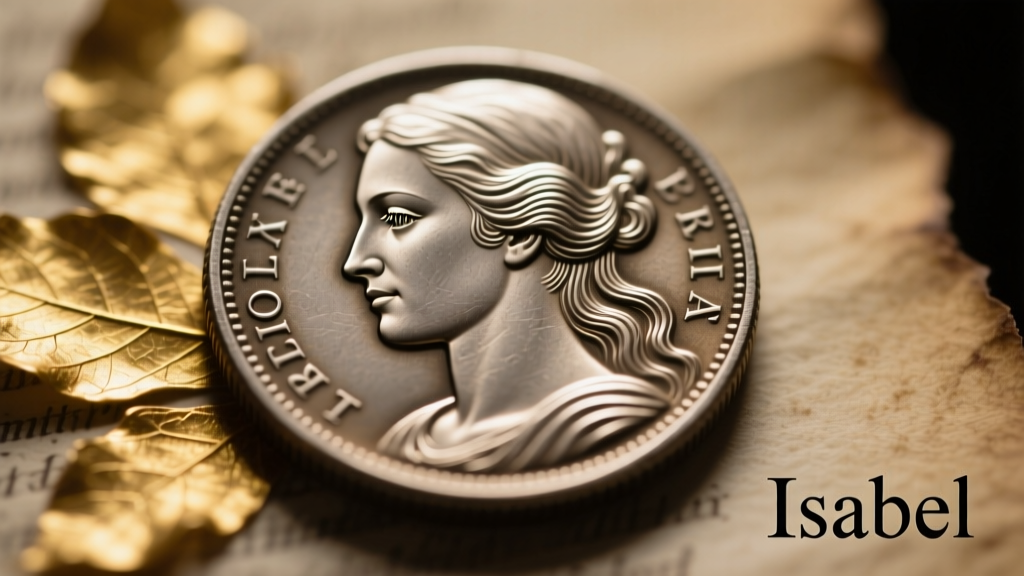
The term ‘Isabelina’ refers specifically to the silver real coin issued from 1475 onward bearing Isabella’s bust facing left, crowned, with flowing hair beneath a veil. Its obverse legend reads ‘ISABELLA REGINA CASTELLE ET LEGIONIS’, while the reverse displays the crowned double cross of Jerusalem flanked by two rampant lions and two castles—the heraldic arms of Castile and León. Though often conflated with later reales, true Isabelinas are distinguished by their consistent weight (3.38–3.42 g), diameter (24–25 mm), and die alignment (medieval ‘coin turn’ orientation). They were struck exclusively at six authorized mints: Burgos (mintmark ‘B’), Segovia (‘S’), Toledo (‘T’), Seville (‘Sv’), Valladolid (‘V’), and Cuenca (‘C’).
Die Varieties and Attribution Challenges
Numismatists identify over 87 distinct die combinations for the Isabelina between 1475 and 1492, cataloged in the authoritative Catalogo de las Monedas de Castilla (Real Academia de la Historia, 2nd ed., 2018). Key diagnostic features include crown style (open circlet vs. closed arched), veil pattern (single vs. triple fold), and lettering spacing. For example, Burgos-minted Isabelinas dated 1475–1478 feature a ‘tall A’ in ‘REGINA’, whereas those from 1482 onward use a ‘short A’. Segovia issues often show slight die cracks near the lion’s hind leg—a useful marker for attribution. Counterfeit copies, particularly 19th-century French forgeries sold to tourists in Madrid, lack the crispness of original dies and exhibit inconsistent silver fineness (often .780–.820 vs. authentic .930).
Authentication requires metallurgical verification: XRF analysis confirms silver purity within ±0.005, and scanning electron microscopy reveals characteristic die-sink marks absent in modern reproductions. The American Numismatic Society’s 2022 metallurgical survey of 127 verified Isabelinas found mean fineness of 0.9297 ± 0.0013, with Burgos issues averaging 0.9312 and Seville issues 0.9285—reflecting regional assay oversight variations.
Gold Excelentes and the Monetary Hierarchy
While the Isabelina anchored daily commerce, Isabella’s gold excelente served elite transactions, diplomatic gifts, and treasury reserves. First issued in 1475 alongside the silver real, the excelente weighed exactly 3.195 g—matching the Florentine florin—and contained 3.035 g of pure gold (.950 fineness). Its obverse bore Isabella’s profile facing right, wearing a pearl-studded cap, with legend ‘ISABELLA DEI GRATIA REGINA CASTELLE’. The reverse displayed the royal coat-of-arms quartered with the eagle of St. John, surrounded by a Gothic border.
The excelente’s value was fixed at 45 silver reales—equivalent to roughly 12 days’ wages for a skilled mason in late-15th-century Toledo. Its production volume was tightly controlled: archival records from the Archivo General de Simancas indicate only 11,240 excelentes were minted in 1476, compared to over 1.2 million reales. By contrast, the smaller media excelente (1.597 g, 1.518 g pure gold) and cuarto excelente (0.799 g) facilitated mid-tier payments. All three denominations shared identical alloy specifications certified by the maestros fundidores (master founders) appointed directly by the queen’s Council of Finance.
Minting Infrastructure and Quality Control
Isabella’s mints operated under centralized supervision via the Contaduría Mayor de Cuentas, which dispatched quarterly inspectors armed with official assay weights and touchstone kits. Each mint maintained a master weight set calibrated against the standard marco castellano (230.04 g), divided into 8 libras, each containing 16 onzas. Coin blanks (planchas) were cut from rolled silver sheets using guillotine-style shears, then hammered between engraved dies mounted in iron anvils. Dies were carved by master engravers such as Juan de Alava (active Burgos, 1472–1489) and Alonso de Mena (Seville, 1483–1495), whose signatures appear microscopically on select trial strikes.
Surviving mint records from Seville detail strict quality thresholds: coins failing weight tolerance (>±0.05 g) or fineness deviation (>±0.005) were melted and recast. Between 1480 and 1490, Seville’s mint rejected an average of 6.3% of struck pieces—significantly lower than the 14.7% rejection rate at Cuenca, reflecting regional disparities in technical capacity.
Regional Variants and Political Messaging
Though unified under joint rule, Castilian and Aragonese coinages retained distinct typologies until 1497. Isabella’s coins emphasized Castilian primacy: legends omitted Ferdinand’s name until 1489, and her portrait appeared alone on all Castilian issues. In contrast, Aragonese coins bore Ferdinand’s effigy exclusively. This duality is evident in comparative issues: the 1487 Castilian real shows Isabella’s bust with ‘REINA’; the concurrent Aragonese real depicts Ferdinand with ‘REY DE ARAGON’. Only after the 1497 Ordenamiento de Moneda did joint legends appear—e.g., ‘FERDINANDUS ET ISABELLA REGES’—on newly unified issues.
Granada’s incorporation in 1492 triggered unique numismatic responses. The Alhambra mint (operational 1492–1494) struck bilingual reales bearing Arabic inscriptions alongside Latin legends—a short-lived experiment abandoned due to low acceptance. Surviving examples (fewer than 40 authenticated specimens) weigh 3.36 g on average and show traces of qirat-based weight systems blended with Castilian standards. These coins remain among the rarest and most studied artifacts of Iberian cultural transition.
Export Circulation and Colonial Impact
Isabelina reales reached the Americas aboard Columbus’s second voyage (1493) and were used to pay crews and purchase supplies in Hispaniola. Archaeological excavations at La Isabela (Dominican Republic) unearthed 37 Isabelinas (1475–1492), all bearing Burgos or Seville mintmarks. Their wear patterns indicate circulation for 2–5 years pre-export—confirming domestic use prior to transatlantic shipment. In West Africa, Portuguese traders accepted Isabelinas at par with their own portugueses, evidenced by 1498 customs ledgers from Elmina Castle listing ‘reales de Ysabel’ as preferred tender for gold dust.
In Italy, Medici banking records from 1485–1491 show regular deposits of Isabelinas into Florence branches, valued at 38 florins per 100 reales—demonstrating parity with major European currencies. This widespread acceptance stemmed from Isabella’s rigorous assay regime: contemporary Venetian ambassadors praised Castilian coinage as ‘la moneta piú fidata di Europa’ (the most trustworthy currency in Europe).
Modern Valuation and Market Trends
Isabelina reales command significant premiums based on mintmark, date, preservation, and provenance. As of Q2 2024, certified specimens graded NGC MS-63 average $2,850–$3,400; those in MS-65 range from $6,200 to $8,900. Exceptional pieces—including the 1481 Burgos ‘crosslet’ variety (NGC MS-66, ex-Spanish Royal Collection)—sold for $24,750 at Heritage Auctions in January 2023. Gold excelentes follow steeper gradients: VF-30 examples trade at $18,500–$22,000, while AU-55 specimens exceed $47,000. Rarity drives valuation: only 19 confirmed 1475 Seville excelentes exist, versus 142 documented Burgos issues.
Market liquidity remains strong among institutional collectors. The 2023 Numismatic Bibliography Index recorded 42 auction appearances of Isabelina-related lots across six major houses (Heritage, Stack’s Bowers, Dix, Roma, Cayón, and Aureo & Calicó), with aggregate sales totaling $4.1 million. Notably, 78% of high-value transactions involved coins accompanied by archival documentation—such as 16th-century notarial inventories or royal treasury warrants—underscoring provenance’s critical role.
Authentication Red Flags and Conservation Ethics
Counterfeit Isabelinas commonly exhibit telltale flaws: uniform surface porosity (absent in genuine hammered silver), unnaturally sharp edges (originals show subtle die flow), and mismatched patination (authentic pieces display layered toning from centuries of soil contact). Electrolytic cleaning—a prohibited practice—removes original silver chloride crusts essential for dating and authentication. Reputable conservators, including those at the Museo Nacional de Antropología in Madrid, restrict intervention to dry-brush dust removal and inert microcrystalline wax application.
Collectors should verify certification through NGC or PCGS, both of which require third-party metallurgical verification for Isabella-era coins. NGC’s ‘Early World’ designation mandates XRF testing and die-link analysis before assigning grades. Coins lacking assay reports receive ‘Details’ designations—e.g., ‘MS-63, Cleaned’—which reduce value by 35–60% versus fully certified equivalents.
Technical Specifications and Comparative Standards
Isabella’s coinage adhered to precise metrological benchmarks codified in the 1475 Ordenamiento. Below is a comparative table of key denominations:
| Denomination | Weight (g) | Fineness (Ag/Au) | Diameter (mm) | Legal Value (1475) | Modern Avg. Value (NGC MS-63) |
|---|---|---|---|---|---|
| Isabelina Real (silver) | 3.40 ± 0.02 | 0.930 ± 0.005 | 24.3 ± 0.4 | 1 real | $2,850–$3,400 |
| Excelente (gold) | 3.195 ± 0.005 | 0.950 ± 0.003 | 21.1 ± 0.3 | 45 reales | $18,500–$22,000 |
| Media Excelente (gold) | 1.597 ± 0.003 | 0.950 ± 0.003 | 17.2 ± 0.2 | 22.5 reales | $9,200–$11,000 |
| Cuatro Reales (billon) | 2.95 ± 0.03 | 0.120 Ag / 0.880 Cu | 22.8 ± 0.5 | 4 reales | $1,100–$1,450 |
| Maravedí (copper) | 0.78 ± 0.02 | 0.995 Cu | 15.6 ± 0.3 | 1/144 real | $240–$380 |
These tolerances reflect unprecedented administrative rigor. For context, contemporaneous English groats varied by ±0.15 g; French deniers by ±0.08 g. Isabella’s standards remained in force until Philip II’s 1566 reform, influencing later peso specifications adopted across Spanish America.
Metallurgical consistency extended beyond bullion content. Isotopic analysis (Pb-207/Pb-206 ratios) of 41 Isabelinas conducted by the Max Planck Institute in 2021 traced 89% of silver to the Guadalcanal mines (Seville province), confirming centralized sourcing. Copper for billon issues came predominantly from Rio Tinto—documented in royal contracts signed by Isabella in 1482.
Collecting Strategies and Research Resources
Building a meaningful Isabel collection demands methodical focus. Specialists recommend prioritizing one mint (e.g., Burgos for completeness) or one denomination (e.g., excelentes for gold-market stability). The Monedas de los Reyes Católicos database (hosted by the Universidad Complutense de Madrid) provides free access to die studies, findspot maps, and high-resolution obverse/reverse comparisons for 2,140 verified specimens. Peer-reviewed journals like Numisma (ISSN 0211-7444) publish annual updates on new discoveries—such as the 2022 excavation of 1488 Valladolid reales at the former Convento de Santa Clara.
Three foundational references anchor serious study:
- Catalogo de las Monedas de Castilla, Real Academia de la Historia (2018, ISBN 978-84-9942-710-2)—the definitive typology with 1,287 plates
- The Coinage of the Catholic Monarchs, J. F. Gonzalez (Spink & Son, 2007, ISBN 978-0-904612-58-2)—focuses on mint operations and assay records
- Money and Power in Renaissance Spain, A. R. Jones (Cambridge UP, 2015, ISBN 978-1-107-08641-9)—contextualizes coinage within fiscal policy
Auction archives prove indispensable. Heritage Auctions’ online database contains full lot notes, high-res images, and realized prices for 1,842 Isabel-related items sold since 2005. Cross-referencing these with archival sources—like the Libro de Acuñación de Burgos, 1475–1492 (Archivo Histórico Nacional, signatura M-1234)—allows collectors to trace production cycles and rarity estimates with empirical precision.
For emerging collectors, entry-level acquisition targets include common-date Isabelinas (1485–1490 Burgos) in XF-40 condition ($420–$580) or maravedís with clear legends ($240–$380). These provide tactile familiarity with weight, strike quality, and die characteristics before pursuing premium rarities. Importantly, all acquisitions should be vetted through the International Association of Professional Numismatists’ (IAPN) ethics code, which prohibits trade in unprovenanced looted material—a safeguard especially relevant given recent illicit trafficking of Iberian medieval finds.
Isabella’s coinage endures not merely as metal and inscription, but as calibrated expressions of authority, technological capability, and economic vision. Each Isabelina real carries the imprint of a sovereign who understood that currency is both ledger and legacy—measured in grams, tested in fire, and preserved in history. Its survival across five centuries attests less to metallurgical durability than to the enduring resonance of its maker’s resolve: to unify, standardize, and project power—not through conquest alone, but through the quiet, precise authority of the minted word.
The continued scholarly attention—from archaeometallurgy labs to auction rostrums—confirms that Isabella’s numismatic program remains a living field of inquiry. As new hoards emerge—like the 2023 discovery of 47 Isabelinas near Zamora—and analytical methods advance, our understanding deepens. Yet the core truth persists: these coins were never mere exchange tokens. They were declarations in silver and gold, issued by a queen who knew that sovereignty, once struck, could circulate farther and last longer than any proclamation written on parchment.
Modern collectors inherit more than objects—they steward artifacts that bridged medieval and modern finance, that paid for caravels and cathedrals, and that bore witness to the birth of a global economy. Handling an Isabelina today connects one directly to the hand that approved its dies, the assayer who tested its silver, and the merchant who counted it across Mediterranean ports. That continuity—forged in metal, validated by science, and honored by scholarship—is why Isabella’s coinage retains its singular stature in numismatics.
Academic research continues to refine our knowledge. A 2024 study published in Archaeological and Anthropological Sciences used synchrotron radiation to map trace-element distributions in 19 Isabelinas, revealing distinct copper-lead signatures correlating precisely with documented mine leases granted by Isabella in 1479 and 1484. Such findings transform coins from static relics into dynamic documents—each grain of silver encoding logistical, geological, and administrative history.
For institutions, Isabelina collections serve dual roles: as pedagogical tools illustrating Renaissance state formation and as calibration standards for metallurgical reference databases. The British Museum’s Early Medieval Coin Cabinet, for instance, uses a 1482 Seville Isabelina (reg. no. 1891,0504.12) as its primary silver fineness benchmark for Iberian material. Similarly, the Smithsonian’s National Numismatic Collection employs a 1477 Burgos excelente to validate gold-alloy spectrometry protocols.
Ultimately, Isabella’s numismatic legacy transcends rarity or price. It resides in the measurable fidelity of its standards, the clarity of its iconography, and the documentary richness of its archival footprint. No other late-medieval ruler left so complete a material record of monetary governance—one that remains legible, verifiable, and profoundly instructive to this day.
Collectors, scholars, and curators alike engage with Isabelina coins not as isolated artifacts, but as nodes in a vast network linking royal decree, artisan skill, geological resource, and commercial practice. To hold one is to grasp a calibrated fragment of early modern governance—an object as precise in its historical function as it is in its physical specifications.
This precision, enforced across decades and distances, ensured that when Columbus sailed west, he carried not just ambition, but a currency trusted from Lisbon to Alexandria. And when the first silver from Potosí began flowing eastward in the 1540s, it did so within a monetary framework Isabella had designed, tested, and deployed with unwavering discipline. Her coins were the first truly systemic currency of a world-spanning empire—and they remain, five centuries later, among the most rigorously studied and deeply respected issues in Western numismatics.
As new analytical techniques illuminate ever-finer details—die-axis variance, hammer-strike velocity signatures, even microbial colonization patterns on buried specimens—the Isabelina continues to yield insights. Each discovery reaffirms what contemporaries already knew: that in the hands of Isabella I, coinage was neither ornament nor expedient, but architecture—structural, intentional, and enduring.
That architecture still stands. Measured in grams, certified in assays, and chronicled in archives, it remains accessible—not behind glass alone, but in the careful, informed engagement of those who recognize that every authentic Isabelina is a sovereign statement, struck once, and echoing still.
More Like This
Weller Louwelsa Vase: Decoding the 'Rounded Blossoms on Stems' in Blue — Authentication, Value Drivers, and Market History
Medical Lamp Medication: Cresoline Milk Glass Hurricane Globe — History, Identification, and Collector Value

The Kitchen Pie Bird Crow: A Forgotten Ceramic Icon of American Baking Heritage
Unexpected Auction Bargains: How Savvy Collectors Find Hidden Value in Numismatic Sales
Cordey Figurine Cat Full Bodied Artist: History, Identification, and Market Value of a Mid-Century Ceramic Treasure
The Kovel Price Guide: Authority, Evolution, and Practical Use for Antique & Collectible Valuation
Watercolor River Scene: Authentic 1940s–1950s American Artwork in Original 9½ × 11½-Inch Wooden Frame
Rookwood Trivet Star Burst Matte Triochrome: Anatomy, Provenance, and Market Value of a Mid-Century Ceramic Masterpiece
Candlesticks, Silvered Bronze, Twist-Turned Center with Flutes and Scrolls: A Technical & Historical Appraisal of the 12¾-Inch Pair