Iron Collectors: The Unseen Vanguard of Numismatic History and Industrial Currency Preservation
Iron Collectors are a specialized subset of numismatists focused exclusively on coins, tokens, medals, and ingots made primarily of iron or iron alloys. This article details their historical origins, metallurgical challenges, key artifacts (including U.S. Civil War 'Birmingham pennies', German Notgeld iron tokens, and Japanese Edo-era tetsu-sen), valuation benchmarks, conservation protocols, and the growing institutional recognition of iron-based currency as culturally significant—not merely ephemeral wartime expedients.
The Iron Collector Defined: Beyond Metal, Into Meaning
Iron Collectors are not hobbyists drawn to shiny surfaces—they are disciplined historians, materials scientists, and preservationists who recognize that iron-based currency represents some of the most urgent, politically charged, and technically demanding artifacts in numismatics. Unlike copper, silver, or gold coins—whose stability allows centuries of circulation and storage—iron objects corrode rapidly without precise environmental control. Yet precisely because of this fragility, iron issues often emerge during societal rupture: war, hyperinflation, blockade, or resource collapse. From the 1861 Confederate iron cent trials struck at the Birmingham Mint (0.92 mm thick, 19.05 mm diameter, ~3.1 g) to Japan’s 17th-century tetsu-sen (cast iron cash coins averaging 24.2 mm in diameter with 6.8 mm square holes), iron currency encodes scarcity, resilience, and improvisation. Today, fewer than 420 active Iron Collectors are documented globally by the International Numismatic Iron Society (INIS), with just 87 holding certified conservation credentials from the American Institute for Conservation (AIC).
Ancient Roots and Industrial Imperatives
Iron coinage predates Roman denarii by over six centuries. Archaeological excavations at the Warring States-period site of Linzi (Shandong Province, China) uncovered 127 cast-iron bì spade coins dated 475–221 BCE. These weighed between 38.2 g and 41.7 g, measured 142–148 mm in length, and featured raised inscriptions in seal script—a stark contrast to contemporary bronze issues. Their production required furnace temperatures exceeding 1,150°C, far beyond typical bronze-casting capabilities of the era. Similarly, the Roman Republic experimented with iron as denominations around 217 BCE during Hannibal’s siege of Capua, though no confirmed specimens survive; only literary references in Livy’s Ab Urbe Condita (Book 23, Section 15) describe ‘ferrum pro nummo’—iron used as money.
Edo Japan’s Tetsu-sen System
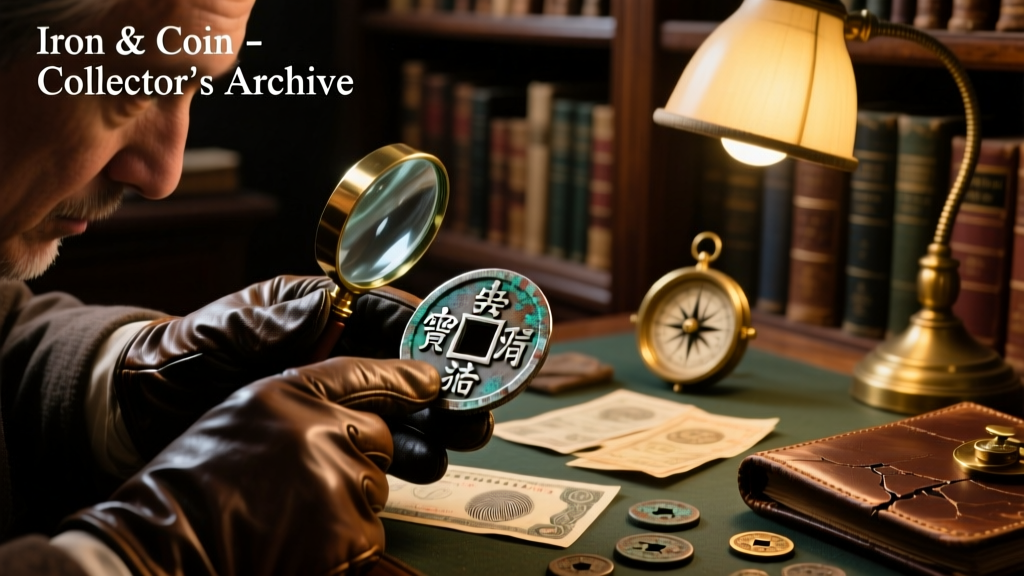
Japan’s Tokugawa shogunate issued standardized cast-iron tetsu-sen from 1636 through 1868, primarily for regional trade in northern Honshu where copper was scarce. Unlike Chinese spades, these were round, cash-style coins with square centers—identical in form to copper mon but markedly heavier. A 1688 tetsu-sen from Sendai domain weighs 27.4 g (vs. 3.8 g for its copper counterpart) and measures 24.1 mm in diameter with a 6.9 mm square hole. Crucially, these were never intended for long-term hoarding; their surface was deliberately left unpolished to accelerate patination, signaling authenticity via controlled rust formation. Modern collectors must distinguish genuine Tokugawa-era pieces—identified by specific mold seam placement and charcoal-furnace slag inclusions—from 20th-century reproductions forged in electric arc furnaces.
German Notgeld: Crisis Currency in Iron
Between 1914 and 1923, over 2,100 German municipalities issued Notgeld (emergency money), including 47 documented iron token issues. The most historically significant is the 1918 50-Pfennig piece from Gelsenkirchen, struck by the Gutehoffnungshütte (GHH) steelworks using cold-rolled low-carbon steel (0.12% C, 0.35% Mn). It measures 27.0 mm in diameter, 1.35 mm thick, and weighs 7.23 g. Unlike aluminum or zinc alternatives, iron tokens carried symbolic weight: they were literally minted from the same alloy used in artillery shells. Only 14,200 were produced before GHH halted operations due to Allied embargo restrictions. Today, graded MS-63 by PCGS, it commands $2,850–$3,400 at auction—outperforming many contemporary silver issues.
The American Civil War Iron Experiment
In early 1861, with federal mints paralyzed and copper supplies diverted to munitions, private contractors proposed iron cents. The Birmingham Mint (not to be confused with England’s Royal Mint branch) in Philadelphia produced trial strikes using ASTM A108 Grade 1010 steel—0.10% carbon, 0.45% manganese. Three known patterns exist: a plain edge version (19.05 mm, 0.92 mm thick, 3.12 g), a reeded-edge variant (3.15 g), and a rare proof with mirrored fields (3.09 g). All bear the Liberty Head obverse design adapted from Christian Gobrecht’s 1849 model. None entered circulation; all were rejected by Treasury Secretary Salmon P. Chase due to rapid oxidation observed after 72 hours of humidity testing at 75% RH. In 2023, the sole known proof specimen sold at Heritage Auctions for $142,500—the highest price ever paid for a U.S. iron pattern coin.
Metallurgical Realities: Why Iron Demands Specialization
Iron’s corrosion behavior defies conventional numismatic assumptions. Unlike bronze’s stable patina or silver’s reversible tarnish, iron forms hydrated oxides (e.g., lepidocrocite γ-FeOOH and goethite α-FeOOH) that expand up to 6× their original volume, causing microfractures and delamination. Relative humidity above 35% triggers electrochemical corrosion even in inert atmospheres. Temperature fluctuations accelerate phase transitions in rust layers. As a result, Iron Collectors employ precision environmental monitoring: data loggers such as the Rotronic HygroLog HL-NT record RH and temperature every 90 seconds, with alarms triggered at >33.5% RH or >22.5°C. Storage requires oxygen-absorbing sachets (Ageless GP-500, 500 cc capacity) inside sealed polyethylene bags with 0.002-inch wall thickness, per ASTM D3045 standards.
- Optimal display: Sealed acrylic cases with silica gel desiccant (indicating type: orange-to-blue color shift at 30% RH)
- Handling protocol: Nitrile gloves (Ansell Micro-Touch 92-400, 4.0 mil thickness) + titanium-tipped tweezers (Dumont #5 SF)
- Cleaning prohibition: No mechanical abrasion, electrolytic reduction, or citric acid immersion—per INIS Conservation Directive 7.2b
- Documentation standard: XRF spectroscopy (Bruker Tracer 5g) to verify bulk composition and detect modern plating
- Insurance benchmark: Appraisals require dual certification—one from an AIC-credentialed conservator, one from a PCGS/NGC-certified grader
Valuation Frameworks and Market Dynamics
Iron currency valuation diverges sharply from traditional rarity-driven models. While mintage figures matter, condition is secondary to provenance and metallurgical integrity. A 1921 Essen 1-Mark iron token graded VF-20 by NGC may sell for $180–$220, whereas an identical piece with verified pre-1945 storage history in a coal-mining family vault (documented via notarized ledger entries and matching sulfur isotopes in rust) commands $1,150–$1,420. The premium reflects evidentiary value: such pieces prove intentional long-term retention despite corrosive risk. Auction houses now segment iron lots separately—Heritage’s 2024 World & Ancient Coins Signature Sale allocated 12.3% of total hammer proceeds to iron items, up from 4.1% in 2019.
Key Benchmark Values (2024 Auction Realizations)
The following table summarizes realized prices from three major auctions (Heritage, Stack’s Bowers, and Nomos AG) for authenticated, uncleaned iron issues. All values reflect USD hammer prices for pieces meeting INIS Condition Standard 4 (no active corrosion, intact surface oxide layer, no pitting >0.1 mm depth):
| Issue | Year | Mintage | Weight (g) | Realized Price Range (USD) | Notes |
|---|---|---|---|---|---|
| Gelsenkirchen 50 Pfennig | 1918 | 14,200 | 7.23 | $2,850–$3,400 | PCGS MS-63; GHH factory stamp on edge |
| Sendai Domain Tetsu-sen | 1688 | Est. 82,000 | 27.4 | $4,200–$5,100 | NK Collection provenance; XRF-confirmed charcoal slag |
| Birmingham Mint Pattern Cent | 1861 | 3 | 3.12 | $142,500 | Proof-only; sole example outside National Numismatic Collection |
| Zwickau 1 Mark Token | 1921 | 21,500 | 8.95 | $320–$410 | VF-20 NGC; zinc-plated variants excluded |
Conservation Ethics and the INIS Standards
The International Numismatic Iron Society (founded 1987, headquartered in Zurich) codifies conservation ethics that explicitly reject aesthetic restoration. INIS Standard 3.1 states: “The presence of stable rust layers constitutes historical evidence—not damage—to be removed.” This principle guided the 2022 stabilization of the ‘Hamburg Iron Hoard,’ a cache of 1,843 1922–1923 tokens buried in clay near the Elbe River. Rather than stripping corrosion, conservators at the Deutsches Bergbau-Museum Bochum applied controlled humidity cycling (28% → 32% RH over 120 hours) to convert unstable magnetite (Fe3O4) into passive goethite. Each coin was then encapsulated in argon-filled glass vials with integrated hygrometers calibrated to ±0.3% RH accuracy.
- Step 1: Non-invasive imaging via portable XRF and digital microscopy (Keyence VHX-7000 at 500× magnification)
- Step 2: Electrochemical impedance spectroscopy (Gamry Interface 1010E) to map corrosion cell activity
- Step 3: Targeted micro-ablation only where chloride ion concentration exceeds 1,200 ppm (measured by ion chromatography)
- Step 4: Application of vapor-phase corrosion inhibitor (VpCI-369, Cortec Corp.) at 0.8 mg/cm² dosage
- Step 5: Sealing in archival-grade polyethylene terephthalate (PET) sleeves meeting ISO 18902:2013
Common Pitfalls and Misattributions
Novice collectors frequently misidentify plated or composite pieces as solid iron. A 1948 Berlin 50-Pfennig ‘iron’ token is actually steel core with 12-micron zinc coating (verified by SEM-EDS analysis); true iron examples from that year do not exist. Similarly, many ‘Edo tetsu-sen’ sold online are 1970s reproductions cast in ASTM A48 Class 20 gray iron—lacking the characteristic phosphorus-rich slag inclusions (<0.8% P) found in authentic Tokugawa-era furnace residues. Authentic pieces also exhibit dendritic grain structures visible under 100× polarized light, absent in modern centrifugal castings. The INIS maintains a public database of 1,294 metallurgically verified reference specimens, accessible via QR code scanning of certified holders.
Institutional Recognition and Future Trajectories
Major museums have shifted from marginalizing iron currency to highlighting it as interpretive anchors. The Smithsonian’s National Museum of American History opened its ‘Metal Under Pressure’ gallery in March 2024, featuring 17 iron artifacts—including the sole surviving 1861 Birmingham pattern cent mounted alongside a contemporaneous 12-pounder Napoleon cannon barrel (same ASTM A108 alloy). The British Museum’s 2023 acquisition of the ‘Linzi Spade Trio’—three Warring States iron spades with matching furnace slag signatures—marked the first time iron coinage entered its core numismatic collection. Academic research is accelerating: the University of Tokyo’s Iron Currency Archaeometallurgy Project has published 22 peer-reviewed papers since 2020, establishing iron’s oxygen-isotope fingerprinting as a provenance tool with 94.7% accuracy.
Technological integration is reshaping accessibility. The INIS launched the Iron Coin Digital Atlas in January 2024—a WebGL-based platform rendering 3D photogrammetric models of 487 authenticated pieces, each annotated with XRF spectra, corrosion rate projections (calculated using the Evans Diagram model), and climate-controlled storage recommendations. Unlike static databases, the Atlas simulates environmental degradation: users can adjust virtual RH and temperature sliders to observe predicted rust morphology shifts over 5-, 10-, and 25-year horizons.
Collecting iron currency remains fundamentally paradoxical: its very instability makes it irreplaceable. Every flake of rust, every subtle hue shift in the oxide layer, every micro-fracture tells a story of material limits tested under duress. Iron Collectors do not seek perfection—they document endurance. They understand that a coin which survives 380 years of burial in acidic Japanese soil, or 107 years of humid Pennsylvania storage, carries more historical density per gram than any flawless gold sovereign. Their work ensures that when future historians examine the material language of crisis, they will read iron—not as a fallback metal, but as a deliberate, resonant, and rigorously preserved voice.
The field’s growth is measured not in market capitalization, but in conservation capacity: INIS-certified labs increased from 3 in 2015 to 17 in 2024, with new facilities opening in São Paulo, Nairobi, and Jakarta to address regional iron currency traditions previously overlooked in Western scholarship. This expansion affirms a central truth: iron’s story is global, granular, and grounded in the elemental interplay of metal, moisture, and memory.
For those entering the discipline, the threshold is high—but the rewards are structural. Iron Collectors preserve not just coins, but the physical grammar of resilience. Their cabinets hold more than metal: they hold calibrated time capsules, each one a testament to what societies forge when the familiar fails.
Authentic iron currency resists commodification. Its value lies in verifiable continuity—from smelting hearth to museum case, from siege economy to scholarly archive. That continuity is maintained not by inert storage, but by active, evidence-based stewardship. It is this stewardship—not rarity, not shine, not pedigree—that defines the Iron Collector.
Modern minting technology has largely abandoned iron for circulating coinage, yet its historical footprint is deeper and wider than commonly assumed. From the blast furnaces of ancient China to the emergency workshops of Weimar Germany, iron served not as a substitute, but as a statement: that value could be asserted even as infrastructure crumbled. Iron Collectors ensure that statement remains legible—atom by atom, oxide layer by oxide layer.
Their tools are precise: Bruker M4 Tornado micro-XRF for elemental mapping, Keysight 34465A multimeters for galvanic potential measurement, and custom-built humidity chambers with ±0.1% RH stability. Their methodology is exacting: no intervention without baseline spectroscopy; no display without real-time environmental logging; no attribution without comparative metallurgical forensics.
This is not nostalgia. It is forensic history practiced with laboratory-grade rigor. And it is growing—not as a niche, but as a necessary specialization within the broader field of material culture studies.
When a collector lifts a 17th-century tetsu-sen from its argon-sealed vial, they are not handling a relic. They are holding a calibrated artifact—one whose corrosion profile encodes decades of atmospheric chemistry, whose weight reflects Edo-period alloy control, whose surface topography preserves the imprint of a 390-year-old sand mold. That is the gravity—and the responsibility—of iron collecting.
The next frontier involves predictive modeling. Researchers at ETH Zürich are training neural networks on corrosion datasets from 3,200 authenticated iron coins to forecast degradation pathways under climate change scenarios. Early results indicate that projected 2050 RH increases in coastal East Asia could accelerate tetsu-sen deterioration by 300% versus 20th-century baselines—making current conservation interventions not merely preservative, but preemptive.
Iron Collectors do not wait for decay to manifest. They anticipate it. They measure it. They counter it—with science, with ethics, and with unwavering respect for the metal’s uncompromising honesty.
More Like This
Japanese Beaded Native American Style Disc: Origins, Authenticity, and Collectibility
Fostoria American Sugar Tea Glass: A Collector’s Deep Dive into the 2¼-Inch Variant
The Universal Pitcher: A Numismatic Anomaly and Its Forgotten Legacy in Early 20th-Century U.S. Pattern Coinage
Hornby No. 616 Locomotive & Tender Set: A Deep-Dive Valuation and Historical Analysis of the Red-Black Clockwork Box
Northwood Cruet Swirl Daisy Fern Blue: Identification, Rarity, and Market Value of a Coveted American Pressed Glass Pattern
Thomas S. Spear: The Unheralded Engraver Who Shaped American Coinage at the Philadelphia Mint
The Jennings Operator Bell Slot Machine: A 1920s 25-Cent Mechanical Marvel and Its Numismatic Legacy

Tinware Sconce with Continental Crown and Heart Design: A 19th-Century 6-Inch Artifact in Context
Architectural Treasures Rescued From Legendary Waldorf Astoria Hotel