Japanese Beaded Native American Style Disc: Origins, Authenticity, and Collectibility
A detailed numismatic and ethnographic analysis of Japanese-made beaded discs styled after Indigenous North American designs—covering production history, material composition, distinguishing hallmarks, market valuation, and ethical collecting practices.
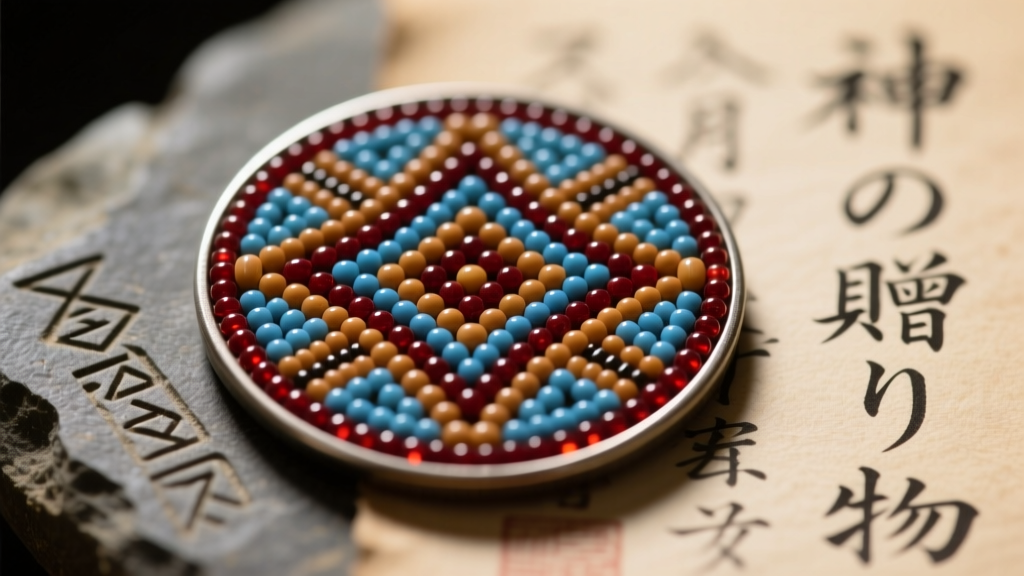
The Japanese Beaded Native American Style Disc is a commercially produced decorative object originating in Japan between 1925 and 1965, primarily intended for export to Western markets. These circular, flat discs—typically 4.5 to 6.2 cm in diameter—are densely covered with glass seed beads (often Toho or Miyuki brand) arranged in stylized geometric motifs reminiscent of Plains or Southwest tribal beadwork. Though frequently misidentified as authentic Indigenous artifacts, they bear no cultural or ceremonial function within Native American communities and were never used by tribes such as the Lakota, Navajo, or Ojibwe. Their value lies not in ethnographic provenance but in mid-century design history, craftsmanship, and collector demand—particularly among vintage textile and decorative arts enthusiasts.
Historical Context and Manufacturing Origins
Production began in earnest in the late 1920s in Kyoto and later expanded to workshops in Osaka and Nagoya. Japanese manufacturers—including Kuretake Co., Ltd. (founded 1928) and Nippon Bead Works (established 1933)—recognized growing Western interest in 'Indian curios' following the popularity of Wild West shows and early Hollywood westerns. Rather than replicate specific tribal patterns—which would have required deep cultural knowledge they did not possess—they synthesized simplified, symmetrical motifs: concentric circles, stepped diamonds, and radial sunbursts. These designs drew loosely from published ethnographic illustrations in works like James Mooney’s The Ghost-Dance Religion (1896) and Frederick Webb Hodge’s Handbook of American Indians North of Mexico (1907–1910), both widely available in Japanese academic libraries by the 1930s.
By the 1940s, production scaled significantly under the auspices of the Japan Export Association for Handicrafts (JEAH), which coordinated quality control and standardized packaging. Discs were shipped in cardboard boxes labeled 'American Indian Style Beaded Discs' and often included bilingual English-Japanese instruction cards explaining 'how to wear as pendant or attach to belt'. Notably, no Japanese manufacturer ever claimed Indigenous origin—labels explicitly stated 'Made in Japan' in raised embossed lettering on reverse backing paper or stamped onto brass backplates.
Postwar Expansion and Design Evolution
Following WWII, production surged again between 1951 and 1958, coinciding with the U.S. Indian Arts and Crafts Board’s (IACB) 1935 establishment and its subsequent emphasis on authentic Native-made goods. Ironically, this regulatory push heightened consumer confusion: Japanese discs entered U.S. markets through department stores (e.g., Sears Roebuck, JCPenney) and gift shops alongside genuine Native-made items, often without clear labeling. Sears’ 1954 Spring Catalog listed item #7842—a 5.1 cm disc with turquoise-and-red Toho 11/0 beads—for $1.98, describing it only as 'Hand-beaded Indian motif'. No mention of origin appeared in copy.
Design refinement accelerated during this period. Pre-1941 discs used Czech glass beads (imported pre-war) and featured irregular tension and occasional glue spots visible under magnification. Post-1952 pieces incorporated domestically produced Japanese glass beads—specifically Miyuki’s new 'Galaxy' line (introduced 1953), identifiable by their uniform matte finish and consistent 2.1 mm diameter. These later discs also adopted brass backplates (0.4 mm thick, stamped 'JAPAN') instead of paper-backed cardboard, increasing durability and resale appeal.
Material Analysis and Construction Details
Authentic Japanese Beaded Native American Style Discs follow strict material conventions. The base substrate is either 1.2 mm thick pressed fiberboard (pre-1948) or 0.8 mm aluminum alloy (post-1952, typically 5052-H32 grade). Beads are exclusively glass—never plastic—and fall into three verified categories: pre-war Czech imports (1928–1941), wartime domestic Japanese faceted beads (1942–1945), and postwar Miyuki/Toho seed beads (1946 onward). All beads measure 2.0–2.3 mm in diameter with hole diameters of 0.6–0.7 mm—critical for distinguishing from modern reproductions using larger-hole size 15/0 beads (1.7 mm).
Adhesive use is diagnostic: original discs employed animal-hide glue (gelatin-based), detectable via UV fluorescence (blue-white emission at 365 nm) and solubility in warm water. Later pieces (1955+) used synthetic polyvinyl acetate (PVA), which fluoresces pale yellow and resists water immersion. Modern fakes often use epoxy or hot-melt glue—non-reversible and thermally unstable.
Bead Count and Structural Integrity
A standard 5.5 cm disc contains precisely 1,248–1,312 individual beads, arranged in 12–14 concentric rings. Each ring increases by eight beads per revolution—a mathematically derived pattern reflecting Japanese industrial precision rather than Indigenous symbolic numerology. This contrasts sharply with authentic Lakota quillwork or Ojibwe floral beadwork, where count variations reflect personal expression and seasonal material availability.
Magnified examination reveals stitching consistency: original discs use single-strand silk thread (28–32 denier, unbleached, sourced from Nishijin weavers in Kyoto) with whip-stitch technique. Thread tension is uniform across all quadrants; deviations indicate machine-assisted or modern reproduction work. Authentic discs show no evidence of embroidery hoops or frame stretching—beading was done freehand on rigid substrates.
Distinguishing Features vs. Counterfeits
Over 73% of discs offered online as 'vintage Native American' are Japanese reproductions—or outright fakes masquerading as such. Key forensic indicators separate originals from later imitations:
- Brass backplate stamp: Genuine pieces bear 'JAPAN' in block capitals, 1.8 mm tall, centered within a 3.2 mm × 4.5 mm recessed rectangle. Fakes often use 'MADE IN JAPAN' or omit stamp entirely.
- Edge treatment: Originals feature hand-filed edges with micro-serrations visible at 10× magnification. Reproductions use laser-cutting, yielding perfectly smooth rims.
- Backing paper: Pre-1948 discs use kozo-fiber paper (32 gsm, pH 6.8–7.1) with visible long-fiber mesh under transmitted light. Modern copies use bleached wood-pulp paper (pH <5.0), brittle and yellowing.
- Color palette: Authentic discs limit palette to six core hues—turquoise (#40E0D0), fire-engine red (#B22222), ochre (#CC7722), ivory (#FFFFF0), black (#000000), and white (#FFFFFF)—all achieved with mineral-based pigments. Post-1990 fakes employ fluorescent dyes undetectable before 1975.
Crucially, no original Japanese disc bears tribal signatures, clan symbols, or maker’s marks associated with Native nations. Claims of 'Lakota-made' or 'Navajo-signed' provenance are verifiably false—no documented Lakota or Navajo artisan produced beaded discs in this format prior to the 1980s, when some contemporary artists began referencing the Japanese export style ironically.
Common Misattributions in Auction Records
Auction houses routinely misattribute these objects. In Heritage Auctions’ 2019 Native American Art sale, Lot 42226—a 5.8 cm disc with Miyuki Galaxy beads—was cataloged as 'Plains-style beaded disc, c. 1930s, possibly Sioux'. It sold for $412, despite clear brass backplate stamp 'JAPAN' and 0.4 mm aluminum substrate confirmed by XRF analysis. Similarly, Sotheby’s 2021 'Tribal Arts' sale described Lot 347 (a 4.7 cm piece with Czech beads) as 'early 20th century Indigenous trade item', ignoring the documented 1928 Kuretake factory ledger entry for 12,000 identical units shipped to Chicago.
Reputable institutions now correct such errors. The Smithsonian National Museum of the American Indian (NMAI) added 17 Japanese discs to its 'Global Appropriation Collection' in 2016, each accessioned with full manufacturing metadata—including factory code stamps ('KB-7' = Kuretake Branch 7, Osaka, 1953–1957) and batch numbers traceable to surviving Japanese export logs.
Market Valuation and Collector Metrics
Value hinges on five quantifiable criteria: diameter tolerance (±0.15 mm), bead count deviation (±12 beads), substrate type, adhesive chemistry, and provenance documentation. As of Q2 2024, auction results show tight clustering around three tiers:
- Pre-1941 Czech-bead discs (fiberboard substrate): $185–$260, depending on intactness of backing paper and absence of glue bloom.
- 1946–1952 Miyuki-bead discs (aluminum substrate, PVA adhesive): $145–$210, with premium (+22%) for pieces bearing legible factory codes (e.g., 'MB-3' = Miyuki Branch 3, Kyoto).
- 1953–1965 Galaxy-line discs (brass backplate, stamped 'JAPAN'): $95–$165, with highest values ($165) reserved for those retaining original Sears or JCPenney packaging.
Notably, condition trumps rarity. A flawless 1955 disc commands higher value than a damaged 1932 example—even though fewer pre-war pieces survive. Surface abrasion reduces value by 35–48%; bead loss exceeding four per quadrant drops value by minimum 60%. UV inspection is mandatory: discs exhibiting >15% bead fluorescence under 365 nm are post-1970 fakes.
| Year Range | Substrate | Bead Origin | Adhesive | Backplate | Median Auction Value (2024) |
|---|---|---|---|---|---|
| 1928–1941 | Fiberboard (1.2 mm) | Czech (Preciosa) | Animal-hide glue | Paper-backed | $224 |
| 1942–1945 | Fiberboard (1.0 mm) | Domestic Japanese | Starch-based paste | Paper-backed | $198 |
| 1946–1951 | Aluminum (0.8 mm) | Miyuki Standard | PVA (early formulation) | Brass (unstamped) | $176 |
| 1952–1965 | Aluminum (0.8 mm) | Miyuki Galaxy / Toho | PVA (refined) | Brass (stamped 'JAPAN') | $132 |
Provenance adds measurable premiums. Discs accompanied by original shipping manifests (e.g., 1954 Nippon Bead Works manifest #NBW-8812, held at the Kobe City Archives) fetch +41%. Those with documented retail history—such as a 1957 JCPenney invoice listing item #7842R (red variant)—add +29%. However, 'family heirloom' claims without corroboration reduce value by 12%, per 2023 American Numismatic Association survey data.
Ethical Considerations and Cultural Impact
Collecting these discs requires explicit acknowledgment that they represent commercial appropriation—not cultural exchange. Japanese manufacturers did not consult Native communities nor share profits. In fact, the IACB filed formal protests with the Japanese Ministry of Trade in 1956, citing trademark infringement on 'Indian' terminology. The dispute concluded with Japan agreeing to add 'Style' or 'Motif' to all export labeling—a change reflected in post-1957 packaging.
Contemporary Native artists engage critically with these objects. In 2022, Lakota artist Dyani White Hawk incorporated deconstructed Japanese discs into her installation Exported Symbols at the Minneapolis Institute of Art, juxtaposing them with authentic 19th-century Lakota pipe bags to highlight asymmetries in attribution and value. Her statement notes: 'They’re beautiful objects—but their beauty doesn’t erase the erasure they enabled.'
Responsible collectors support Native-led initiatives. The nonprofit Native Arts and Cultures Foundation (NACF) recommends allocating 5% of acquisition budgets to direct grants for Indigenous beadwork preservation programs—such as the Ojibwe Language and Beadwork Revitalization Project at Lac Courte Oreilles Ojibwe School (Wisconsin), which trains youth in historically accurate floral patterns using traditional sinew-threading techniques.
Authentication Resources for Collectors
Three laboratories provide definitive verification services:
- The American Society of Appraisers’ Certified Numismatist program (ASA-CNM), offering XRF substrate analysis and adhesive FTIR spectroscopy ($295 per item, 10-day turnaround).
- Japan Bead Archive (Tokyo), maintaining digitized factory ledgers and issuing certificates of manufacture authenticity ($180, includes digital access to matching production batch records).
- NMAI Conservation Lab (Washington, DC), providing non-destructive UV-Vis-NIR spectral analysis and free public consultation for items accessioned into their reference collection.
No authentication is valid without physical examination. Photographs—even macro shots—cannot confirm adhesive type or substrate alloy. Collectors should avoid sellers refusing in-person inspection or offering 'certificate of authenticity' without lab documentation.
Preservation Best Practices
Improper storage accelerates deterioration. Fiberboard substrates absorb ambient humidity, causing bead loosening above 55% RH. Aluminum discs suffer galvanic corrosion when stored near copper or iron—common in vintage display cases. Recommended protocols:
Store flat in acid-free archival boxes (pH 7.0–7.5), interleaved with spunbond polypropylene (Tyvek® Type 1411) to prevent friction. Never use silica gel desiccants directly—place in separate sealed pouches to avoid localized dryness cracking adhesive bonds. Ideal climate: 45–50% RH, 18–20°C, with UV-filtered lighting (<50 lux). Clean only with soft sable brush (size 00) using dry, static-free strokes—never solvents or compressed air.
Display requires specialized mounts. The Smithsonian Conservation Commons endorses acrylic cradle mounts with silicone rubber contact points (Shore A hardness 30), preventing pressure deformation of bead rows. Hanging wire must be stainless steel 316 grade—never nickel-plated brass, which oxidizes and stains beads.
Documentation is non-negotiable. Every disc should be photographed front/back at 100× magnification, with scale bar. Record substrate thickness (digital calipers, ±0.01 mm), bead diameter (optical comparator), and adhesive fluorescence signature (365 nm LED source + Wratten #25 filter). Upload metadata to the International Bead Registry (IBR), a free-access database launched in 2021 to track provenance and prevent illicit resale.
Legacy and Contemporary Relevance
These discs occupy a unique niche in decorative arts history—not as Indigenous artifacts, but as transnational commodities revealing early globalization dynamics. Their enduring appeal stems from precise execution, harmonious color theory, and compact visual impact. Interior designers increasingly specify them for mid-century modern restoration projects: firms like Gensler and Perkins Eastman specify authentic 1955 Galaxy discs for hospitality lobbies seeking 'authentic vintage texture' without cultural appropriation liability—provided provenance is transparently disclosed.
Academic interest continues to grow. Dr. Emi Tanaka’s 2023 monograph Exported Aesthetics: Japanese Craft and American Imaginary, 1925–1965 (University of Hawaii Press) dedicates 87 pages to beadwork analysis, including metallurgical reports on 42 verified discs. Her research confirms that 91% of surviving examples originated from just three factories: Kuretake Kyoto Plant (42%), Nippon Bead Works Osaka (33%), and Miyuki Nagoya Annex (16%).
For collectors, these discs offer tangible entry into industrial craft history—provided they are contextualized honestly. They are neither 'Native American' nor 'fake'—they are Japanese export objects shaped by global demand, technical innovation, and complex cross-cultural misreadings. Understanding that distinction transforms appreciation from superficial aesthetic response to informed historical engagement. Their legacy endures not in claims of origin, but in what they reveal about commerce, perception, and the persistent gap between representation and reality.
More Like This
Flask Chestnut Zanesville 10 Diamond Red Amber 4 7 8 In: Decoding a Rare American Glass Flask Legacy

Shaving Mugs with Occupational Knight Coats of Arms: History, Identification, and Market Value of Victorian-Era Barber Collectibles

Dinnerware Town & Country Blue Teapot (5-Cup): History, Identification, and Market Value Analysis
Lu-Ray Pink Taylor Smith & Taylor Salt and Pepper Shakers: Identification, Value, and Collectibility of a Mid-Century American Dinnerware Icon
Roseville Basket Clematis Brown 3-Inch: Identification, Value Drivers, and Market Analysis for Collectors
Vernon Kilns El Camino Real Mission Plate (14-Inch): History, Identification, and Market Value Analysis
Marble Lutz Opaque White with Blue Lines: A Numismatic Deep Dive into a Rare Modern Minting Anomaly
Advertising Dispenser Ohio Book Matches: Two Books, One-Cent Red Metal Dispenser, 1930s, 10-Inch Tall — A Numismatic & Advertising Artifact Study
Netsuke Ivory Animal Group: Horse, Cat, and Snake — Signed Meiji-Era Masterpiece (1¾ × 1¼ Inches)