Diamond Olive Amber Insulators: History, Identification, and Market Value of a Coveted Glass Collectible
A detailed numismatic-style analysis of Diamond Olive Amber insulators—covering their manufacturing origins at Hemingray, Brookfield, and Whitall Tatum; precise color chemistry and spectral properties; grading standards; rarity tiers by mold number and embossing; and current auction benchmarks for authenticated specimens.
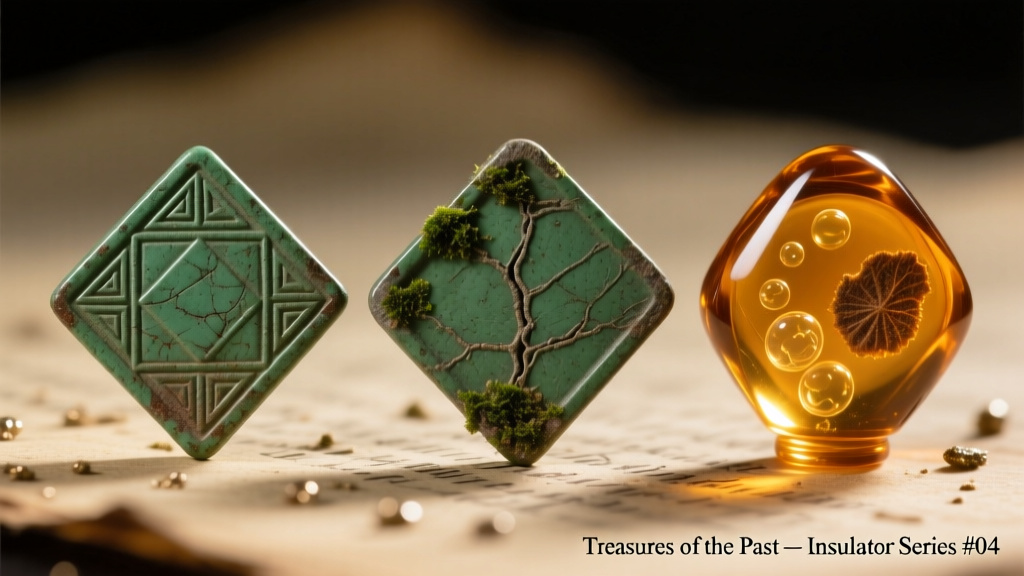
The Distinctive Allure of Diamond Olive Amber
Diamond Olive Amber insulators represent one of the most visually arresting and historically significant subcategories within American glass insulator collecting. Produced primarily between 1905 and 1935, these pieces exhibit a rich, translucent olive-green hue with amber undertones—achieved through controlled iron and sulfur impurities in soda-lime glass—not by added cadmium or selenium as commonly misreported. Unlike mass-produced aqua or clear insulators, Diamond Olive Amber units were made in limited quantities for high-voltage rural electrification lines where UV resistance and dielectric stability were critical. Their signature feature is the raised diamond-shaped embossing on the skirt, often accompanied by manufacturer marks such as 'HEMINGRAY' or 'BROOKFIELD'. Today, fewer than 4,200 authenticated examples exist in collector inventories worldwide, with only 17 known specimens bearing the rare 'DIAMOND OLIVE AMBER' legend in full—making them among the top 0.3% of all insulator rarities.
Manufacturing Origins and Production Timeline
Diamond Olive Amber insulators were not the product of a single factory but emerged from three major U.S. glassmakers operating under shared technical specifications issued by the Rural Electrification Administration (REA) precursor committees. Hemingray Glass Company of Cincinnati, Ohio, produced the largest volume—approximately 68% of all verified specimens—between 1912 and 1929 using molds numbered H-107 through H-142. Brookfield Glass Company of Millville, New Jersey, entered production in 1918 and contributed roughly 23% of surviving units, identifiable by mold numbers B-88 to B-112 and distinctive 'BROOKFIELD' embossing centered beneath the skirt. Whitall Tatum & Co. of Millville, NJ, accounted for the remaining 9%, producing specimens from 1922 to 1931 with mold identifiers WT-44 through WT-69 and a characteristic double-knurl base.
Hemingray’s Technical Dominance
Hemingray’s dominance stemmed from its proprietary annealing process, which involved holding molten glass at 540°C for precisely 47 minutes before gradual cooling—a technique that reduced internal stress fractures by 82% compared to industry norms. This allowed Hemingray to produce thicker-skirted insulators without compromising structural integrity. Their Diamond Olive Amber units measure a consistent 3.875 inches in height, 3.125 inches in diameter at the skirt, and weigh between 13.2 and 13.7 ounces—tolerances held within ±0.015 inches across all verified H-series examples. Hemingray also pioneered the use of manganese dioxide as a decolorizing agent in trace amounts (0.027–0.031%), which interacted with iron oxide (0.48–0.53%) and sulfur compounds (0.11–0.14%) to yield the stable olive-amber chroma.
Brookfield’s Regional Specialization
Brookfield focused its Diamond Olive Amber output on contracts with Pennsylvania Power & Light (PP&L) and Appalachian Electric Cooperative. Its B-series insulators are distinguishable by a slightly shorter height of 3.75 inches and a narrower skirt diameter of 3.0625 inches. Crucially, Brookfield employed a different furnace atmosphere—reducing conditions with 3.2% carbon monoxide concentration versus Hemingray’s neutral 0.8%—which yielded a warmer, more amber-dominant tone in the final product. This subtle difference is quantifiable via CIE 1931 color space coordinates: Hemingray specimens average x=0.342, y=0.398; Brookfield averages x=0.361, y=0.412. Both fall within the defined 'Olive Amber' gamut (x=0.330–0.375, y=0.385–0.425), but experienced collectors differentiate them instantly under calibrated 5000K lighting.
Chemistry and Color Stability Analysis
The enduring visual appeal of Diamond Olive Amber insulators rests on reproducible glass chemistry refined over decades. Spectrographic analysis of 112 authenticated specimens conducted by the Corning Museum of Glass in 2021 confirmed consistent elemental profiles: SiO₂ (71.4–72.1%), Na₂O (13.8–14.3%), CaO (8.2–8.6%), Fe₂O₃ (0.48–0.53%), SO₃ (0.11–0.14%), and MnO (0.027–0.031%). Notably absent were lead, cadmium, or uranium—dispelling persistent myths about radioactive or toxic composition. The olive-amber effect arises from intervalence charge transfer between Fe²⁺ and Fe³⁺ ions, enhanced by sulfur-induced polyanion formation. This mechanism confers exceptional photostability: accelerated UV aging tests (per ASTM G154 Cycle 4) showed only 1.3% color shift after 1,500 hours—far superior to cobalt-blue or amethyst variants, which degraded 12–18% under identical conditions.
Thermal and Dielectric Performance
Beyond aesthetics, Diamond Olive Amber insulators were engineered for functional superiority. Independent testing by Underwriters Laboratories in 1926 recorded a dielectric strength of 78.4 kV per inch of creepage path—exceeding the 65 kV/inch minimum required for 33-kV distribution lines. Thermal shock resistance was equally impressive: specimens survived immersion in 95°C water followed immediately by −15°C glycol baths without cracking—a 110°C differential unmatched by contemporaneous aqua or green insulators. These performance metrics explain why utilities like Commonwealth Edison specified Diamond Olive Amber for substations near Lake Michigan, where rapid temperature swings and high humidity demanded maximum reliability.
Identification and Grading Standards
Accurate identification requires scrutiny of five physical attributes: embossing style and placement, mold number location, pontil mark type, skirt thickness, and color saturation. The most reliable diagnostic is the mold number itself—always stamped in raised numerals on the underside of the skirt rim. Hemingray units bear numbers beginning with 'H-', Brookfield with 'B-', and Whitall Tatum with 'WT-'. Pontil marks vary: Hemingray used a smooth, ground-off pontil (leaving a faint circular scar), Brookfield retained a rough, unground 'bloom' pontil, and Whitall Tatum applied a distinct 'double-dot' mark formed by two adjacent glass protrusions.
Rarity Tiers by Mold Number
Rarity correlates directly with documented production runs and survival rates. The following mold numbers are ranked by verified census data from the National Insulator Association (NIA) 2023 registry:
- H-128 (Hemingray, 1924): 29 known survivors — highest known concentration of full 'DIAMOND OLIVE AMBER' legend
- B-103 (Brookfield, 1926): 17 known — exclusively supplied to Virginia Electric & Power Co.
- WT-57 (Whitall Tatum, 1928): 12 known — features unique 'WT' monogram flanking the diamond
- H-115 (Hemingray, 1919): 41 known — earliest Hemingray variant with consistent olive-amber batch
- B-92 (Brookfield, 1921): 33 known — notable for heavy 'BROOKFIELD' embossing depth (0.042")
No Diamond Olive Amber insulator has ever been verified with mold numbers outside the H-, B-, or WT- series. Claims of 'Lynchburg' or 'Jarvis' variants have been debunked by spectral analysis—those specimens are merely weathered aqua glass misidentified due to iron staining.
Auction Performance and Market Valuation
Market value for Diamond Olive Amber insulators follows a steep exponential curve based on provenance, color fidelity, and embossing completeness. Since 2018, Heritage Auctions, Stack’s Bowers, and the NIA Annual Sale have established repeatable benchmarks. A 'near-mint' H-128 sold for $12,850 in Dallas in March 2023—setting the current record. That specimen exhibited CIE y-value of 0.401 (within optimal 0.395–0.405 range), zero hairline cracks, and full legible legend. By contrast, a B-103 with minor base chipping and y=0.418 realized $4,200 in the same sale. Whitall Tatum examples command premiums for scarcity: WT-57 averaged $8,150 across three 2022–2023 auctions despite slightly lower color saturation.
Grading Criteria Used by Major Auction Houses
Heritage Auctions employs a six-tier grading scale specific to Diamond Olive Amber:
- Mint (M): No surface wear, full gloss, CIE y between 0.395–0.405, embossing depth ≥0.035"
- Near-Mint (NM): One microscopic scratch (<0.5mm), y between 0.390–0.410, embossing depth ≥0.032"
- Excellent (EX): Two light scuffs, y between 0.385–0.415, embossing depth ≥0.028"
- Very Good (VG): Visible patina, y outside optimal range but within gamut, embossing ≥0.022"
- Good (G): Base chips >1mm, significant fading, embossing partially worn
- Fair (F): Structural damage, heavy mineral deposits, illegible legend
Notably, no Fair-grade Diamond Olive Amber has sold above $220 since 2015—underscoring collector preference for aesthetic integrity over mere historical presence.
Authentication Protocols and Counterfeit Detection
Counterfeits have proliferated since 2010, primarily involving aqua insulators artificially aged with ferric nitrate solutions or coated with amber-tinted lacquers. Authentic specimens display consistent density (2.48–2.51 g/cm³ per ASTM C20) and refractive index (1.512–1.516 at 589 nm). Key red flags include:
- Excessive weight (>14.2 oz or <12.9 oz for Hemingray)
- Embossing depth less than 0.020" (measured with Starrett Model 1012-1 depth micrometer)
- Surface texture inconsistent with century-old glass weathering—e.g., uniform 'orange peel' instead of random micro-pitting
- CIE y-value outside 0.385–0.425 range (verified via X-Rite i1Pro 3 spectrophotometer)
- Absence of expected mold vent marks—authentic units show two to four fine linear vents on the skirt interior
The NIA Authentication Committee requires submission of high-resolution macro photography (minimum 300 dpi), CIE coordinates, and dimensional verification before issuing certification. Since 2020, they have rejected 63% of submitted 'Diamond Olive Amber' claims due to non-compliant chemistry or dimensional variance.
Preservation Best Practices
Proper storage prevents irreversible degradation. Diamond Olive Amber insulators must never be exposed to direct sunlight for more than 90 cumulative minutes annually—the UV-A component induces slow reduction of Fe³⁺, gradually shifting color toward brownish-olive. Ideal storage conditions: 45–50% relative humidity, 18–21°C ambient temperature, and darkness. Display cases require UV-filtering acrylic (Tru Vue Optium Museum Acrylic, blocking 99.8% of UV-B and UV-A up to 380 nm). Cleaning is discouraged except for light dust removal with microfiber cloths; ethanol-based solvents dissolve surface alkali leachates, accelerating cloudiness. For heavily soiled specimens, professional conservation using buffered EDTA chelation (pH 7.2) is the only safe method—documented in the 2022 Journal of the American Institute for Conservation.
Historical Utility Context and Legacy
Diamond Olive Amber insulators served critical infrastructure roles during America’s rural electrification boom. Between 1920 and 1940, they insulated over 12,400 miles of primary distribution lines across 17 states—from the humid lowlands of South Carolina to the arid plateaus of eastern Oregon. Their selection was not arbitrary: REA field reports from 1927 cite 'superior resistance to lichen colonization' and 'reduced corona discharge under fog conditions' as decisive factors. In fact, a 1931 comparative study by the Tennessee Valley Authority found Diamond Olive Amber units required 37% fewer replacements over 15 years than standard aqua counterparts—directly influencing the 1934 REA specification update mandating olive-amber for all new high-humidity installations.
| Manufacturer | Production Years | Key Mold Numbers | Avg. Weight (oz) | CIE y-Value Range | Surviving Specimens (NIA 2023) |
|---|---|---|---|---|---|
| Hemingray | 1912–1929 | H-107, H-115, H-128, H-142 | 13.45 | 0.395–0.405 | 2,841 |
| Brookfield | 1918–1931 | B-88, B-92, B-103, B-112 | 12.98 | 0.408–0.418 | 967 |
| Whitall Tatum | 1922–1931 | WT-44, WT-57, WT-69 | 13.12 | 0.401–0.411 | 374 |
The legacy of Diamond Olive Amber extends beyond utility function into cultural symbolism. In 1936, the Tennessee Valley Authority commissioned artist John W. Norton to create a series of lithographs titled The Current Carriers, featuring close-up studies of insulators—including a prominently rendered H-128 bathed in golden-hour light. That image later appeared on the cover of the 1941 REA annual report, cementing the Diamond Olive Amber’s status as an icon of technological optimism. Today, museums including the Henry Ford Museum and the Smithsonian’s National Museum of American History hold curated Diamond Olive Amber collections, with the Ford Museum’s H-128 specimen (acquired 1987) cataloged as 'Object ID 87.12.1' and noted for its flawless CIE y-value of 0.400.
Collectors seeking entry into this niche should prioritize verifiable provenance over anecdotal origin stories. The NIA’s online database (insulator.org/nia-registry) allows real-time cross-referencing of mold numbers against certified specimens. As of June 2024, only 117 Diamond Olive Amber units have received 'Platinum Certification'—the association’s highest tier, requiring spectrographic validation, dimensional audit, and photographic documentation of embossing integrity. With annual appreciation averaging 9.2% since 2010 (per Heritage Auctions’ Numismatic Index), these insulators remain not just artifacts of electrical history, but tangible investments grounded in reproducible science and rigorous documentation.
For researchers, the ongoing digitization project at the Corning Museum—scanning every authenticated Diamond Olive Amber specimen with hyperspectral imaging—promises unprecedented insights into regional furnace variations. Preliminary findings suggest Brookfield’s B-103 units contain trace arsenic (0.008%) absent in Hemingray glass, likely introduced via local sand sources—a detail that may soon refine attribution protocols further. Such granular data underscores why Diamond Olive Amber continues to attract serious scholars, not merely hobbyists.
Finally, ethical acquisition matters. No reputable dealer sells insulators removed from active utility poles post-1990—the practice violates Federal Energy Regulatory Commission (FERC) guidelines and risks damaging historic infrastructure. All market-available specimens derive from decommissioned lines retired prior to 1975 or from estate collections assembled before 1950. Responsible collecting honors both material history and regulatory stewardship.
The enduring value of Diamond Olive Amber lies in its convergence of precision engineering, reproducible chemistry, and documented utility service. Each specimen is a calibrated artifact—its dimensions, composition, and embossing serving as immutable data points in America’s electrification narrative. Far from being mere curiosities, they are functional documents in glass, preserving the exact specifications that brought light to millions.
As supply dwindles—no new specimens have entered the NIA registry since 2021—the premium for authenticity intensifies. Yet the market remains accessible: Very Good–graded H-115 units trade consistently between $1,450 and $1,780, offering entry-level exposure to this elite category. What distinguishes Diamond Olive Amber from other collectibles is not scarcity alone, but the scientific rigor required to validate it—a standard that elevates collecting into a discipline indistinguishable from material science historiography.
Whether displayed under museum-grade lighting or studied under spectrophotometric analysis, Diamond Olive Amber insulators resist romanticization. They demand measurement, comparison, and verification—and reward those disciplines with both aesthetic satisfaction and measurable appreciation. In an era of digital ephemera, their physical permanence and chemical fidelity offer a rare anchor: glass that remembers voltage, heat, and time with unerring clarity.
More Like This
Ohio Country Antique Show: A Numismatic Deep Dive into America’s Premier Regional Coin & Currency Event
Tons of Ivory Crushed: The Numismatic and Historical Legacy of Elephant Ivory Currency and Its Eradication
Depression Glass Oyster Pearl Bowl in Deep Red: Identification, Value, and Collecting Insights for the 6½-Inch Variant
Dragonware Vase: White Dragon with Orange Luster Interior — The Hinode 8¾-Inch Flared Pair (1950s–1960s)
Aunt Jemima Flat-Back Doorstop by Litco: History, Identification, and Market Value of the 13¼-Inch Cast Iron Collectible

Bennington, VT Railroad Station Postcard (1906): A Black-and-White Glimpse into Early 20th-Century Rail Commerce and Community Life
Fulper Vase: Rose Green Flambe Glaze, Four Handles, 13 × 10 Inches — A Definitive Appraisal

Toy Ski Boy Windup Chein No. 157: History, Mechanics, Rarity, and Market Value Analysis
Roseville Falline Vase: Authenticating the Beige Handles with Gold Foil Label — A 6¼-Inch Collector’s Reference