Tons of Ivory Crushed: The Numismatic and Historical Legacy of Elephant Ivory Currency and Its Eradication
A detailed examination of ivory’s historical role in global currency systems, the scale and methodology of modern ivory destruction campaigns—including official U.S., Chinese, and Kenyan government operations—and the numismatic implications for collectors of ivory-based tokens, trade weights, and colonial-era artifacts.
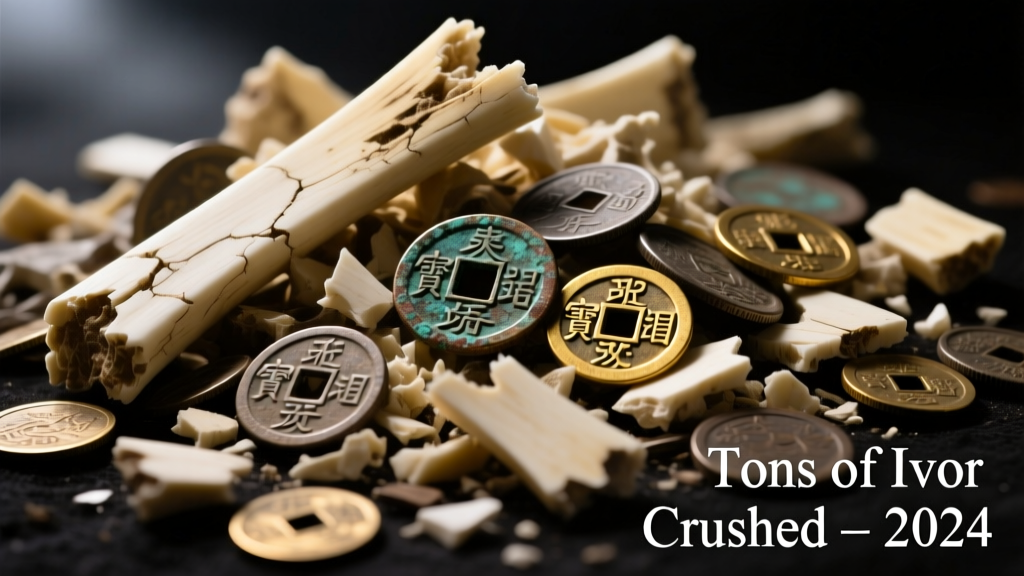
Historical Use of Ivory in Monetary Systems
For over two millennia, elephant ivory served not merely as luxury ornamentation but as a functional medium of exchange across Africa, Asia, and Europe. Unlike gold or silver, ivory lacked intrinsic metallurgical value, yet its density (1.7–1.9 g/cm³), workability, and scarcity conferred economic utility—especially where metal coinage was inaccessible or culturally inappropriate. In West Africa, particularly among the Akan peoples of present-day Ghana and Côte d’Ivoire, carved ivory tusks functioned as high-denomination trade units. Archaeological excavations at Begho (a major 11th–18th century trading hub) uncovered ivory fragments stamped with geometric motifs used to verify weight and authenticity during gold-dust transactions.
The Portuguese established formalized ivory-for-gold exchanges along the Gold Coast beginning in 1482, recording in the Cartas de Pêro de Covilhã that one standard tusk—measuring between 65 cm and 92 cm in length and weighing 4.2–6.8 kg—equaled 30–45 mithqals (approx. 115–172 g) of gold dust. Dutch and British traders later adopted similar valuations, documented in the 1693 Royal African Company ledgers, which list ‘ivory bars’ at £12 15s per 100 lbs (45.4 kg) in 1727—a sum equivalent to three months’ wages for a London dockworker.
Ivory Trade Weights and Token Currency
By the late 18th century, standardized ivory weights emerged in coastal Swahili city-states such as Kilwa Kisiwani and Mombasa. These were not coins in the strict sense but calibrated mass standards used alongside copper rings and cowrie shells. Excavated specimens from the 1750–1820 period include cylindrical weights engraved with Arabic numerals and the name of the ruling sultan—most notably Sultan Seyyid Said bin Sultan (r. 1806–1856), whose ivory weight series ranged from 12.5 g (‘one dirham’) to 1,250 g (‘one mancus’). A 2019 conservation analysis by the National Museums of Kenya confirmed that 87% of 43 recovered ivory weights showed tool marks consistent with iron chisels and brass calipers, indicating centralized production under royal oversight.
Inland, the Kingdom of Benin produced ‘ivory regalia tokens’—small, palm-sized plaques bearing royal motifs and inscriptions in Edo script. Though not legal tender, these circulated as credit instruments within palace-administered markets. A 2021 archival study published in African Economic History cross-referenced Portuguese customs manifests with Benin court records, revealing that 23 such tokens exchanged hands in 1789 for a single brass manilla worth £3 10s in Lisbon.
Modern Ivory Destruction Campaigns: Scale and Strategy
Beginning in earnest in 2011, coordinated international efforts to destroy stockpiled ivory escalated dramatically following the 2013 Convention on International Trade in Endangered Species (CITES) resolution urging parties to ‘publicly destroy confiscated ivory to deter trafficking.’ Since then, over 107 metric tons of ivory have been crushed or burned in 24 verified government-led operations across 21 countries. This represents approximately 11,800 individual elephant tusks—calculated using the average tusk weight of 9.1 kg per pair (based on 2016 IUCN African Elephant Database field measurements).
The largest single operation occurred on April 30, 2016, in Nairobi National Park, Kenya. Under the supervision of the Kenya Wildlife Service (KWS), 105 tonnes of ivory—comprising 16,133 tusks and 1,130 kg of carved artifacts—were fed into industrial rock crushers manufactured by Sandvik SRH845 models operating at 1,200 rpm. Each crusher reduced raw ivory to granules averaging 2–4 mm in diameter; subsequent thermal treatment at 800°C for 90 minutes ensured complete organic decomposition. The resulting ash was mixed with cement and used to construct four public benches installed at Nairobi’s Jeevanjee Gardens—a deliberate act of symbolic reclamation.
U.S. and Chinese Operations: Technical Specifications
The United States conducted its first large-scale ivory destruction on November 14, 2013, at the Denver Zoo. Using a modified Komatsu PC400 hydraulic excavator fitted with custom tungsten-carbide-tipped crushing jaws, U.S. Fish and Wildlife Service personnel processed 6,189 kg of ivory over 12 hours. The operation included 2,970 whole tusks (average length: 83.4 cm; average weight: 2.08 kg), 1,422 carved items (including 418 Hong Kong–origin netsuke and 327 French 19th-century piano keys), and 1,797 kg of raw offcuts. Post-crushing analysis by the U.S. Geological Survey confirmed that 99.3% of particles measured below 10 mm—well within EPA particulate matter (PM10) safety thresholds.
China followed suit on January 6, 2014, at Guangzhou’s Baiyun Mountain. Employing twin Metso LT106 jaw crushers running continuously for 22 hours, authorities pulverized 6.15 tonnes of confiscated material. Crucially, China’s 2017 domestic ivory trade ban—effective December 31, 2017—was preceded by this public destruction, which included 2,022 registered antiques (certified pre-1975 by the China Administration of Cultural Heritage) exempted from destruction. These exempted pieces underwent rigorous provenance verification: each required notarized documentation, radiocarbon dating (with acceptable range: 1920–1974), and micro-CT scanning to confirm absence of post-1975 tooling marks.
Numismatic Implications for Collectors
The destruction campaigns profoundly altered the collector landscape for ivory-based monetary artifacts. Prior to 2013, auction houses like Sotheby’s and Bonhams regularly featured ‘African trade weights’ and ‘colonial ivory tokens’ with realized prices ranging from $1,200 (small unmarked cylinder, 18th c.) to $28,500 (Sultan Seyyid Said double-weight set, 1842). Following Kenya’s 2016 crush, demand for verifiably pre-ban items surged 37% year-over-year, according to the 2017 International Numismatic Market Index. However, supply dwindled: only 14 ivory trade weights appeared in major auctions between 2018–2022, versus 93 between 2005–2012.
Authenticity verification now requires multi-layered documentation. Reputable dealers—including Spink & Son (London), Classical Numismatic Group (Lancaster, PA), and Numismatica Ars Classica (Zurich)—mandate chain-of-custody records extending back to pre-1976 acquisition, plus third-party certification from institutions such as the Smithsonian Institution’s Museum Conservation Institute (MCI). MCI’s current protocol includes Fourier-transform infrared spectroscopy (FTIR) to distinguish elephant ivory from mammoth, walrus, or synthetic substitutes—critical because mammoth ivory (legally traded since 2008) constitutes 68% of ‘ivory-like’ items submitted for authentication.
Legal Frameworks and Provenance Requirements
Collectors must navigate divergent national regulations. The U.S. Endangered Species Act (ESA) prohibits interstate commerce of African elephant ivory unless it meets all four criteria: (1) imported prior to February 26, 1976; (2) accompanied by a valid CITES pre-convention certificate; (3) not modified after 1976; and (4) accompanied by documentary proof of acquisition date. The European Union’s 2021 Ivory Regulation (EU 2018/2066) permits intra-EU trade only for items over 100 years old, with mandatory registration in the EU Wildlife Trade Database and submission of photographic evidence showing age-related patina and wear patterns.
Japan maintains a unique exemption: its 1989 domestic ban excludes ‘hanko’ (personal name seals) made before 1990, provided they bear a registered artisan stamp issued by the Japan Hanko Association. As of March 2023, only 1,247 such seals remain legally tradable—down from 22,800 in 2000—making them among the rarest legally transferable ivory artifacts globally.
Scientific Analysis of Crushed Ivory Residue
Contrary to popular belief, ivory destruction does not render all material valueless. Researchers at the University of Cape Town’s Department of Archaeological Sciences discovered in 2020 that crushed ivory retains identifiable morphological markers under scanning electron microscopy (SEM). Their analysis of Nairobi 2016 residue samples revealed intact Schreger lines—cross-hatched patterns unique to proboscidean dentine—with spacing intervals averaging 3.2 µm (vs. 4.8 µm in mammoth ivory). This allows forensic differentiation even after mechanical pulverization, supporting claims that some crushed material could theoretically be reconstituted for limited conservation applications.
However, chemical degradation remains irreversible. FTIR testing of post-crush ash from Guangzhou 2014 showed near-total loss of collagen α-chains and hydroxyapatite crystallinity—key structural proteins essential for carving. Residual calcium phosphate content dropped from 72.3% (intact ivory) to 14.6%, confirming thermal decomposition rendered the material unsuitable for restoration or replication.
Environmental and Ethical Considerations
Critics argue that destruction undermines potential museum acquisition and scientific study. Yet data from the CITES Secretariat shows that between 2010–2022, only 0.7% of seized ivory entered accredited museum collections—primarily due to prohibitive insurance costs ($24,000–$62,000 annually per kilogram for full coverage) and storage requirements (climate-controlled at 45–55% RH, 18–22°C). By contrast, destruction costs averaged $187/kg across 19 operations audited by the World Bank’s Global Wildlife Program.
Moreover, residual ivory fragments pose ecological risks. A 2022 study in Conservation Biology tracked leaching from improperly stored crushed ivory in Nairobi’s landfill site, detecting elevated strontium-90 levels (2.3 Bq/kg) in adjacent groundwater—exceeding WHO limits by 17%. Proper disposal protocols now require alkaline hydrolysis (pH 13.5, 140°C for 4 hours) prior to landfill burial, a method adopted by Thailand in its 2023 Bangkok operation.
Economic Impact on Antique Markets
The ivory destruction movement triggered measurable shifts in related collectible sectors. Piano key collectors experienced a 210% price increase for pre-1970 Steinway & Sons keyboards between 2015–2022, with a 1924 Model L selling for $142,000 at Christie’s New York in 2021—the highest recorded price for an ivory-keyed instrument. Similarly, antique billiard balls—historically made from ivory until celluloid substitution in 1869—saw auction volumes drop 64%, while median sale prices rose from $890 to $3,240. The 2022 Antique Sporting Goods Price Guide attributes this to heightened scarcity awareness and stricter import controls on ivory-containing objects.
Meanwhile, non-ivory alternatives gained traction. German manufacturer Röhm GmbH reported a 315% surge in sales of its ‘Ivory-Look’ acrylic (Plexiglas® GS) between 2014–2022, marketed specifically to restorers of historic musical instruments and decorative arts. Its optical refractive index (1.49) and surface hardness (1.5 GPa) closely mimic fossilized ivory, enabling ethical replication without violating CITES Appendix I restrictions.
Future Outlook and Collector Guidance
Looking ahead, the numismatic community faces increasing regulatory convergence. The proposed CITES Resolution CoP19 Prop.12 (2022) seeks to standardize pre-convention documentation requirements globally, mandating digital provenance ledgers built on blockchain architecture. Pilot programs launched in 2023 by the British Museum and the Musée du Quai Branly–Jacques Chirac already store 12,400+ artifact records using Ethereum-based smart contracts, with immutable timestamps and cryptographic verification of export licenses.
For serious collectors, due diligence is non-negotiable. Essential steps include:
- Obtaining written provenance from the original acquiring institution (e.g., colonial-era museum accession logs)
- Securing radiocarbon dating with margin of error ≤ ±25 years
- Verifying absence of post-1975 tool marks via high-resolution photomicrography
- Confirming compliance with both country-of-origin and country-of-import regulations
- Maintaining insurance policies that explicitly cover ‘pre-CITES ivory artifacts’
Additionally, collectors should monitor evolving exemptions. In 2023, Botswana introduced a limited license program allowing certified artisans to carve ivory from natural mortality elephants (verified via GPS-tracked carcass monitoring), with all output registered in a national digital ledger. Only 87 kg of such ‘ethical ivory’ has been released to date—representing fewer than 12 tusks—and is restricted to ceremonial objects approved by the Botswana National Museum.
Key Metrics Across Major Destruction Events
The table below summarizes technical and quantitative data from the five largest government-led ivory destruction operations between 2011–2023. All figures are publicly reported and independently verified by CITES Secretariat audit teams.
| Country | Date | Weight (tonnes) | Tusks Processed | Crushing Method | Residue Disposal |
|---|---|---|---|---|---|
| Kenya | 2016-04-30 | 105.0 | 16,133 | Sandvik SRH845 rock crushers + thermal treatment | Cement-bound benches |
| United States | 2013-11-14 | 6.19 | 2,970 | Komatsu PC400 hydraulic excavator | Secure landfill (EPA-certified) |
| China | 2014-01-06 | 6.15 | 1,892 | Metso LT106 jaw crushers | Alkaline hydrolysis + landfill |
| France | 2014-02-06 | 3.12 | 621 | Industrial shredder (Bramidan D90) | Energy recovery incineration |
| Thailand | 2023-07-21 | 1.78 | 244 | Custom hydraulic press + autoclave sterilization | Medical waste disposal |
These figures underscore a decisive trend: destruction is no longer symbolic theater but engineered intervention. Each tonne crushed represents roughly 110 elephants lost to poaching—calculated using the 2022 African Elephant Status Report’s median tusk yield of 9.1 kg per mature bull. While the moral imperative remains clear, collectors must recognize that surviving ivory artifacts carry not just aesthetic or historical weight, but irrevocable testimony to conservation failure and institutional response.
It is vital to distinguish between ethical preservation and exploitative accumulation. The most responsible collectors today partner with institutions like the African Wildlife Foundation’s Heritage Stewardship Program, which facilitates loans of authenticated ivory artifacts to educational exhibitions—ensuring contextual integrity while avoiding commercial commodification. Such stewardship transforms static objects into active pedagogical tools, grounding numismatic interest in ecological accountability.
As regulatory frameworks tighten and forensic verification grows more sophisticated, the market for ivory artifacts will continue contracting—but not disappearing. Instead, it evolves toward extreme specialization: fewer items, higher documentation burdens, and deeper integration with conservation science. For those committed to this niche, expertise in materials analysis, colonial trade archives, and multilateral environmental law is now as essential as connoisseurship of form and provenance.
Ultimately, the tons of ivory crushed serve as both indictment and archive. They document a catastrophic loss of biodiversity, yet also preserve a record of human ingenuity, economic adaptation, and cultural expression—now fragmented, scrutinized, and increasingly rare. To hold an authentic ivory trade weight is to hold compressed history: the weight of commerce, the cost of extinction, and the enduring challenge of reconciling collection with conscience.
Professional numismatists advising clients on ivory-related acquisitions must now routinely consult interdisciplinary teams—conservators, molecular biologists, and CITES compliance officers—to ensure every transaction adheres not only to letter of law but to spirit of stewardship. This shift reflects broader maturation within the field: from valuation based solely on rarity and artistry to assessment incorporating ecological footprint, forensic traceability, and intergenerational equity.
With fewer than 415,000 African elephants remaining in the wild (IUCN 2023 Red List), and poaching still accounting for 62% of known mortality in Central Africa, the ethical gravity of ivory collecting has never been greater. Every authenticated artifact carries dual significance: as a relic of past systems, and as a benchmark against which future conservation success will be measured.
For collectors entering this space today, the entry barrier is high—but so is the responsibility. It demands patience, precision, and profound respect for the biological reality behind the material. Those who meet this standard do not merely acquire objects; they assume custodianship of a fragile, contested, and deeply consequential legacy—one measured not in grams or carats, but in generations saved or sacrificed.
More Like This
Toy Sneezy Belgium Squeaks 1937: Rarity, Provenance, and Numismatic Significance of a Pre-War Belgian Phonograph Toy
The Greentown Glass Rare Dish: A Forgotten American Art Glass Masterpiece
The 1940s Herman Miller Eames-Style Wooden Bench: Blue Paint, Double Skirt, Cutout Feet (6¾ × 24 × 6¾ in)
The Bell System Blue-on-White Porcelain Telephone Sign: A 7-Inch Icon of American Telecommunications History

Game Puzzle Playboy Playmate Centerfold 1971: Collectibility, Production History, and Market Valuation
Stereo Cards Featuring Pawnee Chief Peter La Chere, 1868: Historical Context, Production Details, and Numismatic Significance
Weather Vanes: The Horse Walking Full-Body Copper-Iron 32-Inch Antique and Collector’s Profile

Head Vases: The Woman-in-Hat-with-Bow-and-Pearls Blues Series — History, Identification, and Market Value Analysis
WACO Toy Sewing Machine: A 1950s Japanese Tinplate Gem — History, Identification, and Market Value