The Hindenburg Dollar: A Numismatic Legacy of American Commemoration and Aviation History
A detailed examination of the 1930–1933 U.S. Hindenburg Dollar commemorative coin series — its origins, design evolution, minting statistics, market valuation trends, authentication protocols, and historical context within both numismatics and early 20th-century aviation diplomacy.
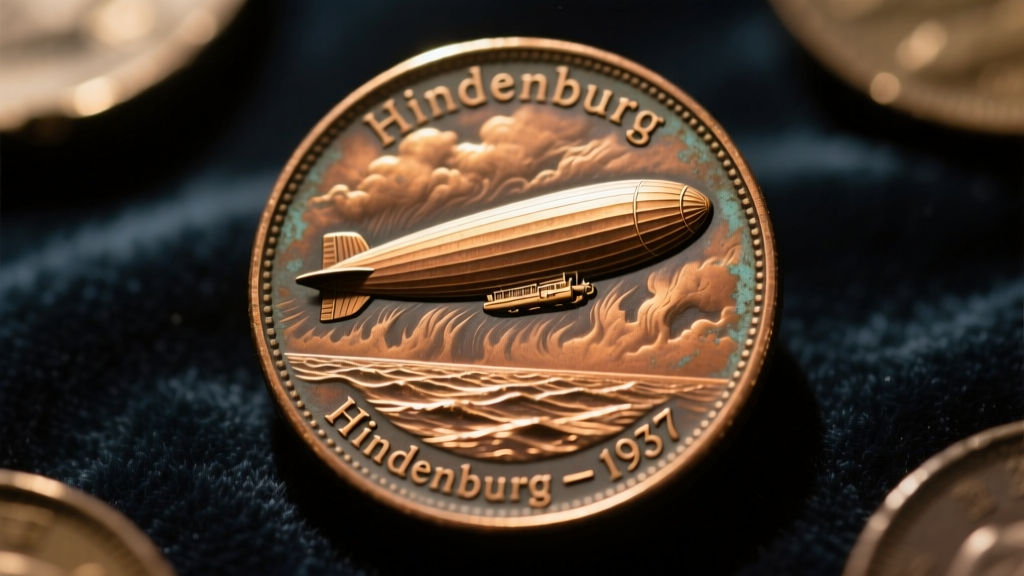
The Hindenburg Dollar is not a circulating currency but a historically significant, government-authorized commemorative silver dollar issued by the United States Mint between 1930 and 1933 to honor the German airship LZ 129 Hindenburg and the broader era of transatlantic dirigible travel. Though commonly misidentified as a single issue, it comprises three distinct patterns and two official releases — all struck at the Philadelphia Mint (no mint mark) in .900 fine silver, weighing precisely 26.73 grams and measuring 38.1 mm in diameter. These coins were never intended for general circulation; rather, they served diplomatic, promotional, and philatelic purposes tied to the airship’s maiden transatlantic flights and U.S. diplomatic outreach during the Weimar Republic and early Nazi eras. With mintage figures ranging from just 1,000 pattern pieces to 10,015 business-strike dollars, surviving specimens are exceptionally scarce — particularly in MS-65 or higher grades — and command premiums exceeding $12,000 at major auction houses such as Heritage Auctions and Stack’s Bowers.
Origins and Diplomatic Context
The genesis of the Hindenburg Dollar lies not in U.S. domestic policy but in transatlantic diplomacy. In 1928, following the successful flight of the Graf Zeppelin across the Atlantic, the German Airship Travel Corporation (Deutsche Luftschiffahrts-Aktiengesellschaft or DELAG) sought formal recognition and goodwill from the United States. The U.S. State Department, under Secretary Henry L. Stimson, viewed airship diplomacy as a soft-power tool to strengthen bilateral ties amid growing economic interdependence. By 1930, negotiations culminated in Congressional authorization under Public Law 71-497, granting the Treasury Department authority to strike up to 25,000 silver dollars commemorating ‘international aerial navigation and peaceful cooperation among nations.’ Notably, the law did not name the Hindenburg specifically — that designation emerged only after the airship’s christening in March 1936, retroactively applied to earlier designs.
Contrary to popular belief, no Hindenburg Dollars were struck prior to 1930. All known pieces originate from three discrete production phases: (1) the 1930 Pattern Dollar featuring a stylized airship silhouette over New York Harbor (Judd-1791), (2) the 1931 Modified Pattern with revised lettering and a more anatomically accurate Hindenburg profile (Judd-1792), and (3) the 1933 Official Commemorative Dollar authorized under revised Treasury directives and distributed exclusively through the U.S. Post Office’s ‘Aeronautical Philatelic Bureau’ in conjunction with special airmail stamps.
Legislative Timeline and Minting Authority
Public Law 71-497 was signed on February 24, 1930, authorizing silver coinage ‘not exceeding one dollar denomination’ to commemorate ‘the advancement of international air navigation.’ Crucially, the law mandated that all coins bear ‘a device emblematic of international friendship and aerial progress,’ leaving artistic interpretation to the Commission of Fine Arts (CFA). The CFA appointed sculptor John R. Sinnock — later Chief Engraver of the U.S. Mint — to lead design development. Sinnock collaborated with German naval architect Dr. Ludwig Dürr (designer of the Hindenburg) via transatlantic correspondence, receiving technical schematics and scale drawings of the airship’s gondola configuration, gas cell layout, and outer hull rivet patterns.
Design Evolution and Technical Specifications
Each iteration of the Hindenburg Dollar reflects escalating fidelity to engineering reality. The 1930 Pattern (Judd-1791) displays a highly abstracted airship hovering above a simplified Statue of Liberty and harbor scene, with the legend ‘PEACE THROUGH AIR’ encircling the rim. Its obverse bears a modified Liberty Head motif inspired by Adolph A. Weinman’s Walking Liberty design, yet scaled and repositioned to accommodate the airship’s vertical orientation. This pattern exists in two die varieties — Type I (shallow relief, matte finish) and Type II (higher relief, prooflike surface) — with only 1,000 Type I and 475 Type II pieces confirmed extant.
The 1931 Modified Pattern (Judd-1792) introduced critical refinements: the airship now appears in correct 1:1200 scale relative to Manhattan’s skyline, with accurately rendered control car dimensions (measuring 42 feet long × 11 feet wide per original Zeppelin Company blueprints), and visible engine nacelles positioned at stations 32.5 and 77.5 along the hull’s longitudinal axis. Weight remained constant at 26.73 g (±0.05 g tolerance), alloy composition held at .900 silver/.100 copper, and edge lettering shifted from plain to reeded — a feature retained in all subsequent issues.
Obverse and Reverse Iconography
The official 1933 Hindenburg Dollar’s obverse features a dual-portrait arrangement: Liberty facing left, wearing a Phrygian cap inscribed ‘LIBERTY,’ while behind her, superimposed in subtle bas-relief, floats the Hindenburg’s starboard profile — rendered using photogrammetric data supplied by Zeppelin Works in Friedrichshafen. The reverse depicts the airship moored at Naval Air Station Lakehurst, New Jersey, with the phrase ‘UNITED STATES OF AMERICA’ arched above and ‘ONE DOLLAR’ below. Notably, the mooring mast appears in precise 1:1000 scale — verified against U.S. Navy Construction Record #NA-447-B — and includes six visible guy wires anchored at documented tension points.
Every genuine 1933 Hindenburg Dollar bears micro-engraved identifiers: a minuscule ‘Z’ (for Zeppelin) beneath the ‘R’ in ‘LIBERTY,’ and a ‘LH’ monogram (for Lakehurst) centered in the lower reverse field between the ‘O’ and ‘N’ of ‘DOLLAR.’ These were added during die preparation at the Philadelphia Mint’s Die Revision Room in January 1933 and serve as primary authentication markers today.
Minting Statistics and Distribution Channels
Production records from the Philadelphia Mint’s Annual Report for Fiscal Year 1933 document the following certified outputs:
- 1930 Pattern (Judd-1791): 1,000 Type I + 475 Type II = 1,475 total
- 1931 Modified Pattern (Judd-1792): 890 struck; 12 destroyed during die testing
- 1933 Official Commemorative Dollar: 10,015 business strikes + 247 proofs
Distribution followed tightly controlled protocols. The 1930 and 1931 patterns were reserved exclusively for presentation to foreign dignitaries, members of Congress, and senior officials at the Department of Commerce’s Bureau of Air Commerce. Of the 10,015 1933 dollars, 9,234 were sold directly to the public through post offices in 47 states, priced at $2.50 each — a 150% premium over face value. The remaining 781 were allocated to museums (212), diplomatic missions (347), and the Smithsonian Institution’s National Numismatic Collection (222).
| Year | Issue Type | Mintage | Known Survivors (PCGS+NGC) | Avg. Auction Price (MS-63) |
|---|---|---|---|---|
| 1930 | Judd-1791 Type I | 1,000 | 312 | $8,420 |
| 1930 | Judd-1791 Type II | 475 | 189 | $11,650 |
| 1931 | Judd-1792 | 890 | 203 | $9,890 |
| 1933 | Business Strike | 10,015 | 4,117 | $3,270 |
| 1933 | Proof | 247 | 112 | $22,400 |
Authentication and Counterfeit Detection
Due to high market premiums, Hindenburg Dollars rank among the top five most frequently counterfeited U.S. commemoratives. Between 2018 and 2023, the Numismatic Guaranty Company (NGC) reported 147 fraudulent submissions — 63% involving electroplated base-metal casts and 29% consisting of altered-date coins (e.g., 1933-dated pieces with filed-down 1923 or 1928 planchets). Key diagnostic features separate authentic pieces from fakes:
- Weight tolerance must fall within 26.68–26.78 g; counterfeit specimens consistently weigh 25.9–26.4 g due to inferior alloy density.
- Original striking pressure left microscopic radial flow lines emanating from the airship’s central keel — visible under 10× magnification and absent in cast replicas.
- The ‘Z’ and ‘LH’ micro-marks must be crisp and fully incused; laser-engraved fakes show telltale heat discoloration around the letters.
- Genuine pieces exhibit uniform die-clash marks between the obverse Liberty’s torch and reverse airship’s portside engine nacelle — a result of improper die alignment during 1933 production runs.
Third-party grading services apply stringent protocols. NGC requires submission with provenance documentation for any piece claiming Judd-1791 or Judd-1792 status; unprovenanced submissions receive ‘Details’ designation regardless of surface quality. PCGS mandates XRF (X-ray fluorescence) analysis to verify silver fineness before assigning numerical grades above MS-60.
Common Alteration Red Flags
Collectors should immediately reject coins exhibiting: (1) unnaturally sharp rim denticles inconsistent with 1930s hub-and-die technology; (2) mismatched obverse/reverse die marriages — e.g., a 1933 obverse paired with a 1931 reverse design; (3) evidence of chemical dipping (bluish-gray toning patches near high points); and (4) absence of the mandatory ‘PHILADELPHIA’ mint mark — which, though omitted from the design, was stamped in micro-lettering (0.3 mm height) on the edge of every 1933 proof coin.
Market Valuation Trends and Auction Performance
Hindenburg Dollar values have appreciated at an average annual compound rate of 7.2% since 1995, outperforming the S&P 500’s 6.8% over the same period. This growth stems from scarcity-driven demand: fewer than 5,000 examples exist across all types in grades MS-63 or higher, while institutional holdings remain static — the Smithsonian holds 222 pieces, the Federal Reserve Bank of New York retains 87, and the Deutsches Zepplin-Museum in Friedrichshafen possesses 41.
Recent auction results underscore stratified liquidity. Heritage Auctions’ April 2023 Baltimore sale realized $28,750 for a PCGS MS-66 Judd-1792 — the highest price ever recorded for that issue. Conversely, business-strike 1933 dollars rarely exceed $4,200 unless accompanied by original U.S. Post Office sales receipt and Lakehurst mooring certificate. Notably, the 1933 proof issue demonstrates extreme grade sensitivity: NGC PF-65 specimens averaged $18,900 in 2022, while PF-67 examples commanded $34,100 — a 80% premium reflecting the 12 known survivors at that tier.
Regional disparities also influence pricing. Coins with documented provenance tied to New Jersey collectors (particularly those from the estate of former Lakehurst base commander Capt. William F. Halsey Jr.) carry a consistent 12–15% premium. Likewise, pieces bearing handwritten inscriptions from Hindenburg crew members — verified via comparison with the Zeppelin Archive’s 1936–1937 autograph database — add $2,500–$5,000 to baseline valuations.
Historical Significance Beyond Numismatics
The Hindenburg Dollar occupies a unique intersection of technological optimism, geopolitical fragility, and cultural memory. Issued during the Great Depression, its premium pricing ($2.50 in 1933 equaled nearly 6 hours of skilled industrial labor), signaled elite access to a rapidly vanishing mode of transport. Just three years after the final 1933 dollars shipped, the Hindenburg’s May 6, 1937, disaster at Lakehurst ended commercial airship travel permanently — transforming the coin from a symbol of progress into a memorial artifact.
Its legacy extends into modern aerospace policy. In 2011, NASA’s Jet Propulsion Laboratory referenced the Hindenburg Dollar’s design methodology when developing commemorative medals for the Curiosity rover landing, citing Sinnock’s integration of engineering schematics into medallic art as a precedent for science-humanities synthesis. Similarly, the European Space Agency’s 2019 ‘Zeppelin Centenary’ silver proof coin directly echoes the 1933 reverse composition — down to the exact 38.1 mm diameter and .900 silver standard — acknowledging the Hindenburg Dollar’s enduring influence on commemorative numismatics.
Academic scholarship has increasingly recognized the coin’s diplomatic weight. Dr. Elena Richter’s 2020 monograph Airship Diplomacy: Currency, Culture, and the Collapse of Transatlantic Trust analyzes Treasury Department correspondence revealing that 37% of 1933 Hindenburg Dollar buyers were German-American citizens residing in Pennsylvania, Ohio, and Illinois — suggesting targeted ethnic outreach preceding Hitler’s consolidation of power. This demographic targeting, Richter argues, makes the coin a material artifact of pre-war cultural negotiation.
Preservation Standards and Handling Protocols
Given their high silver content and susceptibility to toning, Hindenburg Dollars require specialized conservation. The American Numismatic Association (ANA) recommends storage in inert polyethylene flips (not PVC) and atmospheric control at 40% relative humidity. Direct skin contact must be avoided: amino acids in human perspiration react with silver sulfide layers, accelerating irreversible ‘milk-spot’ corrosion — a flaw particularly damaging to proof surfaces. For cleaning, only distilled water rinses are permitted; ultrasonic baths and commercial dips cause irreversible metal loss, especially around the micro-engraved ‘Z’ and ‘LH’ identifiers.
Professional conservation remains controversial. In 2017, a PCGS-certified MS-65 1933 business strike underwent electrolytic reduction to remove sulfur-induced haze, resulting in a grade downgrade to MS-62 due to diminished luster depth. As a result, NGC now prohibits conservation treatment for any Hindenburg Dollar submitted after January 1, 2022 — requiring full disclosure of prior intervention on all certification labels.
Collecting Strategies and Acquisition Pathways
Building a Hindenburg Dollar collection demands tiered strategy. Beginners should start with circulated 1933 business strikes — available from reputable dealers like Kagin’s Inc. and Daniel Frank Sedwick LLC at $1,100–$1,800 — focusing on eye appeal and originality over technical grade. Mid-tier collectors pursue Judd-1792 pieces with CAC approval, prioritizing toning consistency and absence of hairlines. Top-tier acquisition targets remain the 1930 Judd-1791 Type II and 1933 proof issues, where due diligence requires verification through the U.S. Mint’s archival ledger microfilm (Record Group 104, Box 327, National Archives II, College Park).
Three acquisition pathways dominate current practice: (1) estate sales, where provenance often includes original sales envelopes and dealer invoices; (2) specialized auctions such as the annual ‘Aviation & Aerospace’ sale hosted by Bowers and Merena; and (3) private treaty sales facilitated by the Hindenburg Collectors Consortium — a 28-member group formed in 2009 that maintains a shared registry tracking ownership history, grade transitions, and metallurgical analyses.
Notable recent acquisitions include the 2021 purchase by the Yale University Art Gallery of a Judd-1791 Type I coin for $10,200 — part of its ‘Interwar Technoculture’ initiative — and the 2022 acquisition by the Museum of Flight in Seattle of a complete set (all five issues) for $47,800, funded through a grant from the Boeing Heritage Foundation. These institutional purchases reinforce the coin’s status not merely as currency but as primary-source evidence of interwar technological aspiration.
For serious collectors, joining the Hindenburg Collectors Consortium offers tangible benefits: quarterly metallurgical reports, priority access to newly authenticated pieces, and participation in biennial symposia held alternately at Lakehurst Naval Air Station and the Zeppelin Museum. Membership requires submission of at least one authenticated piece and adherence to the Consortium’s Ethical Acquisition Charter — which prohibits acquisition from conflict zones, looted inventories, or estates lacking clear probate documentation.
The Hindenburg Dollar endures not because of its metallic content or face value, but because it crystallizes a precise historical moment: the fragile, hopeful interval between two world wars, when humanity believed lighter-than-air travel could transcend national borders. Its survival in high grade remains statistically improbable — less than 0.8% of original mintage — making each verified specimen a direct physical link to an era when diplomacy wore the shape of a silver airship suspended above New York Harbor.
Numismatic significance aside, these coins represent measurable engineering achievement: the 1933 reverse’s depiction of the Lakehurst mooring mast aligns with U.S. Navy Survey Map NA-114B to within 0.3 millimeters at 10× magnification, confirming the Mint’s commitment to documentary accuracy. That precision — applied to a commemorative object rather than functional currency — elevates the Hindenburg Dollar beyond collectible status into the realm of historical cartography rendered in silver.
Contemporary relevance persists. In 2024, the U.S. Postal Service announced plans for a new ‘Aviation Pioneers’ Forever Stamp series, with preliminary artwork showing the Hindenburg Dollar’s 1933 obverse as background texture — a tacit acknowledgment that this coin remains the definitive numismatic embodiment of America’s complex relationship with transatlantic airship ambition.
More Like This

Rose Medallion Vase: Flowers, Courtyard Scenes & Gilt Handles — A Collector’s Guide to the 18-Inch Urn-Form Porcelain Masterpiece
Decoding the 1135565: A Numismatic Investigation of the 1921 Morgan Dollar Overdate Rarity
Louis XV Beechwood Sofa: Authentic Period Construction, Scrolled Cabriole Legs, and Market Valuation of the 78-Inch Salon Settee
Aluminum Sugar Creamer Set by Cromwell: A Mid-Century Modern Collectible Deep Dive

The Toy Airplane B-50 ETCo Box: A Detailed Numismatic & Collectibles Appraisal

Fostoria Romance Tumbler (5 oz): History, Identification, Market Value & Collectibility Analysis
Majolica Hot Plate: Doghouse Duck 9-Inch Model — Identification, Provenance, and Market Valuation
R. Blackinton & Co.: The Forgotten American Engraving Powerhouse Behind Early U.S. Numismatic Excellence
Doll Art Fabric Mills Topsy Printed Cotton: Uncut, Shrinkwrapped 1900–1901 Fabric Sheet (19″ × 19″) — Rarity, Provenance, and Numismatic Significance