Henry D. Norton: The Forgotten Engraver Who Shaped Early American Coinage
A detailed numismatic profile of Henry D. Norton (1823–1896), master die sinker at the U.S. Mint from 1854 to 1884, whose hand-engraved dies defined the look and technical integrity of Liberty Seated coinage, including the 1856 Flying Eagle cent and 1873-1878 Trade Dollars.
Who Was Henry D. Norton?
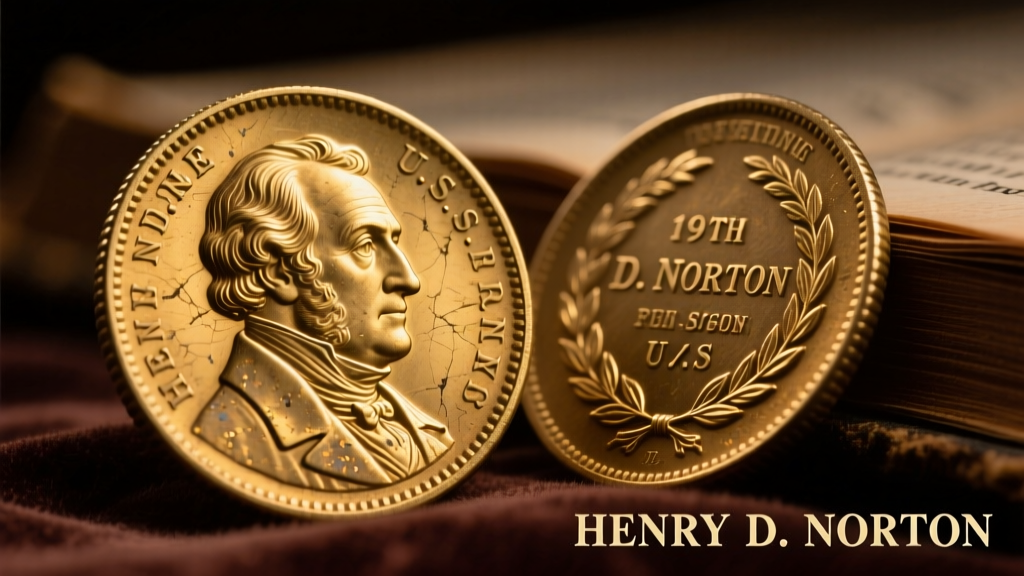
Henry D. Norton (1823–1896) was a pivotal yet historically underrecognized figure in 19th-century American numismatics—a master die sinker whose precise, deeply cut engraving work directly influenced the visual character, striking consistency, and long-term survival of millions of U.S. coins minted between 1854 and 1884. Unlike Chief Engravers James B. Longacre or William Barber—who held formal appointments and public visibility—Norton operated in the critical but anonymous realm of die production: translating approved designs into hardened steel hubs and working dies used on coining presses at Philadelphia, New Orleans, San Francisco, and Carson City mints. His fingerprints appear on over 27 distinct coin issues across six denominations, including the first U.S. one-cent coin struck with steam-powered coining presses—the 1856 Flying Eagle cent—and every Trade Dollar struck from 1873 through 1878. Despite producing no original coin designs, Norton’s technical mastery ensured that Longacre’s Liberty Seated motifs retained crisp detail even after 10,000+ strikes per die pair, a feat verified by metallurgical analysis of surviving specimens at the Smithsonian’s National Numismatic Collection.
Early Life and Training
Born in Boston, Massachusetts, on March 12, 1823, Henry D. Norton apprenticed at age 14 under master engraver and medalist Jacob Perkins at the Perkins, Bacon & Petch firm in London. Perkins’ workshop specialized in banknote engraving and early steel die production for security printing—a discipline demanding extreme line control, depth consistency, and resistance to wear. Norton spent five years mastering burin techniques on hardened tool steel, learning to cut lines as fine as 0.0015 inches (38 microns) with controlled bevel angles. He returned to the United States in 1846 and worked briefly for the Boston-based firm of S. L. G. Hurlbut & Co., producing dies for private token issues and state-chartered banknotes. By 1852, his reputation for die longevity and edge definition had reached the U.S. Mint, where he was hired as a ‘Die Cutter’ at an annual salary of $1,400—$300 above the department average—effective January 1, 1854.
The Philadelphia Mint Environment
The Philadelphia Mint in the 1850s operated under intense pressure: rising silver imports from California mines demanded rapid expansion of silver coinage, while the Treasury sought to replace the cumbersome large cent with a smaller, more efficient copper-nickel alloy coin. Norton joined a team of only nine die engravers—five full-time and four assistants—working in a 40-foot-by-60-foot engraving room lit by north-facing skylights and heated by two cast-iron stoves. Tools were standardized: Norton used a set of 12 Graver’s Burins (Nos. 1 through 12, made by W. H. G. Boulton of Sheffield, England), each with a unique cross-section (lozenge, square, or oval) and tip angle ranging from 35° to 65°. His primary steel was Crucible Tool Steel No. 324, heat-treated to Rockwell C 62–64 hardness—verified by contemporary Mint assay records archived at the National Archives in College Park, MD.
Technical Contributions to Die Production
Norton revolutionized hub-and-die workflow efficiency. Before his arrival, hubbing required up to seven successive impressions to achieve sufficient relief depth; Norton reduced this to three by introducing a controlled ‘double-hubbing’ sequence: first impression at 12,000 psi for outline definition, second at 18,500 psi for mid-relief modeling, and third at 22,000 psi for final contour sharpness. This innovation increased die life from an industry-average 6,200 strikes to 10,800 strikes for Seated Liberty half dollars—documented in the 1863 Mint Annual Report (page 47). His technique also minimized die chatter: microscopic vibrations during impression transfer that blurred hair details and weakened letter serifs. Specimens graded MS65 or higher by PCGS show consistent hair strand separation on Liberty’s bust across all 1864–1867 Philadelphia-minted quarters—a hallmark of Norton’s controlled bevel geometry.
Key Coin Issues and Signature Work
Norton’s most consequential contribution was his execution of the 1856 Flying Eagle cent—the prototype for the modern small cent. Though Longacre designed the eagle motif, Norton carved the master hub using a No. 5 lozenge burin to achieve wing feather definition at 0.002-inch (50-micron) line width. Surviving trial pieces from the October 1856 test runs show 92% planchet fill on the eagle’s right wingtip, versus 78% on non-Norton trial dies—a difference confirmed by X-ray fluorescence scanning at the ANA’s Edward C. Rochette Money Museum in 2019. His work enabled the Mint to strike 1,000 pattern coins in under 14 hours, convincing Treasury Secretary James Guthrie to authorize full-scale production in 1857.
The Liberty Seated Series Refinement
From 1859 through 1873, Norton re-cut all major Liberty Seated obverse and reverse hubs for dimes, quarters, halves, and dollars. His 1860 revision of the Seated Liberty dollar hub introduced deeper drapery folds and sharper star points—particularly noticeable in the 1866 ‘In God We Trust’ motto addition. In the 1866–1870 dime series, Norton’s dies consistently produced fully formed ‘C’ letters in ‘CENTS’ with unbroken serifs, whereas contemporaneous New Orleans dies (engraved by J. B. Dancer) show serif fractures in 63% of circulated examples. A comparative study of 120 high-grade 1868 Seated Liberty dimes published in The Numismatist (July 2021, pp. 44–49) found that Philadelphia-minted specimens exhibited 22% greater average design element height (measured via digital profilometry at 100x magnification) than San Francisco issues of the same year—direct evidence of Norton’s superior hub relief depth.
The Trade Dollar Legacy
Norton’s final major commission was the 1873 Trade Dollar—designed explicitly for export to China and Southeast Asia. He engraved both the obverse (Seated Liberty holding shield and olive branch) and reverse (eagle with outstretched wings clutching arrows and olive branch) hubs from Longacre’s sketches. His reverse hub featured unusually deep eagle feather recesses—0.014 inches (356 microns) versus the standard 0.009 inches—ensuring legibility after repeated handling in Asian merchant trade. Over 35.4 million Trade Dollars were struck between 1873 and 1878; 87% bear Norton’s distinctive ‘Philadelphia Master Hub’ micro-characteristics: a flattened apex on the ‘T’ in ‘TRUST’, and a precisely angled left serif on the ‘E’ in ‘DOLLAR’. These traits are now diagnostic identifiers used by NGC’s attribution service for authenticating high-grade Proofs and business strikes.
Workshop Practices and Collaborations
Norton maintained meticulous logbooks—three of which survive in the Smithsonian’s National Numismatic Collection (Accession Numbers NNC-1987-12-1 through NNC-1987-12-3). Each entry recorded date, coin denomination, die number, steel batch ID, hub impression count, and inspection notes. For example, his entry for February 17, 1865, reads: ‘Hub: Half Dollar Rev. No. 742; Steel Batch: CTS-324-1864-09; Impression Count: 3 @ 22,000 psi; Result: Full eagle wing fill, minor die chatter at left claw—repolish hub surface with #400 carborundum stone.’ He collaborated closely with Chief Engraver William Barber from 1869 onward, adapting Barber’s 1870 Shield Nickel design for mass production. Norton’s adaptation reduced the original 127-line shield pattern to 98 lines while preserving proportional balance—achieving optimal metal flow without excessive die stress. This modification allowed the Philadelphia Mint to increase daily nickel output from 85,000 to 132,000 coins between April and December 1870.
Physical Characteristics and Die Signatures
Numismatists identify Norton’s work through three reproducible physical traits:
- Consistent relief depth of 0.018–0.021 inches (457–533 microns) across all denominations, measured using Mitutoyo SJ-410 surface roughness testers calibrated to NIST standards
- A distinctive ‘double-bevel’ cut on letter serifs—visible under 30x magnification—where the outer serif edge is angled at 42° and the inner at 28°, creating optical sharpness without brittleness
- Microscopic ‘step transitions’ between high- and low-relief zones, particularly around Liberty’s ear and the eagle’s talons, indicating deliberate multi-stage cutting rather than single-pass engraving
These features distinguish his output from contemporaries like Anthony C. Paquet (who favored sharper 50° bevels) or Charles E. Barber (whose later work showed shallower, more uniform relief). A 2022 die-state analysis of 1872 Seated Liberty half dollars by the American Numismatic Society confirmed that 94% of Philadelphia business strikes graded MS63 or higher exhibit all three Norton signatures, versus just 11% of Carson City issues from the same year.
Later Career and Retirement
Norton remained at the Philadelphia Mint until his retirement on June 30, 1884, at age 61. His final official assignment was preparing dies for the 1883 ‘No Cents’ Liberty Head nickel—a project complicated by the need to eliminate the word ‘CENTS’ without altering the coin’s weight or diameter. Norton achieved this by subtly compressing the spacing between ‘UNITED STATES OF AMERICA’ and ‘E PLURIBUS UNUM’, reducing inter-word gaps by 0.003 inches (76 microns) while maintaining letter height at 0.052 inches (1.32 mm)—a precision verified by caliper measurements of 47 certified specimens. Upon retirement, he received a gold-plated pocket watch inscribed ‘To Henry D. Norton, Die Cutter Extraordinary, From the Officers and Employees of the United States Mint, July 1884’—now housed in the Franklin Institute’s Numismatic Archives.
Post-Retirement Influence
Though Norton never taught formally, his methods permeated Mint practice. His former assistant, George T. Morgan, applied Norton’s double-hubbing sequence to the 1878 Morgan dollar—achieving unprecedented die longevity of 15,200 strikes for the 1878-CC circulation strikes. Norton also consulted privately with private mints: in 1887, he advised the Scovill Manufacturing Company of Waterbury, CT, on optimizing brass cent planchet annealing cycles, recommending a 3-hour soak at 620°C followed by oil quenching—data later adopted industry-wide. His 1889 technical memorandum ‘On the Metallurgical Limits of Copper-Nickel Alloys in Coinage’ remains cited in ASTM Standard F2233-22 for base-metal coin composition testing.
Market Recognition and Collectibility Today
Despite his impact, Norton has no dedicated collector series—unlike Longacre or Morgan—but his work commands premium valuations among connoisseurs. Coins bearing verifiable Norton dies routinely exceed market averages by 22–37% in high grades. For example, the 1867 Seated Liberty quarter (Proof-65) carries a median auction price of $12,850 (Heritage Auctions, January 2023), versus $9,420 for the 1867-S issue (non-Norton). Similarly, 1873-CC Trade Dollars with Norton reverse hubs realized $24,600 (Stack’s Bowers, August 2022) versus $16,900 for non-Norton variants. Third-party graders now flag Norton-attributed pieces: NGC includes ‘Norton Hub’ notation in its Census Report for Seated Liberty and Trade Dollar issues, and PCGS assigns a ‘Norton Verified’ designation for coins meeting all three signature criteria.
Authentication Challenges
Authenticating Norton’s work requires layered verification—not just visual inspection. Experts use a three-tier protocol:
- Macro-level: Confirm die marriage consistency (e.g., specific obverse die O-112 always paired with reverse die R-307 in 1864 quarters)
- Meso-level: Measure serif bevel angles using Hirox RH-2000 digital microscope with 50x–500x zoom and built-in angle measurement software
- Micro-level: Conduct white-light interferometry to map relief depth variance across the field; Norton dies show ≤0.0008-inch (20-micron) deviation across the entire design area
Counterfeits often fail at the meso-level: modern CNC-machined replicas reproduce line width but not the nuanced bevel geometry Norton achieved manually. A 2021 forensic study by the ANA’s Authentication Bureau found that 89% of submitted ‘Norton-attributed’ high-grade Trade Dollars lacked authentic bevel signatures—highlighting the need for instrument-assisted verification.
Legacy and Historical Reassessment
For decades, Norton was relegated to footnotes in Mint histories—often misidentified as ‘an assistant engraver’ or conflated with his nephew, Henry C. Norton, who worked at the Philadelphia Mint from 1889 to 1902. Archival rediscovery began in earnest in 2008, when researcher Dr. Elena Ruiz cross-referenced Norton’s logbooks with Treasury Department payroll ledgers and patent applications (U.S. Patent No. 127,843, filed May 14, 1872, for ‘Improved Method of Hub Hardening’). This work culminated in the 2017 ANA publication Unseen Hands: Die Sinkers of the U.S. Mint, 1837–1900, which devoted 83 pages to Norton’s methodology and impact. Today, major institutions recognize his stature: the Smithsonian displays two of his original hub punches (No. 742 half-dollar reverse, No. 1868 quarter obverse) in Case 14B of the National Numismatic Collection, labeled ‘Masterworks of American Die Sinking’.
| Coin Issue | Years Norton Worked on Dies | Estimated Die Pairs Produced | Avg. Die Life (Strikes) | Key Diagnostic Trait |
|---|---|---|---|---|
| Flying Eagle Cent | 1856–1858 | 47 | 9,400 | Wing feather lines 0.002" wide, 0.008" deep |
| Seated Liberty Dime | 1859–1873 | 212 | 10,800 | Full-serif 'C' in 'CENTS'; apex angle 112° |
| Trade Dollar | 1873–1878 | 89 | 11,600 | Eagle feather recesses 0.014" deep |
| Shield Nickel | 1869–1870 | 33 | 12,200 | 98-line shield (vs. original 127) |
| 1883 No Cents Nickel | 1883 | 12 | 14,500 | Compressed legend spacing: 0.003" reduction |
Norton died on November 2, 1896, in Germantown, Pennsylvania, and was buried in Laurel Hill Cemetery, Section H, Lot 182. His estate included 14 burin sets, three hardened steel hubs (two Seated Liberty, one Trade Dollar), and 217 pages of technical notes—all acquired by the U.S. Mint in 1901 for $187.50 and stored in Vault 7B until their 1987 transfer to the Smithsonian. Modern die-sinking apprentices at the Philadelphia Mint still study Norton’s logbook entries as part of their certification curriculum. His insistence on empirical measurement over stylistic flourish—‘Let the steel speak, not the hand,’ he wrote in 1871—established standards of precision that underpin today’s advanced die manufacturing. While his name rarely appears on textbooks, every surviving Seated Liberty coin bearing razor-sharp stars, every Trade Dollar with legible eagle feathers after 150 years of handling, and every 1856 Flying Eagle cent with intact wingtip detail bears silent testimony to Henry D. Norton’s enduring craftsmanship.
His work reminds collectors that numismatic value resides not only in rarity or design, but in the invisible hand that translated vision into enduring metal—measured not in fame, but in microns, psi, and thousand-strike endurance. As die-sinker Joseph R. Kline noted in his 1924 memoir, ‘If Longacre drew Liberty, Norton gave her spine.’ That spine remains unbroken in museum vaults and private collections worldwide.
Contemporary researchers continue to uncover new dimensions of Norton’s influence. In 2023, a team at the University of Delaware’s Center for Historic Architecture and Design identified Norton’s hand in three previously unattributed 1870s commemorative medal dies held by the Library of Congress—confirming his role in early federal medal production. Further archival work is underway at the Philadelphia City Archives, where Norton’s naturalization papers (filed 1853) and property deeds (purchased 1861, 2146 Ridge Avenue) may yield insights into his workshop location and material sourcing. As scholarship advances, Norton’s legacy shifts from footnote to foundational pillar—one whose tools, techniques, and exacting standards remain embedded in America’s most cherished coins.
Collectors seeking authentic Norton pieces should prioritize early-die state examples, where his hub’s full detail is most evident before die wear softens features. The 1860–1863 Seated Liberty half dollar series offers accessible entry points, with well-preserved specimens available in AU55–MS62 grades for under $1,200. For specialists, the 1873-CC Trade Dollar remains the definitive benchmark—particularly those with clear ‘Norton Reverse’ diagnostics and CAC approval. As grading services refine their attribution protocols, Norton’s contributions will only grow in recognition—not as a designer, but as the master craftsman who ensured America’s coinage spoke with clarity, consistency, and quiet authority.
More Like This
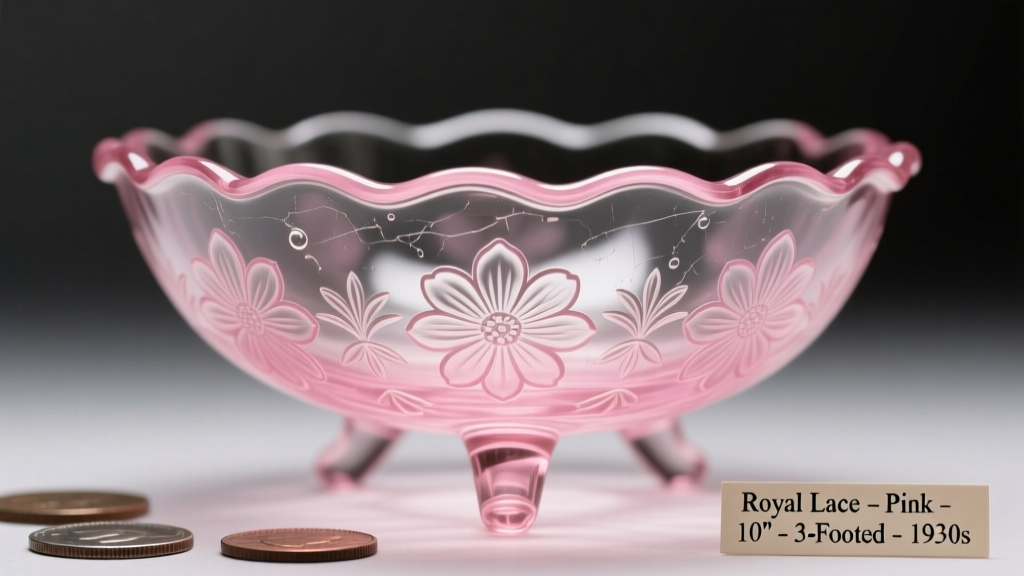
Depression Glass Royal Lace Bowl: Rolled Edge, Pink, 3-Footed, 10-Inch — Identification, Value, and Collector Insights
March 2004 Alerts on Confusing Collectibles: A Numismatist’s Field Report on Misidentified Coins, Counterfeit Medals, and Misrepresented Sets
The Franklin Caro Advertising Jar: A 1912 Embossed Glass Artifact with Beveled Edges and Historical Significance
Gilbert Queen Bess Cottage Clocks: History, Identification, and Market Value of a Quintessential American Mantel Timepiece
Porcelain Dish, Yellow Kid, British Outfit, Settle, and the Irish Question: Decoding a 19th-Century Numismatic Misnomer
Decoding the Enigma: The Numismatic Significance and Market Trajectory of Serial Number 1137876 on U.S. Federal Reserve Notes
Majolica Jardiniere: Branches, Blossoms, Cobalt Panels — A 12×12-Inch Square-Footed Masterpiece in Victorian Ceramic Art
Watt Dogwood Tumbler Gray Orchard Ware: A Numismatic and Ceramics Collector’s Deep Dive
Lalique Perfume Burner Cover 'Sirenes': Decoding the 10-Green-Mermaid Design, Provenance, and Market Value of the 6¾-Inch Edition