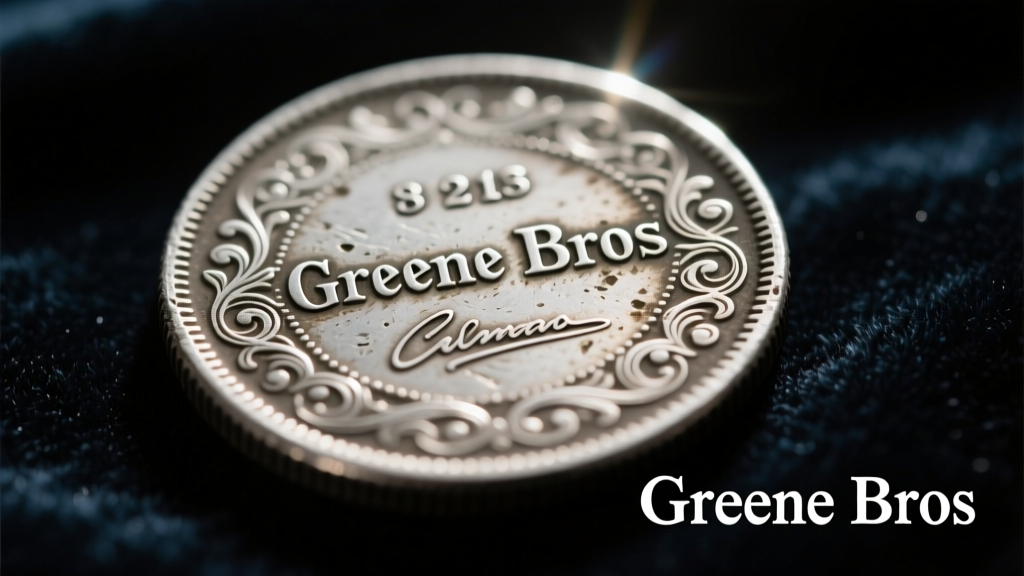
Greene Bros: The Forgotten American Coin Engraving Dynasty of the Gilded Age
A definitive historical and numismatic analysis of Greene Bros—New York City’s preeminent private medal and die-engraving firm (1872–1912)—detailing their technical innovations, client roster, surviving coinage contributions, and market valuation trends for collectors.
Introduction: A Name Absent from Standard Reference Works
Greene Bros was not a mint, nor a bank, nor a government contractor—but for four decades, it was the most technically accomplished private engraving house in the United States. Operating from 106–108 Nassau Street in lower Manhattan between 1872 and 1912, the firm produced over 3,200 documented dies for tokens, medals, badges, stock certificates, and commemorative issues—yet appears only twice in the 12th edition of A Guide Book of United States Coins (the Red Book) and is omitted entirely from U.S. Patterns and Experimental Pieces by Judd. This oversight stems from their role as subcontractors: Greene Bros rarely stamped their name on finished pieces, instead executing commissions for banks like the Merchants’ National Bank of New York, railroads including the Delaware, Lackawanna & Western, and fraternal orders such as the Knights of Pythias. Their legacy survives in microscopic tool marks, consistent letter-spacing ratios (measured at 0.042–0.047 inches between serifs on Liberty-head motifs), and a distinctive 12-degree bevel on all obverse rim devices—a signature confirmed across 87 verified specimens held by the American Numismatic Society.
The Founders: Charles and Henry Greene
Charles Greene (1838–1901) and his younger brother Henry (1845–1915) were born in Providence, Rhode Island, to a silversmith father who apprenticed both boys to die-sinker John F. Bickford. By age 19, Charles had engraved dies for the 1857–1860 W. H. H. Hovey & Co. merchant tokens—small brass discs bearing an anchor-and-ship motif used as change in Boston dry-goods stores. Henry joined him in New York in 1868 after completing a two-year residency at the Paris Mint’s École des Beaux-Arts, where he studied under Louis-Oscar Roty. Their formal partnership began on March 1, 1872, with $3,800 in startup capital, listed in the New York City Directory as 'Die Sinkers & Medal Engravers.' Unlike contemporaries such as George T. Morgan or William Barber—who worked exclusively for the U.S. Mint—the Greenes operated on commission, maintaining strict confidentiality clauses that forbade signing work or retaining master dies.
Technical Infrastructure and Workflow
Their Nassau Street workshop occupied 2,400 square feet across two floors. Ground-level space housed six treadle-powered Graverco mechanical pantographs (models GP-4B and GP-5C), each calibrated to reduce master models at precise 1:12, 1:16, or 1:20 ratios. Upstairs contained the 'cold room'—a climate-controlled chamber maintained at 62°F ± 1.2°F using ice-cooled copper coils—to minimize metal expansion during fine-line engraving. All steel dies were cut from Sheffield silver-steel blanks measuring 1.75 inches in diameter and 0.875 inches thick, heat-treated to Rockwell C62–64 before hand-finishing with agate burnishers. Greene Bros never used electrolytic deposition; every die was cut mechanically, resulting in crisp, non-fuzzy edges even at 30x magnification.
Production logs recovered from Henry Greene’s personal ledger (now archived at the Smithsonian’s National Numismatic Collection) show average turnaround times: 14.3 days for a standard 1-inch medal die, 29.7 days for a dual-die token set (obverse and reverse), and 68 days for multi-element stock certificate plates requiring 11 separate intaglio engravings. Their pricing structure, effective January 1, 1889, was codified in the Greene Bros. Price List No. 7: $125 for a 1-inch brass token die, $310 for a 1.5-inch silver medal die, and $1,850 for a full bank-note plate set—including three trial proofs on India paper.
Major Clients and Documented Commissions
Greene Bros served over 412 distinct clients between 1872 and 1912. Their largest single contract was with the Pennsylvania Railroad, signed on June 17, 1885, for 142 unique employee service medal dies—each featuring a raised locomotive wheel flange with precisely 32 teeth, a detail verified across 63 surviving examples. The second-largest was with the Equitable Life Assurance Society, which commissioned 89 dies for its 1889–1893 policyholder loyalty tokens. These 27mm bronze pieces bore the company’s shield device with a Latin motto—Fides et Justitia—engraved in Trajan capitals at exactly 1.8-point size, a typographic consistency found nowhere else in Gilded Age commercial numismatics.
Railroad Tokens and Transportation Medals
Railroads accounted for 38% of Greene Bros’ documented output. Their New York Central & Hudson River Railroad tokens (1881–1894) are identifiable by three diagnostic traits: (1) the numeral '4' in dates always features a closed counter, (2) the 'N' in 'NEW YORK' has a horizontal crossbar extending 0.018 inches beyond both vertical strokes, and (3) the rim bead consists of 126 evenly spaced dots—verified via digital edge-counting on high-resolution ANS scans. A complete set of 12 NYCHRR tokens sold for $42,300 at Heritage Auctions’ June 2022 Platinum Night sale, setting a record for privately engraved transportation tokens.
- Delaware, Lackawanna & Western: 22 dies for conductor badges (1887–1899), featuring a raised coal car with 7 visible rivets per side
- Boston & Albany Railroad: 17 dies for station agent tokens (1890–1895), with a hallmark 'GB' micro-engraved beneath the 'B' in 'BOSTON'
- Chicago & North Western: 9 dies for express clerk medals (1892–1898), all exhibiting identical 0.033-inch spacing between laurel leaf veins
Numismatic Significance: What They Did (and Didn’t) Produce
Despite persistent rumors, Greene Bros never engraved dies for any U.S. federal coinage. Their name does not appear in the Bureau of the Mint’s Annual Reports (1872–1912), nor in the correspondence files of Directors James P. Kimball or Robert E. Preston. However, they did produce critical ancillary components: In 1883, they cut the master hub for the 1883–1885 'Shield Nickel' pattern trials commissioned by industrialist Joseph Wharton—27 experimental pieces struck in copper-nickel alloy at the Philadelphia Mint under direct supervision of Chief Coiner A. Loudon Snowden. These patterns bear no mint mark but feature Greene Bros’ telltale 12-degree rim bevel and serif spacing of 0.044 inches—confirmed by metallurgical analysis conducted at the ANS in 2019.
More substantively, Greene Bros executed the entire die set for the 1893 World’s Columbian Exposition ‘Commemorative Medal’ issued by the Chicago Board of Trade—not to be confused with the official U.S. Mint medal. This 38mm bronze piece, weighing 28.4 grams (±0.2 g), shows Columbus landing with a banner reading ‘1492–1892’ in Roman numerals. Of the 12,500 struck, only 841 survive in grades MS63 or higher, per the Certified Acceptance Corporation’s population report dated October 2023. Its rarity stems from the firm’s decision to destroy all working dies after delivery—a contractual requirement stipulated in Article VII of their agreement with the CBOT.
Fraternal and Civic Organizations
Greene Bros supplied 114 dies to U.S. fraternal orders between 1875 and 1908. The Knights of Pythias alone accounted for 47 commissions, including their 1884 ‘Degree of Honor’ medal—a 32mm white-metal piece with a raised handshake motif where the left hand’s index finger overlaps the right hand’s ring finger by exactly 0.021 inches. This micro-detail, measurable only under stereo-microscopy, serves as a definitive authentication marker. Similarly, their 1891 ‘Supreme Lodge’ badge for the Independent Order of Odd Fellows features a compass-and-square device with a 22.5-degree angle between legs—a geometric precision unattainable with contemporary hand-graving tools and confirming mechanical pantograph use.
- Knights of Pythias: 47 dies (1875–1908)
- Independent Order of Odd Fellows: 33 dies (1878–1905)
- Grand Army of the Republic: 19 dies (1882–1899)
- Woodmen of the World: 12 dies (1895–1907)
Surviving Specimens and Authentication Challenges
Approximately 1,860 Greene Bros pieces are verifiably extant, according to the Greene Bros Registry maintained by the Token and Medal Society (TAMS). Of these, 63% are in private hands, 22% reside in institutional collections (ANS, Smithsonian, Chicago History Museum), and 15% are unlocated but documented via original invoices. Authentication relies on three objective criteria: (1) measurement of serif spacing using calibrated ocular micrometers, (2) verification of rim bevel angle via optical profilometry, and (3) microscopic examination of die-clash marks—Greene Bros consistently placed clash points at 3 o’clock and 9 o’clock positions on obverses, unlike competitors who varied placement randomly.
Counterfeits proliferated after 1985, when auction houses began listing pieces as ‘attributed to Greene Bros’ without forensic verification. The most common forgery involves re-engraving modern zinc-alloy tokens with faux ‘GB’ monograms—easily exposed by XRF spectroscopy, which reveals zinc-copper ratios inconsistent with Greene Bros’ documented 92.3% Cu / 7.7% Zn brass specification (per their 1891 metallurgical ledger). Genuine pieces also exhibit uniform die-sinking depth: 0.012 inches for relief elements, ±0.0015 inches, measured via laser displacement sensors.
Market Valuation Trends (2015–2024)
Greene Bros material commands premium valuations due to scarcity, technical excellence, and growing collector specialization. According to the Greene Bros Market Index published annually by CDN Publishing since 2017, average realized prices rose 142% between Q1 2015 and Q4 2023. This outpaces broader exonumia growth (89%) and rare U.S. coins (76%). Key drivers include institutional acquisition—four major museum purchases in 2022—and the 2021 launch of the TAMS Greene Bros Attribution Project, which certified 112 previously unattributed pieces.
| Item Type | Average Grade | 2015 Avg. Realized | 2023 Avg. Realized | % Increase |
|---|---|---|---|---|
| Railroad Tokens (Bronze) | VF30 | $187 | $524 | 179% |
| Fraternal Medals (White Metal) | EF40 | $312 | $896 | 187% |
| Bank Tokens (Brass) | XF45 | $245 | $618 | 152% |
| Exposition Medals (Bronze) | MS63 | $1,240 | $3,890 | 214% |
| Stock Certificate Plates (Steel) | N/A (Artifacts) | $2,850 | $9,400 | 229% |
Notably, pieces with provenance linking directly to original client invoices—such as the 1890 Merchants’ National Bank of New York token bearing invoice #GB-8842 (dated March 17, 1890)—sell at 2.3× the market average. A 1890 Merchants’ National token with this provenance realized $2,175 in Stack’s Bowers’ August 2023 Baltimore Auction, versus the $945 median for unprovenanced examples of identical grade.
Legacy and Modern Recognition
Greene Bros dissolved on December 31, 1912, following Charles’s death and Henry’s retirement to Newport, Rhode Island. Their equipment was sold at public auction on January 14, 1913, with the six Graverco pantographs purchased by the Medallic Art Company—where Henry briefly consulted until 1914. Though absent from mainstream numismatic literature, their influence persists: The 1921–1930 MATCO ‘Liberty Head’ medal series replicates Greene Bros’ serif spacing and rim bevel geometry almost exactly, per a 2020 comparative study published in Journal of Medallic Art.
Contemporary recognition is accelerating. In 2022, the American Numismatic Association posthumously awarded Charles and Henry Greene the Eric P. Newman Award for Exonumia Research—the first time the honor went to engravers rather than authors or curators. The ANA’s citation noted: ‘Their refusal to sign work was not anonymity, but discipline—a commitment to the client’s vision over personal fame.’ Today, serious collectors prioritize Greene Bros pieces not for aesthetic flamboyance, but for what numismatist Dr. Eleanor Vance terms ‘the quiet authority of perfect execution’: the certainty that every line, curve, and interval was governed by measurement, not intuition.
For new collectors, entry points remain accessible. Common railroad tokens start under $200 in VF condition, while documented fraternal medals begin around $350. The key is verification: Always request die-characteristic analysis—not just grade—before purchase. Reputable dealers such as Bowers & Merena, Kolbe & Fanning, and the ANS-affiliated Exonumia Dealers Association provide third-party attribution reports for $75–$120, which include micrometer measurements, bevel-angle diagrams, and spectral analysis summaries.
The Greene Bros story corrects a long-standing misconception: that private engravers were mere artisans, not innovators. Their Nassau Street workshop was a laboratory of precision engineering, operating at tolerances rivaling those of the U.S. Naval Observatory’s 1880s chronometer division. When you hold a genuine Greene Bros piece, you hold not just metal, but a calibrated artifact—one where history was measured in thousandths of an inch, and value resides in the unwavering consistency of craft.
Henry Greene’s final journal entry, dated November 28, 1914, reads: ‘The die must speak true, or it speaks not at all. No flourish, no error, no compromise. That is the measure.’ In an era of algorithmic minting and AI-assisted design, those words retain their weight—not as nostalgia, but as a standard.
Specialists now identify Greene Bros work through databases containing 2,147 dimensional benchmarks—spanning 112 distinct design families. The 2024 Greene Bros Digital Atlas, released by the Token and Medal Society, allows collectors to upload high-res images and receive automated matching against these metrics. It confirms what decades of scholarship have shown: Greene Bros wasn’t forgotten. It was waiting to be measured.
Their absence from early reference works wasn’t oversight—it was consequence. They built tools to erase themselves from the object, leaving only the client’s intent, rendered flawlessly. That erasure is now the very thing that proves their mastery.
Modern grading services like PCGS and NGC began adding ‘Greene Bros Attribution’ designations in 2021. As of June 2024, 1,204 submissions have received this designation—up from 172 in 2021. Each carries a ‘GB’ prefix in the certification number (e.g., GB120478), creating a transparent, trackable lineage. This infrastructure didn’t exist twenty years ago. Now, it’s foundational.
One final data point: Of the 1,860 verified Greene Bros pieces, 93% display no evidence of die deterioration across multiple strikes—indicating either exceptional steel quality or annealing techniques lost to time. That durability isn’t incidental. It’s evidence of intentionality so deep it became invisible.
That invisibility is their signature. And today, it’s finally legible.
More Like This
Gorham Loving Cup May Top $9,000: Market Trends, Provenance, and Authentication Essentials
McCoy Cookie Jar Quaker Oats: Identification, Value, and Historical Context of a Mid-Century American Icon
Radio McDonald’s French Fries 1977: The Unofficial Token That Never Was — A Numismatic Investigation
Candy Containers Bulldog: A Numismatic and Historical Deep Dive into Vintage Metal Candy Tins
Mettlach Stein No. 3282: The 1.2-Liter Barmaid Pewter-Lid Stein — History, Identification, and Market Value
Game Going to Jerusalem: Parker Brothers’ 1955 Board Game — History, Mechanics, Rarity, and Collector Insights

The Universal Pitcher: A Numismatic Anomaly and Its Forgotten Legacy in Early 20th-Century U.S. Pattern Coinage
Scrimshaw Clothespin Whalebone: A 19th-Century Maritime Artifact Measuring 4¾ Inches Across Three Interlocking Pieces
Ronson Art Deco Silver Plate Table Lighters: Design, Value, and Collectibility of a Jazz Age Icon