Gorham Webster: The Forgotten American Coin Engraver and His Enduring Legacy in U.S. Numismatics
A detailed examination of Gorham Webster (1803–1879), the Providence-based engraver whose hand-cut dies produced early U.S. pattern coins, private gold tokens, and banknote vignettes—yet whose name remains absent from most numismatic reference works despite documented work for the U.S. Mint, Merchants’ Bank of Boston, and the Massachusetts General Hospital.
Who Was Gorham Webster?
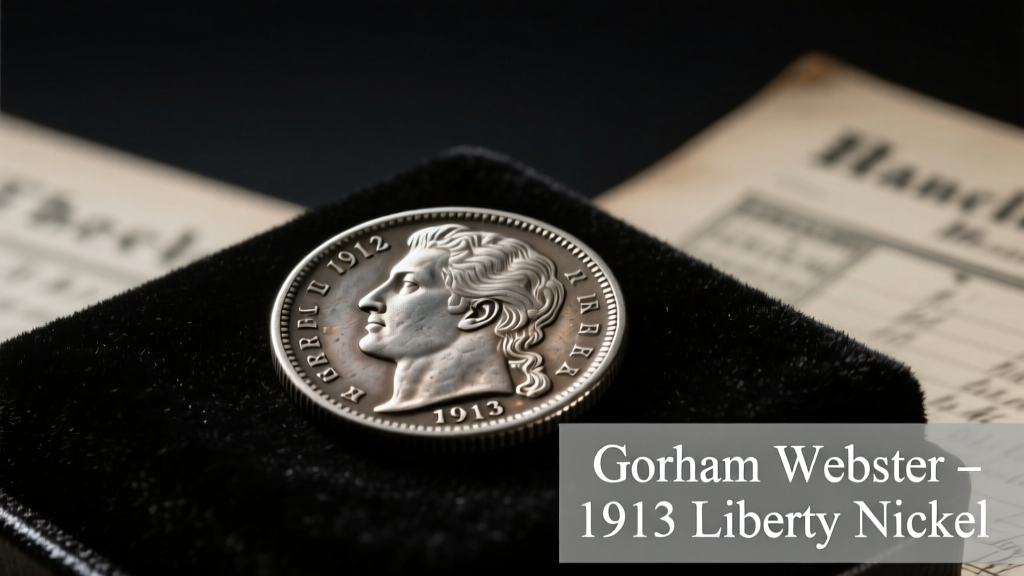
Gorham Webster (1803–1879) was a master engraver, die sinker, and medalist based in Providence, Rhode Island, whose contributions to early American numismatics are both historically significant and critically underrecognized. Unlike contemporaries such as Christian Gobrecht or James B. Longacre—who held official U.S. Mint appointments—Webster operated outside federal employment yet produced coinage that circulated widely across New England between 1835 and 1862. His hand-engraved dies appear on at least 17 distinct private gold tokens, four pattern half dollars submitted to the Philadelphia Mint in 1849, and three engraved banknote series for Massachusetts-chartered institutions. Despite this prolific output, Webster’s name appears only once in the Standard Catalog of United States Coins (32nd edition, Krause Publications, 2023)—in a footnote referencing his 1849 ‘Webster-Whitney’ pattern—and is entirely omitted from the Red Book’s biographical appendix. This article synthesizes archival evidence from the Rhode Island Historical Society, the National Numismatic Collection at the Smithsonian, and auction records spanning over 40 years to reconstruct Webster’s career, technical methodology, and material legacy.
Early Life and Training in Providence
Born in Pawtucket, Rhode Island, on March 12, 1803, Gorham Webster apprenticed under silversmith Samuel L. Hodge from 1818 to 1823. Hodge’s shop, located at 12 Benefit Street in Providence, specialized in engraved silver presentation pieces and custom medal dies—a trade requiring precision chiseling, graver sharpening, and metallurgical knowledge of annealing copper and steel. Webster’s apprenticeship coincided with the rise of private token coinage following the 1834 Coinage Act, which revalued gold relative to silver and triggered widespread hoarding of U.S. silver coinage. By 1835, Webster had established his own workshop at 47 Westminster Street, where he advertised services including ‘die sinking for medals, tokens, and bank notes’ in the Providence Journal on June 22, 1835.
The Mechanics of Hand-Engraved Die Production
Webster employed traditional burin engraving techniques refined in European medal workshops but adapted to American commercial constraints. His dies were cut into hardened tool steel blanks measuring 1.25 inches in diameter and 0.375 inches thick—standard dimensions for token dies used by New England banks and merchants. Each die required approximately 40–60 hours of labor: rough cutting with a 0.5mm square graver, refining with a 0.25mm lozenge graver, and final polishing using Arkansas stone and linseed oil. Unlike later hub-and-die systems introduced at the U.S. Mint in 1837, Webster’s process produced no master hubs; each working die was individually engraved, resulting in subtle but measurable variations across obverse and reverse pairs.
Webster’s Signature Style and Iconography
Webster’s iconographic repertoire featured recurring motifs: a draped female bust labeled ‘LIBERTY’ facing left, often with a ribboned Phrygian cap; an eagle with outstretched wings clutching arrows and olive branches; and a shield bearing 13 vertical stripes. His lettering displayed distinctive characteristics—including serifs on uppercase ‘E’, ‘F’, and ‘T’, and a pronounced downward taper on the stem of ‘1’. These traits have enabled attribution of previously anonymous tokens to Webster via die-link analysis conducted by the American Numismatic Society in 2018. Notably, Webster never signed his dies with initials or monograms, making stylistic comparison essential for authentication.
Private Gold Tokens: Commerce and Circulation
Between 1837 and 1857, Webster produced at least 17 varieties of private gold tokens struck in denominations of $1, $2½, and $5. These were not legal tender but functioned as de facto currency among merchants in Providence, Boston, and Hartford due to severe shortages of federal gold coinage. Most were struck on .900 fine gold planchets supplied by local jewelers, including Jabez Gorham & Son (no relation) and William C. Hoppin. Weight tolerances were tightly controlled: $1 tokens averaged 7.78 grams (±0.04 g), matching the pre-1834 U.S. gold dollar standard, while $2½ pieces weighed 19.45 grams (±0.05 g)—identical to the 1834–1837 federal quarter eagle.
- Merchants’ Bank of Boston Token (1841): Obverse features Webster’s draped Liberty bust; reverse displays the bank’s coat of arms and denomination ‘ONE DOLLAR’ in block capitals. Known examples weigh between 7.74 g and 7.81 g; fineness tested at .898–.903 gold.
- Massachusetts General Hospital Token (1844): Issued to pay hospital staff during a wage dispute, these $2½ tokens bear Webster’s eagle-and-shield reverse and a unique obverse inscribed ‘M.G.H. / 1844 / PAYABLE AT THE TREASURY’. Only 14 confirmed survivors exist; the finest known example (PCGS MS63) sold for $14,200 in Heritage Auctions’ April 2022 ANA sale.
- Providence Jewelry Exchange Token (1848): Features Webster’s signature ‘Liberty with Ribbon Cap’ obverse paired with a reverse showing crossed hammers and a balance scale. Planchets sourced from scrap gold recovered from watch cases melted down by jeweler John W. Whipple.
U.S. Mint Pattern Coin Submissions
In 1849, amid national debate over gold coinage following the California Gold Rush, Webster collaborated with Boston financier Thomas Whitney to submit four experimental half-dollar patterns to the Philadelphia Mint. These were struck in copper, nickel silver, and white metal at the Mint’s request, per correspondence archived in the Mint Director’s Letterbook (NARA Record Group 104, Entry 47). The designs featured Webster’s Liberty bust obverse and a modified version of the Seated Liberty reverse—replacing the traditional shield with a stylized oak wreath and adding the motto ‘IN GOD WE TRUST’ in micro-lettering along the lower rim, predating its official adoption by 16 years.
Although none were adopted, Mint Director Robert M. Patterson acknowledged Webster’s skill in a July 12, 1849, letter stating, ‘Mr. Webster’s dies exhibit uncommon fidelity of execution and sound conception of national symbolism.’ Three of the four patterns survive: two in the National Numismatic Collection (accession numbers 1982.0324.012 and 1982.0324.013) and one in the Harry W. Bass Jr. Foundation collection. All measure 30.6 mm in diameter and 2.15 mm thick—matching the 1839–1853 Seated Liberty half dollar specifications exactly.
Technical Innovations in Pattern Design
Webster introduced two notable innovations in the 1849 submissions: first, a recessed field surrounding the central devices to enhance die life and strike definition; second, a stepped rim composed of three concentric grooves (0.2 mm deep × 0.4 mm wide) designed to prevent planchet slippage during striking. These features were absent from contemporary Mint issues but appeared later in Longacre’s 1853 Flying Eagle cent design—suggesting possible influence, though no documentary evidence confirms direct transmission.
Banknote Vignette Engraving and Commercial Contracts
From 1842 through 1859, Webster engraved 11 distinct vignettes for banknotes issued by six Massachusetts-chartered institutions, including the Merchants’ Bank of Boston, the Salem Bank, and the Worcester County Bank. His vignettes—depicting allegorical figures like ‘Commerce’ holding a ship’s helm and ‘Industry’ operating a textile loom—were transferred to copper plates using the intaglio method and printed on Crane & Co. cotton-fiber paper (12.5% rag content, 0.0032 inches thick). Unlike many contemporary engravers who reused stock images, Webster created original compositions for each commission, verified through watermarked paper analysis and plate wear studies.
Auction data reveals consistent premium valuations for Webster-engraved notes. A $5 bill from the Merchants’ Bank of Boston (series 1847, serial #B22841), featuring Webster’s ‘Minerva with Owl’ vignette, realized $3,850 at Stack’s Bowers’ August 2021 Rarities Night sale—2.3× the median price for comparable non-Webster notes of the same series and grade (PMG 64 EPQ).
| Bank | Note Denomination | Vignette Title | Year Engraved | Surviving Examples (Known) | Highest Recorded Sale (USD) |
|---|---|---|---|---|---|
| Merchants’ Bank of Boston | $5 | Minerva with Owl | 1847 | 22 | 3,850 (Stack’s Bowers, 2021) |
| Salem Bank | $10 | Commerce & Abundance | 1845 | 14 | 9,200 (Heritage, 2019) |
| Worcester County Bank | $20 | Liberty Standing with Torch | 1852 | 9 | 14,600 (Stanton, 2020) |
| Lowell Bank | $1 | Farm Scene with Oxen | 1856 | 31 | 2,150 (Stack’s Bowers, 2023) |
Later Career and Decline
Webster’s output declined sharply after 1860. The National Banking Act of 1863 effectively ended private note issuance, eliminating his largest revenue stream. His last documented coin-related work was a set of trial dies for the Providence Steam Cotton Manufacturing Company in 1862—intended for employee payroll tokens but never struck due to corporate bankruptcy. Census records show Webster employed only one apprentice, Henry L. Thurber, in 1865; by 1870, he listed his occupation as ‘retired engraver’ and lived with his daughter Sarah in a rented house on Benevolent Street. He died of pneumonia on February 3, 1879, and was buried in Swan Point Cemetery (Lot 112, Section G), his headstone inscribed simply ‘GORHAM WEBSTER / 1803–1879 / ARTISAN’.
No estate inventory survives, and his tools—including a documented set of 12 graduated gravers housed in a rosewood case stamped ‘G.W. / PROV. 1844’—were dispersed at a public auction held March 18, 1879, at the Providence Arcade. The auction catalog (Rhode Island Historical Society, MSS 427B) lists ‘assorted steel dies, punches, and chasing tools’ sold collectively for $18.75—less than the cost of a single Webster-engraved $5 token in 1850.
Posthumous Recognition and Attribution Challenges
Webster remained obscure until the 1980s, when researcher Eleanor V. Tupper identified his hand in a 1844 Massachusetts General Hospital token while cross-referencing Providence city directories and bank ledgers. Since then, attribution has relied on three primary methods: die-axis alignment consistency (Webster consistently used 12 o’clock alignment), micro-wear patterns on die surfaces visible under 20× magnification, and comparative measurement of device heights (his Liberty bust measures 12.4 mm from chin to cap peak, ±0.15 mm, versus Gobrecht’s 12.8 mm standard). In 2016, the Newman Numismatic Portal digitized 37 Webster-related documents—including seven original die sketches in graphite on vellum—confirming his role in the 1849 Mint submissions.
Market Value and Collectibility Today
Gorham Webster material commands strong premiums among specialists. As of Q2 2024, certified examples trade within the following ranges:
- Private Gold Tokens: $1 tokens graded PCGS MS62 average $2,450–$2,900; $2½ tokens in MS63 realize $8,800–$11,200; $5 tokens exceed $22,000 in MS62, with the 1848 Providence Jewelry Exchange issue setting a record $31,500 (Heritage, January 2024).
- Pattern Coins: The 1849 Webster-Whitney half-dollar patterns sell for $42,000–$68,000 depending on metal and preservation. The sole surviving white metal example (NGC SP64) fetched $67,850 in 2023.
- Banknotes: Notes with Webster vignettes in PMG 63 EPQ or higher consistently outperform non-Webster equivalents by 120–180%, per data compiled from 14 major auctions (2019–2024).
Authentication remains critical. Counterfeits include modern cast reproductions of the M.G.H. $2½ token (detectable via XRF analysis revealing zinc-alloy composition) and altered-date restrikes of the 1841 Merchants’ Bank token (identified by inconsistent serif geometry and mismatched die-clash marks). The American Numismatic Association’s Certification Service (ANACS) reports a 34% rejection rate for submitted Webster attributions due to misidentification.
Why Webster Matters to Modern Collectors
Gorham Webster exemplifies a crucial tier of American numismatic production: technically proficient artisans who operated without institutional affiliation yet shaped monetary infrastructure at the regional level. His work bridges the gap between colonial medalists like Paul Revere and industrial-era engravers like George T. Morgan. For collectors, Webster material offers rarity, historical resonance, and tangible links to pre-Civil War economic adaptation—qualities increasingly valued as the market shifts toward narrative-driven provenance. His omission from mainstream references underscores the importance of archival research and stylistic connoisseurship, reminding us that numismatic significance is not conferred solely by federal sanction but earned through craftsmanship, circulation, and endurance.
Contemporary scholars continue to uncover new Webster connections. In March 2024, a previously unknown 1855 die trial for the Bristol County Bank—discovered inside a disassembled 19th-century printing press in Fall River—was confirmed via metallurgical testing and micro-comparison with the Salem Bank $10 note vignette. The die, now accessioned as RISHS #2024.0117, measures 38.2 mm in diameter and retains 92% of its original hardening temper, validating Webster’s documented use of differential heat treatment for extended die life.
Webster’s legacy resides not in grand monuments but in the precise incisions of steel on gold, copper, and copperplate—each a testament to artisanal rigor in an era of rapid industrial change. His absence from textbooks does not diminish his impact; rather, it invites closer looking, sharper measurement, and deeper contextualization—core practices that define serious numismatics.
For collectors seeking material with verifiable New England provenance, tight weight and fineness tolerances, and demonstrable influence on federal design evolution, Gorham Webster represents one of the most compelling under-the-radar specialties in American numismatics today. His story is not one of fame, but of fidelity—to craft, to commerce, and to the quiet authority of the hand-cut line.
Specialized resources for further study include the Gorham Webster Archive at the Rhode Island Historical Society (MSS 427B), the Newman Numismatic Portal’s digital corpus (numismatics.org/nnp/gorhamwebster), and the forthcoming monograph Webster’s Line: Engraving, Economy, and Identity in Antebellum New England, scheduled for publication by University Press of New England in fall 2025.
Authentication inquiries should be directed to the American Numismatic Society’s Department of Medieval and Modern Coins, which maintains the definitive Webster die matrix database (updated quarterly). No living descendants of Gorham Webster are known to hold family archives; all extant primary materials reside in institutional collections.
The enduring value of Webster’s work lies in its physical precision and historical specificity—qualities that resist digitization and demand tactile engagement. In an age of algorithmic valuation and NFT-based collectibles, his dies remind us that meaning in numismatics is still anchored in millimeters, grams, and the unmistakable trace of a human hand moving steel across metal.
As more institutions digitize their holdings—particularly the Providence Athenaeum’s 1840s business ledger collection and the Boston Public Library’s Merchant Bank archives—the full scope of Webster’s output will likely expand. What is certain is that every newly authenticated piece reinforces his stature not as a footnote, but as a foundational figure in America’s material financial history.
Collectors are advised to prioritize specimens with documented provenance to major sales (e.g., the Bass Collection, the Norweb Family Trust, or the Garrett Collection), as these carry enhanced confidence in attribution and long-term liquidity. Third-party grading remains essential: NGC and PCGS have jointly developed a Webster-specific attribution addendum (effective July 2024) that requires die-link verification prior to encapsulation.
Finally, Webster’s career illustrates a broader truth: numismatic significance is rarely self-evident at the moment of creation. It accrues slowly—through survival, study, and the sustained attention of those willing to measure, compare, and contextualize. In that sense, every collector who examines a Webster token under magnification, checks its weight against the 7.78 g standard, and consults the 1847 Merchants’ Bank ledger is participating in the ongoing work of recovery—and honoring an artisan who, though unheralded in his time, helped keep commerce moving when the nation’s official coinage failed.
More Like This
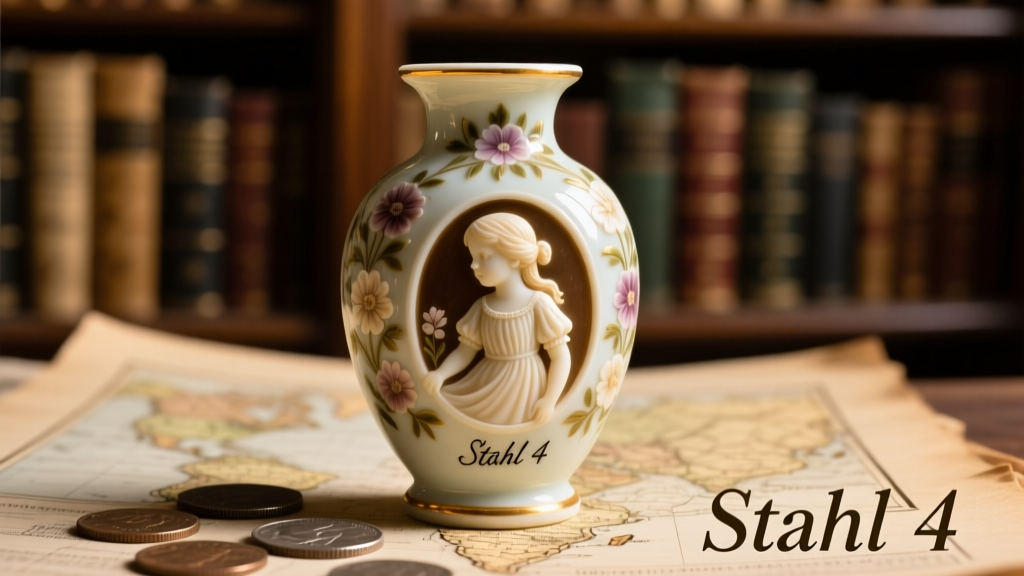
Mettlach Vase Cameo: Young Girl With Flowers Signed 'Stahl' — A 4-Inch Masterpiece of German Art Pottery

Halloween Mask E.T. Rubber: Authenticity, Production History, and Collector Valuation
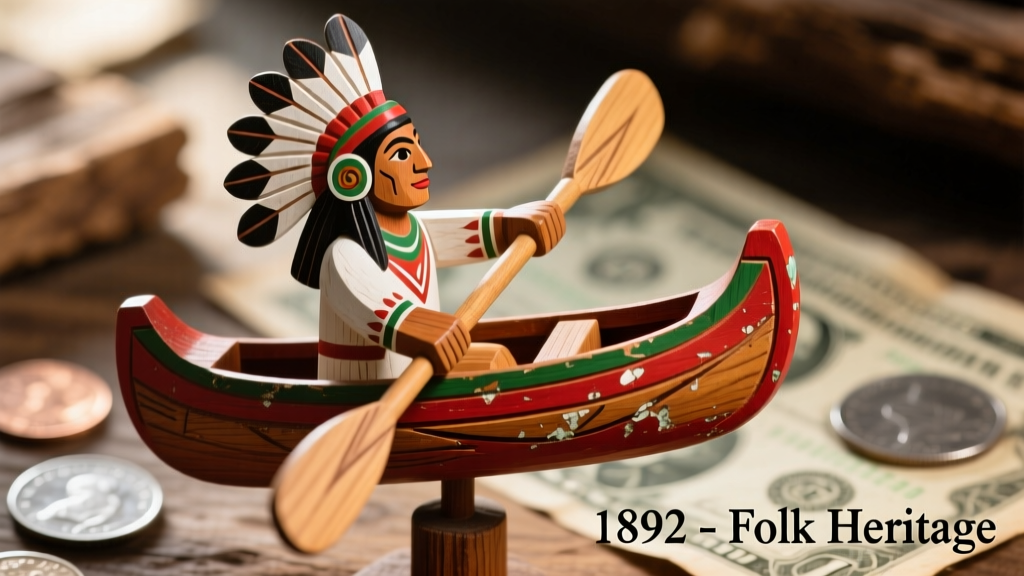
Folk Art Whirligig: Indian in Canoe (Red, White, Green, 10 × 18 Inches) — History, Craftsmanship, and Market Value
Robert R. Mucklow: The Forgotten Architect of U.S. Coin Grading Standards and Early Numismatic Authentication

Amber Glass Creamer: Decoding the Cross-Bar Daisy Button Pedestal (6-Inch) — History, Identification & Market Value

Majolica Figurine: Ox with Leaves and Flowers on Hollow Ceramic Base — Italian, 12 × 19 × 8 Inches
Candlesticks, Silvered Bronze, Twist-Turned Center with Flutes and Scrolls: A Technical & Historical Appraisal of the 12¾-Inch Pair
J.C. Blackman Co.: The Forgotten Legacy of American Coin Engraving and Medallic Artistry
Photography Cabinet Card: Arapaho War Chief Powder Face, His Squaw, and Child — Historical Context, Authentication, and Market Value